


Global Pip Markets wants visitors to believe two foreign regulators stand behind it, and the UK’s financial regulator has just listed it as an unauthorized firm.
We looked for those regulators’ records, ran the plan numbers, compared the site with a lookalike and read the page code, and the story fell apart before any deposit.
Overview
What Global Pip Markets Offers
We opened globalpipmarkets.com and found a site that looks like a forex and crypto broker at the top but sells 17 fixed-return investment plans further down.
The plans pay a stated percentage per trade, promise your principal back on maturity, and accept deposits from $50 to $1,000,000, almost entirely in crypto.
What Our Checks Found
The FCA lists the firm as unauthorized, and the same suite address and phone number appear in a second FCA entry for a different website.
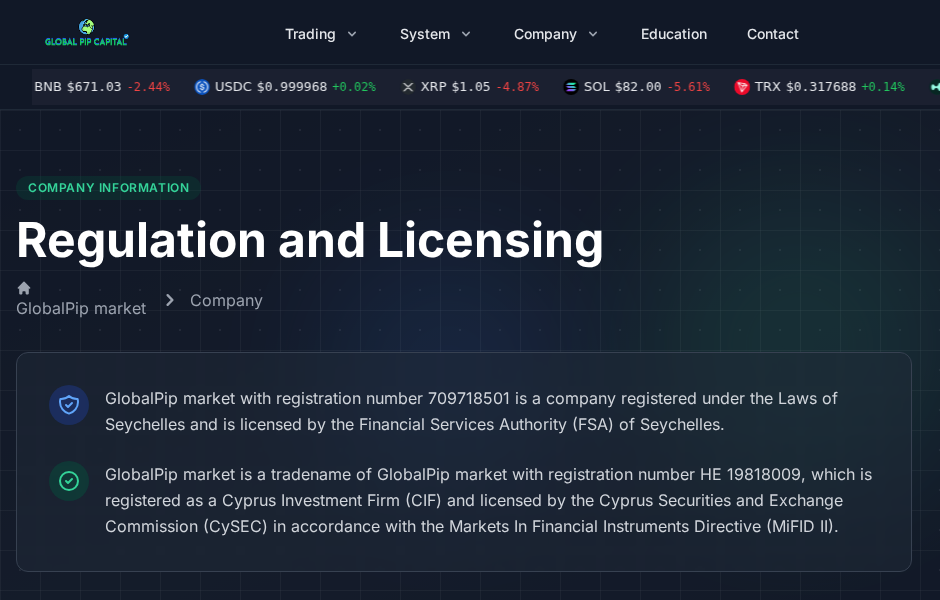
The license numbers on the regulation page match no record we could find, and the UK company number belongs to an unrelated mail-order retailer.
A second site called Qualified Expert Trade publishes the same numbers, the same address and the same phone, so the brand name looks like a swappable label on one template.
The plan table also contradicts itself: the same $500 deposit fits six plans that pay anywhere from 1.2% to 156% per trade.
What We Could and Could Not Verify
Here is where the evidence stands after our checks:
- Verified by us: the FCA entries, the domain dates, the plan figures, the license claims against the public lists, the shared details with the second site and the template leftovers.
- Not found: a named company, a regulator record under these numbers, written withdrawal terms, an insurer behind the $1,000,000 protection line or a working app download.
- Not verified: who operates the site, where deposits go, whether anyone has been paid out, and what sits behind the login we never opened.
Our advice is not to deposit anything, and the section on what to do below covers anyone who already did.
What the FCA Warning Says
We began with the primary document, the FCA’s public warning about Global Pip Markets, which lists globalpipmarkets.com as the firm’s website and was first published on 2 November 2026.
The entry calls the firm unauthorized, warns that it may be targeting people in the UK, and cautions that it may be promoting financial services without permission.
It adds that dealing with an unauthorized firm means no access to the Financial Ombudsman Service and no Financial Services Compensation Scheme protection.
The entry gives a suite at 11 Grace Avenue in Great Neck, New York, and a phone number beginning 702, while its email address is obfuscated on the page.
That is a regulator’s statement about permission, not a court’s finding of fraud, but it removes the first check any careful buyer would run on a broker.
We then opened a second FCA entry, for trade.qualifiedexperties.com, first published on 1 October 2026, and found the same suite address and the same phone number.
Two notices a month apart that share one suite and one phone number are our first sign that the brand on the site matters less than the setup behind it.
How the Global Pip Markets Pitch Works
Step 1: A Broker’s Front Page Sets the Tone
The home page opens like a CFD broker’s, with spreads from 0.0 pips, execution from a NY4 server facility, copy trading and a forex heat map.
We could not check the server location, but the site’s own address resolves to a block assigned to Interserver, Inc, a web hosting company.
The same page calls the firm globally regulated and decorated with more than 40 international awards, yet it names no regulator there and we found no award named anywhere.
Step 2: Seventeen Plans Replace the Trading Account
Further down the broker disappears, and we counted 17 investment plans: five general ones plus four each for stocks, crypto and real estate, all priced per trade.
Each card repeats four bullets, Principal return on maturity, Instant Withdrawal, Professional Charts and 24/7 Support, but none gives the length of maturity or the number of trades.
A CFD broker earns spreads and commissions and cannot promise a return, while these cards promise one, so the offer is closer to an investment contract than a trading account.
Step 3: Money Goes In Through Crypto and PerfectMoney
The FAQ lists eight payment systems: PerfectMoney, Bitcoin, Ethereum, Litecoin, Dogecoin, TRON and Tether on two networks, while the home page boasts of more than 20.
No card, bank transfer or regulated processor is named, which matters because crypto sent to a wallet is very hard to pull back.
The FAQ puts the minimum deposit at $10, yet the cheapest plan starts at $50.
It also caps deposits at $75,000, while three plans accept up to $100,000 or $1,000,000.
Step 4: Withdrawals Are Called Instant
Each plan card promises Instant Withdrawal and the FAQ repeats the word, then admits that crypto payouts can take from 20 minutes to several hours.
The same FAQ sets minimum withdrawals of $0.10 on PerfectMoney and 150 USDT on the Ethereum network, so a smaller balance cannot leave by that route.
No page we could open sets out withdrawal conditions, fees, lock periods or what happens at maturity, because the Terms link opens a privacy policy instead.
Step 5: Referrals Pay Four Levels Deep
The affiliate answer rewards invitations to four levels: 7% for level one, 3% for level two, 2% for level three and 1% for level four, or 13% in total.
The site shows no trade or fund that could pay those commissions, so a structure that rewards recruitment depends on money coming in from new members.
Testing the Plan Numbers
A promise such as 156% per trade is easy to test against the site’s own table, so we parsed all 17 cards and compared their deposit ranges with their rates.
The $500 deposit is the clearest example: six plans accept exactly that amount, and they pay 1.2%, 1.5%, 2.5%, 40%, 100% and 156% per trade.
The 156% belongs to a card named Test, and the 100% belongs to Beginner, which accepts anything from $100 to $25,000.
The same overlap repeats at other deposit sizes, with the rates for the same deposit differing by as much as 130 times:
- $1,000 fits six plans paying from 1.2% to 156% per trade.
- $5,000 fits six plans paying from 2% to 100% per trade.
- $25,000 fits seven plans paying from 2.5% to 100% per trade.
- $100,000 fits three plans paying 2.5%, 3.1% and 5% per trade.
Bigger deposits can earn far smaller percentages, because the Standard card pays 2.5% for $25,000 to $100,000 while a $500 deposit can sit in a card paying 156%.
The Crypto Growth card adds to the confusion: it pays 40% while the Starter card below it pays 2% and the Premium card above it pays 5.5%.
No card gives the length of a trade, so 100% on a $100 deposit could be one $100 gain or, if trades repeat daily, $12,800 after a week.
No market delivers that, and no card names a trade, fund or asset that could, so the percentages read as marketing figures and not as results.
A Broker Page That Describes a Crypto Robot
The FAQ answers a different question than the home page, because it presents a crypto company built around a unique trading bot and not a CFD broker.
Its fee answer folds commissions and extra costs into the company’s profits from cryptocurrency robots, so the CFD spreads promised on the home page have no counterpart there.
The FAQ also asks for no personal information beyond a username, email, password and wallet number, while the privacy policy lists passports, proof of address and source of funds.
Another answer turns away US residents, yet its main address is in New York and the sign-up form offers the United States in its country list.
That form also lists the United Kingdom, the very market the FCA warns the firm may be targeting.
The home page promises that client funds are insured up to $1,000,000, but no insurer is named on any page we read.
The Licenses We Tried to Find
The regulation page offers three registrations, and we tested each one against the public record it points to.
The first is Seychelles: company number 709718501 and a license from the Financial Services Authority there.
We downloaded the FSA’s list of capital markets licensees and searched it for the brand, the Global Pip name and the number, and found no such licensee.
The only entry containing pip is an unrelated firm called Pipbull Limited.
The few registration numbers the list prints have seven digits, while the one on the site has nine.
The second is Cyprus: number HE 19818009 and a Cyprus Investment Firm license from CySEC under the EU’s MiFID II rules.
CySEC’s register of Cypriot investment firms, dated 4 May 2026, runs from 26 Degrees Global Markets to Zemblanco Investments, and neither the name nor the number appears.
The HE numbers printed on that list have six digits, and the one on the site has eight.
The list is 18 days older than the domain, so we cannot rule out a later license, but the site gives no license date and no way to check one.
The third is the UK: the FAQ gives England and number 08683932 as the company’s official registration.
We opened that record at Companies House, and it belongs to ALLBIT LTD, a Rotherham company incorporated in 2013.
Its business is listed as retail sale via mail order houses or via the Internet.
We have no evidence that this company knows about the site, so the number looks borrowed or mistyped, and either way it leads to a business unrelated to trading.
Two of the three registrations therefore lead to no matching record, and the third leads to an unrelated retailer, which leaves the globally regulated label with nothing under it.
One Template, Two Brands
Next we examined the second FCA entry, trade.qualifiedexperties.com, because it shared the suite address and the phone number with our site.
Its pages carry the title Qualified Expert Trade followed by the same tagline as ours: CFD Trading, Trading on Stocks, Gold, Oil, Indices.
Of the 404 lines of text on its home page, 377 appear in the same order on ours.
The differences we inspected were brand names, a few plan labels and some deposit ranges.
Its regulation page shows the same Seychelles number and the same Cyprus number, now attached to a company called Qualified Expert Trade.
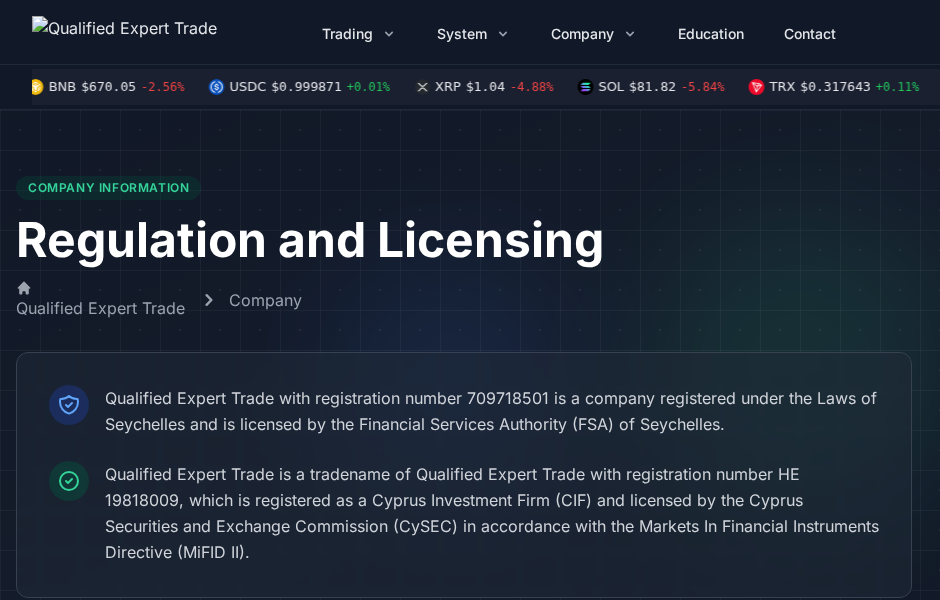
Its FAQ gives the same UK company number, 08683932, and its contact page repeats the same suite, the same 702 phone number and the same offices.
The registrations differ: Qualified Expert Trade was created on 16 April 2025 through NameSilo behind Cloudflare, while Global Pip Markets was created on 22 May 2026 through Dynadot.
The chat widget key also differs between the two sites, so the technical setup is not identical even though the content nearly is.
We cannot name who operates either site, and shared contact details show a common setup, which is not proof of common ownership.
The brand on our own site is not consistent either: the header logo reads Global Pip Capital, the pages read GlobalPip market, and the domain reads Global Pip Markets.
A third name points to a third domain, because the contact page lists a second email address at globalpipcapital.com.
The public registry shows that domain was registered on 20 February 2026 through Spaceship and uses the same two name servers as globalpipmarkets.com, which indicates a shared setup.
It is now on client hold, resolves to nothing on a public resolver, and has no Wayback Machine captures, so mail sent to that address would most likely bounce.
Template Leftovers and Dead Ends
We read every page linked from the home page as text and read the page source without running any of it, and several items looked unfinished.
The Terms link opens a page titled Privacy Policy, and its last paragraph tells readers to email privacy, then a raw template tag in curly braces naming site_name, then .com.
That is the way Laravel templates print a setting, and the session cookies we saw are named XSRF-TOKEN and trading_platform_session, which suggests a packaged script rather than a custom build.
The Web, Windows, Android and iOS buttons in the footer all link to a bare hash mark, so the apps the home page advertises have no download.
The Demo Account link opens the login page, the Help Center link opens the contact page, and the Twitter and LinkedIn icons go nowhere.
Counters on the contact page show 15 offices and 12 languages, but we found nine offices listed and nine languages in the FAQ.
The home page, meanwhile, promises support in more than 20 languages.
The Live Trading Activity pop-up, with messages such as a trader from London just invested $47,230, is not live data at all.
Its script picks a city from a fixed list of 50, an amount from 24, one of three actions and one of 20 instruments, giving 72,000 possible messages.
Dates complicate the picture of an established broker: the domain dates from 22 May 2026 and a Wayback Machine capture from 18 July holds the very text we read.
The plan table, the awards line and the testimonials were therefore all online 57 days after registration.
The boast of being one of the world’s most trusted brands rests on a domain that was 172 days old on 10 November.
The eight testimonials carry only first names and labels such as Elite Investor, and one mentions earning over $200,000 in a month, which we could not verify.
Who Runs Global Pip Markets?
The Site Names a Brand, Not a Company
We read the footer, About page, legal pages and regulation page for a legal entity and found a trade name described as the tradename of a company named the same.
That circular wording gives no owner, officer or registered address, and the only registrations offered lead to the dead ends described above.
The footer copyright reads only GlobalPip market, and the privacy policy mentions services offered through one or more subsidiaries that it never names.
The Address Is a Suite in Great Neck
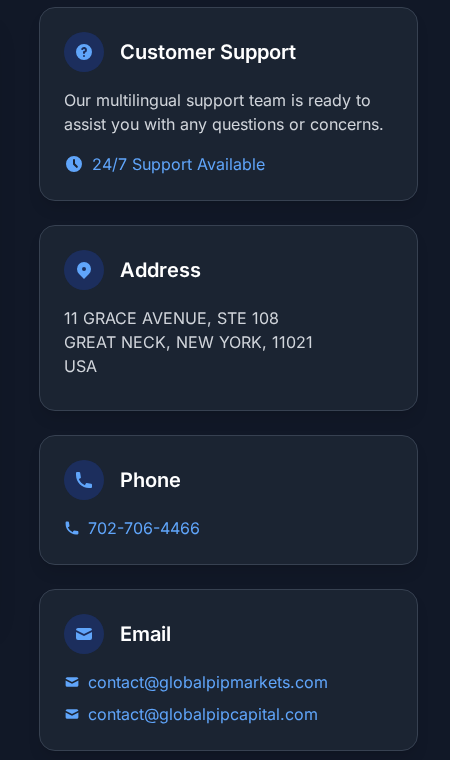
The contact page and the FCA entry agree on 11 Grace Avenue, Suite 108, Great Neck, New York.
The phone number beginning 702 uses an area code assigned to Las Vegas, which is not where the address is.
We found no registry entry tying Suite 108 to a named company, and the same suite and phone number appear on a second site under a different brand.
The contact page also lists eight other offices, from London’s Canary Wharf to Tokyo, and none comes with a phone number or a registration.
The Domain, Name Servers and Hosting
The public registry record shows globalpipmarkets.com was created on 22 May 2026 through Dynadot and last changed three minutes later, with no registrant details shown.
Its name servers are vda2900a.trouble-free.net and vda2900b.trouble-free.net, the site resolves to 206.72.206.88 inside an Interserver, Inc block, and its mail records authorize another address in that block.
None of this tells us who owns the site: it shows an ordinary web hosting range, which sits oddly beside the NY4 facility named for order execution.
What We Could Not Confirm
We could not establish who owns the site, who controls the wallets that take deposits, or whether anyone has ever withdrawn funds, because we opened no account.
The Seychelles list prints few registration numbers, so a missing number there is weaker evidence than the missing name.
The CySEC list could not show a license granted after 4 May, and the plan table sits below our screenshot limit, so we read it from page text.
We make no connection to any other FCA-listed name beyond the pair described here.
What to Do If You Deposited or Shared Details
-
Stop sending money. Do not top up, pay a withdrawal fee or buy more crypto to release a balance, whatever the dashboard shows.
-
Keep every record. Save screenshots of your balance, transaction hashes, the wallet addresses you paid, chat logs and the date and amount of each transfer.
-
Tell the regulators. UK residents can follow the FCA’s page for reporting an unauthorized firm, and US residents can file at ReportFraud.ftc.gov.
-
Tell your exchange. Give the exchange or wallet provider the receiving address and transaction hash and ask whether it can flag the destination, knowing transfers are rarely reversed.
-
Call your card issuer. If a card bought the crypto or paid the site, ask about a dispute using the steps in the FTC’s guide to disputing charges.
-
Ignore recovery offers. Anyone who offers to retrieve lost crypto for an upfront fee, especially after you mention this site, is usually running a second scam.
-
Protect your identity. If you uploaded a passport or proof of address, watch for new credit applications and consider a fraud alert or credit freeze.
-
Secure your accounts. Change any password you reused, turn on two-factor authentication and expect phishing emails and calls built from the details you gave.
Frequently Asked Questions
Is Global Pip Markets legit?
Our checks point the other way: the FCA lists it as unauthorized, its license numbers match no record we could find, and another brand publishes the same numbers.
Is Global Pip Markets regulated?
The FCA lists it as unauthorized, and we found it on neither the Seychelles FSA list nor the CySEC register we downloaded.
Is Global Pip Markets the same as Qualified Expert Trade?
They are separate domains with separate registrars, but they share license numbers, a UK company number, a suite address, a phone number and most of their page text.
Is the Live Trading Activity pop-up real?
No. It builds each message from fixed lists of 50 cities, 24 amounts, three actions and 20 instruments, so it reflects no real trade or customer.
Can I get my money back if I paid in crypto?
Probably not by reversal, because crypto transfers rarely can be undone, but tell your exchange and your regulator about the payment and keep every record.
Who owns Global Pip Markets?
We could not establish that. The site names no company, the UK number belongs to an unrelated firm, and the domain record shows no registrant.
The Bottom Line
Do not deposit money with Global Pip Markets. The FCA lists it as unauthorized, its three registrations lead nowhere we could verify, and its plans contradict each other.
If you want to trade forex, CFDs or crypto, choose a firm listed on your regulator’s register under the same name and number, and read its terms before paying.
If you already paid, stop adding funds, keep every record, tell your exchange and your regulator about the transfer, and treat any withdrawal fee request as a warning sign.

Join the discussion
0 commentsShare your experience or ask a question about this article.
Discussion
Start the conversation
Have a question or something useful to share? Add the first comment.