


Assets Explore promises 2% to 5% profit every day on gold, real estate and crypto plans, and the UK’s financial regulator now lists it as an unauthorised firm.
We opened the site, its code, the warning and the company register, then ran the numbers, and the pieces did not fit together.
Overview
What Assets Explore Offers
We opened assetsexplore.net and found a crypto-funded platform with six plans: five pay 2% to 5% a day for seven days, and one pays 100% a month.
Deposits start at $50, the larger plans have no upper limit, and every plan lists a 10% referral bonus.
The pitch spreads across gold, real estate, farming, oil, stocks and cannabis research, with no named trade, fund or property behind any of it.
What Our Checks Found
The site’s own arithmetic fails, because every seven-day plan’s printed profit equals its daily rate multiplied by ten.
Its counters show more money withdrawn than deposited, it traces its history to 2008 although the domain is 110 days old, and two testimonials praise a different company.
The one company the site names is a real, active property firm, and our search of the FCA register found no firm of that name.
What We Could and Could Not Verify
Here is where the evidence stands after our checks:
- Verified by us: the FCA warning and register entry, the plan figures, the calculator code, the counters, the domain dates, the Companies House record and the hosting overlap.
- Not found: any licence number, any deposit or withdrawal conditions, any link between the website and the registered company, or a listed team member on the company register.
- Not verified: who runs the website, where deposits go, whether anyone has ever been paid, and what sits behind the login that we never opened.
Our advice is not to send this platform any money, and the section on what to do covers anyone who already did.
What the FCA Warning Says
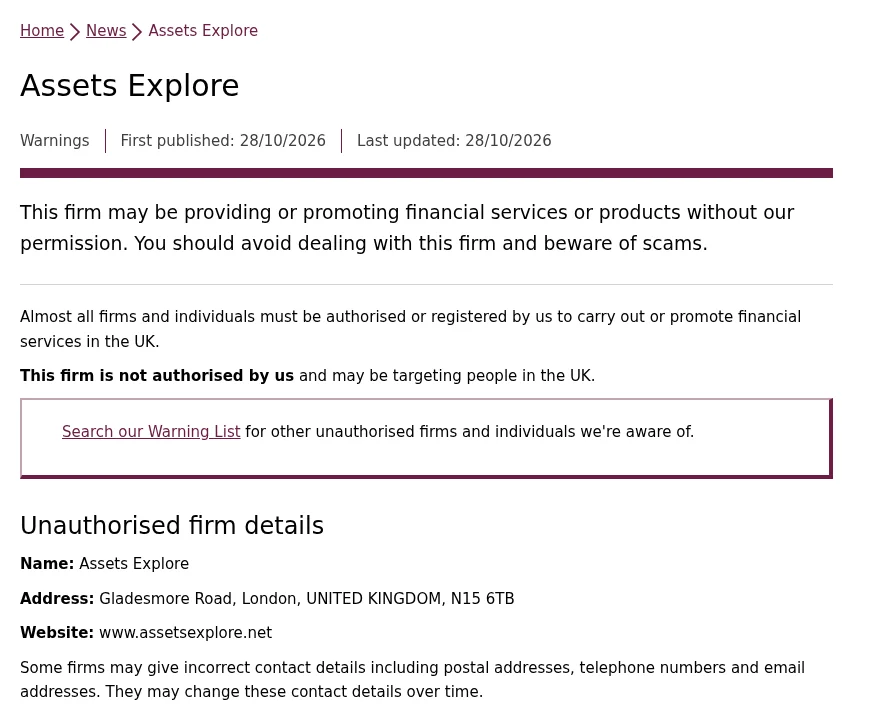
We began with the primary document, the FCA’s public warning about Assets Explore, first published and last updated on 28 October 2026, which lists assetsexplore.net as the firm’s website.
The notice classes it as not authorised by the FCA, adds that it may be targeting people in the UK and may be promoting financial services without permission.
The notice gives a Gladesmore Road address in London N15, lists no phone number, and tells readers to avoid dealing with the firm and beware of scams.
We then searched the FCA register ourselves, and it returns one firm named Assets Explore, marked Unauthorised, with a London N15 6TB address.
A second search for Assets and Investments, the company name we meet later, returned eight results, and none was a firm of that name.
That is a regulator’s statement about permission, not a court’s finding about fraud. In practice, a careful buyer has no register entry to check before depositing.
How the Assets Explore Pitch Works
Step 1: The Promise Is a Plan Menu
The plan section of the page source holds six cards, each with a deposit range, a rate, a term and a 10% referral bonus:
- Standard pays 2% a day for deposits of $50 to $999.
- Pro pays 2.5% a day for deposits of $1,000 to $4,999.
- Deluxe pays 3% a day for deposits of $5,000 to $9,999.
- Gold pays 4% a day for deposits of $10,000 to $49,999.
- Business pays 5% a day for deposits from $5,000 with no maximum.
- Car/House pays 100% a month for two months, from $5,000 with no maximum.
Each of the first five runs for seven days, and nothing on the page tells you whether your capital comes back at the end.
Step 2: The Ladder Doesn’t Follow the Money
The plan ranges overlap in a way that rewards the wrong deposit: a $5,000 deposit qualifies for both Deluxe at 3% a day and Business at 5% a day.
Business also starts at $5,000 yet pays more than Gold, so a $10,000 deposit earns $400 a day in Gold and $500 a day in Business.
Real gold, property and oil markets don’t pay a higher daily return for a bigger cheque, so the rates look chosen by the platform and not by any market.

Step 3: The Deposit Path Runs Through Crypto Exchanges
No public page mentions a bank or card payment, and the Buy Crypto page is just a grid of links to third-party exchanges, among them Paxful and Coinmama.
A deposit appears once the blockchain confirms it, so payment is a crypto transfer to a wallet address that sits behind the login.
We stopped at the registration page, which asks for a username, an email address and a country, and we did not create an account.
The consequence is simple: crypto sent to an address is hard to pull back, and no page offers any other way to pay.
Step 4: Referrals Add a Second Engine
Every card carries a 10% referral bonus, and the site never reveals who pays it, how many levels it reaches or when it is credited.
The home page FAQ and the separate FAQ page both allow one person to open several accounts, without explaining why a platform would want that.
When a daily return has no named source, a bonus for bringing in new depositors is the part worth watching, because new deposits are then the only visible income.
Step 5: Withdrawals Are Instant, and the Terms Are Silent
The FAQ promises that withdrawals are processed immediately and sent to your wallet, yet the terms page never mentions withdrawals, fees, limits or approval conditions.
What the terms do contain is the right to suspend or terminate any account at any time, without prior notice, if the operator suspects a violation.
The About page offers a 100% guarantee to investors, while the terms promise no specific return, so the two pages cannot both be the contract.
Step 6: Trust Badges That Lead Nowhere
The footer shows four security logos, TrustGuard, GeoTrust, Norton and McAfee, but in the code each one is a bare image with no link.
A badge that can’t be clicked can’t be verified, so these logos add decoration and not assurance.
Testing the Daily Returns
A promise of 2% a day sounds modest until it is run forward, so we computed what the listed rates produce over 30, 90 and 365 days.
The site invites reinvestment, because its home page tells visitors to cash out or reinvest and its FAQ allows unlimited repeat deposits, so we ran both versions.
First, a $1,000 Pro deposit at 2.5% a day. Collecting the profit daily without reinvesting gives these totals:
- $750 of profit after 30 days, $2,250 after 90 days and $9,125 after 365 days.
- Reinvesting weekly at the printed 25% turns $1,000 into $2,441 after 4 weeks, $14,552 after 12 weeks and $109,476,443 after 52 weeks.
Next, a $5,000 Business deposit at 5% a day, using the same two methods:
- $7,500 of profit after 30 days, $22,500 after 90 days and $91,250 after 365 days.
- Reinvesting weekly at the printed 50% turns $5,000 into $25,312 after 4 weeks, $648,732 after 12 weeks and about $7.2 trillion after 52 weeks.
No gold, property or oil market has delivered anything like those figures, and the site names no trade, fund, mine or building that could.
The weekly figures lean on the printed profit percentages, and the next section shows that those percentages are wrong against the site’s own rates.
Printed Profits Equal the Daily Rate Times Ten
Each card prints a Profit figure, and when we divided it by the card’s daily rate, the same number came out on every plan: ten.
Standard prints 20% for 2% a day, Pro 25% for 2.5%, Deluxe 30% for 3%, Gold 40% for 4% and Business 50% for 5%.
A seven-day plan at 2% a day earns 14%, not 20%, so every printed profit overstates its own daily rate by about 43%.
In the calculator’s code, each plan stores its total percentage as a separate number, so nothing ties the total to the daily rate or the term.
The calculator’s default view shows the result: a $50 Standard deposit earns $1.00 a day and a $10.00 Total Return, beside a label reading 2% daily × 7 Days.
Seven days of $1.00 is $7.00, so the page’s own default example is $3.00 away from its own arithmetic on a $50 deposit.
Only the Car/House plan adds up, because 100% a month for two months really is 200%, which makes the seven-day cards the odd ones out.
The cards label the figure Profit while the calculator labels it Total Return, and neither label matches the daily rate printed beside it.
A 2008 Platform on a 110-Day-Old Domain
We checked the registration record next, because the home page presents a platform that has been building since 2008.
The public registry record shows assetsexplore.net was created on 23 July 2026 through the registrar TuringSign, trading as Cosmotown, which made the domain 110 days old on 10 November.
The FCA published its warning 97 days after that registration date, and the Wayback Machine’s index holds no captures of the domain at all.
A running-days counter in the page code is set to 4,567, about 12.5 years, which points to May 2014 and matches neither 2008 nor 2026.
The footer’s copyright year is 2025, which matches the registered company’s incorporation year and not the domain’s.
The user numbers disagree as well: the text mentions over 49K users, while the counter script counts up to 72,887.
The same block counts up to 72,198,769.99 withdrawn against 66,726,534.38 deposited, so withdrawals exceed deposits by 5,472,235.61, or about 8%.
Withdrawals above deposits mean either outside income we can’t see or numbers that were typed in, and the page offers no way to tell which.
The Regulation Claims We Could Test
Two regulation lines on the home page needed testing: full compliance with international regulations, and trading on a regulated U.S. based exchange.
We looked for a licence number, a regulator name or an exchange name behind either line and found none, so there was no register to search.
The one regulator record we could open is the FCA’s, and it lists the firm as unauthorised.
A licence counts only when you can find the firm on a regulator’s own register under the same name and number, and here that test cannot start.
Template Leftovers in the Pages and Code
Two of the five testimonials praise Platina Capitals, a name that appears nowhere else on the site, which looks like copy from a different company’s page.
The team section lists a CEO, a director and a team leader with photos, and all nine of its social icons point to a bare # link.
The footer’s Legal Information link opens a PDF instead of a legal page, and its abuse link opens the contact page.
The Terms of Use and the Privacy Policy share one short page, and that page never names a legal entity, a company number or a licence.
Beyond those slips, the code is a standard investment-platform kit with a TradingView ticker, a Google Translate widget, a Smartsupp chat window and the calculator we tested.
Who Runs Assets Explore?
The FAQ Names Assets and Investments Ltd
The separate FAQ page answers a question about registration by naming England’s company house, company number 16611545 and the name Assets and Investments Ltd.
We tested that against the Companies House record, and the company exists: a private limited company, active, incorporated on 29 July 2025.
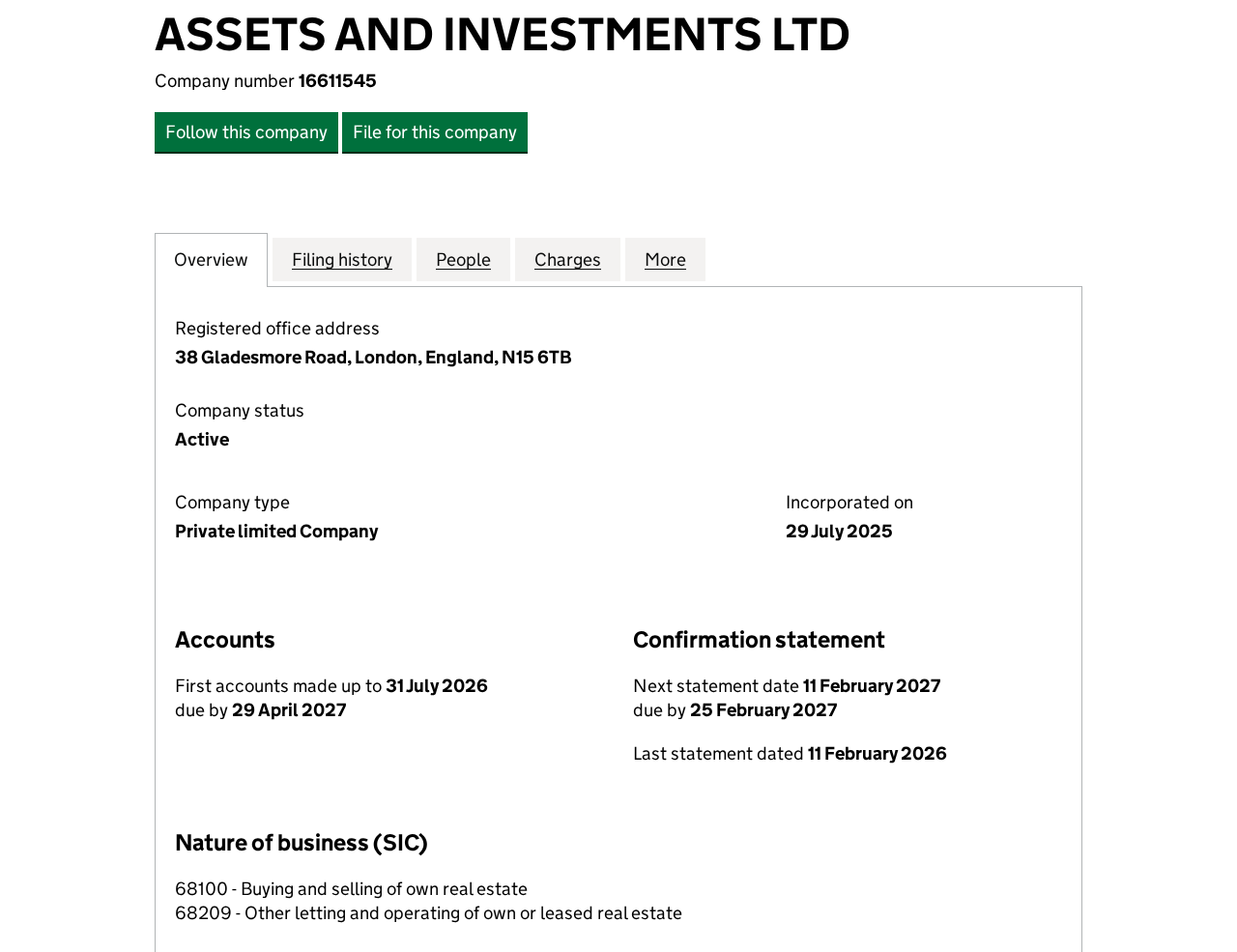
The record lists two property activity codes, 68100 and 68209, for buying, selling and letting its own real estate, and none for investment or financial services.
Registration proves a company exists, not that it may take investments, and Companies House warns that it does not check the accuracy of filings.
No filing shows a name change, so the register gives no sign that this company has ever traded as Assets Explore.
The Address Matches a Property Company, Not a Platform
The company’s registered office has been on Gladesmore Road, London N15, since 17 February 2026, when a filing moved it from an address in London E5.
That is the same street and postcode the FCA lists for Assets Explore and the one printed as the headquarters in the website footer.
The footer, the FCA notice and the register therefore agree, which fits two readings: the company runs the site, or the site uses the company’s details.
The FCA itself cautions that unauthorised firms sometimes give details belonging to another business, and the evidence we hold cannot choose between the two readings.
The Legal Information link opens a PDF of the company’s certificate of incorporation, marked FILE COPY and dated 29 July 2025.
That certificate carries the earlier E5 address and a director who has since resigned, so the document is older than the footer address printed beside it.
The PDF’s server timestamp reads 31 May 2026, 53 days before the domain existed, though a timestamp can be inherited from wherever a file was copied.
The three team names on the site do not match the current director or the former one on the register, so no listed team member appears there.
Ten charges are registered against the company, all outstanding, held by three named lenders and tied to land and buildings.
The newest was created on 4 November 2026, a week after the FCA notice, which reads like a property business carrying on as usual.
The Domain, Name Servers and a Hosting Neighbour
The domain record lists only the registrar and no registrant, and it was last changed about two minutes after it was created.
Its name servers sit at asurahosting.com and my-control-panel.com, and the site resolves to one address in a network registered to Aquiryn LLC.
The site’s security certificate, logged on 23 July 2026 and again on 22 September, also covers two hostnames under swiftscost.net, which we read as the two sharing one hosting account.
The swiftscost.net domain was registered on 5 April 2026, resolves to the same address and name servers, and shows a different investment-style site called SwiftCost.
Both sites use paths ending in /user/login and /user/register, but their templates, chat keys and wording differ.
We therefore see shared hosting and a similar application, not proof of shared ownership.
What We Could Not Confirm
We compared the setup with the Prime Yield Assets, Global Pip Markets and Hedgemark Securities sites from the same weeks of FCA warnings.
Each uses a different registrar and different name servers, and the Prime Yield Assets source holds a different chat key, sharing only two stock FAQ questions.
The Hedgemark site did not answer our request, so for it we could compare only the registry record, and we found no shared setup with any of the three.
We could not confirm who owns or operates Assets Explore, whether the registered company knows about the site, where deposits go, or whether any investor has been paid.
The property company is not accused of anything here: it is the name on a certificate the site displays, and the register shows no link to the website.
What to Do If You Deposited or Shared Details
-
Stop sending money. Do not add to a deposit, pay a withdrawal or tax fee, or buy more crypto to unlock earnings, whatever the dashboard shows.
-
Keep every record. Save screenshots of your balance, transaction IDs, wallet addresses, emails and chat messages, together with the dates you sent money.
-
Tell the regulators. In the UK, tell the FCA about an unauthorised firm, and in the US file a complaint at ReportFraud.ftc.gov.
-
Contact your exchange. Tell the exchange or wallet provider you used, give them the receiving address, and ask whether they can flag it, knowing that crypto transfers are rarely reversed.
-
Call your card issuer. If a card paid for the crypto, ask about a dispute, using the steps in the FTC’s guide to disputing charges.
-
Ignore recovery offers. Anyone who contacts you promising to retrieve lost crypto for an upfront fee is usually running a second scam.
-
Secure your accounts. Change any password you reused, turn on two-factor authentication and expect phishing emails built from the details you gave the site or its chat window.
-
Check before the next investment. Use the FCA’s guide to checking a firm and look for the same name and number on the register.
Frequently Asked Questions
Is Assets Explore legit?
We found nothing that supports that and several things against it: an FCA warning, contradictory plan figures, a 2008 history on a 110-day-old domain and no licence number.
Is Assets Explore authorised by the FCA?
No. The FCA warning and the FCA register both list Assets Explore as unauthorised, and the site’s compliance and exchange lines come with no name or number we could check.
Can anyone really earn 2% to 5% a day?
Not from a market. At 2.5% a day, $1,000 would produce $2,250 of profit in 90 days, and the site never names a trade that could.
Is Assets and Investments Ltd the company behind Assets Explore?
We could not establish that. The company is real and shares the site’s address, but its record shows property activities, no trading name and no link to the website.
Can I get my money back if I paid in crypto?
Probably not by reversal, because crypto transfers rarely can be undone, but flag the payment to your exchange and your regulator, and read the FTC’s article on cryptocurrency and scams.
Why does the site mention 2008 if the domain is new?
A domain can be new while a business is old, but we found no earlier capture, no earlier company and no named owner, so the date remains unsupported.
The Bottom Line
Do not deposit money with Assets Explore. The FCA lists it as unauthorised, its printed profits contradict its daily rates, and the company it names shows no investment activity.
If you want exposure to gold, property or oil, use a firm you can find on your regulator’s register, and read its terms before you send anything.
If you already paid, stop adding funds, keep the records, tell your exchange and the FCA about the payment, and treat any withdrawal fee request as a warning sign.

Join the discussion
0 commentsShare your experience or ask a question about this article.
Discussion
Start the conversation
Have a question or something useful to share? Add the first comment.