


Apex Asset Growth offers 14% to 35% in a week on crypto, farms, oil and gold, and the UK’s financial regulator has told people to avoid it.
We checked the plans, the registration number and the files behind the site, and the paperwork on display belongs to a company dissolved in March 2025.
Overview
What Apex Asset Growth Offers
We opened apexasset-growth.com and found a crypto-funded platform with four plans that pay 2% to 5% a day for seven days, from a $300 minimum.
Deposits go up to $1,000,000, every plan lists a 10% referral bonus, and the terms add three more referral levels paid on other people’s deposits.
What Our Checks Found
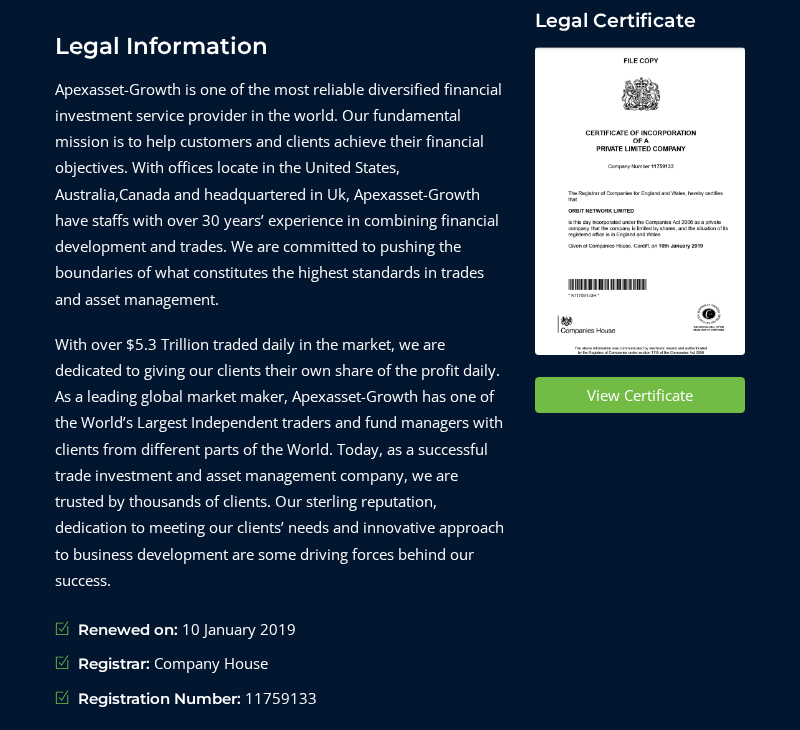
The registration number on the Legal page belongs to Orbit Network Limited, which Companies House shows as dissolved on 11 March 2025 after a compulsory strike-off.
The domain dates from 14 July 2026, yet the footer is dated 2022 and a comment in the page code records a site copy made in November 2022.
The plans page and the home page give different deposit ranges for the same plans, and the support address sits on a domain that does not exist.
What We Could and Could Not Verify
Here is where the evidence stands after our checks:
- Verified by us: the FCA warning, the plan figures, the registry records, the domain dates, the file dates, the contradictions between pages and the template leftovers.
- Not found: any FCA authorisation, any office other than one Cardiff mailbox address, or a live company behind the name.
- Not verified: who runs the site, where deposits go, whether anyone has ever been paid, and what happens behind the login that we never opened.
Our advice is not to send this platform any money, and the section on what to do covers anyone who already did.
What the FCA Warning Says
We began with the primary document, the FCA’s public warning about Apex Asset Growth, first published on 28 October 2026 and unchanged since.
It lists apexasset-growth.com as the firm’s website and Cardiff as its address, and marks the firm as not authorised and possibly targeting people in the UK.
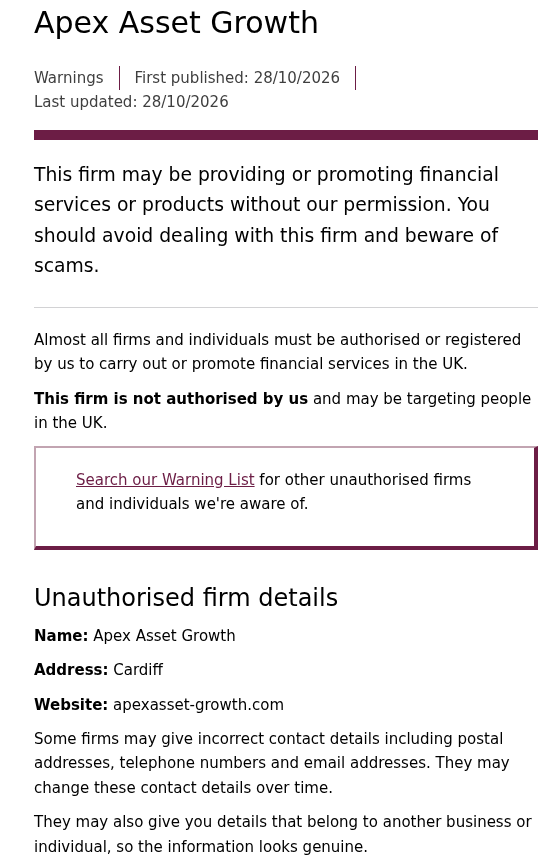
It gives no street, phone number or email, and warns that unauthorised firms may use contact details belonging to someone else to look genuine.
That is a regulator’s statement about permission, not a court’s finding about fraud, and we treat it that way: the firm may be promoting financial services without permission.
The practical result is that a buyer who deposits would have no access to the Financial Ombudsman Service and no FSCS protection, as the notice itself points out.
How the Apex Asset Growth Pitch Works
Step 1: Four Plans That Pay Out in a Week
We started with the plan cards, which promise 14%, 17.5%, 24.5% and 35% after seven days for deposits of $300 and up.
Those headline figures are simply the daily rate times seven: 2%, 2.5%, 3.5% and 5% a day.
Every plan lists the same 10% referral bonus, the same seven-day duration and the same withdrawal rules, so a larger deposit buys a bigger daily rate and nothing else.
Step 2: The Ranges Differ Between Two Pages
The plan section on the home page and the Investment Plans page should match, so we compared them card by card, and the deposit ranges disagree.
- Basic: $300 to $1,999 on the home page, $300 to $999 on the plans page.
- Standard: $2,000 to $9,999 on the home page, $1,000 to $4,999 on the plans page.
- Platinum: $10,000 to $49,999 on the home page, $5,000 to $10,000 on the plans page.
- VIP: from $50,000 on the home page, from $20,000 on the plans page.
A $1,500 deposit earns 2% a day under one page and 2.5% under the other, which is a $7.50 daily difference on the same money.
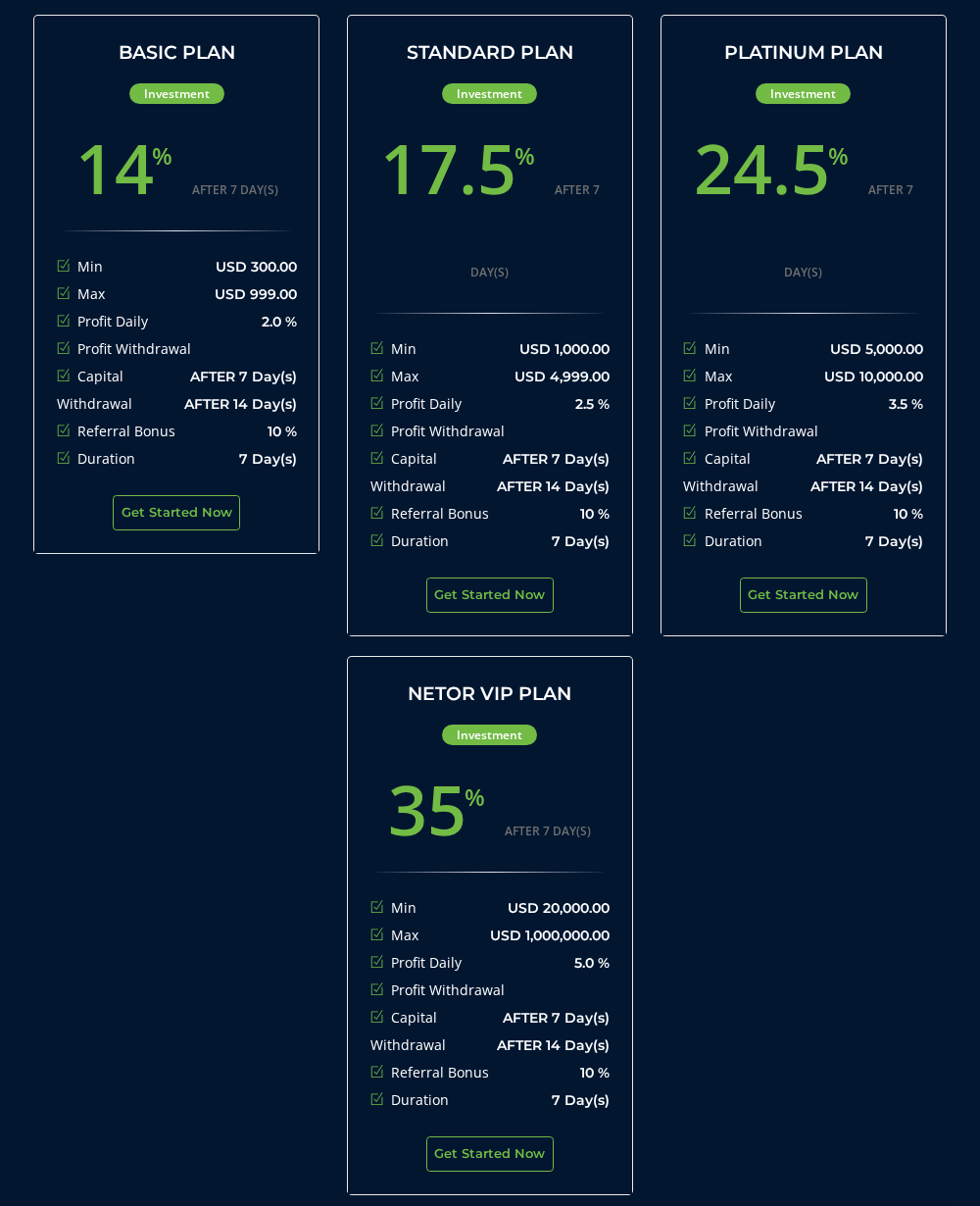
On the plans page, a deposit between $10,001 and $19,999 fits no plan at all, because Platinum stops at $10,000 and VIP starts at $20,000.
The top plan is called Netor VIP Plan on both pages, a name found nowhere else on the site, which suggests a label left over from an earlier version.
Step 3: Deposits Are Made in Crypto and Payment Wallets
We read the terms to see how money goes in, because the deposit screens sit behind an account that we deliberately never created.
Deposits can be made in Bitcoin, Ethereum, Bitcoin Cash, Dash, Payeer, Perfect Money, Ripple or Litecoin, yet the same paragraph limits deposits to USD.
Crypto and e-wallet transfers are hard to reverse, and no page we could read names who receives them, so a deposit goes to an address we cannot tie to anyone.
Step 4: Referrals Pay on Other People’s Deposits
The plan cards show a 10% referral bonus, so we looked in the terms for the full scheme and found four levels:
- First level: 10% of the deposits made by the people you invite.
- Second level: 3% of the deposits made by the people they invite.
- Third level: 2% of the deposits made by the next ring of invitees.
- Fourth level: 1% of the deposits made by the ring after that.
The terms add that no deposit or active investment is needed to collect these bonuses.
Because the bonus is a share of new deposits and not of any trading result, a recruiter gets paid whether or not a single trade ever happens.
A recruiter who brings three friends depositing $1,000 each collects $300 from those deposits alone, more than the $42 a week that a $300 Basic deposit earns.
Step 5: Withdrawals Follow Three Different Rules
The withdrawal timing is where the pages disagree most, so we lined up the three rules:
- Each plan card: profit can be withdrawn after 7 days and capital after 14 days, on a plan that lasts 7 days.
- The FAQ: requests are processed immediately and sent to your Bitcoin wallet.
- The terms: a withdrawal can take up to 48 hours, and capital comes back at the end of the investment term.
A seven-day plan that returns capital on day 14 leaves a deposit locked for a further week after the plan ends, and no page explains the gap.
The FAQ also mentions a starter plan limited to three deposits, but no starter plan appears among the four cards.
It lets only VIP investors hold more than one account, while the terms forbid re-registration and allow extra accounts to be disabled.
Testing the 2% to 5% Daily Returns
A 2% daily return sounds small until it is run forward, so we calculated what each plan’s rate produces over 30, 90 and 365 days.
Without compounding, Basic’s 2% adds 60% in 30 days, 180% in 90 days and 730% in a year, so a $300 deposit would become $2,490 after 365 days.
If profits are reinvested daily, 2% becomes 1.8 times your money in 30 days, 5.9 times in 90 days and roughly 1,377 times in a year.
Here is what each plan’s daily rate produces, first without compounding and then with it:
- Basic, 2% a day: 60%, 180% and 730% over 30, 90 and 365 days; 1.8, 5.9 and 1,377 times your money if compounded.
- Standard, 2.5% a day: 75%, 225% and 913%; 2.1, 9.2 and about 8,200 times your money if compounded.
- Platinum, 3.5% a day: 105%, 315% and 1,278%; 2.8, 22.1 and about 283,900 times your money if compounded.
- VIP, 5% a day: 150%, 450% and 1,825%; 4.3, 80.7 and about 54 million times your money if compounded.
Nothing in real estate, oil, farming or crypto reliably pays like that, and the site names no trade, farm or property behind the payouts.
At the minimum VIP deposit shown on the home page, $50,000 at 5% means $2,500 of profit every day and $17,500 after the first week.
The only source for such payouts that we can see on the site is incoming deposits, which the four referral levels also draw on.
A 2026 Domain Wearing 2022 Paperwork
The Legal page gives a registration number, a date and a history, so we compared those with the domain’s own records.
The public registry record shows apexasset-growth.com was created on 14 July 2026 through the registrar Gransy, s.r.o., which makes the domain 119 days old on 10 November 2026.
The footer reads Copyrights 2022, and a comment in the home page code reads Mirrored from Apexasset-Growth.com by HTTrack Website Copier, dated 21 November 2022.
HTTrack is a tool for saving copies of websites, so the pages were copied in 2022, long before this registration.
An earlier holder of the name could explain the date, but the Wayback Machine holds no capture of the domain, so we could not check.
File dates point the same way: the server dates the certificate image and the main script to 26 July 2025, almost a year before the domain existed.
The logo and the stylesheet carry dates of 17 and 18 July 2026, three and four days after registration, which looks like a ready-made package being branded for this name.
That certificate date falls more than four months after the named company was dissolved, though file dates are set by whoever uploads the files and are clues, not proof.
We then tested the history the pages give themselves: staff with over 30 years of experience, offices in the US, Australia and Canada, and a headquarters in the UK.
Every page we read prints the same single mailbox address in Cardiff, and none gives an address in the US, Australia or Canada.
An NFT paragraph presents a marketplace launched in 2021 that sold over $100 million, but the NFT page sat behind the site’s own bot check, so it stays unchecked.
Template Leftovers in the Pages and Code
We read each page that loaded as text and found wording that belongs to a template and not to a company, starting with the Privacy Policy.
The policy hands card details to a payment gateway provider and leaves the placeholder (insert providers name/s here) where the name should be.
Its opt-out line breaks the same way: (please enter the opt-out or unsubscribe process here is instruction text from a template that nobody removed.
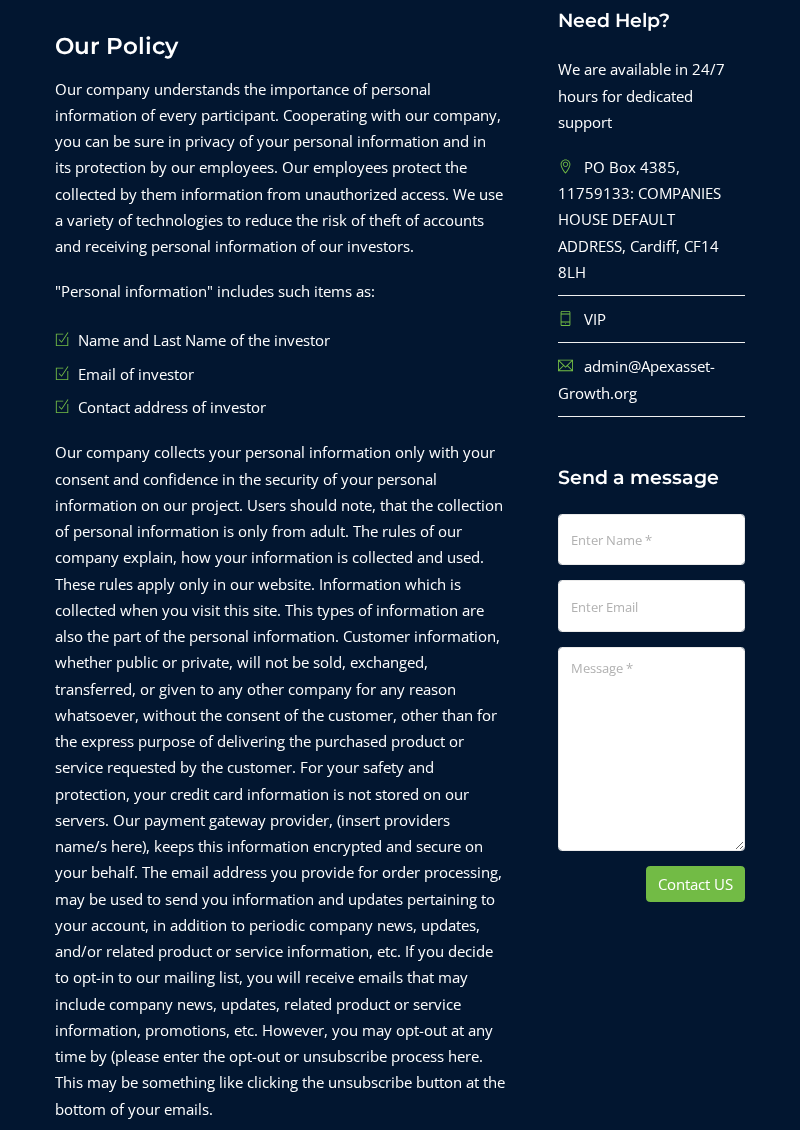
The contact box lists a phone number that reads VIP, and the support email is admin@Apexasset-Growth.org, which is not the site’s own .com domain.
We checked that .org name: it does not resolve in DNS, and the .org registry’s lookup service answered Object not found on 10 November 2026, so the domain is unregistered.
Any message sent to that address cannot be delivered, and anyone could register the name later and start receiving mail meant for the platform, including customer disputes.
The .com has its own oddities: its mail record points to the domain itself, and its SPF record authorises 192.168.168.2, a private address that cannot be reached from the internet.
The About page introduces a team of three people, two titled broker and one founder and CEO, under filler text that begins Distinctively grow go forward manufactured products.
No page gives a biography, licence number or profile link for any of them, and the filler reads like placeholder copy and not like a company history.
The logo in the header reads Apex beside a red emblem, so the brand shown on every page differs from the name Apexasset-Growth used in the titles and text.
The server answers as PHP 5.6.40, a release that stopped receiving security fixes years ago, a poor sign for a site that asks visitors to register with a password.
Who Runs Apex Asset Growth?
The Only Company Named Is Orbit Network Limited
The Legal page shows a UK certificate of incorporation and the registration number 11759133, and its View Certificate button links to the Companies House page for that number.
The FAQ goes further: asked whether the company is properly registered, it answers with that number and the name Orbit Network Limited.
We opened the Companies House record, which shows a private limited company incorporated on 10 January 2019 whose listed business is risk and damage evaluation, not investment.
Its status is Dissolved: the filing history records a first Gazette notice of compulsory strike-off in December 2024 and a final notice on 11 March 2025.
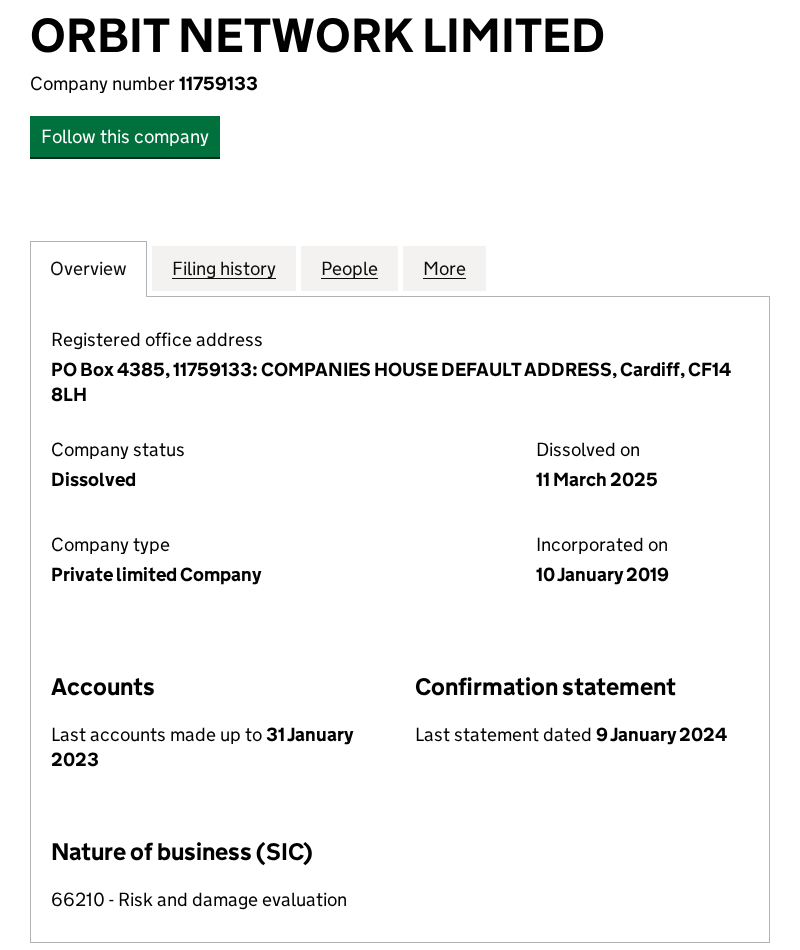
The Legal page labels 10 January 2019 as Renewed on, but that is the incorporation date on the certificate, so nothing was renewed.
A dissolved company cannot trade, and a registration number is public, so any site can display one.
Its appearance here shows only that someone found a certificate, not that Orbit Network Limited has anything to do with this platform.
The Address Is the Registry’s Placeholder
The only address anywhere on the site is PO Box 4385, 11759133: COMPANIES HOUSE DEFAULT ADDRESS, Cardiff, CF14 8LH, which prints the company number and the words default address.
The filing history shows Companies House moved Orbit’s registered office to a default address on 31 March 2022, so this is a placeholder for a company without a valid office.
The Support page calls it Our Headquarters and invites visitors to Visit Us, yet a mailbox set up by a registry cannot be visited.
The FCA notice lists only Cardiff, which matches this placeholder and nothing else we found, although it does not reveal where the address came from.
The Domain, Hosting and Mail
The registry record for the domain expires on 14 July 2027, lists no registrant, and names the servers ns25 and ns26 on my-control-panel.com as the name servers.
The address 198.251.83.106 sits in a block that the ARIN registry shows as belonging to FranTech Solutions, and the server identifies itself as LiteSpeed.
The first TLS certificate was issued on 14 July 2026, the day of registration, and a wildcard certificate followed on 14 September, so someone has maintained the site since July.
We compared the site with other platforms in the same batch of FCA notices that we have investigated and found one real overlap.
The home page of Prime Yield Assets repeats two FAQ answers from this site word for word, the starter plan limited to three deposits and the VIP-only extra accounts.
Both sites also use a title pattern of Bitcoin Investment, Cryptocurrency Investment and Etherium or Ethereum Investment.
Registrars, name servers, hosts and chat keys differ between the two, and Global Pip Markets shares none of them, so we see reused template text, not proof of common ownership.
What We Could Not Confirm
We could not confirm who owns or operates Apex Asset Growth, where deposits go, or whether any investor has ever withdrawn money, because the account pages require registration.
The FCA’s register search needs a browser script that our tools cannot run, so we relied on the warning notice, which marks the firm as not authorised.
The NFT and Loans pages answered with the site’s bot check, which we did not work around, and the Hedgemark Securities domain did not load for us at all.
Nothing we found links Orbit Network Limited or any of its officers to this site, and we do not suggest that they are connected.
What to Do If You Deposited or Shared Details
-
Stop sending money. Do not add to a deposit, pay a withdrawal or upgrade fee, or buy more crypto to unlock earnings, whatever the dashboard shows.
-
Keep every record. Save screenshots of your balance, transaction IDs, the wallet addresses you paid, emails, chat logs and the dates you sent money.
-
Alert the regulators. In the UK, contact the FCA about an unauthorised firm, and in the US file a case at ReportFraud.ftc.gov.
-
Contact your exchange. Tell the exchange or wallet provider you used, give them the receiving address, and ask whether they can flag it, knowing that crypto payments are rarely reversed.
-
Call your card issuer. If a card paid for the crypto, ask about a dispute, using the steps in the FTC’s guide to disputing charges.
-
Ignore recovery offers. Anyone who contacts you promising to retrieve lost crypto for an upfront fee is usually running a second scam.
-
Secure your accounts. Change any password you reused, turn on two-factor authentication and expect phishing emails built from the details you gave the site.
-
Read the guidance. The FTC’s article on cryptocurrency and scams explains why guaranteed returns and demands for crypto are warning signs.
Frequently Asked Questions
Is Apex Asset Growth legit?
We found nothing that supports that and a lot that argues against it: an FCA warning, a dissolved company’s paperwork, contradictory plan ranges and a 2026 domain with 2022 files.
Is Apex Asset Growth regulated by the FCA?
No. The FCA’s notice marks the firm as not authorised, and the site itself names no regulator or licence number that we could look up.
Is Orbit Network Limited the company behind Apex Asset Growth?
We could not establish that. The site displays that company’s certificate and number, but the company was dissolved in March 2025 and nothing we found shows it operates the platform.
Can anyone really earn 2% to 5% a day?
Not from any market we know of. At 2% a day compounded, $300 would pass $1,700 in 90 days, and the site names no trade that could do it.
Why does the support email use a .org address?
We cannot tell why, but the .org domain is not registered, so mail cannot reach it, and a stranger could register it later and read what customers send.
Can I get my money back if I paid in crypto?
Probably not by reversal, because crypto transfers rarely can be undone, but tell your exchange and your regulator about the payment and keep every record you have.
The Bottom Line
Do not deposit money with Apex Asset Growth. The FCA lists it as unauthorised, its company number belongs to a dissolved firm, and its own pages disagree on plans.
If you want exposure to crypto, property or oil, use a firm you can find on your regulator’s register, and read its terms before you send anything.
If you already paid, stop adding funds, keep records, alert your exchange and regulator, and treat any fee demanded to release your balance as a red flag.

Join the discussion
0 commentsShare your experience or ask a question about this article.
Discussion
Start the conversation
Have a question or something useful to share? Add the first comment.