

A text says an unpaid parking ticket could cost you your driving privileges. For someone who needs a car for work, that’s a difficult warning to ignore.
The message offers a quick payment route. Before you use it, find out whether the problem exists anywhere outside the text.
Overview
An alleged ticket comes with a license threat
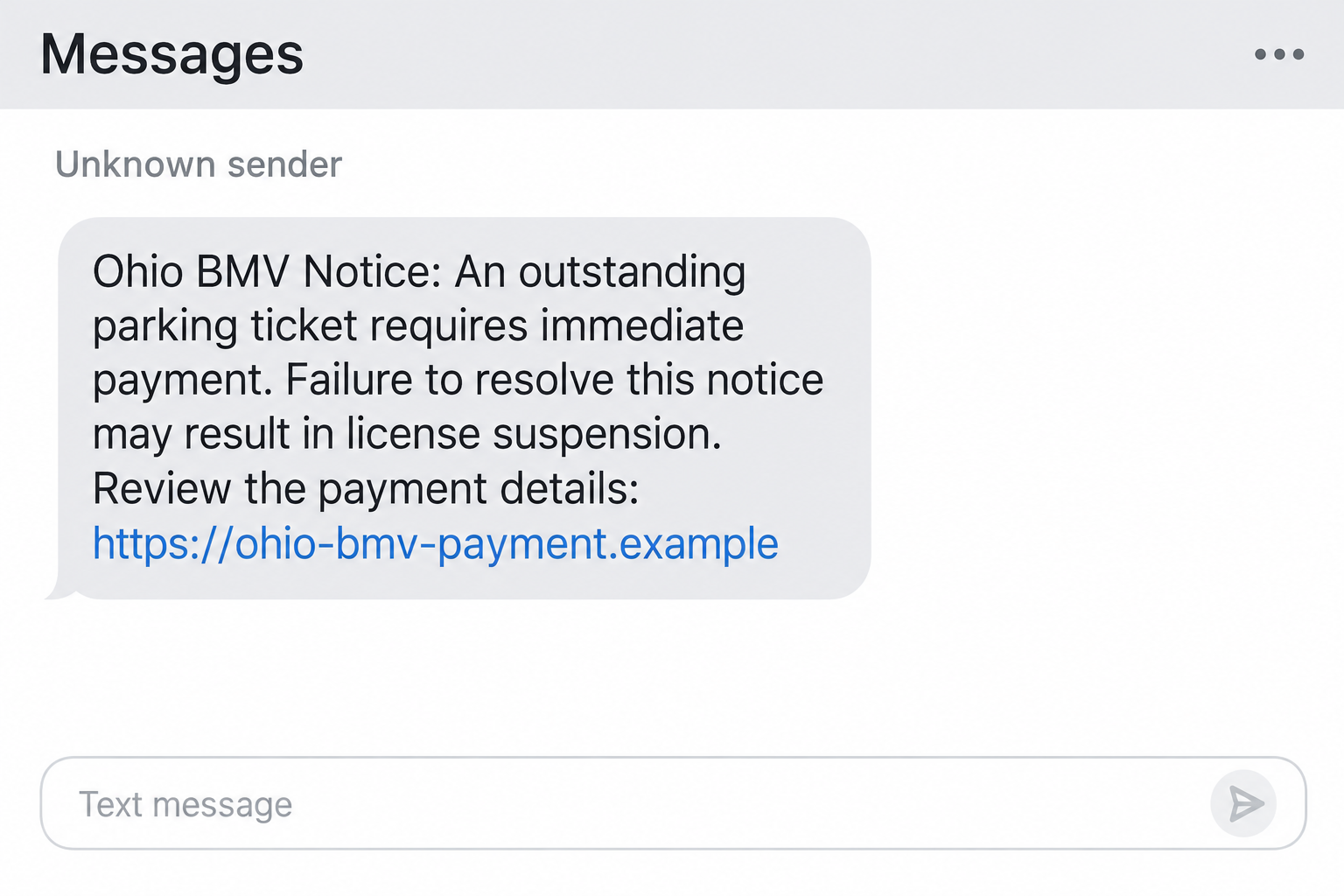
The Ohio BMV text scam impersonates a state agency and tells recipients that an outstanding ticket requires immediate attention.
The threat is usually the part that grabs you: pay now or face a license suspension. The link supplies an apparently convenient solution.
This is an impersonation of the Ohio Bureau of Motor Vehicles, not a legitimate BMV payment request. A genuine traffic obligation needs checking separately.
The example above is an illustrative message with a fictional destination. It demonstrates the pressure without reproducing an active phishing link.
The BMV has directly warned about these messages
In its official warning about agency impersonation, Ohio BMV describes texts claiming an unpaid parking ticket and threatening suspension.
The agency says it will not text you demanding payment or personal information. It also warns recipients not to follow links or scan supplied QR codes.
That is a clear policy for the fraudulent demand described here. It shouldn’t be stretched into a claim that every government notification is fake.
The message is designed to obtain personal or financial information. Merely receiving it doesn’t establish that your driving record has changed or your device is infected.
Your real records provide the useful answer
Start from Ohio BMV’s established website if you need to check a BMV matter. Follow its own service links.
- Do not pay from the unsolicited text.
- Check a claimed license issue through genuine BMV channels.
- Confirm a specific citation with the actual issuing authority or court.
- Tell your financial provider promptly if the linked page received payment details.
These checks address different concerns. Verifying your license is not the same as settling a ticket, and neither requires trusting the sender’s checkout.
Why the Suspension Warning Works
It threatens everyday independence
A license matters for commuting, family responsibilities, and ordinary errands. Losing it sounds more serious than a routine parking bill.
The sender uses that importance to compress the decision. You may feel that a small payment is preferable to discovering later that the warning was real.
That calculation begins with an unverified premise. The message hasn’t established a ticket, a valid deadline, or authority over your license.
Checking the real record is responsible. Paying an unknown destination simply because the alternative sounds frightening doesn’t resolve the uncertainty.
Statewide branding can hide a missing local case
A parking incident normally happens somewhere specific. An agency name alone doesn’t tell you which vehicle, location, or issuing body is involved.
The text may use a generic enforcement label instead of supplying those details. That makes the problem sound official while keeping it difficult to verify.
Ask what actual record the demand refers to. If you remember a citation, use that document’s independently verified process rather than a new text.
If you don’t remember one, don’t help the sender build a case by entering your license number and address into its website.
How the Ohio BMV Text Scam Works
Step 1: The message claims you have an outstanding ticket
The text begins with a conclusion: you owe a payment. It may describe a parking ticket, traffic violation, or another outstanding fee.
The official BMV warning specifically identifies the parking-ticket version. Similar agency-impostor messages can change the wording without changing the basic request.
A formal title and a reference number can make the demand appear personalized. Neither verifies that the reference belongs to a genuine record.
Some messages say “DMV” rather than Ohio’s BMV. That’s a useful mismatch to notice, but correct terminology isn’t proof that a message is genuine.
Likewise, an unfamiliar number is a warning sign rather than a complete test. A sender can vary the number or spoof a familiar-looking identity.
Don’t decide solely from spelling, punctuation, or area code. Focus on the demand for payment and the route through which it wants your information.
Step 2: A short deadline makes verification feel dangerous
The sender warns that failing to pay immediately can affect your license. It makes the payment seem necessary before you have time to ask questions.
The intimidating consequence is supposed to outrank your uncertainty. A reader who would question an ordinary bill may act differently when driving privileges are mentioned.
A real ticket can have a real deadline. Find it in the verified record, not the text’s countdown.
If you’re about to drive and feel frightened, stop and contact the agency through its established service. Don’t try to resolve it while distracted.
Never take the text’s threat as a determination of your license status. The actual BMV record and verified agency assistance are the appropriate checks.
Step 3: A link or QR code delivers the payment page
The message directs you to a web page, sometimes through a QR code. Changing how you open the address doesn’t authenticate the destination.
A QR code can conceal the URL until your camera reads it. You don’t need to scan an unsolicited payment code to investigate the demand.
The website may resemble a state portal with an agency label, notice summary, and payment form. The apparent continuity helps the text’s story hold together.
Look beyond the lettering on the page. A domain containing “Ohio” or “BMV” can still belong to an unrelated operator.
For example, the fictional address in the illustration uses the BMV name but ends in .example. It is not a government service.
For actual verification, start at the BMV’s known site and follow its current links. Don’t guess a service address from an agency-sounding domain.
A secure connection won’t settle ownership. Fraudulent pages can use encryption while sending your information to the wrong recipient.
Step 4: The form collects information under a fines pretext
The first fields may look like a ticket lookup: name, address, or vehicle details. Card information appears when the page advances to payment.
Some versions can ask for more sensitive identifiers. Treat requests for a Social Security number or account credentials as separate exposures, not ordinary parking details.
The BMV’s warning describes phishing for personal and financial information. It does not establish the exact fields collected by every changing website.
If you entered information, make a precise list from memory. A bank can protect a card, while identity data or account access requires other action.
A failed payment screen doesn’t mean nothing was transmitted. The page might have received what you typed before showing an error.
Stop if it asks for a different card or a bank approval code. Those requests extend the exposure instead of validating the supposed ticket.
Step 5: A receipt creates the illusion that your license is safe
The site can finish with a paid status or a confirmation reference. That screen is not evidence that the state received or recognized the payment.
If a real citation exists, it may remain unresolved. Paying an impostor doesn’t connect the transaction to the genuine issuing authority.
Later contact can reuse the same fear, claiming an outstanding processing fee or offering to reverse a failed transaction.
Don’t follow that new route. Once the sender’s identity is unreliable, its refund instructions and supposed account corrections are unreliable too.
Use your own bank for the payment issue and verified state or court channels for the underlying records. Keep those conversations separate.
How to Check the Real Ticket or License Concern
Identify which organization actually has the record
For a BMV license matter, start with the agency’s official website. Its current online services and contact options are preferable to details supplied by the text.
For a particular citation, identify the authority or court on the genuine notice. Find its established website independently before entering a case reference.
The two checks are not interchangeable. A license-service portal isn’t automatically the place to pay every local parking charge.
If an actual notice is unfamiliar, ask the verified organization to explain it. You don’t have to accept the text’s summary as the complete record.
Don’t test a suspicious checkout with invented details
A fake lookup can return a payment demand for whatever you type. Supplying a made-up registration doesn’t meaningfully verify who runs the site.
It can also keep you on an unsafe page longer than necessary. The official record is a better check than experimenting with the impostor’s form.
When helping a family member, use their genuine documents privately. Don’t paste identifying details into public scam comments to ask whether the message is real.
If they already paid, help preserve the receipt and reach their bank. Embarrassment often delays the action that matters most.
What to Do if You Have Fallen Victim to This Scam
- Stop responding and record what happened.
Don’t send another fee or complete a second form. Note whether you opened a link, supplied details, paid, or installed an application.
Save the text and its address without revisiting it. If it included a QR code, preserve the message rather than scanning the code again.
- Protect the card or account used for payment.
Contact the bank through its established app or card number. Explain that a fake BMV notice directed you to a payment page.
Ask about replacing exposed details, reviewing transactions, and stopping further misuse. Mention any security code you disclosed and what its message said it authorized.
- Ask about recovery using the actual transaction.
Provide the amount, date, recipient description, and reference. Explain whether you approved a payment under deception or discovered a separate unauthorized charge.
Ask what dispute or recovery process applies and how quickly evidence is needed. Do not assume that a scam report automatically returns the funds.
- Address exposed passwords separately.
If you entered an account password, change it on the genuine service. Use a trusted device if the suspicious site prompted software installation.
Review sessions and recovery information, and replace reused passwords elsewhere. A card replacement cannot stop someone signing into an account with stolen credentials.
- Take identity exposure seriously, but be specific.
If you supplied a Social Security number or identity documents, use IdentityTheft.gov for an appropriate recovery plan.
Describe what was disclosed and any actual misuse you’ve found. Receiving a text alone doesn’t require treating every identity record as stolen.
- Report the agency impersonation.
The BMV’s official warning directs consumers to the FTC fraud-reporting service and recommends contacting local law enforcement after a scam loss.
Give the message, destination, and transaction evidence. Use established reporting routes, not a phone number in the fraudulent notice.
- Confirm any genuine outstanding obligation.
Check the actual BMV record or contact the citation issuer as appropriate. Keep the reference and genuine response in your evidence file.
Don’t assume a fake payment cleared the real matter. Follow the verified organization’s instructions for a genuine notice or status problem.
- Undo relevant device changes.
Remove an untrusted download, revoke unexpected browser notifications, and disconnect any remote session. A Malwarebytes scan can help investigate unwanted software after such exposure.
AdGuard may reduce malicious ad encounters. These tools don’t recover a fines payment, repair a driving record, or replace account and bank action.
What Changes With Different Versions of the Message?
A scam can replace “parking ticket” with a traffic fee, alter the deadline, or add an official-looking code. Don’t rely on one exact script.
The useful pattern is the same: an unsolicited agency-impostor demand asks you to submit money or sensitive information through its own route.
An older profile-update lure can ask for information without an immediate charge. Treat that information request according to what you disclosed, not only what you paid.
By contrast, an appointment reminder you arranged doesn’t become this scam merely because it arrives by text. Evaluate what the particular communication asks you to do.
- An expected reminder is different from an unexpected fines demand.
- A verified account record is different from a link containing an agency name.
- A genuine citation issuer is different from a generic “enforcement team” label.
- A payment confirmation is meaningful only when the authorized recipient recognizes the transaction.
Don’t search for reassurance from the sender. An independent record can answer the question without letting an impostor control the explanation.
Frequently Asked Questions
Does Ohio BMV text people to demand immediate ticket payments?
The BMV’s official scam warning says it will not text demanding payment or personal information. Do not follow the unsolicited fines-payment route described here.
Can the text establish that my license is suspended?
No. Verify your actual status through genuine BMV services. The sender’s threat is not a substitute for the agency’s records.
Should I scan the QR code to see the notice?
No. Ohio BMV specifically warns against scanning codes in these scam messages. Obtain a genuine record through an independently established agency or court route.
Is a message using “DMV” automatically fraudulent?
It’s a mismatch worth noticing because Ohio uses BMV. But correct naming doesn’t authenticate a message, and terminology alone is not the complete test.
What if I typed my card details but the page failed?
Contact the issuer. The form may already have transmitted those details. Explain the exposure even if no payment appeared to complete.
Will deleting the text fix what I’ve already shared?
No. Deleting prevents further interaction but doesn’t retract disclosed information. Protect the card, accounts, or identity data involved and preserve evidence before removing the message.
The Bottom Line
Do not pay an unsolicited Ohio BMV fines text. The agency has warned about the parking-ticket and license-suspension lure and rejected these payment demands.
The Ohio BMV text scam relies on fear of losing your license. Replace that fear with a check of the real record through verified channels.
If you gave away information or money, contact the relevant financial or account provider now. Resolve any genuine citation separately with its actual issuer.








