

A text message claims you have an unpaid traffic ticket tied to a case number like CO-26-TR-273196, NJ-26-TR-273196, IL-26-TR-273196, TX-26-TR-273196, MN-26-TR-273196, or TN-26-TR-273196.
The notice may include a court name, a judge’s name, legal threats, and a QR code to “settle your unpaid balance.”
It looks official. It feels urgent. It is a scam.
Scam Overview
The 26-TR-273196 traffic ticket scam is a phishing campaign that uses fake court-style notices to scare people into paying bogus traffic, toll, or parking violations.
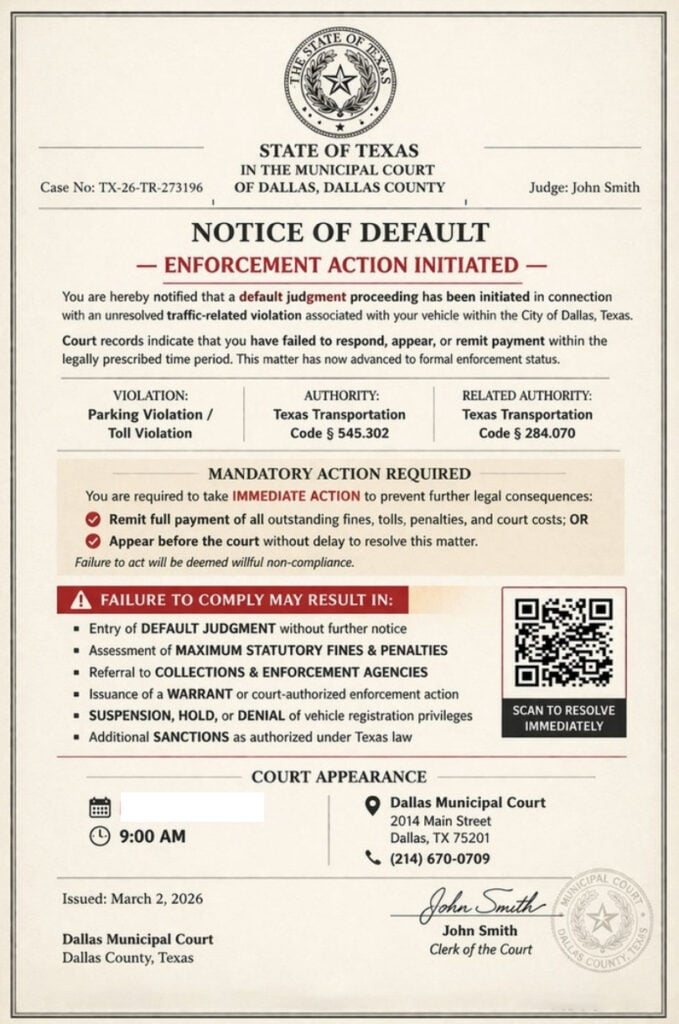
The scam usually arrives by text message. Instead of a simple written message, victims often receive an image that looks like a formal court notice. It may include a state seal, a court heading, a case number, a judge’s name, a hearing date, and a QR code.
The key identifier is the repeated case number pattern:
- CO-26-TR-273196
- NJ-26-TR-273196
- IL-26-TR-273196
- TX-26-TR-273196
- MN-26-TR-273196
- TN-26-TR-273196
- Other similar state-prefix variations
The prefix changes to match the state being targeted, but the core number 26-TR-273196 stays the same.
That is one of the biggest warning signs.
Real traffic cases are tied to a specific court, jurisdiction, and incident. A recycled case number appearing across different states is a strong indicator of a mass-produced scam template.
The Federal Trade Commission has warned about fake traffic violation texts that include official-looking notices, fake case numbers, QR codes, and threats of default judgments or enforcement actions. The FTC says these messages are designed to steal money, personal information, credit card numbers, and in some cases may even expose victims to malware risks.
Why the 26-TR-273196 scam looks convincing
Scammers know that most people do not know how traffic court case numbers work.
So they use a format that looks believable:
- State abbreviation
- Year-like number
- “TR” for traffic
- A long numeric case ID
At a glance, TX-26-TR-273196 or NJ-26-TR-273196 looks like something a real court system might generate.
That is the point.
The scam is not built for legal accuracy. It is built for fast emotional reaction.
Common wording in these scam notices
The fake notices often use phrases like:
- Final Notice
- Notice of Default
- Court Enforcement Action
- Immediate Action Required
- Failure to Act or Appear Will Result In
- Scan the QR code to settle your unpaid balance
They may claim you owe money for:
- Failure to pay electronic toll
- Toll evasion
- Parking violation
- Speeding violation
- Outstanding traffic citation
- Court costs or administrative penalties
Some notices list several violations at once. That is another red flag. Real citations usually describe a specific incident. Scam notices often list multiple generic violations to increase the chance that one feels plausible.
The QR code is the trap
The fake court notice usually includes a QR code.
The QR code may be labeled:
- “Scan to pay”
- “Scan to resolve immediately”
- “Settle your unpaid balance”
- “Official secure portal”
A QR code can feel safer than a suspicious link, but it is still just a hidden web address.
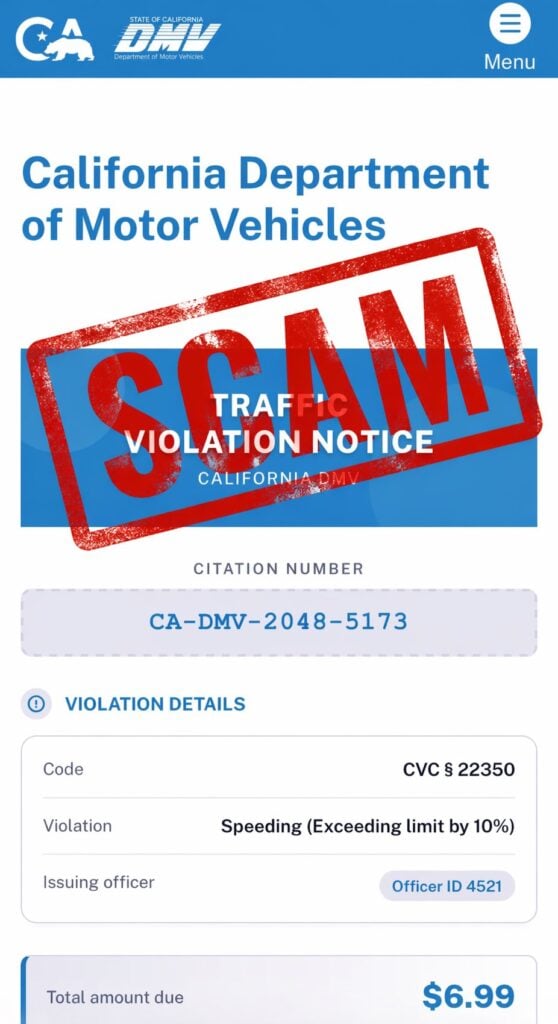
When victims scan it, they are often taken to a fake payment website that may look like a court, DMV, toll authority, or traffic citation portal.
That fake site may ask for:
- Full name
- Address and ZIP code
- Phone number
- Email address
- Vehicle or license plate details
- Credit card number
- Expiration date
- CVV
- Billing address
The scam has appeared in multiple local versions
This fake case number format has been reported in several localized versions.
In Kansas, local reporting described a fake Johnson County court text using KS-26-TR-273196, a QR code payment demand, and a fake court appearance threat. The report stated that no payment was required and no court appearance was necessary.
In Indiana, WRTV reported on a similar traffic enforcement text scam claiming to come from the Marion County Superior Court’s Traffic Division. That scam referenced electronic toll, parking, and speeding violations, used the name Judge Michael Rodriguez, and included a QR code for payment.
Dallas officials also warned about fake court notices involving traffic-related payment demands and QR codes, with examples including Texas-style fake court documents and case-number formats like TX-26-TR-273196.
Why scammers change the state prefix
The scam is modular.
Scammers can reuse the same fake notice and swap only a few details:
- State name
- Court name
- County name
- Case number prefix
- Judge or clerk name
- Legal code references
- Hearing location
- QR code destination
That lets them target different areas quickly while keeping the same basic design.
So one victim may receive NJ-26-TR-273196, while another receives TX-26-TR-273196 or CO-26-TR-273196.
The message feels local, but the structure is copied.
How the 26-TR-273196 Traffic Ticket Scam Works
Step 1: You receive a fake court notice by text
The scam usually starts with a text from an unknown number.
It may include an attached image that looks like a court document. The image may show:
- A state seal
- A court or traffic division heading
- Case number 26-TR-273196
- A judge’s name
- A violation list
- A QR code
- A hearing date
The goal is to make you believe the message is connected to a real legal matter.
Step 2: The message claims you missed a deadline
The fake notice often says prior notices have expired or that the matter is now under enforcement.
This is meant to make you feel late.
Instead of asking “Is this real?” the victim may think “How do I stop this?”
That shift is exactly what scammers want.
Step 3: The notice lists scary consequences
The fake document may threaten:
- Default judgment
- Maximum fines
- Court costs
- Collections
- License suspension
- Registration problems
- Contempt proceedings
- Credit impact
These threats are used to create panic.
Step 4: The QR code offers a fake solution
After creating fear, the notice gives you a simple way out:
Scan the QR code and pay.
This is where the scam turns from intimidation into theft.
The QR code redirects you to a fake website. It may look official, but it is controlled by scammers.
Step 5: The fake website collects your personal information
The site may ask you to “verify” your ticket or case.
It may request:
- Name
- Address
- Phone number
- Vehicle information
- License plate number
Even if you stop before paying, that information may already be captured and used for future scams.
Step 6: The payment form steals your card data
The fake site then asks for payment.
The payment amount may be small, sometimes presented as a quick settlement fee.
This is intentional. A low amount makes victims less suspicious.
Once you enter your card number, expiration date, CVV, and billing details, the card should be treated as compromised.
Step 7: Fraud may happen later
The damage may not appear immediately.
Scammers may:
- Run small test charges
- Attempt larger purchases later
- Sell your card data
- Send more fake traffic notices
- Use your personal information in follow-up scams
A small fake ticket payment can become a much bigger financial problem.
Red Flags in 26-TR-273196 Scam Texts
The same case number appears in different states
This is the clearest warning sign.
A real court case number would not appear as:
- CO-26-TR-273196
- NJ-26-TR-273196
- IL-26-TR-273196
- TX-26-TR-273196
- MN-26-TR-273196
- TN-26-TR-273196
across unrelated jurisdictions.
The notice arrives by random text
A surprise legal notice demanding payment by text is suspicious.
Court matters should be verified through official court systems, not through links or QR codes sent by unknown numbers.
The QR code demands payment
A QR code in a traffic ticket text is a major red flag.
Do not scan it.
The notice uses urgent legal language
Phrases like Final Notice, Notice of Default, and Court Enforcement Action are meant to scare you into acting quickly.
The judge or clerk name looks generic or reused
Many scam templates use names like:
- Judge Michael Rodriguez
- Judge John Smith
- Clerk John Smith
These names may appear across multiple states in fake notices.
The violation details are vague
Fake notices often list several violations at once, such as toll evasion, parking, and speeding.
A real citation usually has specific details tied to a specific event.
What To Do If You Receive a 26-TR-273196 Text
Do not scan the QR code
Do not scan it out of curiosity.
A QR code can send you to a fake payment site or malicious page.
Do not click links
If the message includes a link, do not open it.
Do not reply
Replying can confirm that your number is active.
Do not pay
Do not enter card details through the message, QR code, or linked site.
Verify independently
If you are worried there may be a real issue:
- Go directly to the official court website
- Use an official case lookup tool
- Call the court using a trusted number
- Check your DMV or toll account through official channels
- Do not use contact details from the text
What To Do If You Already Paid or Entered Information
1. Call your card issuer immediately
If you entered card details, call the number on the back of your card.
Tell them:
- You entered your card details on a fraudulent traffic ticket website
- The site came from a scam text
- You need the card blocked and replaced
- You want recent transactions reviewed
2. Review recent transactions
Look for:
- Small test charges
- Unknown online purchases
- Subscription charges
- Repeated declined attempts
- Charges from unfamiliar merchants
Dispute anything you do not recognize.
3. Turn on transaction alerts
Enable alerts for:
- Every purchase
- Online payments
- Transactions over $1
4. Save evidence
Take screenshots of:
- The text message
- The sender number
- The fake notice
- The QR code
- The fake website
- Any payment confirmation or error page
5. Watch for follow-up scams
Scammers may contact you again pretending to be:
- A court clerk
- A collections agency
- A refund department
- Your bank
- A fraud investigator
Do not trust follow-up messages just because they reference the same fake case number.
6. Report the scam
You can:
- Mark the text as spam or junk
- Block the sender
- Forward it to 7726 (SPAM) if your carrier supports it
- Report it to the FTC at ReportFraud.gov
The Bottom Line
The 26-TR-273196 traffic ticket scam text is a fake court notice campaign built around a recycled case number.
Whether it appears as CO-26-TR-273196, NJ-26-TR-273196, IL-26-TR-273196, TX-26-TR-273196, MN-26-TR-273196, TN-26-TR-273196, or another variation, the pattern is the same: a fake legal notice, urgent threats, and a QR code or link to pay.
Do not scan. Do not click. Do not pay.
Verify any real traffic, toll, or court matter only through official websites and phone numbers you find yourself.
FAQ
What is the 26-TR-273196 traffic ticket scam?
It is a phishing scam where criminals send fake court-style traffic ticket notices by text. The message claims you have an unpaid traffic, parking, speeding, or toll violation and pushes you to scan a QR code or pay through a fake website.
Is 26-TR-273196 a real case number?
No. The number is being reused across scam texts in different states. Real court case numbers are tied to specific courts and cases, not recycled across multiple jurisdictions.
Why do the texts use different prefixes like CO, NJ, TX, MN, or TN?
Scammers change the state prefix to make the notice look local. The core number, 26-TR-273196, often stays the same, which is a major sign that the notice is fake.
What happens if I scan the QR code?
You may be sent to a fake payment website that looks like a court, DMV, toll, or citation portal. The site may ask for your personal details and credit card information.
Why does the notice look so official?
Scammers use state seals, court names, judge names, case numbers, legal wording, and warning banners to make the message feel legitimate and urgent.
What information are scammers trying to steal?
Usually:
- Full name
- Address and ZIP code
- Phone number and email
- Vehicle or license plate details
- Credit card number
- Expiration date and CVV
I clicked the link but did not enter anything. Am I safe?
Your risk is much lower if you did not submit information. Close the site, do not return, and watch for follow-up scam texts.
I entered my card details. What should I do now?
Call your card issuer immediately, report the card as compromised, freeze or replace it, review recent transactions, dispute anything unfamiliar, and turn on real-time transaction alerts.
Can a real court demand payment through a QR code in a random text?
A surprise court or traffic notice with a QR code payment demand is a major red flag. Real tickets should be verified only through official court, DMV, or toll agency websites you access yourself.
How do I verify whether I really owe anything?
Do not use the link, QR code, or phone number in the message. Go directly to the official court, DMV, or toll agency website by typing the address yourself.
How do I report the scam?
Mark the message as spam, block the sender, forward it to 7726 (SPAM) if supported by your carrier, and keep screenshots of the text, QR code, and fake website.








