

A final notice appears between ordinary messages. It mentions the Indiana BMV, and suddenly you’re wondering whether an overlooked ticket could interrupt your drive to work.
The Indiana BMV text scam can look convincing well beyond the first message. Before trying to clear the warning, look at what makes its payment route seem official.
Overview
The real BMV warns about lookalike websites and false confirmations
Indiana’s Bureau of Motor Vehicles has warned about texts leading to websites that imitate the agency. Some copies go further than a logo and a payment button.
A March 13, 2026 BMV alert says the fraudulent sites can generate receipts and confirmation numbers. Those documents do not make the transaction genuine.
The warning describes impersonation of the BMV, not misconduct by the real agency. Its original date identifies the warning; it does not prove a newly discovered outbreak today.
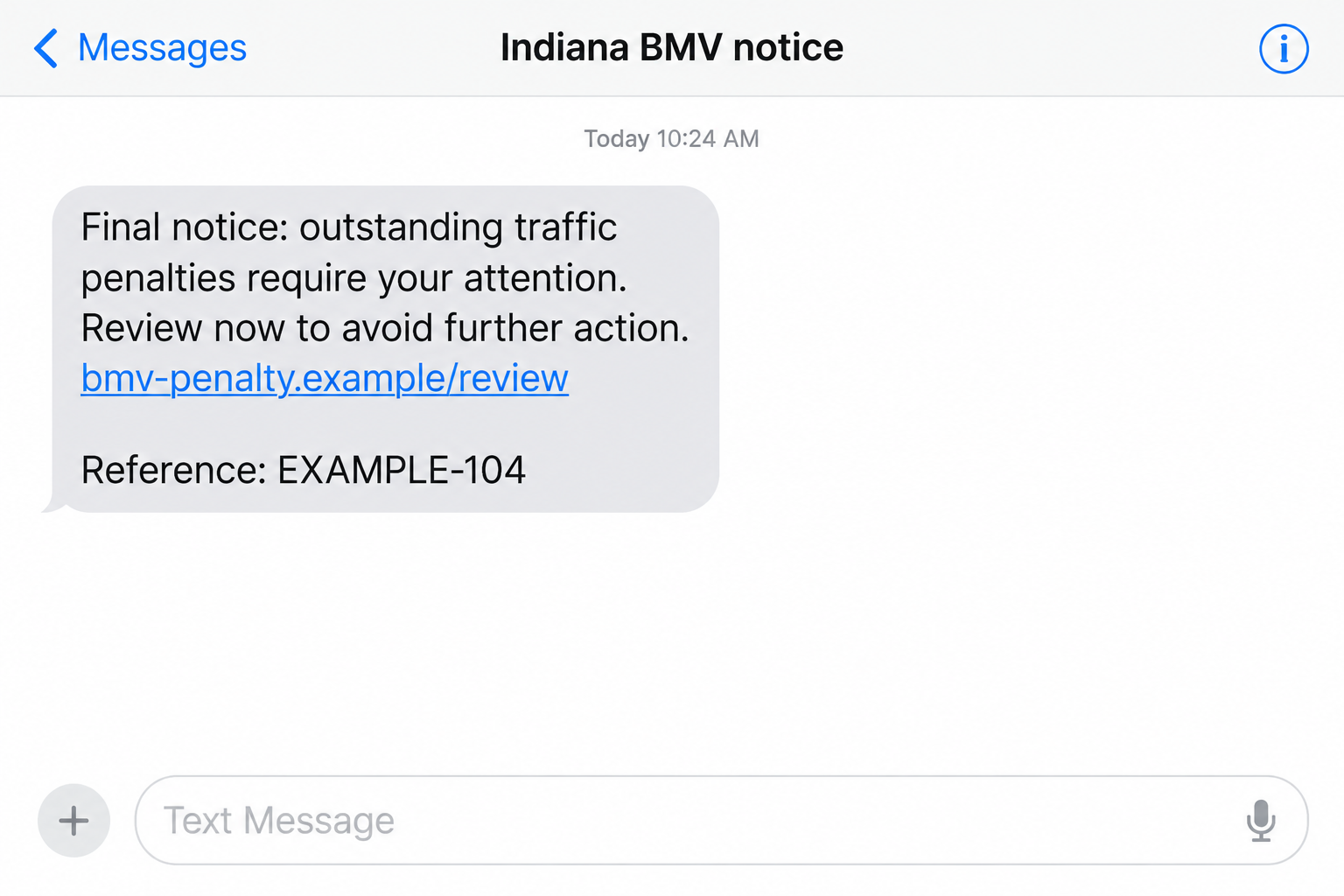
The image above uses fictional wording and a nonfunctional address. It illustrates the message format rather than reproducing an authenticated victim’s conversation.
A real renewal reminder is not permission to use a texted payment link
Indiana’s consumer scam alerts distinguish legitimate registration reminders from impersonation. Customers may have signed up for renewal notices by text.
But the BMV says it never asks people to pay fees through a link sent in a text. A genuine communication channel can still be imitated.
Did you sign up for registration reminders? That still doesn’t give an unfamiliar sender permission to collect your card or identity details.
Open the agency’s website independently. If there is a real renewal or account concern, use the service reached from that trusted starting point.
The unfamiliar fee deserves a check before any card information
Stop before following a message that combines:
- An outstanding penalty or traffic-violation claim.
- A short deadline framed as a final opportunity.
- A threatened interruption to driving or registration.
- A link resembling an Indiana government address.
- A demand to complete payment before checking the allegation.
The BMV warns that the fees in these messages often are not fees it collects. A formal tone does not make that sender the right person to pay.
The Detail That Can Fool You After Payment
A receipt can be produced by the same page that took your details
A confirmation screen feels like the end of a transaction. You may save it, close the browser, and believe the supposed problem has been settled.
That is why the BMV’s warning about fabricated receipts matters. An operator who controls the form can also control the page calling the submission successful.
A confirmation number has no independent authority simply because it follows a payment form. The genuine agency must be able to recognize the underlying transaction.
If you paid through a suspicious route, keep the receipt for your bank and report. Do not treat it as evidence that the government received your money.
A copied seal does not identify the website operator
State colors, a seal, and a familiar arrangement of menus can make a fraudulent page feel routine. Design is easier to copy than official authority.
You should not need to judge tiny visual differences while worried about your license. Leave the page and start again from the genuine BMV website.
A warning with polished spelling can still be false. Likewise, the word BMV is not a guarantee simply because older impostors used DMV instead.
A legal citation is something to verify, not an instruction to pay
A message can include formal references that sound relevant to driving. That does not establish a real violation, a deadline, or the collector’s identity.
Do not assume a legal reference is valid because its numbering looks plausible. Ask the real agency or appropriate court about the actual matter.
If you have a genuine citation, keep its original paperwork separate from the unsolicited text. You need to resolve the real issue through its proper channel.
How the Indiana BMV Text Scam Works
Step 1: An unexpected notice creates doubt about your driving record
The message claims there is an outstanding penalty, unpaid traffic matter, or related enforcement concern. It arrives where you also receive normal reminders and personal conversations.
You may not remember every parking payment or renewal date. The sender uses that uncertainty to make an unfamiliar demand feel worth clearing quickly.
Before acting, look for an actual connection to a known transaction. Do not provide a license number or payment information merely to ask what the text means.
You can check a real concern without replying. Independent verification is available even when the message describes itself as the final notice.
Step 2: The threat makes checking feel like a dangerous delay
A short deadline and threatened restrictions give the message emotional weight. Losing the ability to drive can sound much worse than paying an apparently manageable fee.
That comparison leaves out the real question: who is collecting the information? Paying an impostor does not settle an obligation with the proper authority.
Take the time to identify the agency and the alleged charge. A stranger’s countdown should not decide which website receives your financial details.
If another person helps with your household paperwork, ask them about the real records. Do not let the message isolate you from someone who could recognize the mismatch.
Step 3: A lookalike address leads to a copied BMV page
The link may contain familiar state words while leading somewhere unrelated. The page can then repeat the seal, colors, or service labels you expected.
Read the whole address rather than a recognizable fragment. When unsure, close it and reach official services from the agency’s own website.
Do not adopt a blanket rule that every genuine BMV service must end in .gov. Indiana’s official site also directs customers to myBMV.com.
The safe connection is the one the real agency publishes, not one a text asks you to trust because it contains government-like words.
Step 4: The supposed resolution collects payment or personal information
A form may request identifying details, card information, or both. Follow-up fields can be described as verification even when they expose more information.
Submitting a field does not require a completed charge to create risk. If you supplied sensitive details, tell the relevant provider even if the page later failed.
Do not try a second card to discover whether the first attempt worked. That can disclose another payment method without resolving the alleged penalty.
Any unexpected request for a bank password or security code deserves a separate stop. The explanation attached to a field does not limit what its contents can authorize.
Step 5: A fabricated receipt makes the problem seem finished
The imitation may display a receipt or confirmation number. The BMV has specifically warned about this feature, so a professional ending cannot authenticate the site.
You might wait for an update instead of calling your card issuer. Do not give the fraudulent page that extra time once you recognize the problem.
Keep whatever confirmation you already saved. Give it to the bank as part of the transaction history, clearly explaining that it came from the suspicious website.
The same distinction applies to an email receipt. Another document produced by the same unverified source is not an independent record of official payment.
Step 6: Later messages can reuse the original allegation
A follow-up may claim the payment failed, needs an additional fee, or requires a refund check. Treat the new request as unverified too.
Do not let knowledge of the earlier reference number settle the question. Whoever received the first information may already know those details.
Return to your bank and the genuine agency through established contacts. Keep a single timeline so another message cannot quietly rewrite what happened.
Where to Check a Real Indiana Driving or Registration Issue
Start with the BMV, not a search ad promising immediate clearance
The official online-services page explains myBMV options and BMV Connect services. Use that page to choose the relevant task.
Do not assume the first sponsored result is the government portal. A search is another place where an unfamiliar operator can offer a convenient-looking shortcut.
The BMV publishes 888-692-6841 for checking uncertain communications. Locate the contact on the agency’s site yourself rather than accepting a number from the text.
Match the question to the right authority
A registration renewal, a traffic citation, and a toll account are different matters. Naming the BMV in a message does not combine them into one payment.
If you have original citation paperwork, contact the authority identified there using independently confirmed details. Ask about the real record, not just the text’s invented reference.
Do not ignore genuine notices because you discovered one scam. Resolving the impersonation and handling a legitimate deadline can be separate tasks.
Keep useful records without circulating private information
Save the message and any transaction evidence privately. A family warning can describe the threat and link pattern without publishing license numbers or payment receipts.
When helping another person, let them control their account and bank conversation. You can help organize the timeline without asking them to share passwords with you.
What to Do if You Have Fallen Victim to This Scam
-
Close the unverified process and stop further payments. Do not enter a second card, additional identifier, or another code to complete the supposed clearance.
List the actions you took while they are fresh: opened the link, filled a form, approved a transaction, or downloaded software.
Keep any receipt already available. Label it as a document from the suspicious site rather than proof that the BMV accepted payment.
-
Check the alleged matter with genuine BMV services. Use the official website or its published contact information, not the suspicious page’s support link.
Describe the demand and ask which agency handles that kind of issue. Keep any real response or case reference for later follow-up.
If a genuine citation exists, address it through the proper authority. Paying the impostor does not resolve that separate matter.
-
Tell the card issuer about a financial disclosure promptly. Explain whether the card was entered, charged, declined, or used more than once.
Ask what replacement, transaction review, dispute, or other protection is appropriate. Use the number on your card or your existing banking app.
Do not wait for the fake receipt to change status. The provider can advise on the exposure even before an unfamiliar charge appears.
-
Protect identity details according to what you shared. A license number, Social Security number, and ordinary contact address have different implications.
IdentityTheft.gov offers guidance based on the information involved. Ask the real BMV what steps apply to an exposed driver credential.
Keep records of unfamiliar activity and follow the official recovery process. Do not buy a replacement identity document from an unsolicited helper.
-
Replace any disclosed account passwords. Reach each genuine service directly and use unique replacements, including elsewhere if you reused the exposed password.
Tell the provider about security codes or changed recovery details. A password reset may not answer every question about access already granted.
If a shared family or work account was involved, inform its owner. Avoid leaving another authorized user unaware of the original trap.
-
Investigate downloads or device permissions if those were involved. Opening a text alone does not establish that malicious software was installed.
Malwarebytes can assist with detecting harmful software obtained through the link. It cannot validate a BMV receipt or reverse the payment.
AdGuard may filter intrusive ads and some risky websites. Its protection does not replace checking a government demand through the real agency.
-
Report the message and the actual loss. Use your messaging application’s spam function or forward the text to 7726 where your carrier supports it.
A report at ReportFraud.ftc.gov can include the sender, destination, and payment story. Do not add secret credentials.
Continue your bank case separately and keep its deadlines. A fraud report does not guarantee that a transaction will be reversed.
-
Reject anyone charging to finish or undo the fake penalty. A later caller may use the reference from the first message.
Work with the providers you contacted independently, and show another trusted person the request if pressure starts building again.
Once immediate protection is arranged, check that any genuine renewal or driving issue has been addressed. You should not be left guessing about the real record.
Frequently Asked Questions
Does Indiana BMV ever send text reminders?
Its scam guidance acknowledges registration-renewal text notices for customers who signed up. That does not authorize a texted link demanding fees or penalties.
Can a fake site issue a convincing receipt?
Yes. The BMV’s March 2026 warning specifically mentions fraudulent receipts and confirmation numbers. Confirm payment with the real authority, not the page that created the receipt.
Is every website ending in .com fraudulent?
No. Indiana’s official site links to myBMV.com. Start with the agency’s published services instead of judging a destination solely from its ending.
Does the correct BMV name prove the message is real?
No. Impostors can copy the correct name and seal. Check the requested action and use the agency’s own route to verify it.
What if my card was declined on the page?
The information may still have been disclosed. Stop trying other cards and tell the issuer what you entered and what the site displayed.
Should I ignore an actual citation after receiving a scam?
No. Reject the fraudulent demand, but independently check genuine paperwork and applicable deadlines with the responsible authority.
The Bottom Line
Do not pay through an unsolicited Indiana BMV text. A copied website and fabricated receipt cannot turn its demand into a genuine state transaction.
If you already used the link, protect the information disclosed and contact your financial provider. Then verify any real driving matter through official BMV or court channels.

Join the discussion
0 commentsShare your experience or ask a question about this article.
Community experiences
Did this happen to you?
Your experience could help someone recognize the same scam. Submit a private report for our team to review.
I experienced this tooReports are reviewed before publication. Sharing publicly is always your choice.
Discussion
Start the conversation
Have a question or something useful to share? Add the first comment.