


Cryptoaiml promised AI trading signals worth up to 1,600% in 60 days, and in September 2026 the SEC sued two companies using that name over at least $12.5 million.
We read the whole court filing, then went looking for the platform, its wallets and its website, and what we found matters to anyone holding an invitation or a balance.
Overview
What Cryptoaiml Offered
Cryptoaiml presented itself as an AI-powered crypto trading platform, reached through WhatsApp groups led by famous investment names, where members followed trading signals and watched their balances grow.
We read all 33 pages of the SEC’s court filing against Cryptoaiml Ltd. and Cryptoaiml Capital Foundation, lodged in Manhattan federal court on September 29, 2026 as case 1:26-cv-08508.
The SEC alleges that no trading ever took place, that the profits on screen were invented, and that withdrawals stayed blocked until members paid new fees.
What Our Checks Found
The filing’s own dates put a Form D claiming $10 million raised six days after incorporation, and a money service registration four days before its organization was formed.
Two of the five bitcoin addresses listed in the filing were moving money long before either company existed, and every one of them now holds almost nothing.
The platform’s domain lapsed after its last archived copy, was registered again in February 2026, and today forwards visitors to an unrelated address that first appeared in October.
One quarter of the trading volume the website advertised is about 16,500 times the $12.5 million at stake in the case.
What We Could and Could Not Verify
Here is where the evidence stands after our checks:
- Verified by us: the filing’s dates and figures, the domain registration and redirect, the archived menu with its MSB and SEC tabs, and the history of nine listed wallet addresses.
- Not found: a working trading site, any named human owner, and any Cryptoaiml entry in the SEC’s EDGAR company search.
- Not verified: who controls the two companies, what the old site’s text said, activity on blockchains other than Bitcoin and Ethereum, and how the case will end.
Our advice is not to deposit with Cryptoaiml, and never to pay a fee to release a balance, because that is where, on the SEC’s account, more money was taken.
A Case Built in 14 Days
We began with the dates, because a platform that presents itself as big and established should leave an old paper trail, and this one left a very young one.
Paragraph 14 of the filing gives August 20, 2024 as the day Cryptoaiml Capital Foundation registered with FinCEN as a money service business.
The same paragraph gives August 24, 2024 as the day the Colorado nonprofit was formed, which dates the registration four days before the organization it names existed.
We cannot tell whether that gap is a slip in the filing or a sign of a careless registration, but it is the first date that does not fit.
Cryptoaiml Ltd. was incorporated in New York on August 28, 2024, and filed a Form D on September 3 listing revenue above $100 million and $10 million raised.
A company six days old cannot have earned $100 million, and the filing treats the Form D as false down to the executive’s name, phone number and email.
The filing adds that the signer does not appear to exist and that the notarization looks forged, and the SEC has since removed the Form D from its website.
We searched EDGAR’s company list for Cryptoaiml and it returned no matching companies, which fits that removal.
The first WhatsApp group in the filing, VIP-Wealthy Affiliate Group, was created on September 17, 2024, which is 20 days after incorporation and 14 days after the Form D.
Counting from the money service registration to the Form D also gives 14 days, the same window the filing gives for preparing the entities.
The lesson is simple: every official-looking record was less than a month old when the first group chat opened, yet the website presented them as proof of compliance.
The Website Promised a Giant
We tested the site’s headline numbers against the only hard figure in the case, the $12,512,032 taken from at least 300 victims in the SEC’s account.
Paragraph 21 quotes three of the site’s boasts: more than 1 million users, clients in 190+ countries and $207 billion in quarterly trading volume.
That volume works out to about $2.3 billion a day, and a single quarter of it is roughly 16,500 times everything victims lost in this case.
Spread across a million users, $207 billion means $207,000 traded per user every quarter, while the court papers count about 300 victims at no more than $41,700 each.
We read the site’s safety language the same way, because it promised a 1:1 reserve for all user assets, offline multi-signature cold storage and a User Protection Fund.
The wallet trail below shows deposits passing through quickly, and we found nothing we could check that supports a reserve of any size.
What the Archive Still Shows
We could not open the platform itself, because its address now forwards elsewhere, so we asked the Internet Archive what visitors saw while it ran.
The archive holds seven captures of cryptoaiml.vip between December 25, 2024 and April 10, 2025, and the three we downloaded are the same 5,852-byte page titled CRYPTO AI.
That page is only a loader. It draws everything with JavaScript, which is why the site’s wording is not preserved in the archive.
The loader pulls a charting library from the site’s own server, which draws price charts, but a chart on a screen does not show that any order reached a market.
When we rendered the archived copy from February 10, 2025, the menu read Quotes, Spot, Futures, Options, Activity Hall, Beginner’s Tutorial, AI ETF, MSB and SEC.

The last two tabs matter most. Paragraphs 26 and 27 of the filing give those labels to the pages that displayed the Form D and the money service registration.
That SEC tab is the trap: a visitor who clicked it saw a genuine sec.gov page for a filing the company had uploaded itself, which approves nothing.
The Chat Room Script
We lined up every dated message the filing quotes, and the groups open in a tight order that shows how quickly the personas were assembled.
Everything in this section is an allegation from the SEC’s filing, cited by paragraph, and no court has tested any of it.
The first group, VIP-Wealthy Affiliate Group, opened on September 17, 2024, and Citadel AI Community followed on September 24, led by a supposed president of Citadel Securities.
That biography was copied from the real executive’s public profile, and a second persona tied to Raymond James began posting on October 21, 2024.
Neither firm took part or allowed its name to be used, so the chats borrowed trust from companies with no involvement in the scheme.
A calculator is enough to test the promises. A post offering up to 1,600% profit in 60 days turns $1,000 into $17,000, or about 4.8% growth daily.
An investment agreement sent to clients waived the manager’s fee at monthly profits of 1,200%, which turns $1,000 into about $2.2 million in three months.
The chats also guaranteed against loss: on January 8, 2025 an assistant promised that Citadel would bear up to 90% of a member’s trading risk.
We would expect no legitimate adviser to offer that on crypto trades, so the sentence alone is a reason to walk away, whatever else turns out to be true.
Another persona told a prospect on November 13, 2024 that a 50x contract account would magnify profits 50 times, and it would magnify losses just as much.
At 50x, a price move of only 2% against the position erases the entire stake, so the pitch hid the one number that decides whether a leveraged account survives.
Praise from fellow members completed the picture, and the filing treats that praise as staged by the same people running the groups.
Some members sold employee stock options, and others drew on 401(k) accounts, to fund the platform after chats called stocks the riskier bet.
Where the Money Went
We followed the money as far as a public block explorer lets a reader, without touching a wallet and without opening the old site.
The filing lists nine addresses, five on Bitcoin and four on Ethereum-style networks, as receiving proceeds directly or indirectly, without saying which four primary wallets took $11,998,455.
The filing’s arithmetic is tidy: $11,998,455 in crypto plus $513,577 in cash wires equals the $12,512,032 total, and the cash came from only four people.
Those four averaged about $128,400 each, more than three times the roughly $40,000 average crypto deposit across the 300 or so victims, so the unlock stage hit hardest.
On Bitcoin we pulled the history of each listed address. Together they received 2,276.7 BTC in 1,008 transactions, and four of them hold exactly zero today.
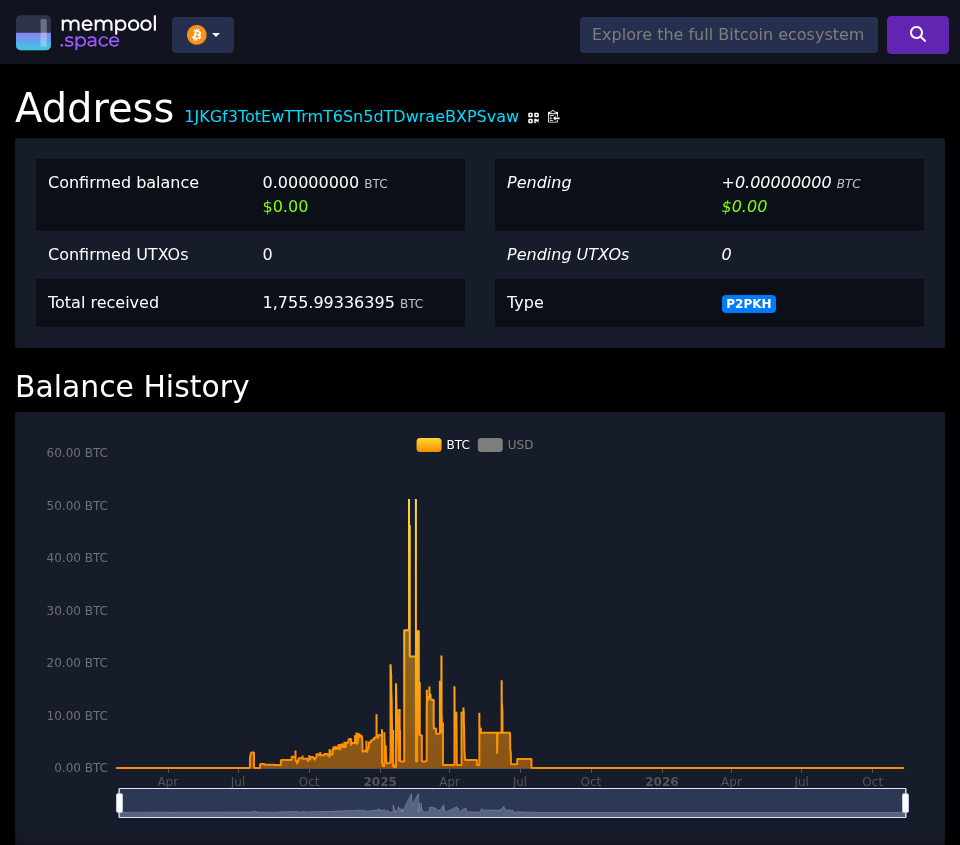
The busiest address, pictured at the top, received 1,755.99 BTC across 346 transactions, peaked near 50 BTC and made its last transaction on July 16, 2025.
That last transaction came about three months after the platform’s final archived copy, so the addresses stayed in use long after the chats went quiet.
That volume of 2,276.7 BTC exceeds $12 million unless a bitcoin is worth under about $5,300, so these addresses carried far more than the victims’ deposits.
Two of the five were active long before the companies existed: one began on October 4, 2023, 329 days before incorporation, and another on January 25, 2024, 216 days before.
Of the other three, the two we could date began on September 19 and December 11, 2024, in step with the WhatsApp groups.
No reader can pick a victim’s share out of that traffic, so your own transaction hash and the destination address in your wallet history are the evidence to keep.
On Ethereum we checked the four 0x addresses. Two show no transactions at all, the others show 214 and 248, and all four together hold about 0.0108 ETH.
Several other networks blocked our tool with a bot check or redirected it, so the quiet Ethereum addresses may be active elsewhere, and we treat the Ethereum picture as partial.
None of this proves who controls the wallets. It shows pass-through, money arriving in many transfers and leaving, which is how a collection point behaves and not a trading account.
What Happened When People Tried to Withdraw
The withdrawal story is the part of the filing to remember, because it is the point at which a paper profit turns into a real loss.
Like the section before it, this one follows the SEC’s allegations, and the quoted dates and amounts are the filing’s.
Members who tried to cash out were told their accounts were locked or frozen, then sent to a Crypto AI Service Center on WhatsApp.
On December 12, 2024, one investor who flagged unauthorized transactions was told the SEC and the MSB were investigating, which reused the regulators’ names as the excuse for the freeze.
A member who could not send more crypto was told to wire cash to US bank accounts held in the names of third parties.
The four recipients named were Flavyo Trading Corporation, Neurotech IT Solutions Inc., INTY Endless LLC and a sole proprietorship called Enjoy Time.
They were introduced as market makers or cooperative suppliers, and on January 14, 2025 one investor was coached to tell the bank that Flavyo was a cooperative supplier.
A miner’s fee was demanded by wire to Enjoy Time on February 24, 2025, from an investor who had been sent to INTY ten days earlier.
From those accounts the filing follows the cash to two entities formed in the UAE, King Cloud and Summit, and to two Chinese trading companies, Global Transline and Guangzhou Yanjin.
That makes eight named bank recipients in the filing: four American accounts that took the payments and four overseas companies that received them next.
When members pressed for answers, the personas and the service center all stopped responding, which is where the fee demands end and the losses become permanent.
If you were ever coached on what to tell your bank, treat that as the clearest sign that someone expected the bank to object.
Who Is Behind Cryptoaiml?
The two companies named in the court papers
The SEC sued Cryptoaiml Ltd., a New York corporation incorporated on August 28, 2024, and Cryptoaiml Capital Foundation, a Colorado nonprofit corporation formed on August 24, 2024.
The filing gives the owners of both as persons unknown, and the Form D listed an officer called James Peat who does not appear to exist.
The case names no individual, so there is no named person to ask for a refund, and nothing in the filing promises victims any money back.
Addresses and registrations that lead nowhere
Cryptoaiml Ltd. listed 66 Hudson Boulevard East in New York and the foundation 675 15th Street in Denver, and per the filing neither did business at its listed address.
We did not visit either address or search the New York and Colorado business registers, so we cannot tell what sits at those streets or who filed the formation papers.
The Form D is titled in the filing a Notice of Exempt Offering of Securities. It is a notice the company files about itself, not a grant of approval.
The domain and its second life
The domain cryptoaiml.vip is registered through CommuniGal Communication Ltd., with the registrant country listed as Cyprus and name servers at emu-dns.com.
The registry dates the current registration to February 21, 2026, 317 days after the last archived copy, so the name lapsed and was registered again after the chats went quiet.
Its record was last changed on July 2, 2026 and now runs to February 21, 2027. We cannot tell whether the same hands hold it.
Every request we made to cryptoaiml.vip, including the www version, returned a redirect to surveymrs.com, and we did not follow it.
Our first probe of the same address went through a numbered subdomain with a token in the link and ended in an error 401, so the destination changes.
The redirect also sets an identifier cookie dated to last until 2094, and surveymrs.com was itself registered on October 15, 2026, 16 days after the SEC’s filing.
Anyone searching the name today will probably meet this redirect, and we recommend against opening it, because we did not test where it leads.
What we could not confirm
We could not read the old site’s text, search the business registers or the FinCEN list, or see activity on blockchains beyond Bitcoin and Ethereum, so those gaps stay open.
The filing is an allegation, and no court has decided any part of it. Neither defendant has answered in public that we could find.
How the Cryptoaiml Scheme Works
Step 1: An invitation to a private group
The groups were joined through invitation links shared with individual investors, so the first contact was a personal message and not an advertisement.
An unsolicited invitation to a group led by a famous investor is the tell, because real advisers do not recruit through links sent to strangers.
Step 2: A famous name and a real biography
The personas wore the names and career histories of real professionals at Raymond James and Citadel Securities, so a search of those names returned true results.
One agreement even pointed clients to the SEC’s adviser database, where the real adviser’s record would appear, so verify the channel that contacted you and not just the name.
Step 3: Regulators as props
The MSB and SEC tabs, and chat messages calling the platform certified by both, turned the regulators’ names into marketing.
The SEC’s own press release advises verifying any assertion of SEC registration or certification instead of accepting it.
Step 4: A balance that only rises
After the first deposit the dashboard showed growing profits from signals the members followed, while staged praise and a VIP tier pushed them to add principal.
The VIP offer paired better signals with a promise that losses would be covered, which is the combination that makes a victim deposit more.
Step 5: A deposit to an address someone else controls
Agents handed members wallet addresses, and the coins moved across blockchains within days, sometimes in under 24 hours.
A real exchange keeps customer assets under its own custody and shows a verifiable record, so a personal wallet address given in a chat is a warning on its own.
Step 6: The unlock fee
The exit led through a service center, a freeze story and a demand for more money by wire or crypto, and then silence.
No honest platform charges a fee to release your own balance, so the first request for one is the moment to stop and keep your money.
What to Do If You Deposited or Paid Fees
-
Stop paying. Send nothing more to Cryptoaiml, a service center or anyone offering to release your balance, because unlock fees were where, on the SEC’s account, more cash vanished.
-
Keep every record. Export the WhatsApp chats and save wallet addresses, transaction hashes, wire confirmations and balance screenshots before anyone deletes them.
-
Call your bank today. If you wired money, ask for the fraud department, give the recipient names and ask whether a recall or a fraud alert is still possible.
-
Dispute card payments. If a card funded any of it, send the issuer a dispute letter within 60 days of the statement that shows the charge.
-
Tell your exchange. If you sent crypto from an exchange, flag the transfer and the receiving addresses, because crypto payments typically are not reversible unless the recipient returns them.
-
Tell the authorities. File with the SEC, the FBI’s IC3 and ReportFraud.ftc.gov, citing SEC v. Cryptoaiml Ltd., No. 1:26-cv-08508.
-
Refuse recovery offers. Anyone who contacts you offering to retrieve the money for an upfront fee is running the next stage of the same game, so pay nothing.
-
Ask a professional. If you sold stock or drew on a 401(k) to fund this, ask a tax professional about reporting the loss and your plan provider about withdrawals.
Frequently Asked Questions
Is Cryptoaiml a scam?
The SEC alleges a confidence scam with no real trading, and nothing we checked points the other way, although no court has ruled, so do not deposit.
Is cryptoaiml.vip still working?
No trading site loaded for us. The address forwards to surveymrs.com, registered in October 2026, and we did not follow it, so we advise against opening it.
Did the SEC certify the platform?
No. The filing treats the certification messages as false, and the Form D behind the site’s SEC tab, filed with fabricated details, has since been removed.
Can I get my money back?
Nothing in the filing promises refunds. The owners are unknown, the money moved abroad and the SEC seeks disgorgement, so file quickly but do not count on recovery.
Were Raymond James and Citadel Securities involved?
The SEC alleges neither firm was involved or authorized the use of its name, and that the personas borrowed real professionals’ names and, in one case, a copied biography.
Were the AI trading signals real?
The SEC alleges no trading took place and the signals and profits were invented, including a 98% accuracy boast, so treat the signals as bait and not as a product.
The Bottom Line
Do not deposit with Cryptoaiml or any chat-group platform like it: the court papers allege invented profits, regulator tabs that certified nothing, and a withdrawal step that takes more money.
If you want crypto exposure, buy it yourself on an exchange you chose, and check any adviser at Investor.gov by typing the address yourself, never from a chat link.
If you already paid, stop all payments, keep your records, call your bank, tell the SEC, IC3 and FTC, and ignore anyone offering recovery for a fee.

Join the discussion
0 commentsShare your experience or ask a question about this article.
Discussion
Start the conversation
Have a question or something useful to share? Add the first comment.