

The account dashboard says your investment is growing. Every time you check, the balance is higher, and the person who introduced the site encourages another deposit.
The first real test comes when you ask to take money out. Across a documented network of fake crypto investment platforms, that moment changed the conversation.
Overview
The platform displays profits it does not have to pay
Fake crypto investment platforms can show a convincing account balance, transaction history, and rising chart without holding the assets those numbers imply.
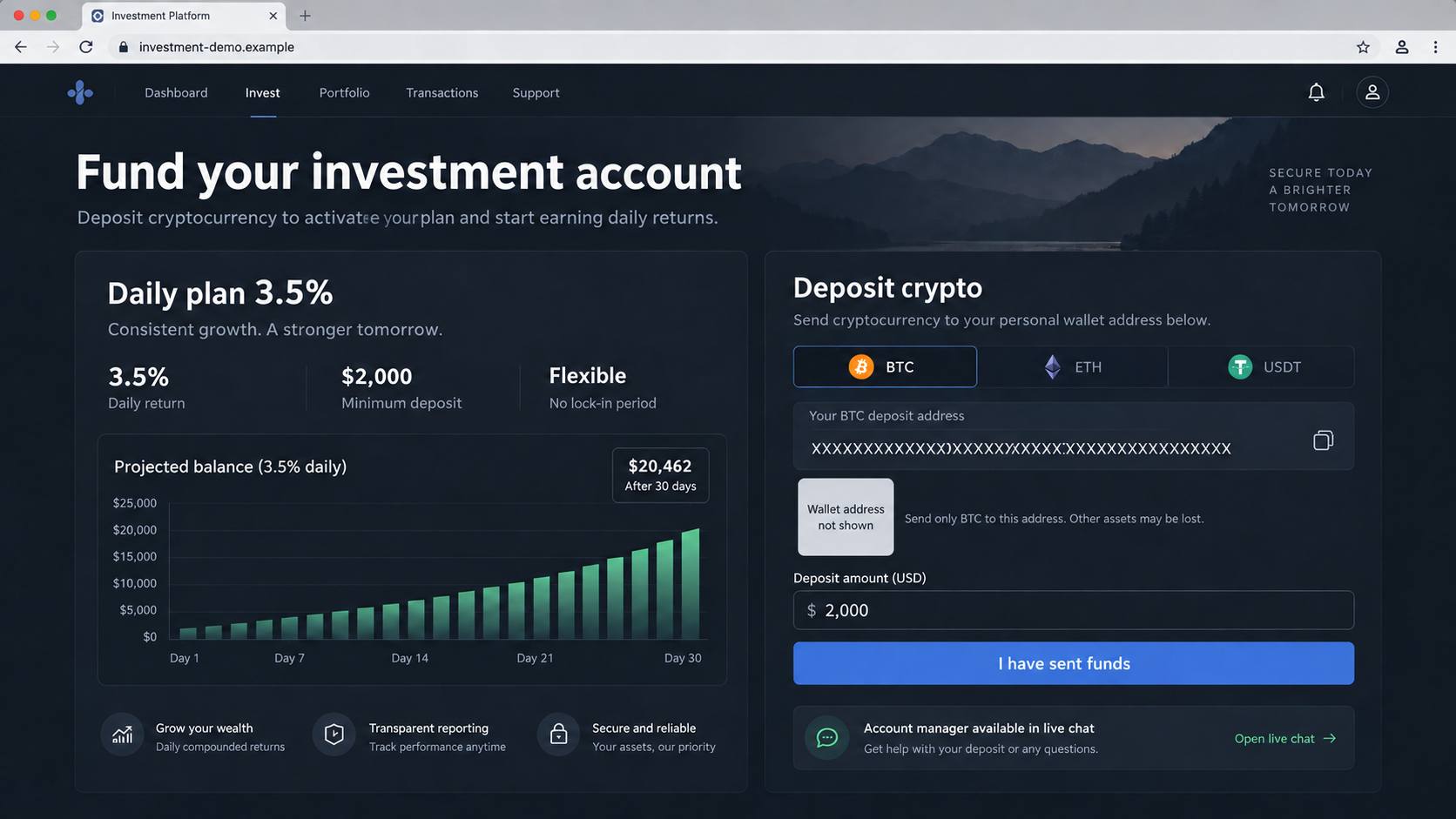
The image above is a fictional reconstruction using an example domain and no usable wallet address. It illustrates a deposit screen, not a captured platform.
In the investigated network, sites promoted implausible daily returns, took crypto deposits, and then imposed obstacles when people tried to withdraw.
Some schemes allow a small early withdrawal to build trust. A successful small payout therefore does not verify that a larger displayed balance exists.
One confirmed site connected to many more
Group-IB’s May 2026 investigation identified one confirmed fake platform sharing contact details with 23 other fraudulent investment sites.
The same confirmed platform shared a hosting IP address with 208 additional domains. Shared hosting is a lead for investigation, not independent proof against every neighbor.
Researchers traced more than $90,000 in on-chain deposits to the confirmed platform. That amount concerns one site, not verified losses across the whole cluster.
The report also extrapolated a far larger network estimate. We are not presenting that estimate as money independently observed to have been stolen.
The exit route becomes a fresh payment demand
When a customer requests a larger withdrawal, the site can invent taxes, compliance charges, account upgrades, or technical holds that require another payment.
A later “recovery” offer may demand a further upfront fee to retrieve the lost funds. That can be another stage of the same deception.
- A social ad, search result, referral, or online relationship points toward the site.
- Polished pages promise unusually strong or steady returns.
- The visitor sends crypto to an address chosen by the operator.
- The account shows gains that may be nothing more than editable numbers.
- A withdrawal request produces new fees instead of the advertised payout.
The core warning is not that crypto investments can lose value. It is that a fabricated platform can show profits while refusing the withdrawal it promised.
Why an Impressive Dashboard Is Weak Evidence
A dashboard is a website. Whoever controls its database can choose what balance and return it displays, even if no trading occurred.
That is why a smooth chart does not prove your deposit was invested. It may simply be a graphic calculated from an invented rate.
The investigated sites used polished layouts, apparent customer numbers, and activity feeds. Such features can make an unregulated operation look mature.
Some copied the language or identity of real financial services providers. A copied registration number does not give the copycat the real firm’s license.
When a platform says it is regulated, look up the entity yourself in the relevant regulator’s register. Compare the exact legal name and authorized website.
A matching name is not enough if the web address and contact details differ. Impersonators often borrow the part of a registry entry people recognize.
Beware of “daily” returns presented as steady and routine. Markets do not produce guaranteed high gains on a schedule just because a website promises them.
The United States SEC’s investor education office warns that fake platforms can show invented profits and even allow small withdrawals to build trust.
That warning is broader than this specific network, but it explains why one successful test payment does not settle the question.
Only a completed withdrawal to an account you control establishes that a specific amount left the platform. Even that does not validate future balances.
How the Fake Crypto Investment Platforms Scam Works
Step 1: The operator finds people already open to investing
According to Group-IB, visitors reached the investigated platforms through search, social advertisements, referrals, or relationships built online.
These routes create different kinds of trust. A search result suggests popularity; a social ad suggests visibility; a friend or romantic contact offers personal reassurance.
None proves who runs the investment site. The person recommending it may be part of the operation or may also have been deceived.
Some pitches begin with a small deposit and a friendly account manager. The small start lowers resistance to the first transfer.
Record where you first encountered the site. That trail can help investigators connect an ad, profile, and platform after pages disappear.
Step 2: The website turns trust into a crypto deposit
The site presents investment plans, expected returns, and sometimes supposed regulatory details. It asks the visitor to create an account and fund it.
A “know your customer” form may collect identity documents. On a fake platform, that step can double as personal-data harvesting.
The deposit often goes by cryptocurrency. Once sent to an address controlled by another party, it generally cannot be reversed like a routine card charge.
Be especially careful if an agent tells you to buy crypto at one service and then send it to a wallet shown by the investment site.
The first service may be entirely legitimate. The fraud occurs when you voluntarily transfer assets from it to the operator’s chosen address.
The generated deposit image uses an unreadable placeholder address. It does not display a real wallet and should not be treated as transaction evidence.
Step 3: The balance grows on screen
After deposit, the dashboard reports gains, often with smooth charts and recent activity. Those elements can be controlled by the same operator taking deposits.
Someone may urge you to compound the apparent profit or upgrade into a higher tier. That request can turn an initial loss into a larger one.
If an early withdrawal succeeds, it may be deliberate. The payment can persuade a person to deposit far more than the operator paid back.
Do not use the screen balance alone to calculate your available funds. Compare actual deposits and actual withdrawals in your independent records.
A site that updates perfectly each day but cannot explain where returns come from deserves scrutiny, not another transfer.
Step 4: A withdrawal triggers a new condition
The most revealing moment is the request to withdraw a substantial amount. The platform may suddenly demand a tax, verification fee, or compliance release payment.
Group-IB documented that obstruction pattern across the sites it analyzed. A new condition often appears after the prior one is paid.
A real tax obligation is not normally settled by sending a fresh crypto transfer to an account manager’s wallet before your own funds are released.
Do not accept a dashboard warning as independent legal advice. It is text written by whoever controls the same site that is blocking you.
The SEC warns that bogus withdrawal taxes and fees are an advance-fee fraud pattern on fraudulent crypto trading websites.
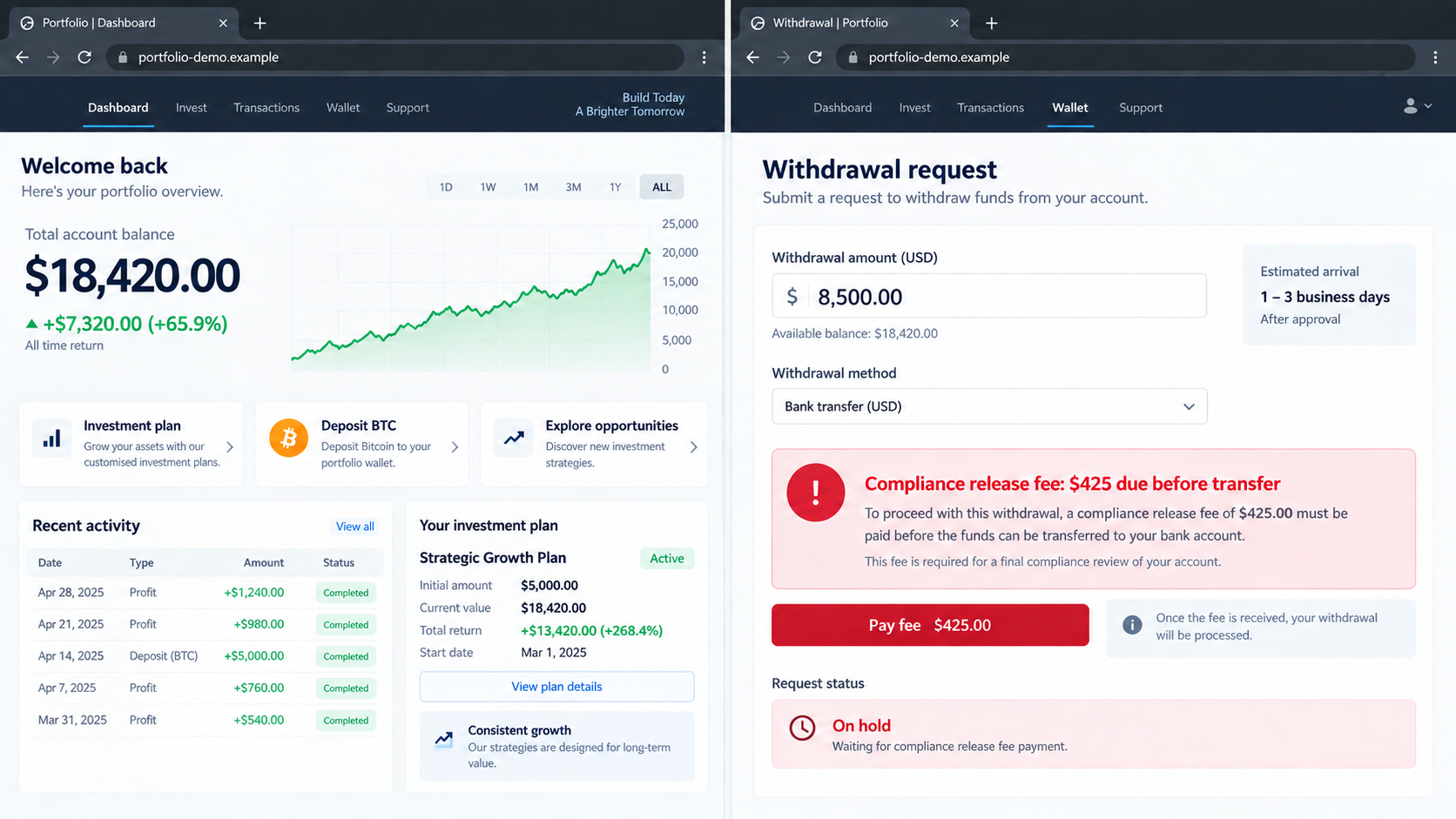
This second image is also a fictional reconstruction. It illustrates the observed sequence; its balance and fee are invented and belong to no real victim.
Step 5: The failed investor is offered another supposed solution
When the platform vanishes or refuses to pay, another contact may claim to trace the funds and recover them for a fee.
Group-IB identified that follow-on risk in its investigation. A recovery service asking for crypto upfront is not evidence that it can reach the original deposit.
The SEC’s victim resources warn that fraudsters can impersonate regulators, lawyers, or recovery agents and demand money or wallet keys.
Keep private keys and recovery phrases secret. No genuine investigator needs those to receive a report about a transaction.
Report the first fraud through official channels even if the operator claims the case is confidential or already handled by a private recovery team.
What the Network Numbers Actually Mean
Large figures attract attention, but they are easy to misunderstand. Group-IB tied one confirmed fake site to other sites through contacts and shared hosting.
Twenty-three additional platforms shared contact information. That is a stronger operational link than a domain merely occupying the same hosting address.
The 208 further domains shared an IP. Shared infrastructure is useful investigative evidence, but it is not a verdict on each domain in isolation.
On-chain deposits exceeding $90,000 were observed for the confirmed platform. That is a traced amount in the report, not a full accounting of all victims.
Group-IB estimated that the wider connected network could have generated approximately $187 million by extrapolating from that one platform.
An extrapolation is not a ledger of verified losses. We deliberately keep it out of the headline and do not describe it as confirmed stolen funds.
This caution does not soften the real finding: the analyzed platform was fraudulent, and its operating patterns are dangerous to anyone considering a deposit.
It also prevents guilt by hosting association. A domain on a shared server needs its own evidence before being accused of defrauding investors.
How to Check a Platform Before Sending Crypto
Search the operator’s exact legal name in the financial regulator’s register for your country. Use the regulator’s own website, not a link provided by the platform.
Compare the registered website, telephone, and address with the page asking for deposits. Impersonation often shows up in those mismatches.
Read the promised return in plain terms. An unusually high daily rate with little stated risk is a reason to stop and seek independent advice.
Do not let an online acquaintance choose an investment for you merely because they show account screenshots. Screenshots can be created or altered.
Look for an identifiable custodian, withdrawal terms, and credible independent records. A live-looking activity ticker on the platform itself is not independent.
Ask why a supposed regulated investment firm requires crypto transfers to a wallet address instead of a traceable account in the firm’s legal name.
A real firm can still use digital assets, but the burden of proving identity and authorization remains on the firm asking for your money.
If you cannot verify that identity without using contact information supplied by the promoter, do not deposit while the questions are unresolved.
What to Do if You Have Fallen Victim to This Scam
- Stop sending crypto immediately. Do not pay an unlock, tax, verification, or recovery fee to the platform or an associated contact.
- Preserve transaction evidence. Save wallet addresses, transaction hashes, exchange receipts, chats, ads, emails, and screenshots of the displayed balance and withdrawal demand.
- Contact the exchange or service you used. Report the receiving address and ask whether it can flag related accounts. Do not expect an automatic reversal.
- Report the fraud to authorities. Use the appropriate financial regulator and cybercrime reporting channel in your country. In the US, the SEC and FTC offer reporting routes.
- Protect identity information. If you uploaded documents, ask local identity-protection services what monitoring or replacement steps are available.
- Secure any reused credentials. Change passwords from genuine sites, review sessions, and protect email first because it can be used to reset other accounts.
- Check for a secondary compromise. If the promoter made you install software or a browser extension, run Malwarebytes. AdGuard can help reduce malicious-ad exposure, but neither retrieves crypto.
- Reject paid recovery claims. Do not share a wallet seed phrase, private key, or upfront fee with anyone claiming to retrieve the deposit.
A person who merely visited the site should not follow its deposit instructions. If no personal data or money was sent, focus on avoiding later contact.
If you have already paid one withdrawal fee, stop before the next request. Each new condition can be another attempt to increase the loss.
Take copies of evidence now, while the website and chats still load. A disappearing page does not mean a report is pointless.
Frequently Asked Questions
Does a rising balance prove my crypto was invested?
No. The operator can edit a website’s numbers. Verify actual assets and completed withdrawals independently of the platform’s dashboard.
What if I withdrew a small amount successfully?
That does not validate the larger displayed balance. Fraudulent platforms may allow a small payout to encourage a much larger deposit.
Should I pay a tax or compliance fee to release funds?
No. A fresh upfront payment demanded by the same site blocking your withdrawal is a documented advance-fee fraud warning.
Are all 208 domains in the report proven scam sites?
No. They share a hosting IP with a confirmed fake platform. Shared hosting alone does not establish what every individual domain did.
Was $187 million independently confirmed stolen?
No. That was Group-IB’s extrapolated estimate. Its traced on-chain deposits exceeded $90,000 for one confirmed fake platform.
Can a recovery company guarantee the crypto comes back?
No. Be suspicious of upfront fees and requests for wallet keys. Report through official channels and discuss realistic options with trusted professionals.
The Bottom Line
Fake crypto investment platforms can print attractive gains on a screen, then demand new money when you ask to withdraw. The extra fee is part of the warning.
The evidence supports a confirmed deceptive platform and a wider connected infrastructure, not a verified loss figure for every domain. Stop paying and preserve the trail.

Join the discussion
0 commentsShare your experience or ask a question about this article.
Discussion
Start the conversation
Have a question or something useful to share? Add the first comment.