


AdSelect users reported being asked for $10 or $12 in crypto to withdraw money they thought they had earned. If you see that request, stop. Don’t pay it.
We checked the ad-watching pitch and a written promise of free withdrawals. The key question isn’t how much your dashboard shows. It’s why someone needs your money.
Overview
Stop at the request for your money
A separate transfer to release task earnings matches advance-fee fraud. Treat it as a scam, even if the sender uses a familiar name or knows your balance.
This investigation concerns the AdSelect-branded ad-watching offer and reports of withdrawal fees in November 2026. It does not cover every unrelated ad service with a similar name.
Separate the earnings pitch from the payout claim
AdSelect Global promoted rewards for simple tasks. An AdSelect-branded FAQ separately disavowed advance payments. Neither statement shows that anyone received the advertised balance.
Distinguish a reported demand from its operator
People who tried to withdraw reported being quoted fees. We did not enter an account, send funds, or authenticate those users’ sessions.
That limits who we can blame. It doesn’t change what you should do when the screen asks you to send cryptocurrency first: leave without paying.
- Displayed rewards: Don’t treat them as income until a payment reaches your own account.
- Advance transfer: Don’t pay a supposed miner, agent, or support account to release a balance.
- Already paid: Save the transfer record and report it through your provider and local authorities.
What the AdSelect Global Channel Promoted
Step 1: Simple actions make the offer easy to try
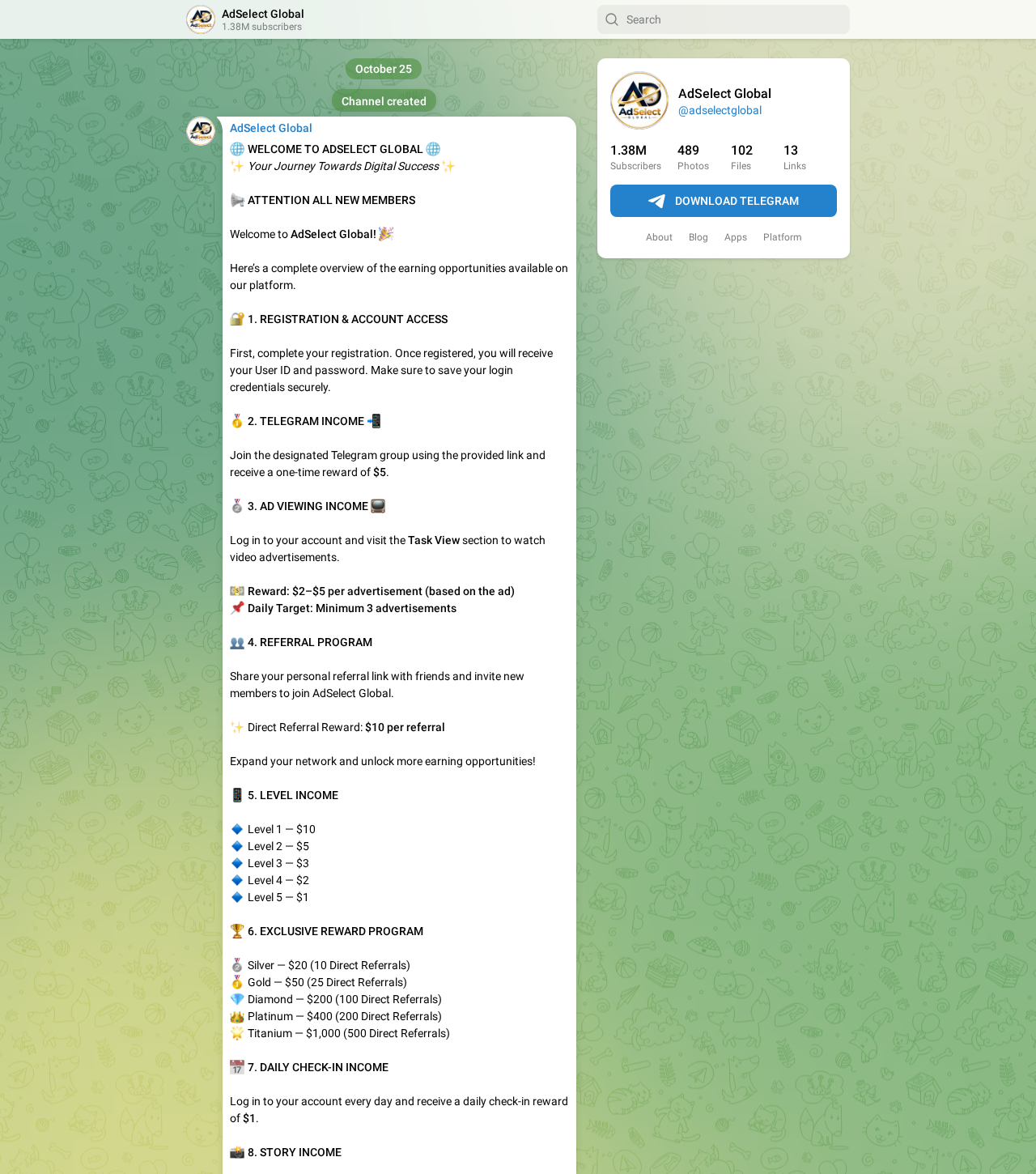
The public channel advertised rewards for watching advertisements, joining Telegram, and returning for check-ins. It advertised $2 to $5 per viewed ad and $1 for a daily check-in.
It also promoted $10 for a direct referral and additional incentives tied to the number of people brought in. These figures describe the pitch, not proven income.
People may forward an invite because they can see a balance after a small amount of work. A referral from someone you know does not prove the program paid them.
Ask what they actually received, when, and whether it arrived without a separate transfer. A friend can pass on an enticing offer sincerely without knowing how withdrawals work.
Step 2: The advertised withdrawal date gave people a reason to wait
Older AdSelect Global posts advertised withdrawals opening November 12. The channel also said free registration would end, with a $100 minimum package for new members afterward.
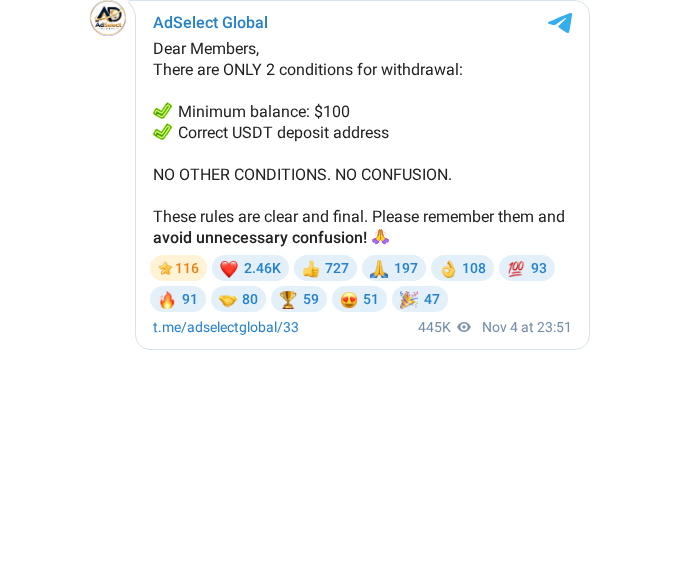
The channel set a $100 earnings threshold and said a correct USDT address was the only other withdrawal condition. It did not list a prepaid miner fee there.
These were promotional announcements. They show what the channel said would happen, not that the payout schedule or the proposed new-member package worked as described.
A shared date can make the offer feel more credible. Readers see others waiting for the same day and expect that a displayed balance will soon turn into cash.
The timing matters for another reason. A $100 package for newcomers is not the reported $10 or $12 withdrawal fee. Don’t combine different payments into a single claim.
Why the Withdrawal Fee Is the Point to Stop
Step 3: A visible balance looks like money you can spend
A dashboard can display $250, $1,200, or any other total without proving that money was set aside for you. Only a completed transfer demonstrates you received a specific payment.
An earlier small payment would not make a later fee safe. The FTC explains how initial payouts can build trust before someone asks you for a deposit.
Do not calculate the $10 as a percentage of a balance you cannot verify. Compare it with the only amount you control: the money still in your own account.
Step 4: The reported miner charge adds a new payment
In accounts reported around the opening date, the charge was described as paying a miner to process the withdrawal. Similar reports named $10 or $12.
Network costs exist for real cryptocurrency transfers. That fact does not show that an unrelated wallet address, private chat, or payment screen belongs to a network or genuine payout system.
There is a practical distinction between a disclosed charge deducted from a verified payment and being asked to originate a new transfer before an unverified balance can move.
If someone insists the money cannot come out of your supposed earnings, take that as the reason to stop. Don’t offer to pay a smaller amount as a test.
A transport problem and a payment demand are different evidence
Kenyan users also described pages that failed to load around the payout window. A broken page doesn’t prove fraud. An accessible page doesn’t prove a payout.
The payment request matters more than a timeout. An outage might explain a delay. It does not justify sending your own money to make the screen work again.
Treat a new link pitched as a fix separately. Find out where it came from without signing in. Do not enter old credentials to see whether a migrated balance appears.
If the address does not match the one in your notes, save both addresses in your private evidence. Do not tell family members to move their accounts there.
A website can accept a sign-in for reasons other than restoring access. If you already reused your password on the replacement page, change it on legitimate accounts.
Which AdSelect Page Made Which Claim?
Different public channels
The public Telegram channel used the name AdSelect Global. The trust page at adselect.org listed adselect.net and a different Telegram channel as its own official routes.
What the trust page and terms actually say
That trust page said users should not pay to earn or withdraw. The FAQ published alongside it reported a 0% withdrawal fee. These were the site’s own claims.
In contrast, the site’s general terms allowed for fees on a specific service if displayed before confirmation. That is not proof that the reported miner fee was a permitted charge.
We did not confirm common control of both channels, authenticate every fee prompt, or verify the websites shared by all users. Keep the source of each claim attached to it.
It also doesn’t follow that a site calling itself official is safe. Don’t use a trust page to sign in, download software, or send payment to settle a disagreement.
The overlap we could document
Both the AdSelect Global announcement archive and the adselect.org trust page referred readers to a support bot with the same handle. That is overlap worth noting, not ownership proof.
The AdSelect-branded homepage gave $50 as a minimum, while AdSelect Global promoted a $100 threshold for the November opening. The common support handle does not explain the difference.
Ownership remains unresolved
Don’t assume a support bot represents whoever sent your payment prompt. If your report goes to authorities or a provider, label what you saw and where.
For example, “I saw this account post the schedule” is different from “I sent money to a wallet they controlled.” Record the first without asserting the second.
How to Read an AdSelect Withdrawal Screenshot
- Separate the balance from the demand. Record what the app says you earned and exactly what you are being asked to pay out of pocket.
- Record the route. Note the page or account name and whether the request came from inside the dashboard or arrived later in a private channel.
- Keep the timing. Preserve the date and time of the prompt and any last-minute instructions. Do not crop away context in your private copy.
- Protect sensitive details. Don’t post your login, verification code, personal details, wallet recovery phrase, or complete financial record to ask a group for help.
- Leave the payment unfinished. Evidence is useful without proving whether a deposit works. Don’t send someone a reversible-looking test amount.
Withdrawals discussed publicly involved different balances and fees. Those were examples from individual accounts, not an average, payout forecast, or verified loss tally.
Look at what the screen asks you to do next. If the next step is funding a new transfer, a different amount or label doesn’t change the risk.
Likewise, a group screenshot saying a member got paid does not show whether the transaction belongs to that member, whether it cleared, or whether they had to fund another transfer.
If somebody offers a screenshot showing your own payout, check the incoming balance in the service you already use. A picture of a transfer is not receipt of funds.
Keep the recipient identifier visible in your private copy of the request. That is more useful to fraud teams than just the number on the dashboard.
What to Do If You Already Acted
If you registered but did not pay
Leave the withdrawal flow. Don’t complete additional tasks to reach a higher minimum, and stop sharing referral links until the people you invited know what to watch for.
If you reused the same password on another service, change it there, starting with your email and financial accounts. Enable two-factor authentication and check for unfamiliar sessions.
If you only read a public page and did not install anything or share credentials, a withdrawal scam allegation by itself isn’t a reason to reset your device.
If you sent crypto or paid someone to send it
- Stop any further payments. Ignore a second request described as verification, a corrected network charge, or money that will be returned with the withdrawal.
- Save your transfer details privately. Keep the transaction ID, amount, token, network, recipient, and relevant screenshots or messages.
- Contact the payment service through its own app or site. Ask its fraud team about preservation, tracing, and whether any response is possible. Recovery is not guaranteed.
- Report locally. In Kenya, report to your nearest police station or Directorate of Criminal Investigations office. In the United States, report to the FTC.
If mobile money or a bank transfer funded the crypto purchase, call that provider too. Explain who received each payment rather than describing everything as one card charge.
Use the transaction ID from your own wallet or provider, not a success notice the recruiter sent you. A genuine record helps support identify the correct transaction.
Be wary of anyone who promises to reverse an on-chain transfer for another fee. Avoid sending recovery agents your seed phrase, verification code, or access to your device.
If you paid through a local intermediary, keep both your receipt to that person and the transfer details they provided. The records may show separate recipients and dates.
Tell the provider what happened before deleting your messages. Save the original chat and payment notices privately, then use the platform’s reporting controls to flag the account.
If someone had access to your accounts or device
If you sent a login code or saw an unfamiliar sign-in, secure the affected account from a trusted device. Treat the group chat’s reassurances as unverified.
If you shared a wallet recovery phrase, get official wallet-provider guidance immediately from a trusted device. Resetting your AdSelect password cannot protect a wallet with an exposed recovery phrase.
If you installed an untrusted app or allowed remote access, disconnect the affected device and get trusted help checking it before signing into financial accounts again.
If you sent an identity document, note exactly which one. Consider notifying the issuing authority or relevant financial providers and watch for accounts being opened in your name.
What to Tell People You Referred
Warn people where you shared the invite. Give the name they recognize and tell them not to fund a withdrawal or send account details to a supposed administrator.
Don’t claim you recovered funds or prove other people lost money if you don’t know. A simple warning about the advance payment gives them enough to act.
Our merchant assistance task-scam investigation shows a different recruiting pitch and the same decision at withdrawal: whether to spend your own money to access supposed earnings.
Let people who see a new domain know that it doesn’t resolve the original discrepancy. A balance displayed under a second address is still not money in their possession.
If you recommended the offer because registration was free, correct that impression explicitly. Starting without a payment doesn’t mean a later request is either normal or worth testing.
Frequently Asked Questions
Is the AdSelect $10 or $12 miner fee legitimate?
Do not pay an upfront crypto transfer to release the balance. The reported demand matches advance-fee fraud, even if you cannot identify who controls the screen.
Did all AdSelect accounts charge people to withdraw?
We found user reports, not account-wide data. An AdSelect-branded FAQ claimed withdrawals were free. Neither source identifies the operator behind every fee request.
Does a number on my dashboard prove AdSelect can pay me?
No. It shows what the dashboard displays. It doesn’t show whether the operator holds funds for your payment or whether they will send them.
Is the $100 package the same as the miner charge?
No. The $100 package appeared in a separate announcement about prospective new members. Reports of $10 or $12 concerned people attempting to withdraw.
Can I get a crypto withdrawal fee back?
Contact the service you used as soon as possible and keep the transaction details. Completed cryptocurrency payments typically can’t be reversed, and recovery promises can be another trap.
Do I need to reset my phone if I only viewed the offer?
No, not solely for viewing the offer. Escalate if you installed something, shared login or payment information, or granted someone access.
The Bottom Line
AdSelect Global pitched easy income from ordinary online activity. The part you can act on is a demand for fresh crypto to release supposed earnings.
Keep your own money, save any evidence you already have, and tell people you referred. If you paid, report the transfer now rather than waiting for another payout date.

Join the discussion
0 commentsShare your experience or ask a question about this article.
Discussion
Start the conversation
Have a question or something useful to share? Add the first comment.