


A monthly investment email arrives with another reassuring update. Over time, those messages become the history you remember when the manager introduces a new fund.
The Superstars Fund case shows how that familiar stream of news can influence a fresh decision, even after the earlier investment has already disappeared.
Overview
An empty crypto fund continued reporting growth
Luciano Schipelliti created the Superstars Fund in 2018 and raised roughly $275,000 for cryptocurrency investments. By 2019, he had lost all that money.
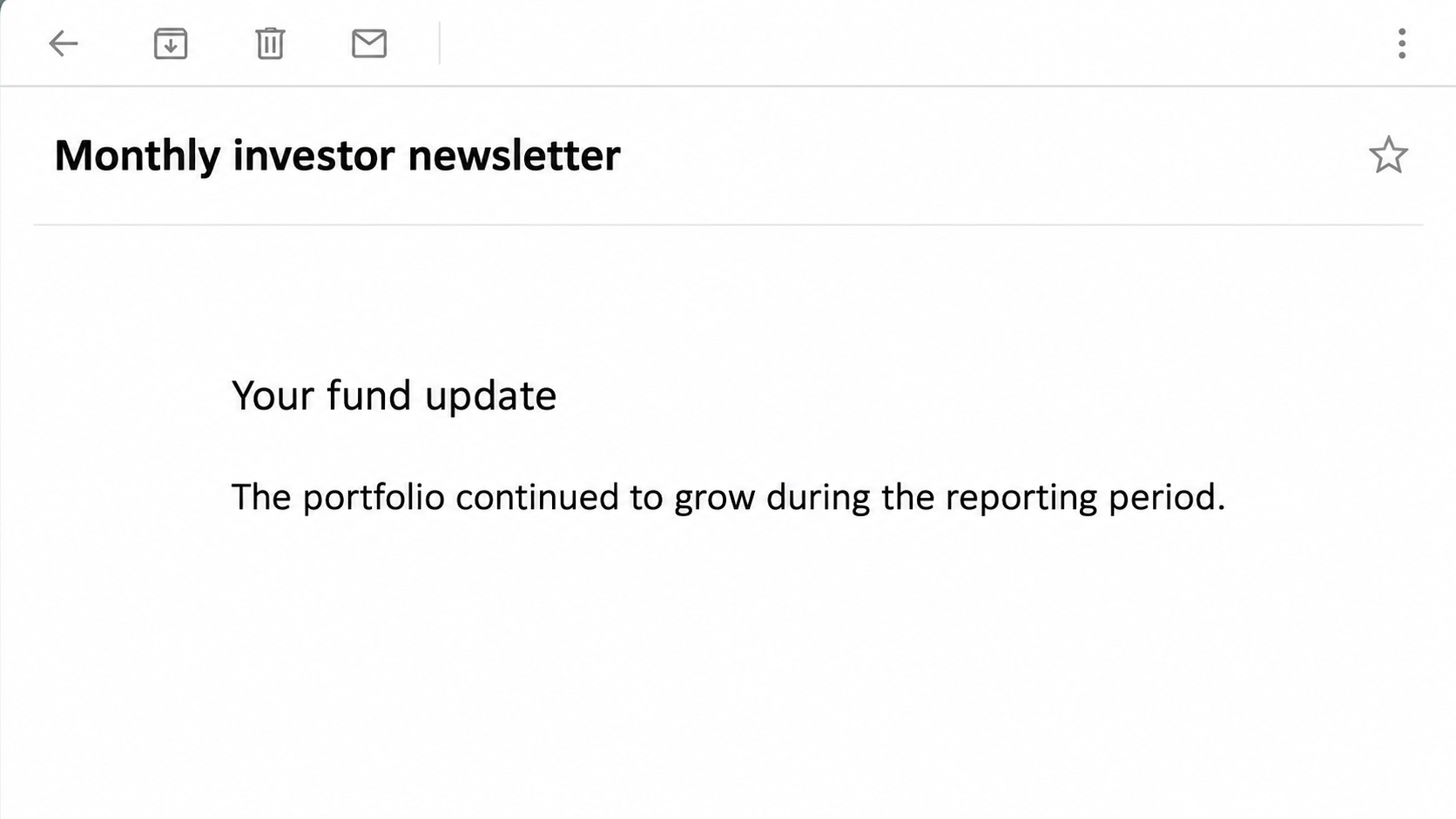
Investors were not told their money was gone. Beginning around November 2020, monthly newsletters falsely described the fund as continuing to increase in value.
That fictional performance history helped him launch the TTM Fund around February 2021. The new fund raised approximately $350,000, which was lost by September 2021.
A guilty plea established the deliberate deception
Schipelliti pleaded guilty to wire fraud in April 2026. He received a prison sentence of one year and one day in August 2026.
The DOJ’s sentencing announcement also records a $350,000 restitution order. It distinguishes the fraudulent fundraising from the broader total of client money managed and lost.
- The original fund’s money was gone before the false newsletters began.
- The newsletters portrayed continuing growth rather than disclosing the loss.
- That misrepresented history supported fundraising for a separate crypto fund.
- The new fund also lost its money, with some uses inconsistent with its agreement.
The warning concerns fabricated history, rather than crypto losses alone
An investment can fail without involving fraud. The confirmed wrongdoing here involved concealing the earlier loss and using false performance reports to obtain more investor money.
The published account does not establish a current offer, specific exchange, promised return rate, or complete investor count. Those details should not be invented.
The lead email illustration is a reconstruction of a false-growth update. It is not one of the newsletters recovered in the criminal case.
Why a Familiar Newsletter Can Become a Sales Pitch
A regular update can feel different from an advertisement. It appears to explain an investment you already hold, rather than ask you to buy something new.
Repeated delivery can build a sense of continuity. The manager seems present, the fund seems active, and the information arrives without you having to request it.
That routine can become persuasive when the same manager introduces another opportunity. You may feel that you already know the person’s results.
But familiarity with the communication is not the same as confirmation of the performance. Receiving twelve updates does not create twelve independent checks.
In this case, the reported growth concealed an earlier total loss. The history available to investors differed fundamentally from the actual condition of their money.
The new fund therefore arrived with a reputation built from false information. A fresh name did not create a fresh, independently established track record.
For readers considering another investment from a familiar manager, the key question is what supports the old results, rather than how often those results were repeated.
A genuine answer should connect the claim to records and explain the complete period. It should not depend on selecting only the updates the manager wants remembered.
How the Superstars Fund Newsletter Scam Works
Step 1: An initial fund establishes the relationship
Schipelliti launched Superstars Fund in the fall of 2018 to invest in cryptocurrency. He raised approximately $275,000 from investors.
That first investment gave him an existing audience and an apparent investment history. Subsequent communications could be interpreted as updates on an established relationship.
The source does not identify every recruitment channel or describe every investor’s circumstances. There is no basis to invent a social-media campaign or private messaging group.
What matters is the relationship between the original money, the later reports, and the decision to raise another fund using that reported history.
Step 2: The original investment is completely lost
By 2019, bad investments had exhausted the Superstars Fund. Schipelliti did not tell investors that all the money was gone.
That undisclosed loss changed the meaning of everything reported afterward. An investor could not fairly evaluate continuing growth without knowing there was no remaining fund money.
Ordinary volatility does not explain the omission. A portfolio fluctuating in value is a different situation from one whose entire investment has already been lost.
The truthful starting point for any subsequent discussion would have been that loss, including what happened and what assets, if any, remained available.
Step 3: Monthly emails replace the missing financial reality
Beginning around November 2020, Schipelliti sent newsletters falsely reporting that Superstars Fund continued growing. The updates gave investors a reassuring account unsupported by the actual balance.
The chronology matters because the money was already gone. These were not simply optimistic comments issued before an unexpected downturn.
A newsletter can describe trading activity, market opinions, or strategy without proving that investor assets exist. Readers should not confuse explanatory writing with independent account evidence.
If an update gives a performance claim, ask what exact period, account, and calculation support it. The answer should remain understandable outside the manager’s narrative.
Step 4: The fabricated track record supports a new fund
Around February 2021, Schipelliti launched the TTM Fund based on the misrepresented performance of Superstars Fund. It raised approximately $350,000 for cryptocurrency investments.
This is the central connection between the two funds. False information about an earlier investment was used to support a separate decision to provide new money.
A new agreement may describe a different vehicle, but it does not correct a false account of the manager’s previous results.
Before reinvesting with someone, separate what you know from what they have told you. An old statement becomes consequential again when it is offered as a qualification.
Step 5: The second fund also loses its money
By September 2021, all the TTM Fund’s money was lost. The charging documents also described some uses inconsistent with its operating agreement.
Most of that fund’s money was lost through cryptocurrency investing, according to the sentencing account. It should not all be described as money personally pocketed by Schipelliti.
The criminal case ultimately concerned fraudulently obtaining $350,000. The combined amount managed and lost across both funds was greater than $600,000.
Those figures describe different parts of the story. Combining them into a larger restitution claim would give affected readers an inaccurate impression of the court’s order.
Superstars Fund and TTM Fund: Follow the Money Separately
The earlier fund supplied the supposed reputation
Superstars Fund was the original cryptocurrency investment. Its loss came before the false monthly reporting that later made its history look successful.
Anyone reconstructing their own experience should retain the original agreement and contribution records. They establish which investment the newsletters were supposed to describe.
Keep later claims about that fund with the original records. The gap between the actual investment and the claimed result is central to the deception.
The new fund involved a separate contribution decision
TTM Fund raised its own approximately $350,000. Its name should not disappear into a general description of everything as one crypto account.
For affected investors, separate records make it easier to explain when money was provided, which agreement applied, and which performance claims influenced the decision.
A statement about one fund should not automatically be treated as a statement of assets in the other. Request that distinction whenever a manager discusses combined results.
The operating agreement controlled permitted uses
The DOJ account notes that some TTM money was used inconsistently with its operating agreement. That is another reason the actual agreement matters.
An operating agreement describes the arrangement investors entered, rather than simply serving as formal decoration. Preserve the version you received and any later changes.
If a manager proposes a different use of funds, compare it with that document and obtain qualified advice. A friendly explanation does not automatically amend your rights.
Current balances need records beyond a newsletter
The published case does not identify every custodian, wallet, or exchange used. Do not fill those gaps by assuming a particular platform was responsible.
For any similar investment, ask who holds the assets and who independently checks the reported balance. Identify the records you are actually entitled to receive.
An unanswered custody question is a reason to stop a new contribution. It is not a reason to send more money in exchange for promised access.
Reading a Track Record Without Accepting Its Story
Begin with the dates rather than the headline return. A manager should be able to explain when the strategy started and which periods the claim covers.
Ask whether the reported performance belongs to the fund offered, another fund, a personal account, or a hypothetical strategy. Those histories describe different kinds of experience.
Next, distinguish contributions from investment gains. A larger fund balance can reflect new deposits, while a growing newsletter audience says nothing about assets.
Find out whether returns include fees and expenses and whether losses appear in the same presentation. Selected favorable periods can give an incomplete account.
The SEC’s bulletin on private placements recommends considering financial statements, independent auditing, management history, and the intended use of the money.
It also explains that a Form D filing does not represent SEC approval. A filing or official-looking record cannot certify a newsletter’s performance claims.
Check the manager’s professional background independently, using the relevant regulator’s records. Match the person’s identity and business rather than trusting a document forwarded by the promoter.
Then return to the investment itself. A genuine identity is useful, but it does not replace confirmation of assets or an honest explanation of earlier losses.
Finally, give yourself permission to decline the new fund. Having invested before does not create an obligation to provide more money to the same manager.
What to Do if You Have Fallen Victim to This Scam
-
Pause further contributions and do not roll money into another vehicle based on the same disputed history. Preserve the new solicitation without accepting it.
If you recently sent money, notify the institution that processed your payment. Provide the transfer reference and receiving details, then ask what intervention remains available.
Do not delay that call while waiting for the manager’s next newsletter. A future explanation cannot preserve a payment option that has already expired.
-
Build a chronological file containing contributions, withdrawals, agreements, and newsletters. Keep Superstars Fund records separate from TTM Fund records.
Save original emails with their available sender and delivery information, not just cropped screenshots. Retain attachments in their original form as well.
Note which update or claim influenced each additional investment. This connects the false history to your own decision without guessing what other investors received.
-
Prepare a simple accounting of money you actually provided and money you actually received. Label advertised returns separately from completed withdrawals.
A claimed balance in an email is not a payment back to you. Keep those categories distinct when reporting losses or discussing possible recovery.
Compare the records against your bank or exchange history. If something does not match, preserve both versions and describe the discrepancy.
-
Use the SEC’s official securities-fraud reporting page to reach its online submission system. Explain the false performance reporting and subsequent fundraising.
Include fund names, the manager’s identity, your dates and amounts, and the records you retained. Save the confirmation number supplied after a successful online submission.
If the solicitation or payment involved internet communications, you can also report through the FBI’s IC3 website. Keep each report reference with your records.
-
For this criminal case, the Massachusetts U.S. Attorney’s Office lists its Boston office at 617-748-3100. Request the victim-assistance contact handling this case.
Identify Luciano Schipelliti and the relevant fund, then ask whether any instructions apply to your circumstances. Do not interpret an old news release as a claims form.
If a private person claims to represent a receiver or administrator, verify that role independently before supplying sensitive documents or acting on payment instructions.
-
Obtain qualified legal and tax advice about your actual investment, records, and potential deadlines. A criminal sentence does not answer every question about an individual agreement.
Never provide a wallet recovery phrase or private key to someone offering compensation. Do not pay an advance fee to unlock a supposed government recovery.
The SEC’s resources for harmed investors explain that recovery may be incomplete and warn about scammers targeting people who have already lost money.
The Restitution Figure Is Not a New Investment Balance
The $350,000 order is part of Schipelliti’s sentence. It should not be entered into your own records as cash recovered unless a real distribution occurs.
Likewise, the broader amount lost across the two funds does not establish that every participant has an equal share of the ordered restitution.
Keep relying on actual payment records and verified case instructions. A stranger quoting the correct criminal sentence may simply have read the same public announcement.
If someone promises access to seized crypto or a reserve account, ask the established case contact about that claim before doing anything.
The original deception exploited trust in financial updates. A recovery message deserves the same independent checking, even if it arrives with accurate names and dates.
Frequently Asked Questions
What was fraudulent about the Superstars Fund newsletters?
They reported continuing growth after the fund’s money had already been lost. That false history was then used to help raise money for TTM Fund.
The problem was deliberate misrepresentation of past performance, rather than simply choosing cryptocurrency investments that later declined in value.
How much did the two funds raise?
Superstars Fund raised roughly $275,000, while TTM Fund raised approximately $350,000. The DOJ described more than $600,000 in client money managed and lost overall.
The criminal sentencing account identifies $350,000 fraudulently obtained and the same amount ordered in restitution. Do not treat the combined total as a separate repayment order.
When did the false reporting begin?
Superstars Fund had lost all its money by 2019. False monthly newsletters began around November 2020, before the new fund launched around February 2021.
That sequence explains why the updates were deceptive. They described growth in an earlier investment whose money had already disappeared.
Did Schipelliti personally take every contribution?
The sentencing account says bad cryptocurrency investments caused most TTM losses and that some money was used inconsistently with the operating agreement.
It does not establish that every contribution became personal spending. The confirmed fraud includes obtaining new money through the false performance history.
Does an old successful-looking update validate a new fund?
No, the earlier result still needs independent support. The fact that a manager emailed it repeatedly does not establish that the reported assets existed.
Check which fund and period the claim concerns, who verifies the figures, and how the new investment differs before making another commitment.
Does the sentence guarantee that investors will be repaid?
No, an ordered obligation is different from a completed payment. Recovery depends on the relevant proceedings and the assets actually available.
Use government case contacts and qualified advice for your circumstances. Refuse demands for advance payments or private keys to release supposed compensation.
The Bottom Line
Do not fund a new investment using newsletters as the sole proof of a manager’s past success. Superstars Fund’s false history helped raise money after the original balance vanished.
If you contributed, separate the two funds’ records, stop further commitments, and report the specific false claims. Verify any recovery instructions independently before sharing information or money.

Join the discussion
0 commentsShare your experience or ask a question about this article.
Community experiences
Did this happen to you?
Your experience could help someone recognize the same scam. Submit a private report for our team to review.
I experienced this tooReports are reviewed before publication. Sharing publicly is always your choice.
Discussion
Start the conversation
Have a question or something useful to share? Add the first comment.