


A private coupon group promises enough savings to justify a monthly membership. The files look ready for the checkout, and other members appear confident about using them.
The Janet Bernal case shows what can sit behind that paywall, and why a discount appearing on a receipt does not settle the question.
Overview
A paid group distributed counterfeit coupons nationwide
Janet Bernal operated a subscription group where members could download counterfeit coupons. They were redeemed at pharmacies, grocery stores, and other retailers across the United States.
The scheme ran from June 2020 through August 2024. Bernal later pleaded guilty to conspiracy to commit wire fraud and received a 15-month prison sentence.
Her sentence was imposed on September 9, 2026, according to the Justice Department’s sentencing announcement. This is a documented criminal case, rather than an allegation based on one shopper’s complaint.
The membership sold access rather than genuine authorization
Members paid monthly fees to mobile cash accounts Bernal controlled. In return, they obtained unlimited access to the counterfeit coupon files posted inside the group.
The group used a commonly available cloud-based messaging application. The sentencing announcement does not name the application or accuse its operator of running the fraud.
- A paid membership unlocked downloadable coupon files inside a chat group.
- The files were counterfeit, regardless of their familiar retail appearance.
- Redemptions caused losses to retailers and the manufacturers involved.
- A subscription payment did not make the coupons authorized promotions.
The loss figures concern fraudulent discounts
The court ordered $17,865,614.70 in restitution and forfeiture of $67,290.68. Those amounts serve different purposes and should not be added together as separate coupon losses.
The fraud caused more than $17 million in losses to retailers and manufacturers. That is not $17 million stolen from membership subscribers.
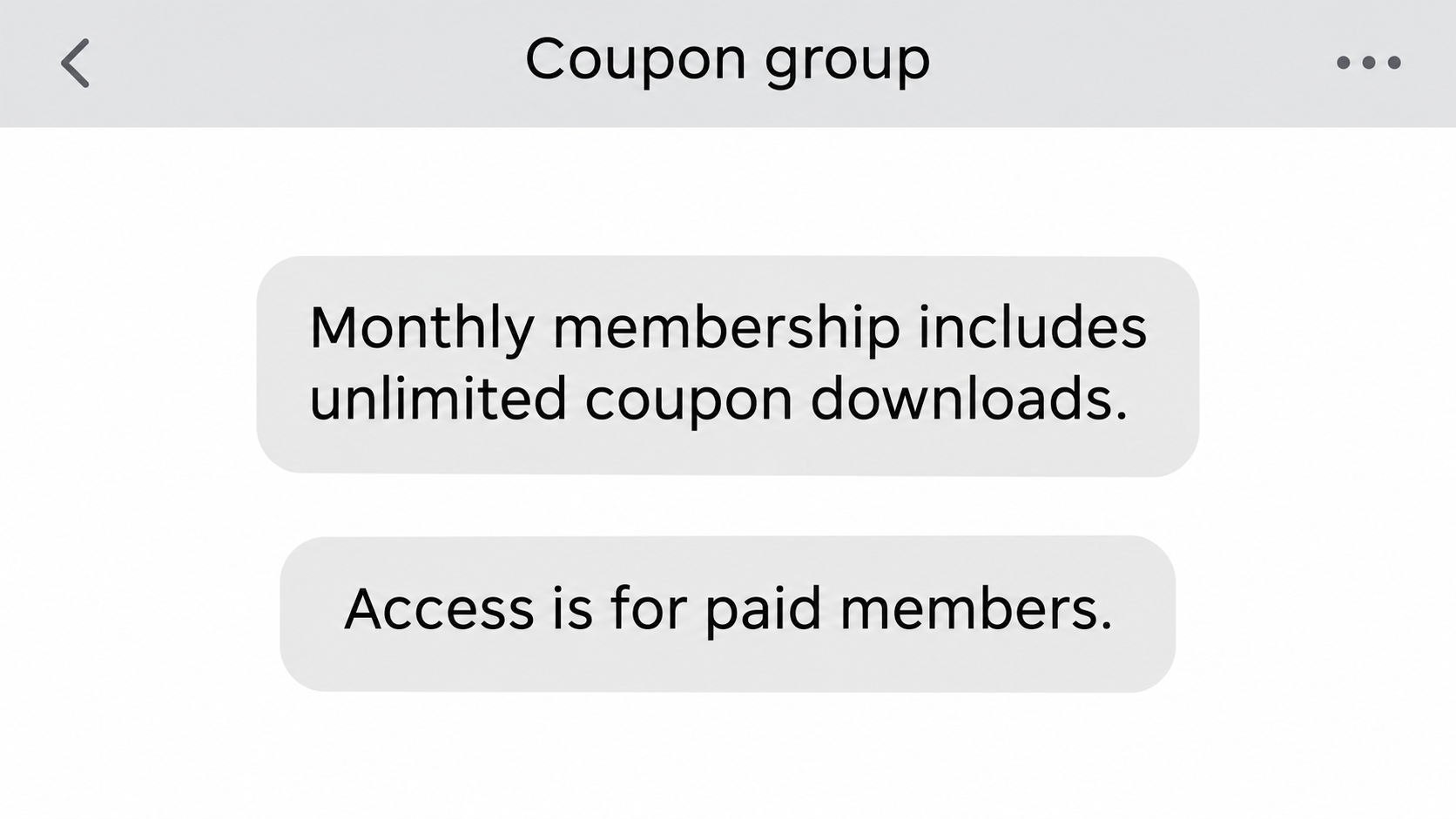
The lead illustration reconstructs the group’s membership proposition. It contains no real coupon, usable barcode, payment destination, or recovered message from the case.
Why a Coupon Can Scan and Still Be Counterfeit
A checkout result answers a narrow operational question: did the register process the presented item? It does not independently establish who issued the coupon.
A fake promotion can borrow recognizable product names and familiar formatting. Those visual cues are easy to confuse with permission from the actual manufacturer.
The original federal complaint explains that coupon authenticity was examined through clearinghouse analysis and redemption records, beyond the moment at the register.
That complaint describes the investigation at its charging stage. The later guilty plea and sentence establish the criminal outcome; preliminary estimates are not additional final losses.
For shoppers, the distinction matters before downloading anything. A screenshot of another member’s receipt shows a transaction, not an agreement by the manufacturer to honor the discount.
An administrator’s assurance that the files work cannot answer the authorization question either. That person is selling access to the very files being questioned.
Even a technically readable coupon can have a false origin. Appearance, scanning, and genuine promotional authorization are different things.
This is why testing a suspicious file at another store is the wrong way to resolve doubt. Verification should happen with the issuer or retailer beforehand.
How the Janet Bernal Counterfeit Coupon Scam Works
Step 1: A chat group offers recurring access to discounts
The paid group placed coupon distribution inside an ongoing membership. Members were purchasing continued access rather than receiving a one-time promotion directly from a manufacturer.
According to the original complaint, an undercover investigator joined the group and paid an initiation fee followed by monthly membership fees.
The complaint identifies an earlier group name as Darkside Jungle and describes a later renaming. A changed name did not change the underlying paid-access model.
These are historical case details, not names of a newly verified active group. Do not treat an unrelated community as the same operation based on similar wording.
Step 2: Payments keep the member inside the distribution channel
The sentencing account says fees went to mobile cash accounts directly controlled by Bernal. The payments supported access to the material she supplied.
Using an ordinary payment service can make an arrangement seem routine. The service processing a payment does not certify that the underlying goods are genuine.
An individual account name or transaction receipt is useful evidence of where money went. It does not establish authorization to issue a manufacturer’s coupons.
The practical question is what the membership actually delivers and who stands behind it. A payment confirmation cannot resolve that question for you.
Step 3: Members download files that look ready to redeem
Bernal posted numerous counterfeit coupons for members to download without a quantity limit under the subscription arrangement.
A large supply can make the fee appear economical. It can also distract from the missing link between the file distributor and the supposed issuer.
For an authentic promotion, the manufacturer or retailer controls the offer and its conditions. A group administrator cannot create that authority by charging for access.
Do not redistribute suspicious files while asking whether they are genuine. Save them privately as evidence and request verification without encouraging additional redemptions.
Step 4: The files are presented at retail checkouts
Members redeemed thousands of counterfeit coupons at stores in New Jersey and elsewhere. The effect extended beyond the chat group to businesses processing the discounts.
At the register, a discount can feel like proof that a paid membership delivered what was promised. The later authenticity question is less visible to shoppers.
That gap helps explain the attraction of receipt photographs inside coupon communities. A successful transaction is more immediately persuasive than a later accounting dispute.
However, a cashier processing a transaction is not granting the group’s administrator permission to manufacture offers. Issuing a promotion involves a different authority.
Step 5: Investigators connect the downloads to actual losses
The original complaint describes investigators downloading files and supplying them for clearinghouse analysis. Redemption data connected counterfeit material to transactions at retailers.
That work supplied more than an opinion about whether a coupon looked unusual. It connected the group’s files to the losses produced when they were used.
The final sentencing account reports losses exceeding $17 million. Its restitution figure should take priority over treating the complaint’s earlier estimate as a second total.
The case therefore supports a firm conclusion about Bernal’s counterfeit distribution. It does not establish that every person who downloaded a file had identical knowledge.
Who Was Actually Harmed by the Scheme?
The main documented losses were unauthorized discounts borne by retailers and manufacturers. Describing every subscriber as a victim would misstate the case.
Some people may join a group without understanding a file’s origin, while others may recognize warning signs. The published outcome does not decide every member’s individual circumstances.
If you discover that material you purchased is counterfeit, stop using it. Continuing to redeem it is not a sensible way to recover the membership cost.
A retailer is also not automatically participating in fraud because its checkout accepted a coupon. The counterfeit scheme exploited the discount process.
Similarly, the unnamed messaging application and payment services were channels used by the operator. The available account does not establish that they authorized the coupons.
Those distinctions keep the warning focused: the confirmed wrongdoing was producing and distributing counterfeit offers that generated unauthorized discounts.
Those distinctions also make your report more useful. Investigators need actual files, payment records, and communications, rather than accusations against every company visible in the process.
Checking a Coupon Group Without Trying Its Files
Start with the offer’s origin rather than its promised savings. Can you locate the promotion through the manufacturer or retailer using contact information found separately?
Compare the described product, expiration, purchase conditions, and distribution method. A group administrator’s explanation should not replace the issuer’s own terms.
If the offer cannot be found, ask the issuer or retailer to examine it. Provide a private copy through a verified channel instead of publishing the file.
Do not edit the coupon to make the comparison easier or remove the conditions. Preserve the original version so the recipient can assess what you received.
Useful questions include whether the promotion exists, whether that distribution is authorized, and what the store wants you to do with a suspicious copy.
A legitimate coupon discussion group may simply point members toward authorized offers. The existence of a group or membership fee alone is not the proof of counterfeiting.
The problem in Bernal’s case was established through the actual distributed material and its redemption. Avoid replacing that evidence with a blanket claim about all coupon communities.
Also keep price comparisons in perspective. Large savings can attract attention, but the size of a discount does not tell you whether the file was genuinely issued.
What to Do if You Have Fallen Victim to This Scam
-
Stop downloading, sharing, or redeeming the questioned coupons. Do not test them at another branch or ask someone else to try them for you.
Keep the original files privately and note where they came from. Retain membership instructions and messages explaining what the administrator claimed to provide.
If you already used a file, record the store, approximate time, products, and receipt details. Accurate records help distinguish what happened from what the group promised.
-
Contact the manufacturer or retailer through its own published customer-service route. Ask whether the specific offer and distribution method were authorized.
Explain that you obtained the file from a paid group and are seeking instructions. Send a copy only through the verified channel the organization provides.
Keep its written reply or a note of the conversation. If authenticity remains unresolved, leave the coupon unused rather than treating silence as approval.
-
Review how membership payments were made and whether any future payment is scheduled. A monthly fee does not automatically establish that the account has automatic billing.
If you enabled a recurring payment, locate that authorization in the actual payment service and cancel it through the service’s verified process.
If payments were manual, stop sending further fees. Save the transaction identifiers and recipient information already shown in your payment history.
-
Ask the payment provider about a disputed membership purchase when the delivered material was misrepresented. Explain precisely what you purchased and what you later learned.
Do not falsely describe an intentional payment as an unauthorized account takeover. A truthful explanation lets the provider assess the correct type of dispute.
Request the applicable deadline, supporting-document requirements, and a reference number. A reimbursement request is worthwhile, but approval should never be promised.
-
Report the distributor and preserve the evidence before using the platform’s reporting tools. Include the actual group identifier and administrator account rather than an unrelated community’s name.
The U.S. Postal Inspection Service investigated the Bernal case. Its official reporting page lists reporting options and the public number 1-877-876-2455.
Use that published route for guidance about relevant evidence, or contact local law enforcement. A public report should omit reusable coupon files and other people’s personal details.
-
If a retailer contacts you about a redemption, verify the contact through the retailer’s independently published information. Preserve the communication and respond accurately.
Seek qualified legal advice if questions concern your own conduct or a formal demand. A group administrator cannot reliably explain your obligations or resolve an investigation.
Do not pay someone who promises to erase the transaction or prevent prosecution. Keep any such demand with the rest of the records.
Why the Sentence Does Not Create a Subscriber Refund Program
Bernal’s restitution order addresses the losses recognized in the criminal case. It does not announce a compensation application for everyone who paid a membership fee.
The forfeiture amount is also not a membership-refund fund simply because money was ordered surrendered. Different court orders should not be presented as interchangeable pots of money.
If you have a genuine case-related inquiry, use an independently verified government contact. Avoid administrators or strangers claiming private access to restitution payments.
Anyone requesting a fee to release your share should explain their claimed authority through documents you can check separately. Do not send another payment while doing that.
For a retailer or manufacturer, preserve redemption and loss records through the organization’s own fraud team. A social-media complaint cannot replace the business’s evidence.
For a shopper, the immediate priority is stopping questionable use and retaining records. Recovering a subscription fee does not make the downloaded coupons legitimate.
Frequently Asked Questions
Was Janet Bernal convicted of a confirmed fraud?
Yes, Bernal pleaded guilty to conspiracy to commit wire fraud and was sentenced to 15 months in federal prison in September 2026.
The case involved counterfeit coupons distributed through a paid group and redeemed nationwide. It was not merely a dispute about an ordinary retailer’s promotional policy.
Did subscribers lose more than $17 million in fees?
No, the announced losses concerned retailers and manufacturers affected by counterfeit redemptions. They should not be described as the total membership fees paid by subscribers.
The court ordered $17,865,614.70 in restitution, which is distinct from the separate forfeiture order and any individual member’s payment.
Does a coupon scanning successfully prove it is genuine?
No, processing at a checkout does not establish that the manufacturer issued the offer. Authenticity can be examined later through the coupon and redemption records.
Seek verification from the issuer or retailer before using questionable material. Another member’s receipt is not an authorization document.
Were the messaging app and payment services running the scheme?
The published account identifies those services as channels Bernal used. It does not establish that their operators created, approved, or knowingly distributed her counterfeit coupons.
Keep any report focused on the actual group, administrator, payments, and files. Familiar service branding does not establish promotional authority.
Is every paid coupon community a scam?
No, a fee or a private group alone cannot establish fraud. A community may discuss legitimate promotions without manufacturing counterfeit offers.
Bernal’s case was confirmed through the distributed files, redemption evidence, guilty plea, and sentence. Apply that distinction instead of accusing unrelated groups.
What should I do with coupons I already downloaded?
Stop using or sharing the suspicious files and keep private copies with your payment records. Ask the genuine issuer or retailer how to submit them for review.
If you redeemed any, preserve the receipts and describe events accurately. Do not keep using them to recover what you spent on membership.
The Bottom Line
Do not pay for access to counterfeit coupons or keep redeeming files once their origin is in doubt. A successful scan cannot supply genuine issuer authorization.
If you joined such a group, stop further payments, preserve the files and receipts privately, and verify the offers with the actual retailer or manufacturer.

Join the discussion
0 commentsShare your experience or ask a question about this article.
Community experiences
Did this happen to you?
Your experience could help someone recognize the same scam. Submit a private report for our team to review.
I experienced this tooReports are reviewed before publication. Sharing publicly is always your choice.
Discussion
Start the conversation
Have a question or something useful to share? Add the first comment.