


An unexpected call about suspicious spending can interrupt an ordinary afternoon. When the caller offers to collect your bank card, the conversation becomes harder to judge.
That doorstep request sits at the center of the Franco Fuentes case, which shows how a supposed fraud investigation can move into someone’s home.
Overview
A bank investigation that required handing over cards
Franco Fuentes pretended to be a bank employee investigating fraud and persuaded older people to surrender their physical bank cards.
The cards then funded cash withdrawals and expensive purchases. The genuine banks were being impersonated, rather than arranging the collections.
This was a confirmed criminal scheme. Fuentes received a 57-month federal prison sentence in September 2026 after admitting the conduct in his plea agreement.
The Justice Department’s sentencing announcement describes victims losing substantial savings through withdrawals and purchases they had never intended to authorize.
The collection mattered more than the caller’s name
The dangerous request was practical and immediate: put a usable payment card into another person’s possession because an incoming caller said it was necessary.
A convincing caller ID, a professional tone, or a driver arriving at the right address could make that request feel like an established bank procedure.
Those details did not establish the caller’s authority. They helped the caller turn a remote conversation into access to the victim’s money.
- The caller claimed to represent a bank investigating suspicious activity.
- The victim was persuaded to surrender physical payment cards.
- Collected cards were used for cash withdrawals and purchases.
- A driver could transport a card without proving the collection was legitimate.
What the documented case actually establishes
The sentence included restitution exceeding $270,000. That court obligation should not be confused with an assurance that every victim has already received money.
The published account identifies older victims but does not provide a complete victim count. There is no reason to invent one to explain the danger.
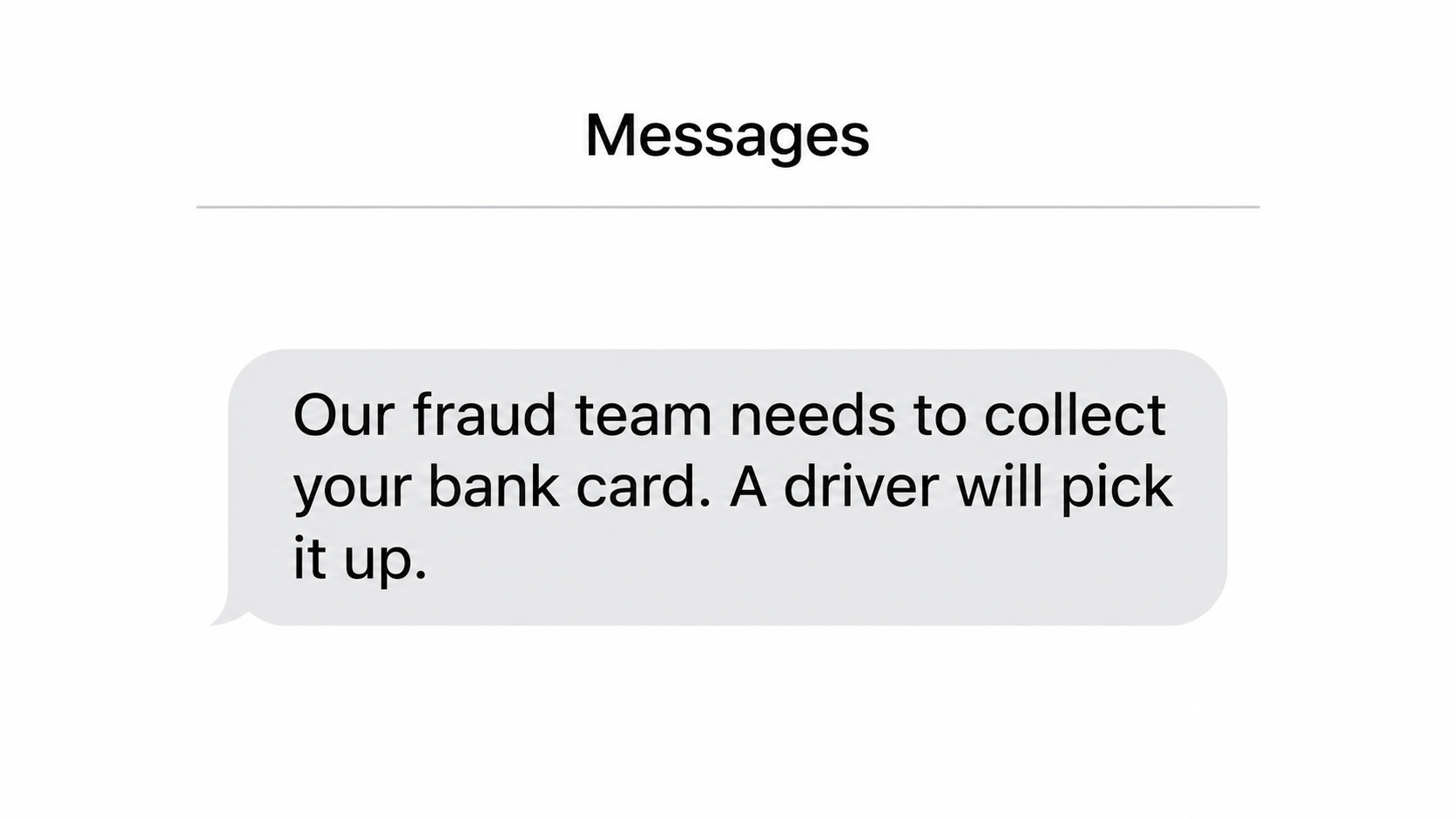
The lead illustration visualizes the caller’s collection request in a message-style screen. It is a reconstruction, rather than an original text sent to a victim.
Why a Fraud Alert Can Lower Your Guard
Most people expect a thief to ask for money. A caller who appears to be stopping theft starts with a much more persuasive explanation.
You may already know banks contact customers about unusual activity. The scam borrows that familiar situation, then introduces a completely different action.
Instead of independently reaching your bank, you remain inside the caller’s account of what supposedly happened and what must happen next.
The person directing the conversation can present hesitation as dangerous. Waiting might supposedly allow another withdrawal, while handing over the card sounds protective.
That pressure changes the question you are trying to answer. You stop asking whether the caller is genuine and start asking how quickly you can cooperate.
The request also moves the decision away from a familiar banking screen. A person at home may be trying to interpret instructions without seeing account records.
This is especially consequential when the caller reaches someone who relies on telephone banking or wants help resolving an unfamiliar security problem.
Age does not explain away the deception, however. The same reversal of trust can work whenever a convincing stranger offers to rescue someone from an invented emergency.
The useful interruption is independent contact. You do not have to determine who the incoming caller really is before ending the call and contacting your bank.
How the Fake Bank Card Pickup Scam Works
Step 1: The caller introduces a supposed banking problem
Fuentes posed as a bank employee investigating fraud. That claimed role supplied a reason to discuss the victim’s cards and financial security.
The supposed investigation made the conversation sound responsive to an existing problem, rather than an unsolicited request from someone seeking access to money.
You should separate those two claims when evaluating a call. Suspicious spending might exist, but that does not authenticate whoever happens to telephone you.
A real transaction concern can be checked through your established banking channel. The incoming caller does not need to remain involved while you do that.
Step 2: The proposed solution requires the physical card
The scheme crossed a critical boundary when victims were persuaded to give up their cards. A security conversation became a transfer of a usable payment instrument.
That handover is different from reading a transaction list or asking a bank to cancel a card. Someone else can now carry the card away.
The instruction can sound administrative because cards are small, familiar objects. Their spending power does not disappear when they are placed inside an envelope.
Do not assume a caller has disabled the card simply because they say so. Verify its status directly with your bank through a separate conversation.
Step 3: A collection makes the story feel organized
In one documented incident, a rideshare driver was sent to an 80-year-old victim’s home to collect cards.
An arrival at the promised time can look like confirmation. In reality, it establishes only that someone arranged transportation to an address.
The published account does not establish that this driver knew about the fraud. A driver’s appearance or booking should never be treated as banking authorization.
The person paying for transportation may control the destination while another person handles the call. The victim need not see the organizer at the doorstep.
Step 4: The card is used while the victim expects protection
That victim’s cards were used for more than $43,000 in withdrawals and purchases, including approximately $22,000 spent at Apple.
Another victim, aged 72, lost approximately $56,000. These examples show why a request involving a small plastic card can produce a large financial loss.
The source does not specify every authentication detail used for those transactions. Do not infer that every victim disclosed a PIN or online banking password.
Once a card has left your control, report the handover itself. Waiting to reconstruct every purchase can delay the bank’s opportunity to restrict further use.
Step 5: The victim has to separate real help from the original caller
After discovering the problem, a victim may still have messages, a displayed number, or instructions supplied by the person who arranged the collection.
Using those details to seek help can return the victim to the same deception. Start again with a bank contact obtained independently.
Explain that a person impersonating bank staff collected your card. That description gives the bank more useful information than simply saying you received a suspicious call.
Ask which cards and related access need restrictions, then check the recorded transactions with the genuine bank representative.
Caller ID and Doorstep Collections: What to Check
A displayed bank name is not a guarantee about the caller. The Fuentes announcement describes a victim who believed the call came from her bank.
Caller identification supplies a label on the screen; it does not give the caller permission to collect property or direct activity on your account.
The FTC’s warning about targeted bank impersonation also explains how personal details can make a fraudulent call sound informed.
Knowing your name, card type, or part of an account number does not answer the important question: did you reach your bank through a channel you selected?
For a collection request, ask your bank directly whether anything is scheduled. Do not accept a caller’s instruction to confirm it with their colleague.
If a driver is outside, keep the cards and close the door while you make that independent contact. You do not owe the visitor an immediate decision.
Avoid confronting a visitor or trying to recover a package yourself. If someone threatens you or will not leave, seek help from local emergency services.
Someone helping a relative can make this easier by locating the bank’s genuine contact details beforehand. Preparation removes an unnecessary search during a stressful call.
Agree that unexpected card collections will wait until the account holder speaks to the bank independently. That arrangement should support the person, rather than take away control.
The Money Figures, Without the Confusion
The restitution amount describes a court-ordered obligation. It is not the same thing as the amount seized during an investigation or the amount returned already.
Investigators seized more than $37,000 in cash and a bill-counting machine. The announcement does not identify that cash as a completed refund distribution to victims.
Similarly, the two described victim losses illustrate particular incidents. They should not be added to restitution as though they were separate, additional losses.
Keeping those categories separate matters when a victim receives a supposed recovery offer. A real sentence does not authenticate a stranger claiming to control seized money.
Anyone who asks for an advance payment to release your compensation should be checked through the genuine agency or bank handling your case.
Do not provide a full card number to a person who contacts you unexpectedly about restitution. Reach the institution using information you obtained separately.
What to Do if You Have Fallen Victim to This Scam
-
Contact your bank immediately through its existing app, a statement, or another contact you already trust. Explain that an impersonator arranged collection of your physical cards.
If your cards are gone, do not rely on a number supplied by the caller. Ask the bank to restrict the affected cards and explain replacement arrangements.
Tell the representative whether you also shared a PIN, password, or security code. Each disclosure may require a different restriction or account change.
-
Review the account with the bank and identify unfamiliar withdrawals and purchases. Record the dates, amounts, merchants, and whether transactions are pending or completed.
Describe accurately what you did and what you never authorized. Ask how to submit a fraud claim, what evidence is required, and when you must respond.
Keep the claim reference and any written confirmation. The FTC’s recovery guidance recommends promptly contacting the payment provider and requesting a refund.
-
Preserve the call history, displayed number, messages, collection time, and any booking information you already possess. Save copies without replying to the original caller.
Write down what the visitor collected and anything you remember about the handover. Distinguish observations from guesses about the driver’s involvement.
If the bank requests documents, use its verified secure submission route. Avoid sending complete statements to an unfamiliar email address that offers to investigate.
-
Report the incident to local police and the FBI’s Internet Crime Complaint Center when the deception involved electronic communications.
On IC3, choose File A Complaint and describe the caller’s story, the card collection, and the resulting transactions. Save the complaint information provided after submission.
Reporting complements the bank claim rather than replacing it. If immediate card protection is still unresolved, finish the bank conversation before gathering a perfect report.
-
Help an older victim get practical support without blame. The DOJ announcement directs people aged 60 and older to the National Elder Fraud Hotline, 1-833-372-8311.
A trusted person can sit alongside the account holder during bank calls, organize records, and help follow instructions while the account holder remains involved.
Continue checking replacement-card and account activity. Report fresh unfamiliar transactions promptly instead of assuming the first restriction solved every related exposure.
-
Reject anyone who demands another payment to recover the money, cancel the investigation, or clear a supposed problem created by reporting.
Verify unexpected recovery contacts through the bank or agency you already reached. A caller quoting your original loss does not establish authority over your claim.
If the original impersonator calls again, preserve the new contact and end the conversation. There is no need to negotiate a return of the cards.
Frequently Asked Questions
Was the Franco Fuentes case a confirmed scam?
Yes, Fuentes admitted the bank impersonation and card-collection conduct in his plea agreement. A federal court sentenced him to 57 months in September 2026.
The account concerns deliberate deception and misuse of collected cards, rather than an ordinary customer complaint about a legitimate bank’s service.
Does a bank name on caller ID make the collection genuine?
No, a displayed name cannot establish that the person speaking represents your bank. Independently contact the bank before taking action on an unexpected collection request.
Keep the cards with you while checking, even if a visitor has already arrived. Transportation arrangements do not authenticate banking instructions.
Did the rideshare driver knowingly help the scammers?
The published sentencing account describes a driver collecting cards but does not establish the driver’s knowledge. Do not accuse an individual driver based on that description alone.
Give investigators the collection details you actually observed, and let them determine the roles of the people involved.
Should I wait until a suspicious purchase appears?
No, report a card that has left your control immediately. The bank can assess restrictions without waiting for you to identify every transaction.
If you also disclosed security information, explain exactly what was shared. That helps the bank address access beyond the physical card.
Does the restitution order guarantee a refund?
No, restitution is a legal obligation imposed on the defendant. It does not establish that the full amount has already been collected or distributed.
Follow your bank’s fraud process and verified case communications. Do not pay someone who unexpectedly claims a fee will unlock your compensation.
Is receiving the call enough to require a device scan?
A telephone call alone does not establish a malware infection. The central exposure here was surrendering cards and allowing an impersonator to direct the victim.
Focus first on the bank, transaction records, and reporting. Tell the bank separately if you also revealed login details during the conversation.
The Bottom Line
Do not hand your bank cards to someone dispatched by an unexpected caller. A collection appointment and convincing caller ID do not establish banking authority.
If a card has already been collected, contact the genuine bank immediately to restrict it and report transactions. Preserve the handover details for your claim and investigators.

Join the discussion
0 commentsShare your experience or ask a question about this article.
Community experiences
Did this happen to you?
Your experience could help someone recognize the same scam. Submit a private report for our team to review.
I experienced this tooReports are reviewed before publication. Sharing publicly is always your choice.
Discussion
Start the conversation
Have a question or something useful to share? Add the first comment.