


Your files won’t open, and work has stopped. Then a recovery firm tells you it has a way to get the files back that nobody else has offered.
You need an answer quickly, but you also need to know what the quote is actually buying.
Overview
A ransomware recovery quote needs to say what work is included
If your files have been encrypted, a firm might be able to restore a clean copy from backups, use a verified decryption option or help you rebuild systems.
Those are different services with different chances of success. A single price for recovering your files doesn’t tell you where the recovered files will come from.
Ask the vendor to put the proposed method, limits and approval rules in the scope of work. If you’re unsure, have a second responder review it before payment.
- Ask which systems and files the result actually covers, not just whether some data can be returned.
- Request a breakdown of labor, tools, third-party fees and costs subject to separate approval.
- Separate getting files back from deciding whether it is safe to put the affected environment back into use.
- Do not transfer funds to a vendor that refuses to explain what it will do or where the money will go.
What federal prosecutors allege in the Palacio Escobar case
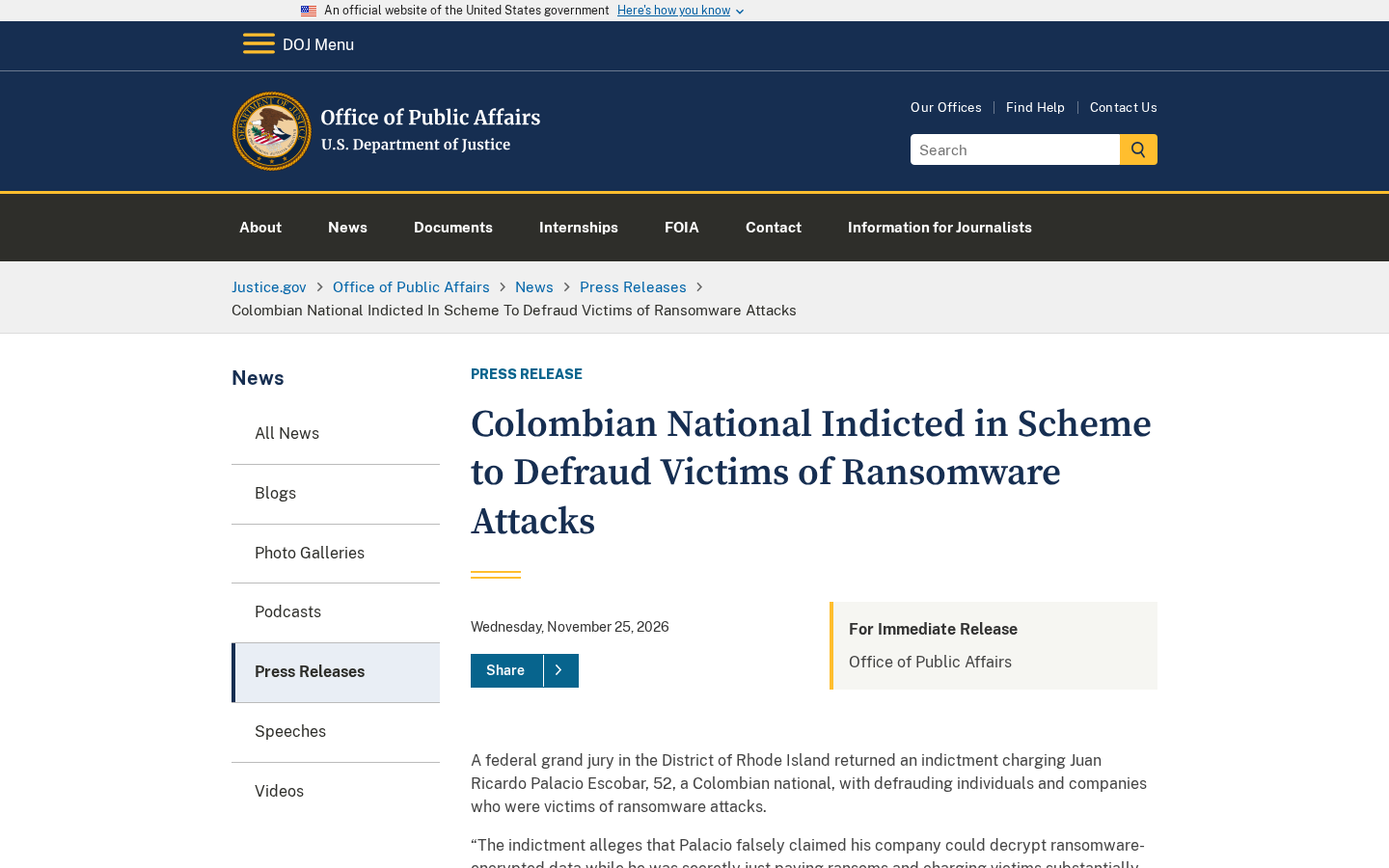
On November 25, 2026, the Justice Department announced that a federal grand jury in Rhode Island had indicted Juan Ricardo Palacio Escobar on three wire fraud counts.
Prosecutors say he co-founded a Florida business that advertised recovery using its own technology and represented that it did not negotiate with or pay ransomware attackers.
The indictment alleges he instead arranged ransom payments without customers’ knowledge and charged them more than he paid. That is the government’s allegation, not a finding of guilt.
The release doesn’t name the business. It doesn’t give readers a reliable way to identify a vendor from a name or a similar logo, so don’t guess.
Why the two figures in the indictment are not a market price
Prosecutors describe an FBI exercise in June 2026. Agents posed both as the company seeking recovery and as the purported ransomware actor.
The indictment alleges Palacio paid about $6,000 in Bitcoin to the purported actor and billed the undercover customer about $13,260 for what was described as decryption technology services.
Those figures describe a government-controlled operation, not a disclosed bill from an ordinary victim. The allegation turns on the difference between the promised method and the alleged conduct.
A provider can reasonably charge for professional work. The question is whether the proposal accurately tells you what that work consists of, and who can approve any new costs.
What a Ransomware Recovery Quote Should Tell You
Where will the restored files come from?
Start with the copy you can control. Ask which backups or previous versions are available and whether the team has checked when they were created and what they contain.
A vendor that proposes decryption should explain, in terms you can follow, what gives it reason to believe the files are recoverable. A sales promise is not a test result.
Ask whether it can demonstrate recovery on a small set of copied files that your responder has cleared for that purpose. Do not send sensitive originals to an unverified provider.
Agree on what the test would show. Opening a few documents doesn’t tell you whether a database or shared drive will be restored, or whether its contents are complete.
Ask who selects the files for that test. Samples that matter to your business give a better answer than a demonstration that uses only the vendor’s examples.
Where a backup is available, check whether your authorized team can validate it without sharing it outside the organization. A vendor does not automatically need every archive you hold.
If the source of recovery changes, require a new written description before the work continues. Your approval to restore backups is not permission for any other method the vendor chooses.
What is a third party allowed to do?
A responder might bring in a specialist for a particular system. Ask who can see the files, what access is needed and how the provider will remove access when finished.
Require explicit written authorization for outside contact and spending. An authorization to diagnose damaged systems should not be interpreted as authority to arrange or make a payment on your behalf.
Set one verified channel for quote changes. If a new account or invoice arrives through a different channel, contact someone you already know at the firm before approving it.
Check the firm’s identity through its established website and confirm the legal entity that will sign. Compare that name with the one on the bank details and agreement.
Get the names and roles of responders who will work on your case. You should know whom to call if a remote-access request comes from someone you have not met.
Ask when a subcontractor would need permission and who is accountable if the arrangement changes. Get that explanation before making company files available through a new service.
Check whether the agreement says where copies of your files are kept and who can retrieve them. Ask how the provider will confirm that temporary copies are removed when appropriate.
Make sure you can reach the provider after the first transfer of files.
The name on an invoice will not help if no one can identify your case or its owner.
What happens if only part of the data comes back?
List what needs to be restored first. A payroll file and a backup of a whole department are not necessarily equally urgent, and the quote should reflect your priorities.
Put the deliverables and acceptance checks in writing. You can ask which systems are included, what counts as restoring them and how the responder will document anything still unavailable.
Ask what you would owe if the vendor cannot restore the key files. That might be a disclosed diagnostic fee rather than the full amount for successful work.
Set a decision point before larger charges begin. A brief update with the results so far gives you something concrete to review before committing a new portion of the budget.
Define partial recovery in plain language before someone starts counting files. Getting thousands of low-priority items back may not justify a charge tied to restoring the one system you needed.
Save the quote version used for each decision. If a vendor later says an extra fee was always included, you should be able to see which description you actually approved.
What a File Recovery Service Cannot Promise
Readable files are not a clean network
Getting a folder back does not mean the person who compromised your environment has lost access. It also does not establish whether they copied information before files became unreadable.
Make restoration and security separate assignments, with a named owner for each. Ask the incident lead when it is appropriate to reconnect affected systems or continue normal operations.
Have that person document what remains uncertain. Restoring a service and deciding whether sensitive information was accessed are different outcomes, even when the same team handles both.
Ask the provider for a handoff that describes what was recovered, where it was placed and what the authorized team should verify next. Keep the original records with that handoff.
If a service cannot be brought back safely yet, make plans for essential work with your incident lead. A narrow workaround may remove some pressure to accept an unclear offer.
The FBI does not recommend paying a ransom
The FBI’s ransomware guidance says it does not support paying. A payment is not a guarantee that you will get your data back.
Do not let a recovery business decide on payments without your knowledge. If a proposal involves money going beyond the firm, get it reviewed and seek independent advice before acting.
Talk to your incident lead about clean backups and other options the team actually has. A deadline from the people who caused the disruption should not replace that discussion.
A fast quote is not the same as informed consent
Imagine one quote offering a documented backup assessment and another promising full recovery by tomorrow. The second claim sounds better, but it gives you less information about the work.
Ask how each firm would report a failed attempt. A credible proposal gives you a way to limit new spending even when the news is not what you hoped for.
If your insurer or organization has a response process, ask who can approve a vendor and whether using an outside firm changes what costs may be covered.
Keep a written list of decisions that belong to your organization, not the service provider. Include sharing sensitive data, accepting third-party charges and deciding when restored systems return to service.
If the sales contact refuses to distinguish a support fee from money destined elsewhere, stop the approval. You can still seek independent advice without giving up on the recovery itself.
Review termination terms before work starts. Know who will return your copies, how to receive logs and what you might owe for work already completed if you switch firms.
What to Do If You Have a Recovery Quote You Don’t Trust
-
Pause unapproved payments and call your incident lead. Use established contact details and explain what the vendor proposed, what you have approved and what money is still pending.
If no one is coordinating the response, appoint an authorized person to manage decisions and contact a qualified provider. Share the evidence with that person through a trusted channel.
-
Get the original quote and agreement in one place. Save the scope, invoices, signed authorizations, emails, details of any external fees and notes from calls.
If the firm says the method changed, ask for the change in writing. Identify the amount already paid and which work the provider says it has completed.
-
Check whether the vendor already has access. Tell your incident team which service accounts, remote sessions or shared storage the firm could use and who approved them.
Let the authorized team decide which access to remove and how to preserve the records. Keep a note of when access started and what data it covered.
-
Ask your insurer or another qualified responder to review the scope. Give them the written proposal and your recovery priorities. Ask for an explanation of any unexplained charge.
Find out how to continue essential work without authorizing the disputed part of the proposal. Your response may still need to move while the billing issue is being checked.
-
Report suspected deception and document the earlier attack separately. In the United States, contact the FBI or report through IC3, using records you can verify.
In your notes, distinguish what the attacker demanded from what the vendor sold you. If you paid the provider, ask your payment institution what review is available.
If anyone claims to be connected to the Rhode Island case, verify that claim through a government office independently before sharing records or responding to instructions.
-
Record what the organization still needs to restore. List the affected services, available backups and highest-priority records with the person managing the incident.
Keep that operational list separate from the vendor complaint. A dispute about charges does not establish what is recoverable or remove the need to protect the remaining records.
If several providers are involved, tell them which person can make decisions. That helps prevent anyone relying on an old approval or conflicting instructions during the handoff.
Frequently Asked Questions
Was Juan Ricardo Palacio Escobar convicted in the November announcement?
The announcement concerns an indictment on three wire fraud counts, not a conviction. The prosecution’s assertions about the recovery service remain allegations at that stage.
Did the undercover scenario involve a real ransomware actor?
The DOJ says the purported actor and the purported customer were both undercover FBI operatives. The quoted amounts describe what prosecutors allege happened during that operation.
Is every paid recovery firm a problem?
Charging for legitimate technical work is not the issue. Ask what the provider is actually selling, who will do the work and what any third-party payments would cover.
Can a responder tell me in advance that everything is recoverable?
Ask for the evidence behind that commitment and which systems it covers. A small recovery test can be informative without proving every file or service can be restored.
Should I give the vendor my only copy of the damaged data?
Keep the original evidence under your control. Have the incident team explain what copy the vendor needs, whether it contains sensitive information and how it will be protected.
Does receiving readable files mean the incident is over?
File recovery answers only part of the question. Ask the incident lead about the safety of your systems, remaining access and any evidence of data exposure.
The Bottom Line
Do not approve a ransomware recovery quote unless you can verify who will do the work, how the files would be recovered and what every major charge covers.
If the proposal changes or money has already moved, involve an independent responder and preserve your records. Keep the effect on your systems separate from any dispute with the provider.

Join the discussion
0 commentsShare your experience or ask a question about this article.
Community experiences
Did this happen to you?
Your experience could help someone recognize the same scam. Submit a private report for our team to review.
I experienced this tooReports are reviewed before publication. Sharing publicly is always your choice.
Discussion
Start the conversation
Have a question or something useful to share? Add the first comment.