


Your phone shows a local police number. The caller says you missed jury duty and makes it sound as if there’s already a warrant with your name on it.
The most unsettling part may be how ordinary it sounds. The person on the line seems to expect you to recognize the procedure.
Overview
The Georgia prison jury duty scam reached people nationwide
The callers made a court problem sound personal and immediate.
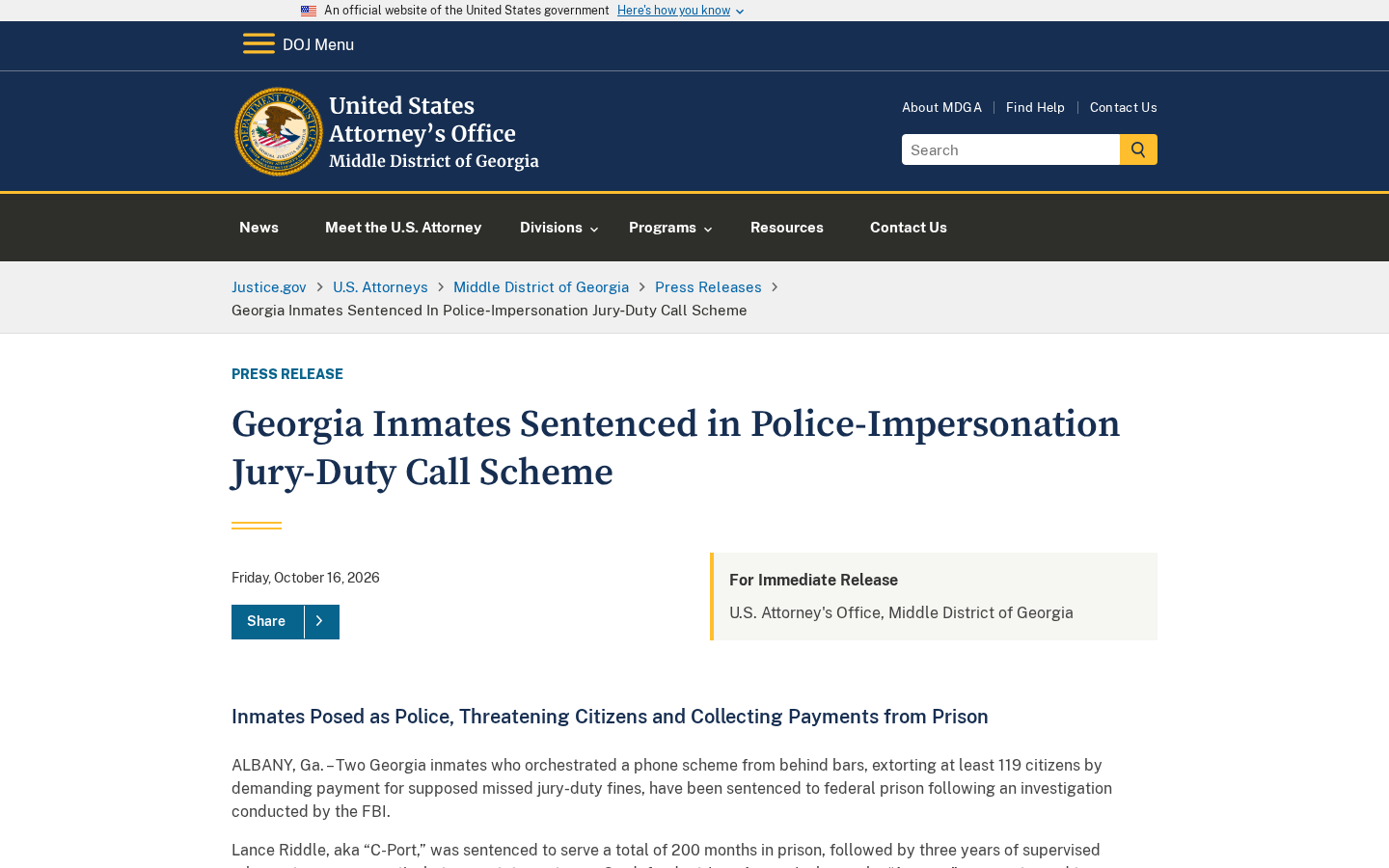
According to the Middle District of Georgia’s sentencing announcement, their calls produced more than $464,920 in documented losses across 119 victims.
They were not coordinating with anyone’s actual court. The Justice Department said two men helped run the scheme while incarcerated at Calhoun State Prison, with accomplices outside managing financial accounts.
Investigators received referrals from authorities in several states, not just Georgia. Someone could see the name or number of their own police department regardless of where the callers actually were.
What the callers told people and why it mattered
The callers claimed to be police officers and told people they faced arrest for missing jury duty.
They offered a way out that put the supposed officer in charge of payment.
This case didn’t always end after money changed hands. Prosecutors also described demands for intimate recordings, followed in some cases by sexually explicit messages or violent threats.
- A police number on your screen tells you what the display says, not who is speaking.
- An order not to talk to anyone is a reason to leave the call and check with the court yourself.
- Gift card codes sold as a bond are a payment to the caller, not a court procedure.
- Do not record or send intimate material to satisfy a caller’s supposed security or identity requirement.
What a federal jury found and the court imposed
A jury found Lance Riddle and Joey Amour Jackson guilty of conspiracy to commit wire fraud and conspiracy to commit money laundering. The verdict followed a January 2026 trial.
On October 14, 2026, the court sentenced Riddle to 200 months and Jackson to 120 months in federal prison. The terms run consecutively to any state sentence.
The court imposed three years of supervised release for each. The October news release said restitution would be determined later, rather than announcing an amount already distributed to victims.
The district included the case in its November enforcement update. The October sentencing predates that summary and was not a refund announcement.
How the Georgia Prison Jury Duty Scam Worked
Step 1: A stranger arrived with the appearance of a local officer
Prosecutors said the group used numbers that looked like those of victims’ local departments. They used both invented officer names and the names of real officials.
If the caller gives you a name you can find online, all you’ve learned is that the name exists. You still need to establish who contacted you.
Hanging up and calling the number in your call history can take you right back to a questionable contact. Find the official listing yourself, then dial it manually.
If the number belongs to a real department, tell the dispatcher it appeared on a suspicious incoming call. Do not assume the department made that call.
Step 2: The missed-jury-duty story made the consequences feel immediate
Recipients were told there were warrants for their arrest and that a bond payment could clear them. The urgency was part of the pitch, not evidence about the court’s records.
Jury duty is a real obligation, so the accusation may feel plausible even if you don’t remember receiving a summons.
You do not need to argue with the caller about that.
When a call leaves you wondering whether mail was delivered to an old address, start with the court’s independently listed clerk.
Explain the call and ask whether there is a summons.
Use the official route the clerk describes to handle a real address change or missed appearance. Do not send an address, photo identification or other records to the original caller.
Step 3: A supposed order discouraged victims from asking for help
People were told they were under a gag order and could be arrested for discussing the supposed warrants before payment.
That put pressure on them to act without a second opinion.
Someone who threatens consequences for checking with a court has put you in a false choice.
Ending contact with them does not prevent you from dealing with a genuine court matter.
If you’re already outside your home or work because of their directions, move somewhere you feel safe. Call the court or someone you trust without keeping the caller connected.
If someone else is nearby, ask them to help you reach the official number. Stepping away from instructions that keep changing makes it easier to hear what the clerk says.
Step 4: Victims were asked for gift card codes or wire transfers
The callers usually asked for gift card numbers. Some people sent wire transfers instead. Neither method gave the caller control over a real warrant.
You don’t need to know how a card would be spent to protect it. The important moment is before you disclose the number or send a photo that shows it.
A card can still be in your hand after someone uses its value. Keep the card and receipt so the issuer can identify it and check whether funds remain.
If you bought a card but didn’t share the code, keep it private. Check the retailer’s return rules or speak to the issuer rather than sending it to the caller.
Step 5: A further demand made the scam more than a payment loss
The callers sometimes pointed people toward a real police department after payment, making the call sound like part of an official visit. Some victims then faced demands for intimate material.
Being directed to a real public building does not turn the person directing you into an official.
A legitimate court clerk can explain where and how the public handles jury questions.
If a scammer has a recording or threatens to distribute one, paying them is not a reliable way to get it back. Consider the threats separately from your financial report.
How to Check a Jury Duty Call Without Calling the Number Back
Work out which court the caller is claiming to represent
A local police number does not tell you which court supposedly issued the summons.
Use any court name already given in the call, a message or a notice you actually received.
For a federal summons, the US Courts juror scam guidance directs people to contact their district’s clerk. It also links to the Federal Court Finder.
For a state or county court, locate that jurisdiction’s official jury office. If you don’t know which one applies, ask the relevant local court for help finding the right office.
Check whether you can locate your original summons or a jury service confirmation. Having that record nearby can help you ask the real court a precise question.
If the phone call happened after office hours, put the money and documents aside. A demand to pay before the clerk opens is not a reason to bypass verification.
Check your summons instead of negotiating a payment
When you reach the official number, explain that someone called claiming you had missed service. Ask whether the court has records under your name and where to verify a notice.
Contact from a real court may vary by jurisdiction. Do not treat the possibility of a real reminder as a reason to give a surprise caller payment codes.
If a clerk says there is a legitimate issue, ask what official steps to follow. That is a separate conversation from anything the unexpected caller demanded.
Look at the court name and case information on a notice you actually received. If something does not match, ask the official clerk to explain it before sharing sensitive information.
Leave the caller’s contact details behind
Use your own search and type the official number, rather than trusting a number in a text or a link to what looks like a government page.
You can retain the suspicious number as evidence without sharing it publicly as if it belongs to a scam operator. A caller ID display can contain a real department’s number.
If money was requested at a store, do not give another person the card so they can read it to somebody over the phone. Put it away and end contact.
If someone else in your household received the call, help them break off contact without blame. Offer to sit with them while they reach the bank, issuer or actual court.
Write down which official office you reached and when. If the caller tries again, you do not owe them an explanation of what the clerk told you.
If someone says you need to attend in person, ask the clerk where public jury matters are handled. Go only on instructions you obtained directly from the verified office.
What to Do If You Have Fallen Victim to This Scam
-
End contact and protect your immediate safety. Hang up and stop following directions given on the call, even if the caller threatens arrest for disconnecting.
If there is an immediate physical danger, use your local emergency number. Otherwise, reach a trusted person and verify court business independently.
-
Call the gift card issuer or bank without delay. If you shared card codes, find the issuer’s real support channel and give it the retained card and purchase details.
Ask the issuer whether unused value can be frozen. For a wire transfer, ask the sending institution whether it can stop or recall it and how to preserve the record.
Even if someone has already spent the money, keep the receipt. It establishes when you bought the card, for how much and from which retailer.
-
Keep a record of the demands and payments. Save messages, voicemails, caller ID information and the names used, along with the receipt or wire confirmation.
Write down what happened before and after payment. Store the records privately and do not upload intimate material to an open folder or send it to a stranger offering help.
-
Report intimate demands or threats as a separate harm. Tell police or the FBI if the caller requested a recording, threatened to share one or sent violent messages.
You can report the threat even if you did not comply. If content appears online, use the platform’s reporting tools and keep identifying links without spreading the content yourself.
-
Notify the court and report the fraud. Contact the clerk using the court’s official website, then report the incident to the FTC or the relevant law enforcement office.
If the Georgia case appears relevant, give officials the original date, location and transaction details. Similar wording alone does not connect a new call to Riddle or Jackson.
-
Keep genuine follow-up separate from surprise calls. If someone claims the government has found your money, find the office yourself and ask whether it sent the communication.
Do not buy another gift card to release restitution. Report that new demand and add its time and contact details to the record of your earlier loss.
-
Tell your employer if the contact reached your work accounts. Ask the appropriate person to preserve messages and keep your contact information private if threats are continuing.
If someone points to public details about your job or office, record what they already knew. That can help you explain the threat without assuming your accounts were breached.
Frequently Asked Questions
Can the call really show my local police department’s number?
The displayed number can match your local department’s listing. Investigators found that callers in this case mimicked local agency numbers, so contact the department independently.
What if I really did miss a jury summons?
Call the clerk listed on the actual court website and ask what to do. Do not pay an unexpected caller to resolve something the court has not verified.
Should I pay if the caller promises to give back the gift card value?
Do not share the code or send more money. Contact the issuer yourself and ask whether it can act on the card, using the receipt if you have it.
What if there were threats but I didn’t lose any money?
There’s still something useful to report. Save the dates, messages and nature of the demand and notify the real court or law enforcement agency.
Did the Georgia case affect only people living in Georgia?
No, the operation reached people nationwide. The prosecution’s release describes victim referrals from places including Colorado, Florida, Virginia, Nevada, California and Ohio.
Can I use the sentencing announcement to claim an immediate refund?
The release did not announce a public refund or claim portal. If you believe you were directly affected, check the case with the responsible district rather than paying a middleman.
The Bottom Line
If a caller says you can avoid arrest for missing jury duty by sharing card codes, wiring money or doing anything intimate, hang up.
Verify your status with the court yourself.
When you’ve already paid, call the card issuer or bank promptly. Report any threats too, even if the person said you weren’t allowed to tell anyone.

Join the discussion
0 commentsShare your experience or ask a question about this article.
Community experiences
Did this happen to you?
Your experience could help someone recognize the same scam. Submit a private report for our team to review.
I experienced this tooReports are reviewed before publication. Sharing publicly is always your choice.
Discussion
Start the conversation
Have a question or something useful to share? Add the first comment.