


You hire a campaign consultant because there are bills to pay, donations to track and reports due whether or not anyone has time to prepare them.
Then a line in the bank statement doesn’t match the records. It looks small enough to ask about on Monday.
Overview
The Abbey Lee Cook fraud began with a real job
Abbey Lee Cook ran a Montana campaign compliance business. She helped clients set up bank accounts, deposit donations and file financial reports with the state.
The suspicious activity did not begin with a text from an unknown person or a fake bank login. Cook had account access because clients had engaged her for legitimate work.
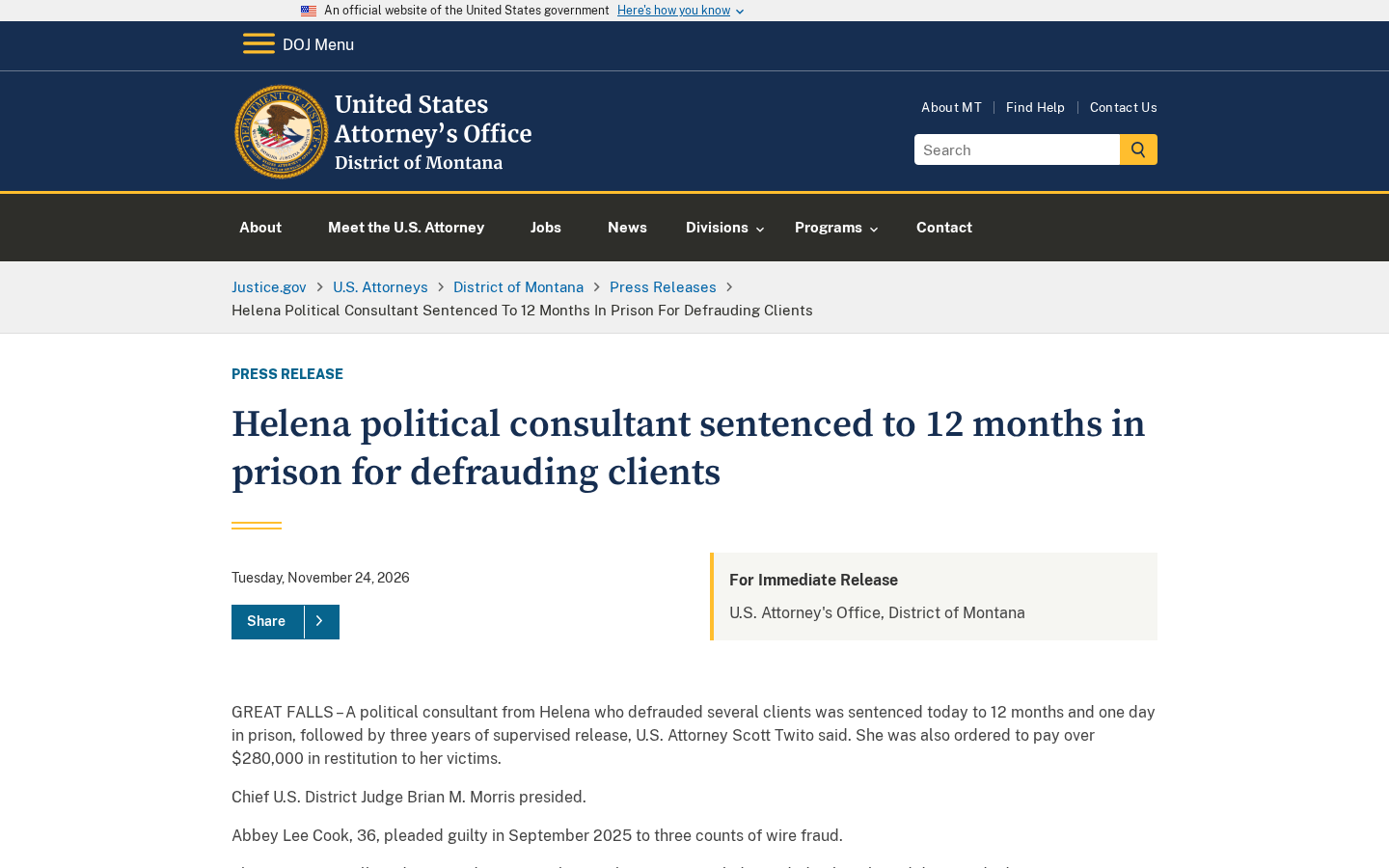
The November 24, 2026 sentencing announcement says Cook took money from six clients between September 2021 and November 2024. Four were candidates and two were political action groups.
Keeping the books and controlling the money were different responsibilities
Preparing a report is an accounting responsibility. Authorizing a transfer is a payment responsibility. In this case, Cook had the means to move money and to misrepresent the activity.
Some clients spotted discrepancies and asked what happened. The answers and the paperwork could make a real shortfall look as if it had been resolved.
- An independent bank statement tells you where money actually went, regardless of how the transaction was described.
- A filing shows what was reported. It cannot by itself establish that every bank transaction was included.
- A statement showing a restored account balance does not explain whether missing money was reversed or replaced from somewhere else.
What was admitted and what the court ordered
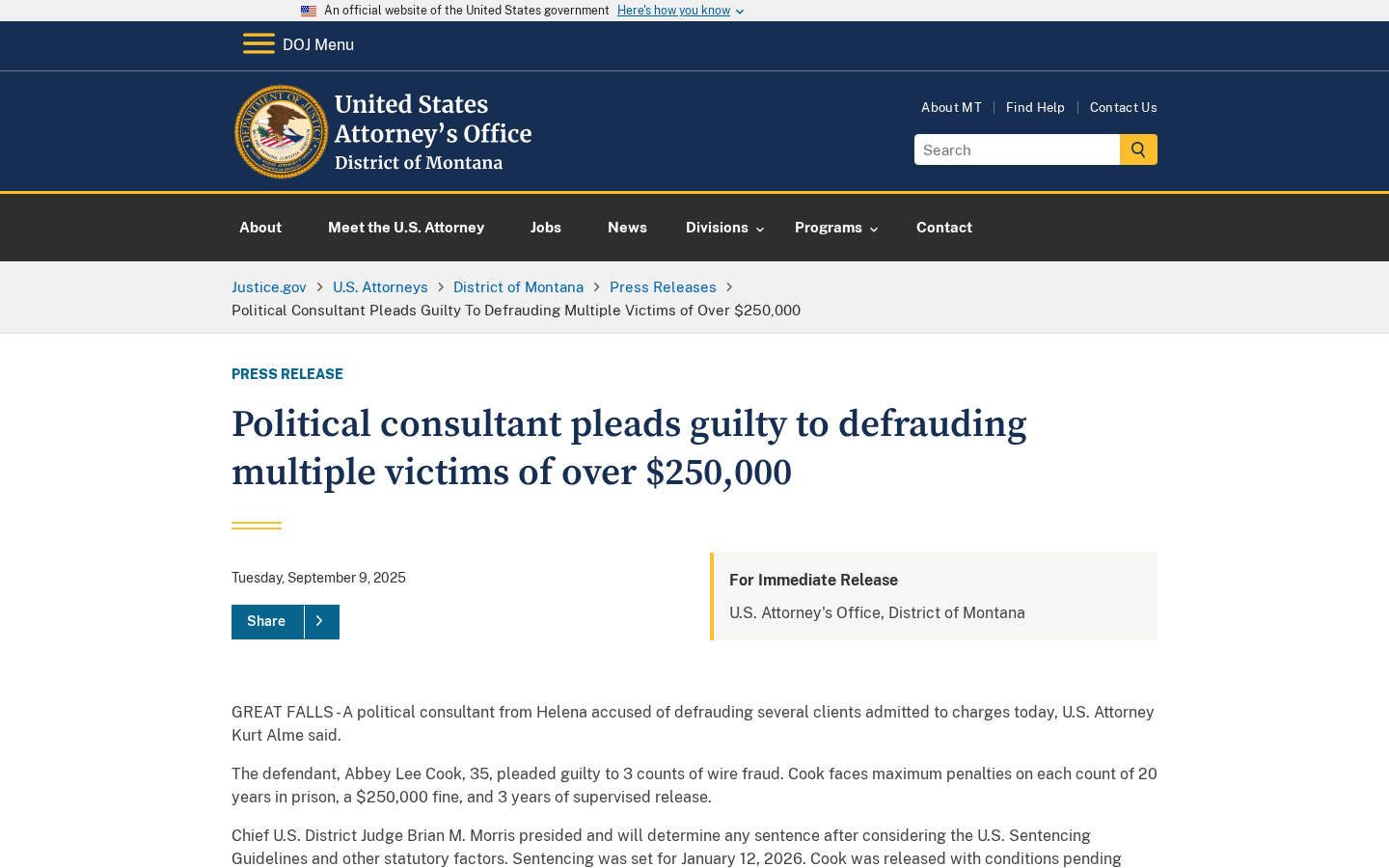
Cook pleaded guilty to three wire fraud counts on September 9, 2025. The court imposed 12 months and one day in prison, followed by three years of supervised release.
The sentencing release reports more than $280,000 in court-ordered restitution. The earlier guilty-plea announcement reported losses above $250,000 as reflected in the charging document.
Those are figures from different stages of the same case. They should not be added together, and the restitution order does not show that any particular client has been paid.
How the Campaign Account Fraud Worked
Step 1: Cook received access through her work for campaigns and committees
Prosecutors described clients that hired Cook to handle reports, bills and other campaign finance tasks. At one committee, her role began as volunteer work before she obtained bank signing authority.
Signing authority let her carry out legitimate transactions. It did not mean the committee had authorized every payment she could technically make with that access.
For a campaign, agreeing that someone can pay a budgeted bill is different from deciding they can add their own company as a recipient without a second person’s review.
Write down the spending authority you intended to grant. Include the maximum amount and restricted recipients, then ask the bank which instructions it can enforce.
Step 2: Campaign and committee money went to accounts Cook controlled
Federal prosecutors said Cook transferred client funds into her own accounts and her business account. In documented examples she used both checks and electronic transfers.
Prosecutors identified two checks without an advocacy committee’s permission: $3,000 in March 2023 and $15,000 in August. They drew on the same committee’s bank account.
In that committee’s case the estimated loss was about $82,000. The issue was not whether a consultant can charge a fee. These payments did not have the client’s permission.
Prosecutors also documented money used for Cook’s personal credit cards, vehicles and commercial property obligations. Those expenses were not the campaign activity for which her clients provided funds.
An unfamiliar payee warrants review, but a familiar one can warrant it, too. Compare the check to a contract, approved invoice and schedule before treating a consultant payment as routine.
Step 3: A transfer shifted the shortfall from one account to another
One incident matters because it shows how a missing balance can look fixed.
Prosecutors identified an approximately $26,000 transfer from one client’s committee to another client’s campaign in July 2024.
When questioned, Cook said she was redirecting payments that had gone to the wrong place. She did not provide the requested written explanation, according to the plea announcement.
Cook later told investigators the transfer covered obligations of the receiving campaign and that neither client knew of or authorized it. A different organization had supplied the replacement money.
If an unexplained entry reappears as an equal deposit later, open both transactions. Check whether the bank reversed the first or someone initiated a new payment.
Step 4: False reports made the accounts harder to reconcile
The Justice Department said false filings underreported the money Cook had taken. Some clients confronted her about inconsistencies, and one campaign terminated her bank access after uncovering a problem.
Nothing in the releases establishes that a bank was hacked or that the campaigns participated in her fraud. The central fact was misuse of access those clients had granted.
The documents a consultant prepares should not be your only source for the review.
A person who receives statements directly from the bank can compare them against filings without depending on summaries.
How to Audit an Account Someone Else Manages
Put the bank statement next to the report
Download the full statement directly from the bank, including the opening and closing balances. Get images of paid checks and payment records for transactions you need to identify.
Reconcile each outgoing amount against an invoice or another approved obligation. For any mismatch, note who authorized it, the payee and the entry in your internal books.
Keep a list of entries no one can yet explain. Mark which account they came from rather than checking them off when someone gives a verbal explanation.
Compare the statement date with the date in the ledger. A check written in March may clear in April, making the underlying check image useful when two reports disagree.
For a check to a consulting business, compare the endorsement or deposit information with the actual recipient. Ask the bank for records you are authorized to review.
Get copies of filings from the actual regulator or the account used to submit them. In Montana, check which reporting rules apply to your candidate or committee.
You need to know who is responsible for filing and how to correct records. Verify the procedure with the regulator rather than copying how a different campaign handled it.
If a public report is missing an entry, check whether it was excluded, posted under another category or genuinely outside the period. Make a note of who verified the explanation.
Give another person enough access to ask questions
A treasurer or second reviewer can receive statement alerts and compare entries without having authority to move funds. Keep that access under the organization’s control.
Agree who approves changes to signers, account alerts, bank contact details and spending permissions. Make it clear that changing one of those settings is not routine bookkeeping.
Give the second reviewer a date to check the statements every month.
If an election or filing deadline falls that week, decide who will handle the review instead of skipping it.
Use the bank’s supported approvals where available. When a payment requires two people, the second person needs evidence of the payee and amount, not simply a notice to approve.
For a small group with two volunteers, start by assigning reconciliation to whoever did not initiate payments. Give that person direct access to the source records.
Send important exceptions to the treasurer in writing. A change to a consultant’s fee should have a dated approval that anyone authorized to review the books can find.
Test the handoff before the consulting relationship ends
Take inventory of the bank, accounting system, shared files and filing accounts. Check that your organization can sign in independently and recover its own access.
Make sure the list covers old accounts as well as current ones. An inactive campaign account may still hold a balance or retain a signer whose access was never removed.
When an engagement ends, document when account access should stop and who must contact the bank or system owner. Ask for confirmation rather than assuming an email ended access.
Check scheduled payments and standing instructions as well. Removing one person’s access does not necessarily cancel a future payment they already set up while they had permission.
Make a list of recurring payees with the new person responsible for the account. Have that person verify who still provides a service and which commitments remain open.
For outgoing checks that have not cleared, ask the bank what records are available. Match any check number and payee to the authorization instead of waiting for next month’s report.
Update statement delivery if it went only to the former consultant. Check that the organization receives the first new statement and has someone assigned to reconcile it.
What to Do If You Find Unauthorized Campaign Payments
-
Call the bank from a known number and secure the account. Tell its fraud team you suspect misuse by an authorized signer and name the affected transactions.
Ask how to suspend the person’s authority, stop pending payments and preserve records. A bank’s handling may differ depending on whether the transfer was a check, wire or another payment.
Give the bank your best evidence now. You can supplement it later if reconciliation shows the activity reached earlier statements or another account.
-
Make copies before you change the books. Export statements, cleared check images, filing confirmations, invoices, authority forms and correspondence without editing the originals.
Preserve your first reconciliation, even if it is incomplete. Keep a separate working copy for findings and record who has handled sensitive documents.
Save access logs or account change notices where you have permission to retrieve them. Do not try to sign in to someone else’s personal account to look for evidence.
-
Bring in an independent reviewer promptly. Give the reviewer direct records and enough authority to compare them across the period you’re concerned about.
Start with the suspicious transfer, but also inspect recurring recipients and money that appears to have come back. A repaired balance may not tell you where the money originated.
If the records identify transfers involving another organization, have an authorized person or counsel coordinate the contact. Don’t send that organization’s bank details around informally.
-
Ask the election regulator about disputed filings. Explain what you can verify, which periods are affected and that you are preserving the original submissions.
Ask who should correct the records and what format or timetable applies. Don’t quietly replace a disputed report with a new one and discard the evidence of the first.
-
Report suspected criminal activity to the appropriate authorities. Provide a dated chronology, responsible contacts and payment records rather than only a list of missing totals.
For a possible match to the Cook case, contact the US Attorney’s Office for the District of Montana through its own site and ask for the appropriate contact.
Do not assume a court ordered restitution for your organization merely because the consultant or the payment description sounds familiar. Ask how victim status is established in that case.
-
Separate confirmed losses from the questions still open. Keep an incident log that distinguishes money confirmed missing, reversals already credited and entries waiting for documentation.
Give the organization a clear update without circulating private bank records in a group chat. Name the next person responsible for verifying the amounts and note what remains unresolved.
Frequently Asked Questions
Who was affected in the Abbey Lee Cook case?
The sentencing announcement identified six victims: four clients who ran for statewide office at different times and two political action groups.
There was no allegation the victim campaigns ran the scheme.
Did the bank transfers require stolen passwords?
Prosecutors described Cook misusing access obtained from the clients she worked for. The public case accounts did not identify stolen passwords as the basis for the transfers.
Was this about a political position or election outcome?
The federal case concerned client funds, false reporting and payments that lacked authorization. The Justice Department did not present it as a finding about the result of an election.
Can I trust a bank balance that is back to normal?
Check the original debit and the later credit separately. You need to know whether the bank reversed a payment or whether another account supplied the money.
Does a second signer eliminate the risk?
A second approval helps if the reviewer checks the underlying record. It will not catch much if both signers rely on a summary produced by the person requesting payment.
Were all six clients repaid when Cook was sentenced?
The sentencing notice reports a restitution order above $280,000. It does not give a payment ledger or say each victim had recovered the full amount.
The Bottom Line
Never let the same person be your only source for both payment approval and proof that the books are right. Get statements independently and investigate transactions that don’t reconcile.
When money may have moved without permission, contact the bank, keep the source records and get a separate review. Don’t close the question just because the balance looks right again.

Join the discussion
0 commentsShare your experience or ask a question about this article.
Community experiences
Did this happen to you?
Your experience could help someone recognize the same scam. Submit a private report for our team to review.
I experienced this tooReports are reviewed before publication. Sharing publicly is always your choice.
Discussion
Start the conversation
Have a question or something useful to share? Add the first comment.