


FentiCoin.com looks like a clean, modern crypto exchange, with live prices, trading bots and a free demo account. TikTok promoters pitch it as a way to grow small deposits.
The site’s own code tells a different story. It decides whether a trade wins before the chart moves, and it treats demo and real money very differently.

Overview
What FentiCoin Claims to Be
FentiCoin presents itself as a cryptocurrency platform for spot trading, futures and automated trading bots. It claims more than three million users, offices on three continents and 12 support languages.
Sign-up takes an email and password. Every new account gets a practice balance, and real money goes in through crypto transfers or mobile money such as M-Pesa.
Where FentiCoin Stands Now
fenticoin.com is still online and still accepts sign-ups. The domain was registered on May 19, 2025, through Cloudflare’s registrar.
A September 2025 archive copy loads the same app shell, title and app-builder script as today, so the current site is the one people complained about last year.
Is FentiCoin Legit?
No. The trading results inside FentiCoin are generated by its own software rather than by a market, so neither the profits nor the losses are real trades.
- The code gives demo accounts a 70% chance to win and real accounts a 20% chance when its server check fails.
- Its 10-second trades pay 80% of the stake on a win and take all of it on a loss.
- Withdrawals need a government ID and selfie, cost a 5% fee and wait in a pending queue.
- The site names no company, no address and no licence from any regulator.
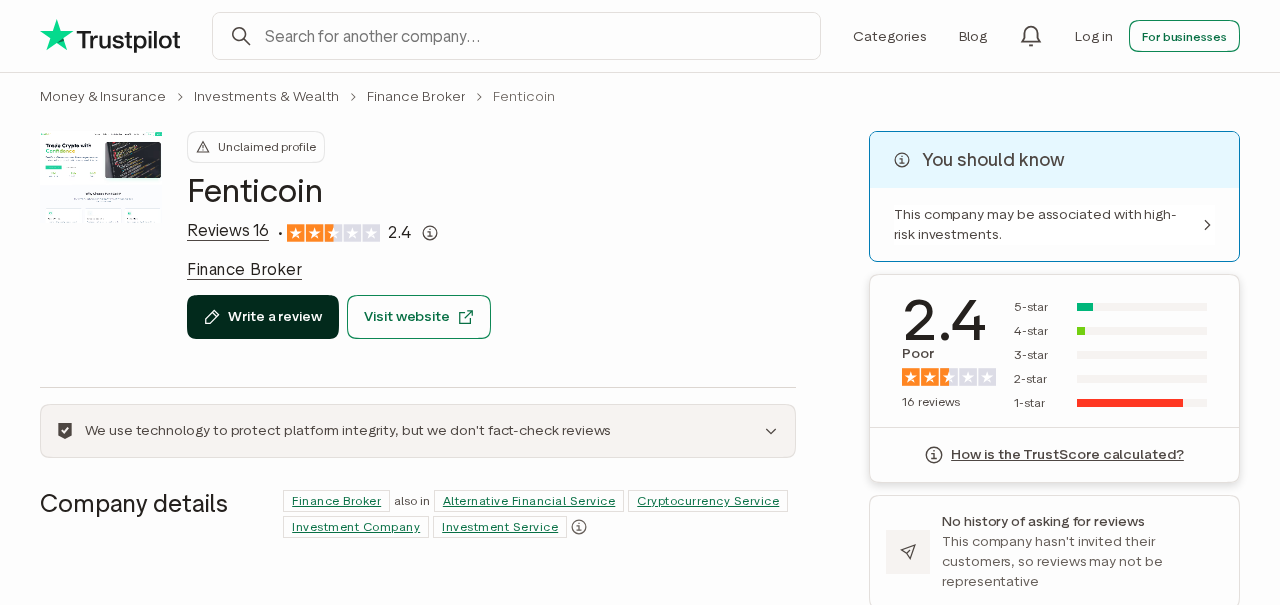
- 13 of its 16 Trustpilot reviews give one star, with warnings about lost deposits, demo-only wins and blocked withdrawals.
How the FentiCoin Scam Works
Step 1: A Promoter Shows Quick Profits
Trustpilot reviewers describe finding FentiCoin through TikTok videos. One says a TikTok promoter cost them 70 USD, and another says critical comments under promotional posts were deleted quickly.
Step 2: The Demo Account Wins
New users start in demo mode, where trades mostly win. “Once you switch to demo, all runs are wins,” one reviewer wrote after losing a 26 USD deposit.
That is not luck. A FentiCoin server function picks each result, and the code’s own fallback, used when that check fails, gives demo trades a 70% win rate.
Step 3: A Small First Deposit
Real deposits start small. The code sets a 17 USD minimum for mobile-money payments and converts the amount to Kenyan shillings for an M-Pesa push request on your phone.
Currency conversion is hard-coded too. The code uses a fixed 129.5 shillings to 1 USD for M-Pesa, so the deposit you approve is not priced at a live rate.
The payment screens also list Airtel Money for Kenya, Uganda, Tanzania, Rwanda, Malawi, Zambia and Nigeria. Prices can be shown in naira, cedis, rand, shillings and other African currencies.
Crypto deposits are offered too, in coins such as bitcoin, ether, Solana, XRP and BNB. A blockchain transfer is the hardest payment of all to reverse.
Step 4: Real Trades Start Losing
Its quick trades need at least 50 USD of balance. The outcome is fetched from a server function named “validate-bot-trade” before the trade animation starts.
If that function fails, real accounts get only a 20% chance of winning. Either way, the price line on screen is nudged to match the result already chosen.
A win adds 80% of the stake. A loss removes 100%. Even a fair coin flip on those terms drains an account, and FentiCoin’s own fallback odds are far worse.
Each trade closes after just ten seconds. That timing belongs to a betting game, not to an exchange where orders meet real buyers and sellers.
The market list does show genuine prices, pulled from Binance and CoinGecko. Those real numbers make the dashboard feel live, while the trades themselves never reach any market.
Step 5: Withdrawals Stall
Withdrawal minimums are 12 USD for mobile money, 25 USD for crypto and 30 USD for bank transfers. A 5% fee comes off the top of every request.
Before any payout, the code demands completed identity verification with a government ID and a selfie. It then deducts your balance at once and files the request as “pending”.
That identity step has its own cost. An anonymous operator ends up with a clear photo of your ID document and your face, which can be reused in other fraud.
Nothing in the code sends the money automatically. Requests wait as pending until someone on FentiCoin’s side approves them, which matches the reviews describing no payout at all.
The help center promises crypto withdrawals within one to two hours “after approval”. That phrase carries the whole risk, because approval is the step FentiCoin controls.
Step 6: Recovery Offers Follow the Losses
One Trustpilot review credits a “DP” with fund recovery, a pattern often used to advertise recovery services.
The Fine Print That Lets FentiCoin Hold Your Money
The terms give the platform wide room to stall. They reserve the right to “delay or refuse withdrawals if suspicious activity is detected” without defining what counts as suspicious.
Large withdrawals “may require manual approval”, and the terms allow restricting withdrawals during any “suspicious activity investigation”. Accounts can also be locked temporarily on the same grounds.
FentiCoin can also demand extra identity checks at any time. Each clause gives support staff a ready excuse when a customer asks where the money is.
Why FentiCoin Looks Convincing
The design is polished, with a dark mode, live-looking charts and a help center full of how-to articles. Real price feeds make the market list match genuine exchanges.
The terms borrow real exchange language, with long risk warnings about futures, liquidations and bot trading. Those warnings sound responsible, but they also shift every loss onto the customer.
Who Runs FentiCoin? Company, Address and Licence Checks
No Company Name Anywhere
The terms of service refer only to “FentiCoin” and say disputes follow “applicable laws” without naming a country. No registered company or registration number appears on any page.
An Address That Stops Mid-Line
The terms end with “Address: FentiCoin Headquarters” and nothing after it. The contact page offers only support@fenticoin.com and a web form promising 24-hour support.
The About page claims offices in Singapore, London, New York and Tokyo, with no street addresses. A June 2025 reviewer said an earlier version claimed an Empire State Building office.
A 2021 Story on a 2025 Domain
FentiCoin says it “was founded in 2021” by blockchain developers and financial experts. Its domain did not exist until May 2025, and the earliest archive copy dates from June 2025.
The About page still shows empty grey placeholders where team and office photos would go. Its leaders, “Sarah Johnson” and “Alex Chen”, have no photos or profile links.
A Template Built in an App Builder
The site loads a Lovable app-builder script and keeps accounts, balances and withdrawals in a hosted Supabase database. Its social icons link to bare Facebook and Twitter home pages.
None of that is illegal by itself. It does show a platform assembled quickly from off-the-shelf tools, not the infrastructure of an exchange with millions of users.
The trading bot screen even picks its strategy label at random from a list such as Momentum, RSI and MACD.
The careers page advertises equity options and unlimited paid vacation, at a company that never states its own name.
FentiCoin Timeline: From Registration to Ongoing Complaints
May 19, 2025: fenticoin.com is registered. The earliest archive copy follows on June 25, 2025, with the same app-builder site in place.
June 2025: the first Trustpilot reviews appear, including warnings about TikTok promotion and a 30 USD balance lost in minutes.
July to September 2025: one reviewer reports a bitcoin deposit that never arrived, and others ask whether anyone has managed a withdrawal.
December 2025: a reviewer describes winning only in demo mode. In October 2026 the site is still online and still accepting new accounts.
Is FentiCoin Regulated? Licence Checks and Warnings
FentiCoin says it works “closely with regulators” in every jurisdiction where it operates, but it names no licence. A genuine exchange publishes its licence numbers so customers can check them.
We found no regulator warning that names FentiCoin, and California’s DFPI Crypto Scam Tracker does not list it. A missing warning is not approval, since regulators list only reported platforms.
The FTC’s guide to cryptocurrency scams warns that “only scammers will guarantee profits or big returns” and that victims of fake investment sites often cannot withdraw their money at all.
Before using any trading platform, check your regulator’s register. In the US that means FINRA BrokerCheck and the NFA’s BASIC search. In the UK, it is the FCA register.
In Kenya, Nigeria and other targeted countries, check the national securities or capital markets regulator. A platform that cannot be found in any official register should not receive your money.
FentiCoin Reviews: What Depositors Report
FentiCoin’s Trustpilot profile is unclaimed and carries a notice that the company “may be associated with high-risk investments”. It holds 16 reviews with a TrustScore of 2.4.
One reviewer sent 30 USD in bitcoin that never reached the account and heard nothing from support. Another watched a 30 USD balance vanish within two minutes of real trading.
The few positive reviews are short. One praises the app as easy to navigate. Another claims a 600 USD profit paid to a mobile-money account, with no checkable detail.
FentiCoin Recovery Scams: Who Contacts Victims Next
After a loss, people offering to recover the money often appear in comment threads, inboxes and private messages. Some pose as hackers, lawyers or police units.
In August 2025 the FBI’s Internet Crime Complaint Center warned about fictitious law firms that contact crypto-scam victims and promise to recover funds for an upfront fee.
Paying a stranger a fee cannot reverse a blockchain transfer. Anyone asking for money, wallet access or remote control of your device is running a second scam.
Warning signs include a message that arrives soon after you post a complaint, a promise of guaranteed recovery and a fee or “tax” that must be paid first.
Requests to install remote-access apps or share a wallet recovery phrase are the clearest signs. No legitimate investigator needs either to file a report.
What to Do If You Deposited Money on FentiCoin
- Stop depositing. Do not pay any “withdrawal fee”, “tax” or “verification deposit”. Extra payments only increase the loss.
- Save your records. Keep M-Pesa or Airtel confirmation codes, crypto transaction IDs, wallet addresses, screenshots of your balance and every chat or email.
- Contact your payment provider. Tell your bank, card issuer or mobile-money provider that you paid a fraudulent trading site, and ask whether the payment can be disputed or flagged.
- Report it. In the US, report to IC3.gov and ReportFraud.ftc.gov. Elsewhere, report to your police cybercrime unit and your financial regulator.
- Protect your identity. If you uploaded an ID and selfie, watch for loans or accounts opened in your name. US residents can follow the recovery steps at IdentityTheft.gov.
- Change reused passwords. If your FentiCoin password is used anywhere else, change it there and turn on two-factor authentication.
- Ignore recovery offers. Block anyone who contacts you promising to retrieve your funds for a fee.
Related Fake Trading Platform Investigations
Our Coinplex investigation covers another “AI trading” platform whose balances could not be withdrawn.
The Stock Tips Group report shows how chat groups steer members into a fake crypto platform.
For the follow-up wave of fraud, read our report on fake police recovery ads on Facebook, which target people who already lost money.
Frequently Asked Questions
Is fenticoin.com legit?
No. A FentiCoin server function picks trade results in advance, its fallback code favours demo accounts over real ones, and withdrawals depend on manual approval.
Can you withdraw money from FentiCoin?
The site accepts withdrawal requests, deducts a 5% fee and removes the balance immediately. Payment then depends on a pending review, and reviewers report never being paid.
Why does the FentiCoin demo account always win?
Its fallback logic gives demo trades a 70% win chance and real trades only 20%. Winning practice runs are meant to persuade you to deposit.
Is FentiCoin regulated?
It names no licence and no company that a regulator’s register could confirm. A licensed exchange publishes both, along with the authority that supervises it.
Is FentiCoin a Kenyan platform?
It targets Kenya and neighbouring countries through M-Pesa and Airtel Money, but it publishes no Kenyan company or address. Its owners are unknown.
Can a recovery company get my FentiCoin money back?
Do not pay one. Recovery offers that demand upfront fees are a known follow-up scam, and nobody can guarantee a refund. Report the loss to police and your payment provider.
The Bottom Line
FentiCoin.com is not a working trading platform. It is a simulation that shows demo profits, decides real trades in advance and keeps every withdrawal under manual control.
Do not deposit, and do not pay to unlock a balance. If you already sent money, keep your records, report it and treat every recovery offer as a new risk.
This article is for educational purposes only and does not constitute professional, financial or legal advice. The content is intended for general information and should not be construed as definitive guidance. Information contained herein is subject to change without notice.  For concerns, please contact us via the provided form.
If you are the owner of the website or product in question and wish to offer clarifications regarding your business or website, please reach out to us through the provided Contact Form.

Reviews & discussion
0 commentsShare a firsthand experience, or ask a question.
Community reviews
fenticoin.com
Moderated reader experiences, not an editorial verdict.
Start the conversation
Have a question or something useful to share? Add the first comment.