

A small crowd has gathered, someone has just collected a win, and the right cap seems obvious. For a moment, stopping to watch feels harmless.
The bottle cap scam starts with that ordinary pause. Before you decide whether to play, it helps to understand who may already be controlling the scene.
Overview
A street bet dressed up as a simple challenge
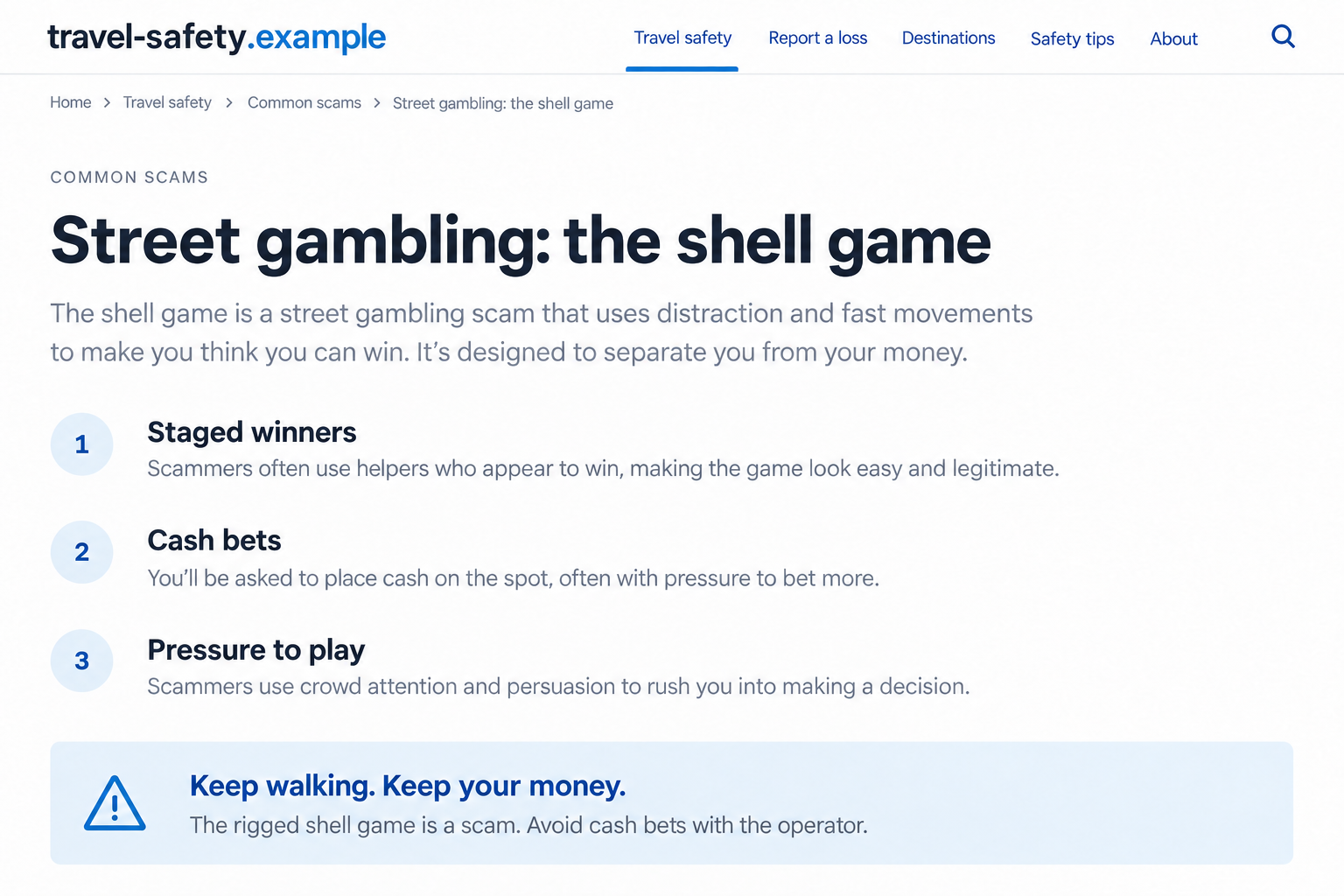
The bottle cap scam is a rigged version of the shell game. An operator moves small covers and invites passersby to bet on a hidden object’s location.
Caps, cups, or small boxes can serve the same role. Changing the props doesn’t change the deception: the victim is offered a contest the operator secretly controls.
The apparent task is visual. Keep track of the ball, choose correctly, and collect money. That description leaves out manipulation and the people helping sell the game.
Berlin Police’s visitor-safety guidance describes shell-game fraud as a group operation targeting tourists. It is not a fair lottery or an ordinary test of attention.
The spectators can be part of the offer
A cheering crowd makes the activity look established. A supposed stranger’s easy win can give a newcomer confidence before the newcomer has risked anything.
Some spectators may be genuine, but accomplices can imitate casual players. Their job is to make the game seem popular, winnable, and worth joining.
You don’t need to identify every person involved to make a safe decision. The person taking bets has no reason to give you an independently verifiable contest.
Watch the conduct, not anyone’s nationality, appearance, or accent. The warning is coordinated pressure around a cash wager, not a stereotype about who commits fraud.
The loss may extend beyond the stake
Cash placed on the game is the immediate risk. A distracting crowd can also expose a wallet, bag, or other belongings while attention stays on the covers.
Once an argument begins, personal safety becomes more important than proving you chose correctly. A dishonest operator doesn’t become trustworthy because you demand another demonstration.
- The attraction: an easy-looking choice and visible cash.
- The persuasion: apparent winners who may be working with the operator.
- The concealed advantage: control over the object, movement, and outcome.
- The safest response: don’t bet, don’t display money, and leave the group.
Why Watching a Winner Feels Like Evidence
You see a result without knowing the arrangement
Ordinarily, seeing someone receive money is useful information. Here, the payment may be a performance between people who share the same goal.
The newcomer sees a successful player. The operator sees an opportunity to make the next person believe the rules work exactly as described.
That is why following the ball more carefully doesn’t solve the main problem. The visible demonstration can differ from the contest offered after your money appears.
A person can also look independent while following the operator’s cues. You cannot confirm a stranger’s relationship to the game from a brief exchange on a sidewalk.
The invitation can turn embarrassment into a wager
Someone may ask you to point, help another player, or demonstrate that you noticed the answer. A small social interaction can pull you toward participation.
You might feel rude walking away after answering. You might also feel embarrassed when others insist the choice is obvious and you should back yourself.
Neither feeling creates an obligation. You are allowed to leave without explaining why, agreeing to a final round, or accepting a stranger’s description of the rules.
When money enters the conversation, pause before reaching for a wallet. The crowd’s approval has no bearing on whether the operator will honor a payment.
A near miss makes another attempt tempting
After losing, a player may believe they almost had it. That feeling can encourage a larger bet meant to erase the first loss.
For a simple illustration, losing $20 doesn’t become safer because another $40 could supposedly win it back. The second stake still goes to the same operator.
A rising bet also increases the pressure to stay. The more important the recovery feels, the easier it becomes to overlook the unfair setup.
The amount already lost is a reason to stop, not evidence that the next round will be different. You cannot repair an unfair contest by funding another round.
How the Bottle Cap Scam Works
Step 1: The setup attracts attention in a busy place
The activity begins where people can stop briefly: a busy pedestrian route, visitor area, or another location with a steady flow of passersby.
The arrangement looks uncomplicated. A few covers, a small hidden object, and an animated exchange are enough to make someone wonder what is happening.
You don’t need to approach closely to become interested. Laughter or a visible payout can reach people who would normally ignore a direct sales pitch.
Continue along your route before the activity becomes a conversation. You won’t lose a legitimate entitlement by declining an unsolicited street wager.
Step 2: Apparent players make winning look ordinary
A participant points to a cover and appears to win. Other people react as though the result was earned through ordinary observation.
Berlin’s official street-scam explanation describes accomplices posing as interested bystanders. Their apparent success encourages unsuspecting outsiders to join.
The visual story is appealing: if that person can do it, you can too. You may even believe you tracked the object more accurately.
But you are assessing a staged demonstration as though it were a transparent competition. The operator’s incentives and the participant’s independence remain unknown.
Someone else’s displayed winnings should therefore stay outside your decision. You cannot inspect the arrangement by counting how many times the crowd cheers.
Step 3: The invitation brings out real money
The operator or another participant encourages you to try. A confident choice is turned into a request for a stake.
This is the moment to refuse. Once cash leaves your control, you depend on the operator’s willingness to return it and apply the advertised rules.
Don’t accept a stranger’s claim that pointing already created a debt. Don’t let someone else place a bet on your behalf and insist you must reimburse them.
The aim of those claims would be to turn a casual interaction into a payment. You do not need a debate about the game to decline further involvement.
If someone blocks your departure or threatens you, treat that as a safety issue. Move toward staff, other safe public assistance, or police where available.
Step 4: The operator controls more than the shuffle
In the fraudulent version, the hidden object can be manipulated instead of merely moved. The player’s observation no longer determines a fair outcome.
You don’t need a lesson in sleight of hand. Once the operator secretly changes where the object can be found, your tracking skill isn’t the deciding factor.
The central advantage belongs to the person controlling the covers and the reveal. A correct-looking choice may still be dismissed when that person controls the demonstration.
Arguing about which cover you watched doesn’t restore independent oversight. Nor does a promise to move more slowly make the next round trustworthy.
What matters is the mismatch between the offered challenge and the actual arrangement. The victim risks real money while the operator controls the supposed evidence.
Step 5: The crowd keeps you engaged or makes leaving uncomfortable
After a loss, encouragement can shift toward another round. If you object, the atmosphere may become hostile rather than helpful.
Official Berlin guidance also warns about pickpocketing around the distraction. That is a possible additional risk, not proof that every person watching is a thief.
Don’t attempt to seize the operator’s cash, grab a cover, or follow the group. A cash dispute is not worth escalating into a confrontation.
Get out of the crowd first. From a safe spot, check your belongings and write down the location before discussing the loss with police.
The best outcome is not winning an argument in front of the crowd. It is preventing another payment and getting yourself and your companions to safety.
How to Leave Without Getting Pulled Back In
Use a short refusal
A simple “No, thank you” is enough. Long explanations give the person more openings to challenge your reasoning or promise a different arrangement.
Keep moving rather than waiting for approval. You can be polite without remaining available for a discussion about your eyesight, confidence, or willingness to take a chance.
If you’re with someone, use a brief signal to leave together. A companion trying to win back the group’s approval can accidentally prolong the interaction.
Keep the wallet closed
Don’t display cash to prove you could afford a bet. Don’t show a card or account balance to explain why you won’t participate.
Those details aren’t required to refuse. They may reveal what you carry and create a new opportunity for pressure or theft.
Likewise, don’t agree to visit an ATM because someone says only cash is accepted. A street invitation should not dictate where you withdraw money.
Don’t film at the expense of safety
Evidence can help, but filming a hostile group from close range can increase the risk. You don’t need a perfect recording before reporting a suspicious operation.
Remember the location and time once you are away. A nearby landmark, shop, or transit entrance can help describe the spot accurately.
Ask police how they want information submitted. Avoid posting allegations about an identifiable bystander whose role you cannot establish.
Helping a Friend Who Has Already Started Playing
Interrupt the decision, not the performance
Arguing with the operator can make your friend feel they must defend the bet. It may also keep both of you inside the group.
Instead, address your friend directly and suggest leaving together. A practical reason to step away can be easier to accept than a public lecture.
Once you’re out of the crowd, discuss what happened calmly. The goal is to stop further loss, not to establish who should have noticed first.
Offer support without funding another round
A friend may ask for a loan to recover the stake. Providing more betting money helps the same operation continue.
Offer help with transportation, reporting, or replacing essential items instead. Those actions address the problem without giving the operator another opportunity.
If someone feels embarrassed, remind them that staged winners and crowd pressure are deliberate tactics. Shame should not keep them from checking for theft.
Set a simple travel rule before the next outing
Agree that nobody in the group places an unsolicited street bet or follows a stranger to get money. The rule is easier to apply before pressure starts.
For children or teenagers, explain the difference between a performance and an invitation to pay. A lively scene can be interesting without being a fair contest.
Make leaving an acceptable choice. Nobody needs to prove cleverness to a person taking cash from passersby.
What to Do if You Have Fallen Victim to This Scam
Start with personal safety and the possibility of additional theft. A lost stake alone calls for a different response from a stolen wallet or unauthorized card payment.
-
Leave the group and stop betting. Move to a safer public place with your companions. Do not stay for a promised refund round or an argument.
If you are threatened, blocked, or hurt, seek urgent local assistance. Use the destination’s emergency service when the situation warrants it.
-
Check what is missing. Look for your wallet, identification, cards, travel documents, and other belongings once you’re away from the distraction.
Make a separate list of the gambling loss and any suspected theft. The distinction helps authorities and service providers understand what they need to address.
-
Write down the encounter. Record the place, approximate time, amount, props used, and how you were encouraged to participate.
Describe observed roles and actions rather than guesses about identities. Include whether there were threats, obstruction, or a separate attempt to take belongings.
-
Report the incident locally. Ask the relevant police service how to submit a fraud or theft report. Keep the reference number and any instructions.
In Berlin, the police visitor-safety page includes local contact guidance. Elsewhere, use that location’s official police information rather than a copied foreign number.
-
Protect missing payment cards promptly. Contact the issuer through a route you already trust if a wallet disappeared or a card was taken.
Explain which payments you made and which you didn’t authorize. A voluntary cash wager is not automatically an unauthorized card transaction eligible for reimbursement.
-
Ask about document and travel support where needed. Lost identification or a passport may require police records, consular help, or changes to travel plans.
If you hold travel insurance, check the actual terms and reporting requirements. Don’t assume every cash loss is covered or that a claim will be accepted.
-
Keep recovery offers out of the response. Don’t pay someone who approaches afterward claiming they can retrieve the stake for a fee.
Ask a trusted person to help organize the records if you’re overwhelmed. Practical support is more useful than another stranger’s promise of easy money.
Frequently Asked Questions
Is the bottle cap scam the same as the shell game?
Yes, the name describes a version using caps. Cups or boxes can serve the same purpose when the operator rigs the supposed challenge.
Can I beat it by watching more closely?
Not reliably. The fraudulent arrangement involves concealed manipulation and potentially staged participants. Better observation does not give you control over the reveal or payout.
Are the people winning always ordinary tourists?
No. Accomplices can pose as players and display staged winnings. Some observers may be uninvolved, so focus on the coordinated behavior rather than accusing everyone nearby.
Should I grab the cover to prove I was right?
No. That can escalate a hostile encounter. Leave safely, record what you remember, and let the relevant authorities decide how to investigate.
Will my bank refund the cash I wagered?
A voluntary cash stake isn’t automatically a disputable card charge. Contact the issuer if there was separate card theft or unauthorized activity, and explain the facts accurately.
Does watching carry any risk if I don’t bet?
A crowded distraction can expose belongings or draw you into pressure to participate. Keep your possessions secure and move on instead of joining the gathering.
The Bottom Line
Don’t bet on the bottle cap scam. The easy-looking choice hides an unfair setup, and a stranger’s displayed winnings don’t make it trustworthy.
If you lost money, leave the group, check for missing belongings, and report the incident locally. Another round is not a recovery plan.








