

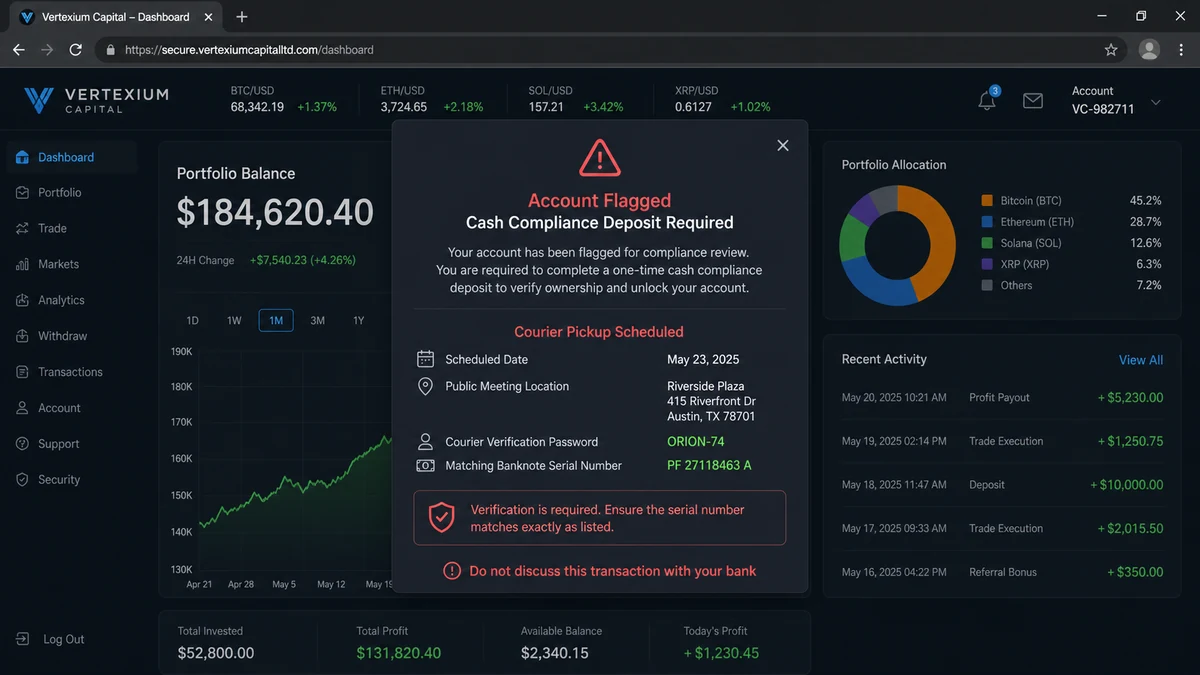
The investment dashboard shows months of steady gains. When a bank blocks the next transfer, the platform offers another route: withdraw cash, wait for an approved courier, and use a private code to confirm the pickup.
The stranger who arrives may present a matching password or the serial number from a specific banknote. The balance on the website rises soon after the cash changes hands.
That polished sequence is meant to make an extraordinary handoff feel like a controlled financial procedure.
Overview
The crypto cash courier scam is an investment fraud in which criminals persuade victims to hand physical cash to an in-person collector. The pickup is described as a deposit, compliance payment, withdrawal tax, account unlock, or protected way to continue investing after a bank rejects other transfers.
The FBI warned in June 2026 that scammers were using this method primarily against older victims. The online relationship and fake trading platform create belief, while the courier converts that belief into cash that can disappear without a normal account-to-account trail.
The investment exists only on the screen
The website may show deposits, trades, charts, bonuses, and large profits. Those figures are controlled by the operator. A rising balance does not demonstrate that cryptocurrency was purchased, held, or traded on the victim’s behalf.
The platform can add the exact amount collected by the courier within minutes. That apparent confirmation proves only that the scammer updated a database after receiving notice of the pickup.
The courier is part of the payment system
The collector may be a knowing participant, a recruited money mule, or another person being manipulated. A password, receipt, vest, badge, or matching banknote serial number can make the meeting feel organized without creating consumer protection.
Legitimate retail investment platforms do not send strangers to a customer’s home or a parking lot to collect envelopes of cash. That single instruction is enough to stop the transaction.
The withdrawal problem was designed from the beginning
Victims are allowed to see profits but not to remove them. When a withdrawal is requested, the account becomes flagged or supposedly owes tax, insurance, liquidity verification, anti-money-laundering clearance, or a security deposit.
Paying does not clear the balance because there is no real balance to release. The next fee repeats the cycle, sometimes with another courier pickup.
Red flags include:
- An unsolicited romantic, business, or investment contact slowly introduces cryptocurrency.
- The person chooses the platform and sends the registration link.
- The website displays smooth profits regardless of market conditions.
- Small early withdrawals are used to establish trust.
- The bank blocks a transfer and the contact criticizes the bank for interfering.
- The platform says an account is flagged but requires more money to unlock it.
- A stranger is scheduled to collect cash at a home or public location.
- A code or banknote serial number is used to authenticate the courier.
- The victim is told not to discuss the pickup with family, police, or bank staff.
- Each payment creates a new tax, penalty, or compliance requirement.
How the Crypto Cash Courier Scam Works
Step 1: A stranger creates a reason to keep talking
The first contact may be a wrong-number text, a social media message, a romantic approach, or a supposed investment expert. The scammer does not always mention money immediately. Regular conversation is used to establish familiarity and learn about savings, family, and financial concerns.
Love bombing can accelerate trust through constant attention, praise, and imagined plans. A business persona may use market commentary, screenshots, and confident terminology instead.
Step 2: The relationship introduces a private trading opportunity
The contact describes a successful crypto strategy, inside method, mentor, or limited platform. The victim is instructed to register through a supplied link and may be guided through every screen.
The site can look like an exchange, but account creation happened inside infrastructure controlled by the criminal group. Our fake online investment adviser report shows why a familiar coin price or live chart does not prove that orders reach a real market.
Step 3: Early deposits appear to grow
The victim sends a wire, bank transfer, payment-app transfer, or cryptocurrency. The dashboard credits the deposit and begins showing gains. Some operations permit a small withdrawal because a modest payout can unlock a much larger second deposit.
The relationship contact celebrates the result and encourages retirement funds, savings, loans, or asset sales. The numbers on screen can be adjusted to match whatever amount will create the strongest pressure.
Step 4: Banks begin questioning or blocking transfers
A bank may identify unusual beneficiaries, large wires, repeated crypto purchases, or a sudden change in behavior. The scammer frames that protection as ignorance, hostility to cryptocurrency, or an attempt to keep the victim from becoming financially independent.
The victim may be coached on what to tell staff. A script about buying a car, paying a contractor, helping family, or holding cash for personal use is designed to bypass questions.
Step 5: The platform demands cash as the alternative
Once normal transfers become difficult, the account is supposedly flagged. The operator says a cash deposit will verify ownership, satisfy compliance, or preserve the profitable position.
Another version says taxes or penalties must be paid before withdrawal. The fee cannot be deducted from the displayed balance because that balance is fictional.
Step 6: A courier pickup is arranged
The victim obtains cash and shares an address or meeting point. The scammer sets a time and provides a code. According to the FBI warning, the authentication may use a password or a U.S. banknote serial number that the courier shows on arrival.
This ritual gives the collector a professional appearance. It does not identify a regulated firm, create a deposit record, or protect the cash.
Step 7: The fake dashboard confirms the handoff
After the courier leaves, the platform balance increases. The victim sees the pickup apparently settle like a real deposit and may agree to repeat it.
No independent custodian confirms the transaction. The same people who arranged the collection control the number displayed as the portfolio.
Step 8: A withdrawal triggers more pickups
When the victim finally tries to withdraw profits, a new obstacle appears. Taxes, fines, account insurance, blockchain validation, or a final security reserve must be paid first.
The cycle continues while money remains available. If the victim stops, another person may pose as police, a lawyer, or a recovery firm. The XMoney deepfake investment case shows how recovery contact can follow the original theft.
Why the Code and Banknote Do Not Make the Courier Safe
A shared secret proves only that the courier and remote operator communicated. Criminal organizations can coordinate passwords as easily as a legitimate delivery company can.
The banknote serial trick is particularly theatrical. The scammer gives one person a serial number and tells the other person to present the matching note. The match feels too specific to be fake, yet it provides no legal identity and no accountable custody.
A badge or receipt has the same limitation. It can be printed from information controlled by the operation. The useful evidence is the courier’s appearance, vehicle, meeting location, communications, and pickup time, all preserved for police rather than used to justify the handoff.
How Banks and Families Can Interrupt the Pickup
A large cash withdrawal may be the last point where the money remains inside a regulated institution. Bank staff cannot know every customer’s plans, but questions about purpose, recent online contacts, secrecy, and a waiting courier can surface a story that deserves a pause.
The scammer anticipates those questions and may stay on the telephone throughout the branch visit. They can tell the victim to claim the cash is for a vehicle, construction, family, or personal storage. The cover story protects the scam, not the victim’s privacy.
Family members may notice repeated bank trips, unusual secrecy, a new online relationship, crypto discussions, or anxiety about an account that cannot be unlocked. Respond with calm questions. Ridicule can push the victim back toward the person offering reassurance.
Ask to see the withdrawal process rather than debating whether cryptocurrency can be profitable. The decisive facts are often simpler: a stranger chose the platform, displayed returns cannot be withdrawn, and more money must be handed to an unknown collector.
If a pickup is scheduled, do not stage a confrontation. Contact police, provide the location and timing, and follow their directions. The collector’s role and risk are unknown, and protecting the victim is more important than preserving the meeting.
Useful questions include:
- Who first introduced the platform, and have you met that person?
- Can the company be found in an official regulatory register?
- Has a meaningful withdrawal reached your own bank account?
- Why can the required charge not come from the displayed balance?
- Why must the payment be cash rather than a traceable business transaction?
- Why is the recipient a courier instead of the registered investment firm?
- Why were you told what to say to bank staff?
- What happens if you stop and verify for 48 hours?
The last question is powerful because a legitimate investment survives a short review. The scammer may claim that markets, taxes, or law enforcement make delay impossible. That urgency exists to prevent the victim from checking the company and discussing the pickup.
Banks and relatives should document the contact even if the victim refuses help. Platform names, domains, telephone numbers, chat handles, withdrawal dates, and planned meetings may become important if the fraud continues.
The victim may believe stopping now sacrifices the displayed profit. In reality, the dashboard can show any amount. Preserving remaining cash is a successful outcome, even when the fictional balance continues rising on screen.
Do not ask the online contact to prove legitimacy by sending another screenshot. The operator controls the app, documents, and supposed customer service. Verification must leave that closed system and reach regulators, banks, and records found independently.
If the victim has borrowed against a home, retirement account, or credit line, notify those institutions too. Preventing an approved loan from reaching the courier may still protect funds even after the borrowing process began.
How to Verify a Crypto Investment Before Sending Money
- Remove the recommendation link and search the exact domain independently.
- Check whether the platform and named professionals are registered with the appropriate regulator.
- Search the URL, company name, contact details, interface screenshots, and withdrawal language.
- Confirm where assets are actually held and whether blockchain transfers can be verified.
- Ask why a fee cannot be deducted from the alleged balance.
- Discuss the investment with an independent licensed adviser or trusted family member.
- Stop immediately if cash, secrecy, coached bank answers, or an in-person courier appears.
A convincing platform can fabricate profit. A regulated identity, independent custody, withdrawal history, and verifiable transaction trail are harder to fake together.
Try a withdrawal before increasing any position, but do not treat one small payout as proof. Investment-fraud operations sometimes release a modest amount because it makes a later request for savings or retirement funds feel safer.
Bank resistance is another moment to pause. Staff may not know every detail of the platform, yet an unusual wire or cash withdrawal can still activate useful controls. A genuine adviser will not coach a customer to lie about the purpose.
Never invite an unknown collector to a home. Beyond financial loss, the pickup reveals where the victim lives and may expose other valuables. Contact police rather than attempting to identify or detain the person yourself.
Company, Address, and Fulfillment Checks
The platform company may exist only on its own pages
A polished footer can list a company number, regulator logo, and office address copied from an unrelated business. Verify each fact at the regulator or corporate registry rather than through links supplied by the platform.
The courier may not reveal the organizer
The collector can receive instructions shortly before the meeting and may know only a code and destination. That is why vehicle details, video, messages, timing, and the exact cash amount can matter to investigators.
The pickup address is not an investment office
A home, parking lot, hotel lobby, shopping center, or roadside meeting place offers no custody protection. Even a professional office should be verified independently before cash or documents are delivered.
The cash never purchases the displayed portfolio
The operation may show a deposit receipt and add funds to the dashboard, but it does not provide independently verifiable ownership of cryptocurrency. The website’s number is the claimed fulfillment, and the same operator can erase it at any time.
What to Do if You Have Fallen Victim to This Scam
- Do not arrange another pickup. Do not confront a courier yourself. If a meeting is pending, contact local police and follow their instructions.
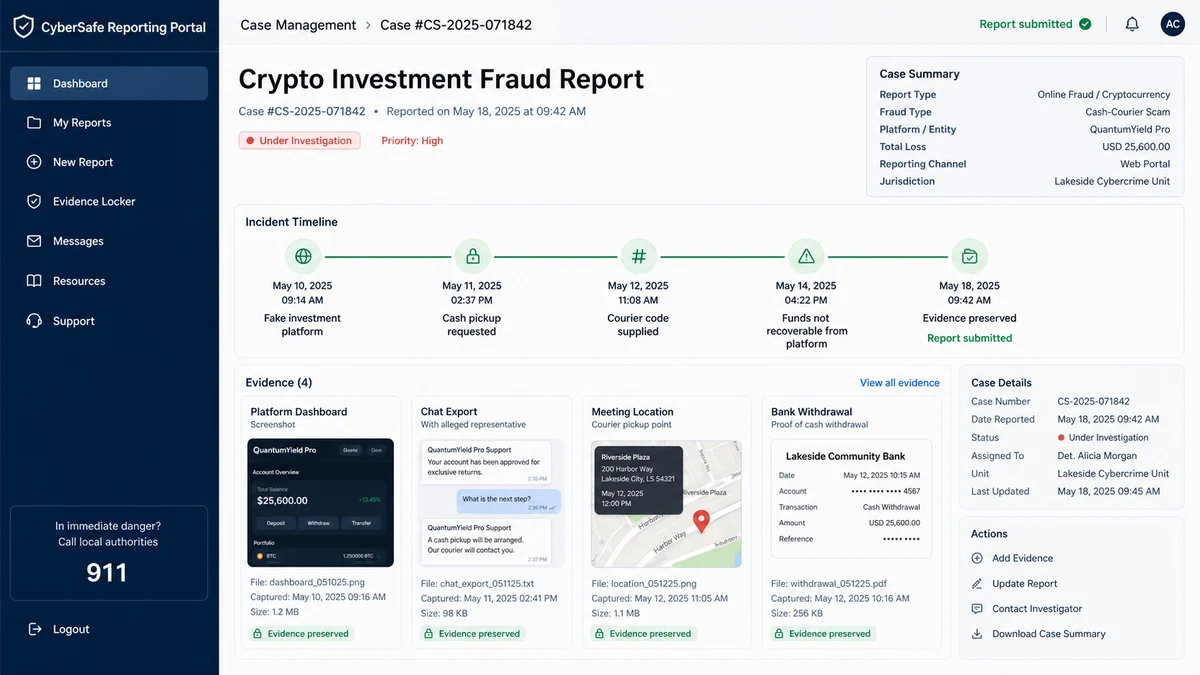
- Call local law enforcement. Provide the pickup location, time, code, vehicle details, video, photographs, messages, and cash amount.
- Contact every financial institution involved. Report wires, transfers, crypto purchases, loans, and large cash withdrawals connected with the scheme.
- File a detailed IC3 complaint. Include the platform URL, application, profiles, telephone numbers, emails, wallet addresses, bank accounts, courier descriptions, and all payment dates.
- Preserve the dashboard without adding funds. Save screenshots, account numbers, transaction pages, chats, and error messages. Do not log in from new devices after passwords are changed.
- Secure email and financial accounts. Change unique passwords from a clean device, revoke sessions, and enable strong multifactor authentication.
- Warn the bank about coaching. Correct any false explanation the scammer told you to give. Accurate information helps the fraud team understand the transaction pattern.
- Run a complete Malwarebytes scan. Scan any device used to install the platform app, open attachments, or grant remote access. Remove untrusted remote-support software.
- Use AdGuard after cleanup. It can help block some known malicious sites, but it cannot confirm an investment or stop an in-person collection.
- Protect identity documents. Use IdentityTheft.gov and consider credit freezes if licenses, passports, Social Security information, or bank statements were shared.
- Tell family or a trusted adviser. Continued secrecy benefits the operation. Another person can help review messages and protect remaining assets.
- Ignore recovery guarantees. A stranger who claims to track the courier or recover the crypto for an upfront payment is likely starting another scam.
Older victims who need help filing can contact the Department of Justice National Elder Fraud Hotline at 833-372-8311. If a courier is expected at a home, personal safety takes priority over collecting additional evidence.
Frequently Asked Questions
Do legitimate crypto platforms collect cash by courier?
Reputable retail investment platforms do not send strangers to homes or public meeting points for cash deposits. An instruction to prepare an envelope for a courier is a decisive fraud warning.
Why did the balance increase after the cash pickup?
The operator controls the dashboard and can type in any deposit or profit. The increase is not independent settlement evidence and does not prove cryptocurrency was purchased.
Could the courier be another victim?
Possibly. Some collectors knowingly participate, while others may be recruited through jobs, romance, debt, or money-mule schemes. Do not confront the person. Give evidence to police.
Does a matching password prove the courier is authorized?
It proves only that the remote scammer shared the same information with both sides. A password or banknote serial number does not create a regulated financial relationship.
Can I pay the tax and then withdraw everything?
No legitimate withdrawal tax is paid to an unknown courier because a website says so. Scam platforms invent taxes and penalties precisely when a victim asks to withdraw. Another payment normally produces another obstacle.
What if the investment originally came from a romantic partner?
End financial contact and verify the identity independently. Romance can be the trust-building layer of the same investment fraud. The length or intimacy of the conversation does not authenticate the platform.
The Bottom Line
The crypto cash courier scam combines a digital illusion with a physical handoff. Fake profits keep the victim hopeful, while the courier removes cash beyond the bank’s normal transfer controls.
No investment account needs a stranger at your door, a secret code, or a matching banknote. Stop when the pickup is proposed and contact police if one has already been arranged.
If cash was collected, preserve the online and physical evidence together. The platform, messages, withdrawal story, meeting details, and payment trail describe one operation, not separate problems.

Join the discussion
0 commentsShare your experience or ask a question about this article.
Discussion
Start the conversation
Have a question or something useful to share? Add the first comment.