

The pitch is almost irresistible: Elon Musk has supposedly launched a secret AI trading system, only 50 people can join, and a $200 deposit could produce $3,000 in a single week. If the software fails, Musk will allegedly hand you $100,000 from his own pocket.
That is the story being sold by XMoney—and every part of it is engineered to overpower common sense. The offer uses a fake social media post, a manipulated celebrity video, impossible profit claims, and manufactured urgency to funnel potential victims toward an investment operation with no demonstrated connection to Elon Musk, X, Tesla, or SpaceX.
Overview
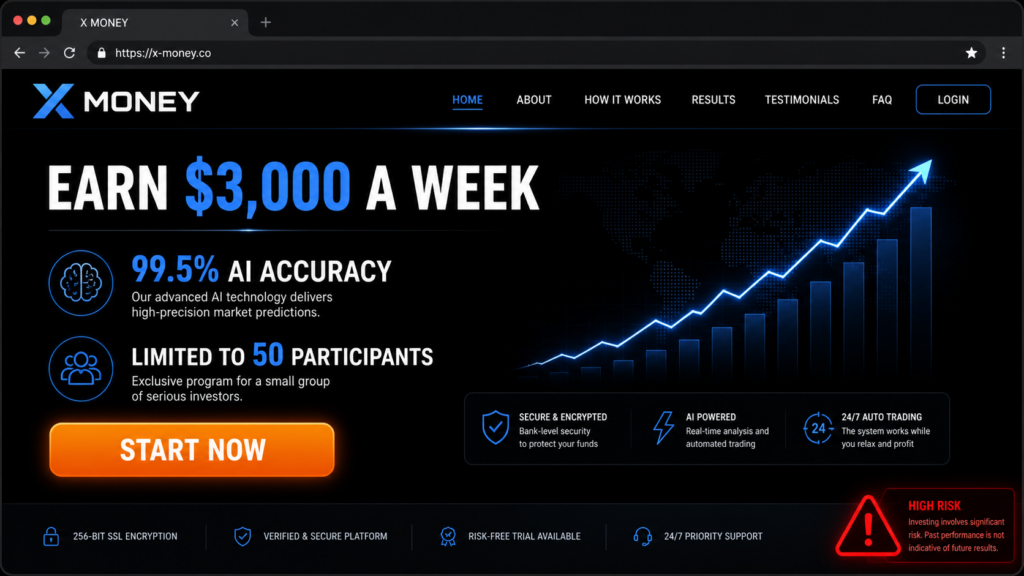
The XMoney scam appeared on X-Money.live in July 2026, wrapped in the name and visual identity of X Money. That choice was deliberate. X Money is associated with genuine financial ambitions surrounding the X platform, so the domain did not need to invent an entirely new story. It borrowed a recognizable name, attached Elon Musk’s face to it, and transformed public curiosity into a weapon.
The page presented the offer as a rare launch rather than an ordinary investment. Only the first 50 participants would supposedly be accepted, and each one was promised the opportunity to earn at least $3,000 during the first week. Anyone who failed to hit that target would allegedly receive $100,000 directly from Musk.
The guarantee is not merely unrealistic; it exposes the entire pitch. A $200 starting balance would need to grow fifteenfold in seven days, while the person promoting the system would somehow agree to pay six figures whenever that extraordinary return failed to materialize. No legitimate trading firm, regulated broker, or responsible public figure makes an open-ended promise like that through an anonymous landing page.
The website then attributed a lengthy statement to Musk, claiming he had created an artificial-intelligence platform capable of generating passive income for ordinary people. No experience was required, no training was necessary, and users supposedly did not even need to understand how trading worked. The AI would analyze the market, select the right opportunities, and execute profitable trades on their behalf.
To make that fantasy sound technical, the page referred to neural networks and claimed an accuracy rate of 99.5%. Elsewhere, the number slipped to 99%, but the message remained the same: the system almost never lost, risk was virtually nonexistent, and the AI consistently closed positions at a profit.
Those changing percentages are not evidence of performance. They are advertising numbers chosen because they sound close enough to perfection to eliminate fear without using the word “guaranteed” in every sentence. Real investment results require independently audited records, clearly defined testing periods, fees, drawdowns, risk measurements, custody details, counterparty disclosures, and an identifiable regulated company. X-Money.live supplied none of them.
Instead, the page claimed Americans had already earned more than $870 million through the system and that people beginning with only $200 averaged $3,000 during their first week. There were no audited financial statements, no verifiable customer accounts, no registered investment entity, and no transparent explanation of the alleged strategy behind those enormous returns.
The numbers were included not to inform visitors but to make hesitation feel expensive.
The Elon Musk endorsement is the centerpiece of the illusion
The page displayed what appeared to be a post published by Elon Musk on X. It copied the familiar ingredients of a genuine social media post: his name and profile photo, a verification symbol, translated text, reaction counts, and visible engagement. To a visitor moving quickly on a phone, the imitation could feel convincing enough to earn the next few seconds of attention.
The site also used a video that appeared to show Musk speaking about the platform. Manipulated lip movement, translated narration, edited footage, or AI-generated audio made it seem as if he had personally endorsed XMoney. The visual did not need to survive forensic analysis. It only needed to look authentic long enough for the viewer to accept the story and continue scrolling.
That is what makes modern celebrity impersonation scams so dangerous. A familiar face and recognizable voice once felt like strong proof, but criminals can now combine real footage, synthetic speech, altered mouth movements, fabricated subtitles, and cloned websites into a polished endorsement that never happened.
The FBI has warned that criminals use generative AI to create videos of public figures for investment fraud. The SEC, FINRA, and state regulators have issued similar warnings about deepfake audio, fake websites, cloned voices, and celebrity imagery being used to give fraudulent opportunities a veneer of legitimacy.
This original MalwareTips illustration shows how a synthetic endorsement, invented AI performance claim, and fake trading dashboard can work together to make an anonymous investment funnel look credible.
Musk is an especially powerful choice for this type of impersonation. He is closely associated with technology, artificial intelligence, cryptocurrency discussions, and the X platform. Once his face is placed beside a futuristic trading claim, the scam no longer has to explain how the supposed system works. His stolen identity does the heavy lifting.
The registration form is where the real operation begins
After surrounding visitors with earnings claims, scarcity messages, fabricated comments, and celebrity imagery, the page asks for a name, email address, and phone number. A consent box for personal-data processing appears preselected, making submission feel like a routine final step rather than the start of a high-pressure sales funnel.
The page does not need to take money immediately to be dangerous. Anyone who completes the form has identified themselves as interested in a high-return investment and has supplied the exact contact details needed for aggressive follow-up. To a fraudulent lead operation, that information has value.
The next contact may arrive through a phone call, email, text message, WhatsApp, Telegram, or a redirect to another website. The person on the other end may introduce themselves as an account manager, onboarding specialist, broker, analyst, or financial adviser. They may sound calm and professional, refer to the exact ad the visitor saw, and behave as though an account has already been reserved.
MalwareTips did not submit the form or transfer funds. The live domain was blocked during our August 10, 2026 verification, so the precise broker, payment processor, or destination presented to every visitor could not be confirmed.
The surrounding setup, however, closely follows a well-established investment scam pattern. Fraudulent platforms commonly begin with a modest deposit, display rapid gains on a controlled dashboard, pressure the victim to invest more, and then block withdrawals unless additional fees are paid.
Signs of a recycled international scam funnel
The XMoney page also contained details that did not fit its supposed American audience. The fake X post included Russian-language material and a translated-post label, while comments featured names such as Sergey, Alexey, Andrey, Denis, Roman, and Valeria.
These inconsistencies strongly suggest a funnel that was translated, relabeled, or recycled across multiple regions. The structure can remain almost identical while operators swap the celebrity, currency, language, domain, and supposed investment product. One version may use Elon Musk and X Money; another may feature a television personality, politician, or well-known entrepreneur.
The legal pages offered little reassurance. Links labeled as terms and privacy information reportedly returned users to the registration area instead of supplying meaningful company disclosures. A genuine investment service should clearly identify its legal operator, jurisdiction, regulatory status, fees, risk disclosures, custody arrangements, withdrawal rules, and complaint procedures. None of those essentials can be replaced by a celebrity video or an impressive-looking logo.
XMoney scam warning signs
- X-Money.live is not an official corporate domain belonging to X.
- The page presents an unverified offer as an Elon Musk project.
- Access is supposedly restricted to the first 50 participants.
- A $200 deposit allegedly produces an average of $3,000 in one week.
- Musk supposedly pays $100,000 personally if the system fails.
- The AI is advertised with conflicting accuracy figures of 99% and 99.5%.
- The page suggests trading is virtually risk-free.
- It claims Americans have earned more than $870 million without audited proof.
- A manipulated or deepfake Elon Musk video is used as evidence.
- A fabricated X post includes suspicious engagement and translated content.
- The form collects personal contact details before identifying a regulated operator.
- The data-processing consent box is preselected.
- Names and languages on the page do not match the stated target market.
- The legal links fail to provide meaningful independent verification.
Investor.gov’s AI and investment fraud alert warns that bad actors use deepfake videos, cloned voices, fake websites, and celebrity imagery to promote fraudulent schemes.
How the XMoney Operation Works
XMoney combines three themes that are exceptionally effective online: the authority of a famous technology leader, the fear of missing a major financial launch, and the belief that artificial intelligence can produce results ordinary investors cannot. The landing page is only the opening act. Its real purpose is to create trust, capture a qualified lead, and prepare that person for a much larger financial loss.
1. A social media ad announces a secret X Money launch
The first contact is usually an ad, post, video, or imitation news story suggesting that Elon Musk has quietly opened a new wealth platform to the public. The X Money name gives the claim a thread of reality because visitors may already have seen genuine reporting about payments or financial services connected to X.
This is how the scam survives a quick search. A visitor looks up “X Money,” sees legitimate discussion around the brand, and mistakes that general connection for proof that the specific trading offer is real. The authentic news does not validate X-Money.live, but it makes the invented story feel plausible.
2. The offer turns hesitation into fear of missing out
The page says only 50 people can participate. That artificial limit changes the visitor’s mindset: instead of asking whether the platform is legitimate, they begin wondering whether they will lose their place by taking time to investigate.
Scarcity also makes the offer feel private, prestigious, and unusually valuable. Yet a legitimate regulated professional should welcome careful questions and allow time to review documents, verify registrations, understand fees, and consider the risks. Urgency is not proof of exclusivity; in investment fraud, it is often a method of preventing scrutiny.
3. The $100,000 guarantee makes failure sound profitable
The alleged personal guarantee from Musk is the most audacious part of the pitch. If the platform succeeds, the user supposedly earns thousands. If it fails, they supposedly receive $100,000. The story is designed to erase the possibility of a bad outcome altogether.
But a promise printed on an anonymous webpage is not an enforceable guarantee from Musk, X, or a regulated institution. There is no verified contract, no identified guarantor, and no transparent process for making a claim. The six-figure figure exists only to suppress doubt and make a $200 payment feel trivial.
4. AI jargon disguises an impossible financial promise
The page claims neural networks analyze enormous amounts of market data and automatically select profitable trades. Because AI can perform complex and impressive tasks, the offer encourages visitors to believe it can also eliminate uncertainty from investing.
AI cannot eliminate the realities of financial markets: models make mistakes, prices react to unpredictable events, liquidity can vanish, fees can erase gains, and counterparties can fail. Even a sophisticated strategy can go through losing periods, so the phrase “powered by AI” does not transform an unverified return into a credible one.
5. The deepfake becomes the proof visitors want to see
Once viewers see Musk apparently speaking, the rest of the page feels easier to believe. Translated narration can hide mismatched lips, unnatural pacing, cloned audio, or cuts taken from an unrelated interview. Familiarity fills in the gaps that the manipulation fails to perfect.
The video is most effective on people who already hope the opportunity is genuine. Instead of examining every frame, they treat the famous face as confirmation and move forward. That psychological shortcut is exactly what the scam is built to exploit.
6. Fabricated profits and comments manufacture a crowd
The page adds enormous earnings totals, enthusiastic comments, impressive reaction counts, and stories from supposed users. These details create the appearance that thousands of people have already tested the system and profited.
Nothing displayed inside a webpage proves that a real person wrote a comment, opened an account, placed a trade, or completed a withdrawal. Every name, balance, reaction, and testimonial can be inserted by the same operator who controls the site. What looks like public consensus may be nothing more than text in a template.
7. The form turns curiosity into a sales lead
Once the visitor submits their information, the anonymous webpage becomes a direct-contact operation. Leads can be sorted by country, language, phone number, advertising campaign, or apparent level of interest before being assigned or sold to a caller.
The caller may know the visitor’s name, the promotion they viewed, and the amount advertised as the minimum deposit. That familiarity can make the conversation feel official, but it comes from the completed form and tracking data—not from any relationship with Elon Musk or X.
8. A small first deposit tests how far the victim will go
The alleged account manager typically asks for an initial payment of around $200 or $250. The figure is low enough to seem recoverable and matches the amount advertised on the landing page, which makes the request feel consistent rather than suspicious.
Payment instructions may involve a bank card, wire transfer, payment service, cryptocurrency exchange, or company name the victim has never seen before. Once the payment is complete, the victim may receive credentials for a dashboard that appears to show trades and a rapidly increasing balance.
9. The dashboard transforms fake numbers into real pressure
A balance displayed by an unregulated website is not proof that securities, currencies, or crypto assets were ever purchased. If the operator controls the dashboard, it can type in any profit, transaction history, or account value it wants.
The apparent success gives the caller a powerful argument for a larger deposit. Victims may be told that more money unlocks premium AI settings, higher-yield trades, a matching bonus, insured positions, VIP status, or access to an urgent market event. The first fake profit is bait for the second, much larger payment.
10. A withdrawal request triggers a new financial trap
The illusion often breaks when the victim tries to take money out. Instead of processing the withdrawal, the platform may demand a tax, verification charge, commission, insurance payment, liquidity contribution, or anti-money-laundering fee. Each payment is described as the final obstacle.
It is rarely the last demand. Once one fee is paid, another can appear because the displayed balance was never real money waiting to be released. Legitimate taxes are not normally sent to an anonymous broker to unlock a fictional account, and an additional deposit cannot turn fabricated dashboard figures into recoverable funds.
11. Recovery scammers arrive when the victim is most vulnerable
The fraud may continue even after the original operators disappear. Victim details can be retained, traded, or passed to another group. Weeks or months later, someone may claim to represent a regulator, law firm, blockchain investigation company, or recovery service that has miraculously located the missing funds.
The new caller may know precise details about the original loss, making the approach feel credible. If they require an advance fee, a crypto payment, remote access, or a wallet connection before releasing the supposed recovery, it is another scam. Genuine law-enforcement agencies do not charge victims a private fee to return seized money.
What to Do If You Have Fallen Victim
Discovering that an investment platform may be fraudulent can be overwhelming, particularly after a caller has spent days or weeks building trust. The priority is not to argue with the operator or recover the loss through one more payment. It is to stop the flow of money, protect every exposed account, and preserve evidence while transactions and communications are still recent.
- Stop sending money immediately. Do not pay taxes, verification charges, insurance, commissions, upgrades, or withdrawal fees. Another transfer will not unlock a fake balance or turn the platform into a legitimate investment.
- Contact the payment provider without delay. Call the bank, card issuer, wire service, crypto exchange, or payment app through a number obtained independently. Explain that the payment funded an impersonation investment scam and ask about recalls, reversals, disputes, and account-protection measures.
- Notify the sending cryptocurrency exchange. Provide the transaction hash, destination wallet, amount, and time of transfer. Blockchain transactions are usually irreversible, but rapid reporting may help an exchange flag the address, preserve records, or respond to law enforcement.
- Preserve the entire trail. Save the advertisement, website address, fake Musk video, account dashboard, displayed balances, payment instructions, wallet addresses, transaction hashes, bank records, emails, phone numbers, and names used by callers.
- Export chats before blocking anyone. Do not delete WhatsApp, Telegram, SMS, or email conversations until copies have been saved. Dates, payment requests, links, and account identifiers may help investigators connect the operation to other complaints.
- Secure email and financial accounts. Change reused or exposed passwords, enable two-factor authentication, verify recovery addresses and phone numbers, review recent activity, and sign out sessions you do not recognize.
- Remove any remote-access software. If a caller installed AnyDesk, TeamViewer, RustDesk, or a similar program, disconnect the device, uninstall the software, and arrange a security check. Change important passwords from a clean device.
- Report exposed identity documents. If you uploaded a passport, driver’s license, bank statement, card image, or selfie, tell the relevant bank and identity authorities. Ask what monitoring, replacement, or account changes are appropriate.
- Consider a credit freeze. U.S. victims who disclosed identity information can place free freezes with Equifax, Experian, and TransUnion, then review their credit reports through AnnualCreditReport.com.
- Submit a report to IC3. File a detailed complaint at IC3.gov and include every known domain, payment route, wallet, transaction, phone number, email address, and alias.
- Report securities-related conduct. U.S. investors can send information to the SEC and use Investor.gov to check whether a professional or firm is registered.
- Reject unsolicited recovery offers. Do not pay anyone who contacts you unexpectedly and claims to have recovered the money. Preserve the new messages and share them with the agency or investigator handling the original report.
- Tell someone you trust. Scammers rely on embarrassment and secrecy to keep victims isolated. A family member, attorney, financial adviser, or victim-support organization can help document what happened and make the next decisions calmly.
The FBI’s investment fraud guidance explains that fraudulent platforms may display lucrative returns to persuade victims to invest more, while emphasizing a truth the XMoney pitch tries to bury: there is no guaranteed return on investment.
Once the incident has been reported, do not continue negotiating with the supposed broker. Every new conversation gives the operator another chance to invent an emergency, manufacture a fee, or extract more personal information.
The Bottom Line
X-Money.live was not Elon Musk’s investment platform. Its $3,000 weekly profit, $100,000 personal guarantee, 99.5% AI accuracy rate, fabricated social media post, and manipulated celebrity video were components of the same illusion—an illusion built to capture personal details, manufacture trust, and move victims toward a deposit.
No celebrity face, blue verification badge, AI buzzword, trading dashboard, or enormous on-screen balance can replace independent verification. When an anonymous website promises extraordinary returns with almost no risk and pressures visitors to act before the opportunity disappears, the urgency is not a reason to invest. It is the reason to stop.
If you already submitted information or sent money, cut off further payments, contact every financial provider involved, secure your accounts, preserve the evidence, and report the operation immediately.

Join the discussion
0 commentsShare your experience or ask a question about this article.
Discussion
Start the conversation
Have a question or something useful to share? Add the first comment.