


Trusted Finance Refund sounds like a service that gets your money back, so we opened its website expecting a fee-first recovery pitch and found a full retail bank instead.
That bank claims a 1985 founding and an FDIC badge, yet our checks found a domain from June 2026, a routing number from Virginia and no charter anywhere.
Overview
What Trusted Finance Refund Presents
We read trustedfinancerefund.com as a visitor would and found savings and checking accounts, credit cards, loans, a mobile app, a $200 new-account bonus and a Grants & Aid section.
The home page calls the company a full-service credit union owned by its members, and the About page counts 50K+ customers, $2.5B in assets and 25 branch locations.
What the Checks Found
The domain was registered on June 26, 2026, so a company that claims to be 41 years old runs on a site that was 137 days old when we looked.
The routing number on the home page belongs to a credit union in Prince George, Virginia, while the contact page gives a New York street called 123 Banking Street.
The FDIC’s public database of insured banks has no entry for this name or web address, and the site’s code carries a session cookie named after another brand, Aurevia Trust.
What We Could and Could Not Verify
Here is where the evidence stands after our checks:
- Verified by us: the domain dates, the routing number and its owner, the contact details, the missing FDIC entry, the grant pages and the registration form fields.
- Not found: a legal entity, a charter number, an NCUA insurance notice, a fee schedule, a working street address or any named officer.
- Not verified: who operates the site, what happens after login, whether anyone has lost money, and whether the toll-free number reaches anyone.
Our advice is not to open an account, deposit money or hand over identity details here, and to look up any bank yourself before you trust it.
Looking for a Refund Service
The name promises a refund, so our first test was to search every page of the site for the vocabulary a recovery service would use.
Across the home page and twelve other pages we read, the words recovery and chargeback never appear, and refund appears only as part of the company name.
We found no upfront fee for retrieving lost money, no success rate, no law firm and no government tie, which are the usual ingredients of a recovery pitch.
The FTC’s page on refund and recovery scams describes the fee-first version aimed at people who lost money, and this site asks for no such fee anywhere we could read.
That fee-first pattern is the one we dissected in our guide to crypto recovery scams, and this case is a different animal.
So the useful question here is not whether the site recovers money. It is whether a real bank stands behind the name, and the rest of our checks answer that.
A 41-Year-Old Bank on a 137-Day-Old Domain
The About page tells a story in four dates: founded in 1985, online banking in 2005, a mobile app in 2015 and AI-powered services today.
We tested that history against the public record. RDAP shows trustedfinancerefund.com registered on June 26, 2026 at TuringSign, trading as Cosmotown, and set to expire on June 26, 2027.
The record has not changed since the day of registration, and the registrant’s details are not shown, so the public record does not say who bought the name.
We also asked the Internet Archive whether it holds any snapshot of the domain, and it holds none, so there is no earlier version of this site to compare.
The live chat widget gave us one more date. Its property identifier begins with 6a42ea77, which in this format decodes to June 29, 2026, three days after registration.
That decoding is our inference from the format, but it fits the registration date, and nothing in the page source points to an older account.
The hosting is ordinary shared hosting. The security certificate lists cPanel, webmail and webdisk names, and the server address sits in a block registered to 3HCloud LLC.
The Terms of Service and Privacy Policy both end with Last updated: November 10, 2026, the day we read them, so the stamp is probably generated whenever a page loads.
A depositor therefore has no track record to lean on. A bank founded in 1985 would leave a trail, and this one leaves four months.
A Routing Number From Virginia
The home page shows a card labeled ROUTING # beside the branch hours and support line, with the number 251480576 in large type.
We ran the standard checksum on it, weighting the digits 3, 7 and 1 in turn. The sum is 180, a multiple of 10, so the number is correctly formed.
We then looked it up in public routing directories. The two we opened list it under HomeBase Federal Credit Union in Prince George, Virginia.
Those directories are not the Federal Reserve’s own list, so anyone who needs certainty should confirm the number with that credit union directly.
The contrast still matters. The site says it is based in New York, yet the only verifiable number on the page identifies a different institution in another state.
We found nothing that connects HomeBase to this site, and a routing number alone cannot move money without an account number behind it.
Here is the effect on a visitor. Pasting the number into a lookup shows a real credit union, and the visitor may stop checking.
That is our reading of why a correctly formed number sits on the home page.
Credit Union, Bank or Neither?
The home page describes a full-service credit union owned by its members and not by shareholders, while the footer on every page carries the words FDIC Insured.
Those two claims do not belong together. We read the NCUA’s page on share insurance coverage, which says insured credit unions are backed by its own fund.
The same page says insured credit unions must display the official NCUA sign on their websites, so that sign is the first thing we looked for.
We searched all thirteen pages we saved for NCUA, charter and license. None of those words appears, and FDIC appears only in the footer badge.
We then queried the FDIC’s public institution data, indexed on November 6, 2026, for the name Trusted Finance and the web address trustedfinancerefund. Both returned zero institutions.
As a control, a search for Wells Fargo in the same data returned 35 institutions, so the search itself works.
The FDIC’s database covers banks and not credit unions, so a missing listing fits only the credit union story, which needs an NCUA record we could not query.
The FDIC’s own page on scammers and fake banks says some fake sites borrow the FDIC name to look safe and advises comparing a bank’s name with its web address.
It also tells readers that the FDIC does not charge consumers fees, which is worth remembering if any site asks for an insurance fee.
A real insured institution gives its certificate or charter number in the first place anyone would look, and this site gives neither.
Contact Details That Cannot Be Used
We read the contact page the way a customer with a problem would, looking for a way to reach a person.
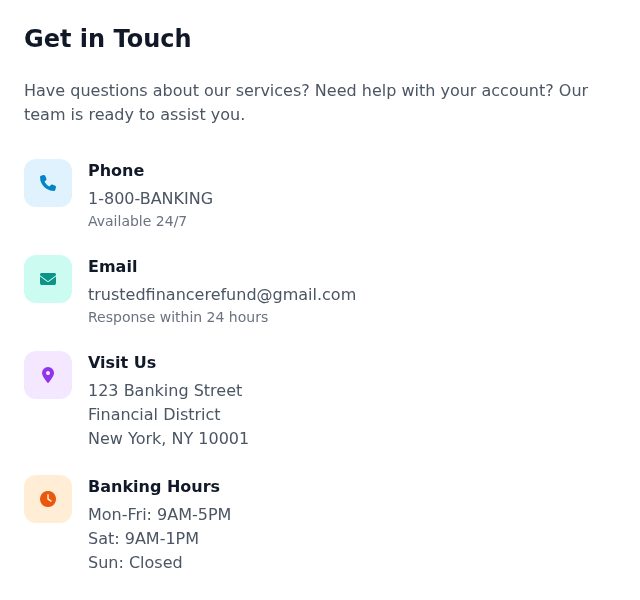
The street address is 123 Banking Street, Financial District, New York, NY 10001. The street name reads like a template placeholder, and we could not tie it to a branch.
The phone number is 1-800-BANKING, spelled with seven letters that map to 800-226-5464. We did not call it, so we cannot say who answers.
The home page adds a second line labeled International, +1-555-0123. The +1 prefix is the North American code itself, and the 555-01xx range is reserved for fiction.
The email address is a free Gmail account, even though the domain has its own mail records and a sender policy that names the web server.
A bank that runs its own mail but answers from Gmail is unusual, and it leaves a customer with no way to confirm who reads the inbox.
The contact page promises Find Our Locations and Visit any of our convenient branch locations, then shows a gray box carrying the text Interactive map would be integrated here.
So a site that claims 25 branches lists one address, offers no branch finder and promises 24/7 support through a number we could not confirm.
Code and Choices From Another Bank
The page code gave us the most revealing evidence, and we read it as plain text without running anything.
The server sets a session cookie named aurevia_trust_session. An application picks that name in its own settings, so we infer the software was first set up for Aurevia Trust.
The meta description, the line search engines display, promises Swift and Secure Money Transfer to any UK bank account. A New York credit union has no reason to say that.
The registration form offers six account types, including Current Account and Fixed Deposit Account, which are British and Commonwealth banking terms.
It also lets a visitor choose from 247 countries and territories and 156 currencies, an odd menu for an institution that describes itself as a community credit union.
The placeholders on that form read John, Smith, David, johnsmith123 and john@example.com, which are the sample values that come with the template.
Three addresses linked from the home page also disagree with their pages. The alerts address opens a page titled Business Banking, chart opens Personal Banking and send-money opens Loans & Credit.
The technical shortcuts fit a template that was reskinned quickly. Styling is built in the browser by a script loaded from cdn.tailwindcss.com on every visit.
Icons come from a Font Awesome Pro stylesheet loaded from a personal GitHub repository through jsDelivr, and its header cites a commercial license. We did not check this copy.
Four photographs are hotlinked from Unsplash, and the three testimonials carry a name and a label such as Verified Customer, with no photo, link or date.
None of these details proves fraud on its own. Together they describe a site assembled from a ready-made banking template in a hurry.
Grants That Need an Account
The Grants & Aid page is the part of the site that sounds most like free money, so we read it line by line.
It lists six programs with ceilings of $50,000, $25,000 per year, $15,000, $10,000 and $100,000, and the Healthcare Grant has no amount at all.
The Small Business Grant lists Flexible repayment terms among its benefits, and money that has to be repaid is a loan, so the label contradicts itself.
All six Learn More buttons point to the same #apply block lower on that page, so no program has its own rules, funder, deadline or eligibility test.
The How to Apply steps end with Approved grants are disbursed directly to your account, and the only Start Application button leads to the registration form.

The FTC’s page on government grant scams says real grants require an application for a specific purpose and that no agency demands payment to release one.
It also says the only place to find every available federal grant is grants.gov, and this site does not link there.
We did not register, so we cannot say whether a fee appears after login. We can say the grants have no terms to check before an account exists.
The home page makes the same move with a $200 checking bonus, whose asterisk points to no conditions on any page we read.
What Opening an Account Asks For
We opened the registration form in a browser, read its fields and typed nothing. It runs in four steps called Personal, Contact, Account and Security.
The fields cover first, middle and last name, a username, email, phone, country, currency, account type, a 4-digit PIN, a password and a terms checkbox.
A second page at the verify address asks for a numeric code, so the site can reach a phone or inbox before a visitor reaches any account screen.
The Privacy Policy is broader than the form. It lists Social Security number, account balances, credit information and recordings of phone calls among the data it collects.
The form we read asks for no Social Security number, so that data would have to be requested somewhere we could not see.
The Terms of Service run to ten short sections. The one headed Services and Fees names no fee, and the one on governing law names no state.
It says only that the terms follow the laws of the jurisdiction in which Trusted Finance Refund operates, and no company name, address or officer appears in any legal page.
A visitor who registers therefore hands a name, phone, email and password to an operator that cannot be named, under terms that do not say which court applies.
How the Pitch Works
Step 1: A Familiar Bank-Shaped Page
The first screen shows a smiling customer with a phone, two buttons for opening an account or logging in, and a card with a routing number.
Nothing on it asks for money, which is the point: the page copies the look of a retail bank so a visitor relaxes before any check begins.
Step 2: Badges That Settle Doubt
Next come the reassurances: FDIC Insured, 256-bit SSL, 50K+ happy customers, $2.5B in assets and a 1985 founding date.
Each of those was testable, and each failed our checks or could not be confirmed, which is why we tested them one by one above.
Step 3: Free Money as the Hook
The $200 checking bonus and the grants of up to $100,000 give a reader a reason to act today rather than check tomorrow.
The only route to either offer is the registration form, so the visitor must register before seeing any terms for them.
Step 4: An Account Built From Your Details
Registration collects a name, phone, email, country, a 4-digit PIN and a password, then sends a code to confirm the visitor is reachable.
That makes the sign-up valuable on its own, because an identity and a working phone and inbox have value to whoever holds them.
Step 5: The Part We Could Not See
We stopped at the form, so we cannot describe what a logged-in customer sees or is asked to pay.
The FDIC’s fake bank page lists fees, such as an insurance fee demanded before a large sum arrives, among the ways such sites take money.
We did not see any such fee here, because we never went beyond the form.
Who Runs Trusted Finance Refund?
The Company Named in the Documents
The Terms of Service and Privacy Policy name only Trusted Finance Refund. They give no LLC, no Inc., no charter number, no registered address and no officer.
The only contact in those documents is the Gmail address and the New York address that we already found unusable.
Where the Address and Registration Leads
The New York address has a placeholder-style street name, and the routing number leads to Virginia, so neither points toward a verifiable office.
The domain’s registrar is Cosmotown, the registration runs one year, and the registrant’s identity is hidden in the public record.
We did not search state business registers or the NCUA’s credit union locator, because no legal name exists to search for.
Domain, Platform and Reviews
The platform is a PHP application that looks like Laravel, judging by its cookies and storage paths, on shared cPanel hosting with a live chat widget from tawk.to.
We searched the web for the exact name and for the domain and found no business listing, regulator record or customer review for either.
A genuine institution with 50K customers would leave far more of a trail than a four-month-old domain and silence.
What We Could Not Confirm
We could not confirm who operates the site, whether the toll-free number is answered, or how the account area behaves after login.
We also never confirmed whether the NCUA’s own locator lists a credit union with this name, so a quick check there is worth doing yourself.
Shared tracking tools and templates show a common build, and they do not prove who is behind this site.
What to Do Before You Register or If You Already Did
-
Do not register or deposit. Skip the account, the $200 bonus and the grants until the institution is verified by someone you trust.
-
Look up any bank yourself. Search the FDIC’s BankFind by name and web address, as its fake bank guidance advises, and use the NCUA locator for credit unions.
-
Check the routing number. Compare it with a printed check or statement from your own institution, never with a number on a website you are testing.
-
Ignore grants that need an account. Browse real federal grants on grants.gov, which is free, and never pay to receive one.
-
Change reused passwords. If you registered, change that password anywhere else you used it, and follow the credential steps in the FBI’s account takeover alert.
-
Contact your bank if money moved. Ask your bank or card issuer to recall the payment, and use the FTC’s card dispute steps if a card was charged.
-
Never pay to get money back. The FTC says anyone asking for a fee before a refund is a scammer, so refuse any follow-up offer to recover what you sent.
-
Report it. File at ReportFraud.ftc.gov and with the FDIC at 1-877-ASK-FDIC, naming the domain, the routing number and the dates.
Frequently Asked Questions
Is Trusted Finance Refund a scam?
We cannot prove from outside what it does with deposits, but it fails every check a real institution passes, so treat it as unsafe and do not use it.
Is it a refund or recovery service?
No. We found no recovery or chargeback wording on any page, only a bank-style site whose name happens to include the word refund.
Is Trusted Finance Refund FDIC insured?
The footer says so, but the FDIC’s public institution data has no bank with this name or web address, and credit unions are insured by the NCUA instead.
Is the routing number on the site real?
The number is correctly formed and public directories list it under HomeBase Federal Credit Union in Virginia, which is not this site.
Are the grants real?
We found no funder, eligibility rule, deadline or terms, and every Learn More button leads to the same registration prompt, so we would not rely on them.
What should I do if I already registered?
Change any reused password, watch your accounts, never pay anyone to recover funds, and report the site to the FTC and the FDIC.
The Bottom Line
Do not open an account or deposit money at Trusted Finance Refund. A 137-day-old domain, another institution’s routing number and no charter are too much to explain away.
If you need a bank, find it yourself in the FDIC’s BankFind or the NCUA’s locator, type its address into your browser, and compare its routing number with your paperwork.
If you already registered or sent money, change reused passwords, ask your bank to recall the payment, refuse paid recovery offers, and report the site to the FTC.

Join the discussion
0 commentsShare your experience or ask a question about this article.
Discussion
Start the conversation
Have a question or something useful to share? Add the first comment.