


A vendor’s request arrives in a familiar work conversation, asking your company to use different bank details. The invoice looks routine, and someone is waiting for payment.
Before accounts payable changes the destination, there is a more important question than whether the email looks convincing: who actually authorized that instruction?
Overview
The target was an existing business relationship
Chijioke Timothy Odimegwu and Harafat Mogaji participated in a cyber intrusion scheme that exploited employee credentials and the trust between businesses exchanging payments.
Their approach gave a fraudulent instruction the appearance of an ordinary request from someone the recipient already knew. It did not require selling an obviously suspicious new product.
The DOJ sentencing announcement describes phishing, stolen credentials and spoofed email addresses used to divert payments and carry out other financial fraud.
Large transfers followed apparently familiar instructions
The documented transactions included a wire exceeding $1.68 million from a company in Iowa City and another exceeding $720,000 from an Ohio company.
Those examples illustrate the scale of particular transfers. They should not be treated as a complete accounting of every successful or attempted transaction in the scheme.
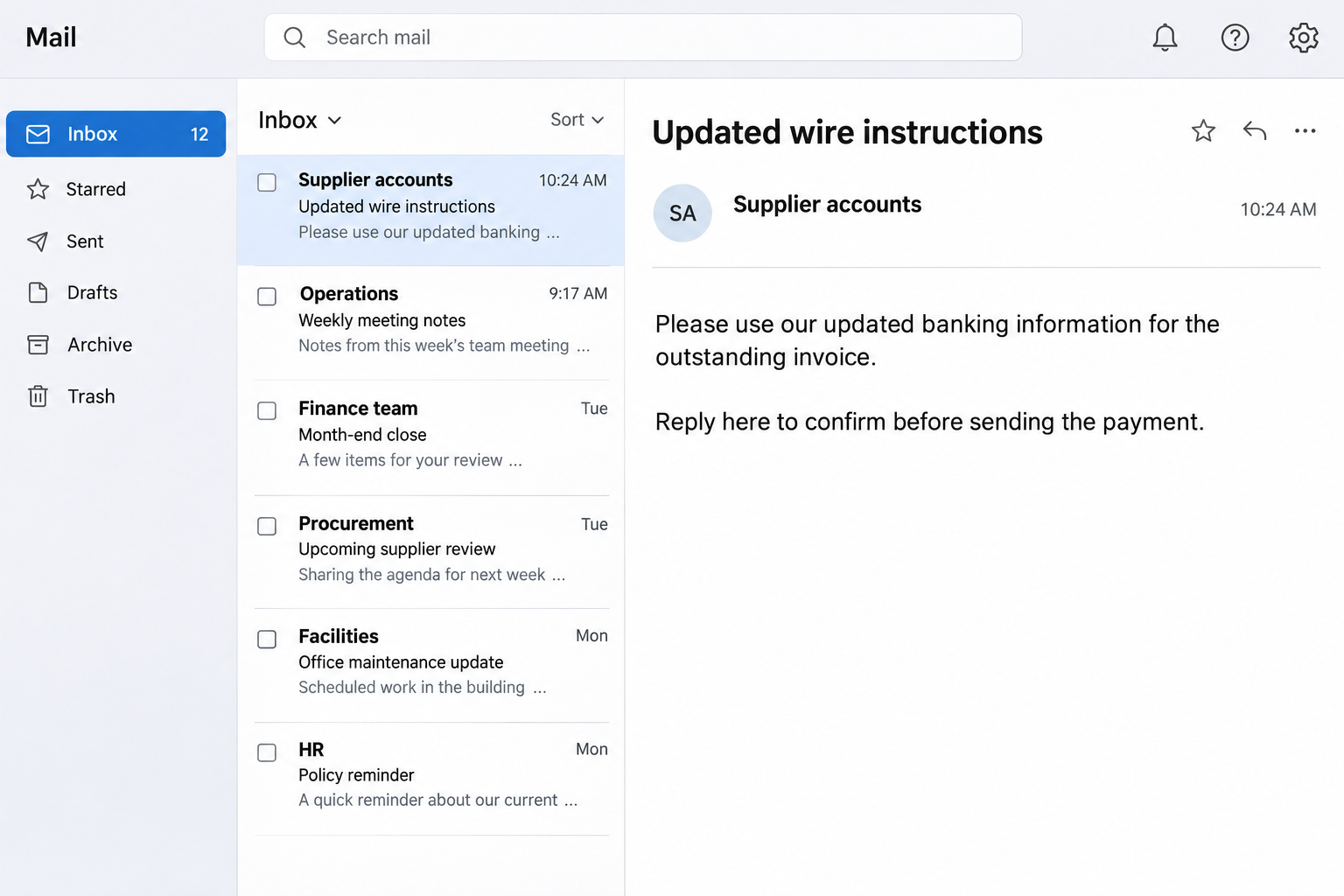
The email image illustrates a fictional change of payment instructions. It is a reconstruction of the mechanism, not recovered correspondence from either company’s case.
A change in bank details needs independent approval
These are the decisions a recipient should separate before paying:
- Whether the invoice represents a genuine outstanding obligation.
- Whether the person requesting the change actually controls that instruction.
- Whether the proposed receiving account belongs to the intended payee.
- Whether someone independently verified the change using an established contact.
A legitimate invoice can coexist with a fraudulent payment destination. Checking the amount and invoice number alone leaves the most consequential change unverified.
What the Criminal Case Established
Odimegwu and Mogaji received federal prison sentences on September 25, 2026. This report concerns confirmed criminal conduct, rather than an unresolved complaint about a vendor.
Odimegwu received 111 months, while Mogaji received 78 months. The combined prison term was 189 months; that combined figure was not imposed on each defendant.
The court ordered Odimegwu to pay $366,617.59 in restitution and Mogaji to pay $995,680.45. Each also received three years of supervised release.
The restitution orders are defendant-specific court obligations. They do not establish that every victim has already recovered funds or that either amount represents the entire scheme.
The DOJ account says both men were members of the U.S. Air Force when the conduct occurred. Their employment did not authorize the financial activity.
Their service status also does not turn this into a military benefit offer or establish a broader allegation against other service members. The mechanism was account intrusion and payment diversion.
Over nearly two years, the scheme targeted employee email credentials and used access or impersonation to exploit communications between businesses and trusted partners.
Investigators also described financial account information, PINs and payment cards that were harvested or purchased for unauthorized transactions and attempts.
That additional conduct matters when assessing an affected person’s exposure. A diverted vendor payment and misuse of a payment card call for related but distinct responses.
How the Vendor Payment Diversion Scam Works
Step 1: Phishing targets the employee’s credentials
The scheme began with email spamming and phishing intended to obtain employees’ account credentials. Those credentials provided a route into communications a business already relied upon.
A phishing message can make a sign-in request seem connected to ordinary work. The important boundary is the moment someone provides credentials to an unauthorized recipient.
This case does not establish that every targeted employee installed malicious software. A person can surrender account access by entering a password without downloading a program.
For employees, the practical lesson is to report a suspicious sign-in request through the organization’s known security channel. Do not use contact details supplied inside that message.
Step 2: Access and impersonation create a familiar appearance
The conspirators used stolen credentials and spoofed email addresses. Those are different techniques, even when both make a message appear to come from a trusted business contact.
A spoofed address imitates the sender. Stolen credentials may allow unauthorized use of an actual account, making a check of the visible address insufficient.
Recipients often associate a familiar sender with an authorized instruction. The scam exploits that connection by presenting a new financial decision through a relationship that already exists.
The relevant question becomes whether the real person authorized this specific change. Prior genuine correspondence does not answer that question for a newly supplied bank account.
Step 3: A payment is redirected away from its intended recipient
The deception sought transfers intended for trusted business partners. Money that should have reached the legitimate payee instead went to an account used in the scheme.
This is why verifying the underlying invoice does not finish the check. The debt can be genuine while the substituted receiving instructions are fraudulent.
The Iowa City and Ohio transfers show the consequences of that substitution. The amounts involved made an apparently administrative change a major financial event.
An independent callback should address the destination change directly. Asking only whether an invoice exists can leave the false account details untouched.
Step 4: The fraudulent instruction passes through an ordinary workflow
A recipient may see a normal payment task: update details, process the invoice and close the request. The attacker benefits when those steps proceed without independent verification.
Do not assume a second employee’s approval necessarily resolves the problem. Two people reading the same compromised conversation may be relying on the same false evidence.
A meaningful second check brings in an independent source, such as an established telephone contact and previously verified supplier information.
The organization should define who can authorize a payment change. Staff need a usable route for pausing suspicious instructions while that authorization is checked.
Step 5: Other stolen financial information can create separate losses
The DOJ account also describes stolen or purchased account details, PINs and payment cards. Their use created additional unauthorized transactions or attempts beyond redirected vendor wires.
A victim should therefore identify what actually happened to their information. One suspicious email does not prove every account was compromised, but known card exposure needs attention.
Report the affected transfer to the bank’s wire fraud team and any separate card misuse to the card issuer. Explain that these may involve different transactions.
Keep those records linked in your incident timeline without collapsing them into a single unsupported loss figure. Investigators need to distinguish completed payments from unsuccessful attempts.
Why Familiar Email Conversations Can Mislead Accounts Payable
Business payment requests often arrive among genuine invoices, approvals and delivery questions. That setting can make a fraudulent account change seem like one more administrative detail.
An employee may recognize the sender’s name or remember previous successful transactions. Those observations establish a prior relationship, not approval of today’s receiving account.
The attack also takes advantage of divided responsibilities. One team may maintain supplier details while another releases payments and assumes the earlier checks were completed.
When nobody owns verification of the changed destination, a false instruction can move through several otherwise legitimate steps without meeting a genuinely independent check.
The answer is not to reject every emailed invoice. It is to give changes affecting where money goes a clear verification process before payment.
Use an established contact that predates the suspicious request. A telephone number introduced alongside the new bank details could be controlled by the same person sending them.
Ask the known contact whether they requested the change and how your organization should confirm the receiving details. Follow the company’s approved process for documenting the answer.
If the contact denies the request, preserve that discrepancy and escalate it. Continuing the email discussion with the suspected sender may simply produce more convincing excuses.
Avoid treating pressure for immediate payment as a reason to waive verification. A genuine supplier should be contacted through a trusted route when an instruction appears inconsistent.
The FBI’s business email compromise guidance recommends independent verification and immediate contact with the financial institution when fraudulent transfers are discovered.
Assess Your Exposure Before Choosing the Response
Start by separating receipt of the message from a completed compromise. Reading an email, entering credentials and releasing a wire are different events with different priorities.
If you only received the instruction, pause the requested change. Preserve the message and verify it through the real vendor contact already held in your records.
If an employee entered account credentials, notify the authorized security team even if no payment has moved. Unauthorized access may allow additional messages to appear genuine.
If money was transferred, contact the bank immediately while the organization investigates the messages. Do not wait for a complete technical explanation before requesting financial action.
These actions can proceed together when different teams are involved. Accounts payable should preserve transaction facts while authorized security staff address account access and message evidence.
What to Do if You Fell Victim
-
Call the sending bank through its established business banking contact immediately. Explain that a vendor payment was induced by fraudulent instructions and identify the actual transfer.
Provide the payment date, amount, reference, receiving bank and beneficiary details from your records. Ask whether the transfer can be recalled and the receiving institution contacted.
Request a case reference and the bank’s next evidence requirements. A recall request is an attempt to recover money, not confirmation that the funds remain available.
-
Place further payments to the changed destination on hold through your organization’s authorized process. Identify pending invoices that might use the same fraudulent receiving details.
Contact the genuine vendor using a previously verified number. Confirm the intended payment instructions and tell them the earlier transfer may have been diverted.
Do not use a replacement telephone number supplied in the suspicious email. Record who confirmed the instructions and how their identity was independently established.
-
Notify authorized security staff through a known internal route. State whether anyone entered a password, approved a sign-in prompt or observed unexpected account activity.
Give them the account involved, approximate times and the relevant messages. Ask them to contain unauthorized access and assess whether other users or conversations were affected.
Follow their instructions for approved password changes, session revocation and account recovery. Do not make organization-wide mailbox changes without authority or delete records during an investigation.
-
Preserve the original emails using your mail application’s approved export process or the security team’s instructions. Include headers, attachments and the complete conversation when available.
Keep the genuine invoice, altered instructions, approval records and bank confirmation together. Screenshots can help explain events but may omit technical details found in original messages.
Write a short timeline showing when instructions changed, who received them and when payment occurred. Distinguish verified facts from assumptions about how access was obtained.
-
Contact the issuer separately if payment cards, PINs or financial account details were exposed or misused. Identify the specific information involved and any unfamiliar transactions.
Ask the institution what must be blocked, replaced or disputed. Obtain its instructions and deadlines for your account type rather than assuming one rule covers every payment method.
Continue checking affected accounts and give the institution any additional unauthorized activity promptly. Do not send full credentials or PINs to someone offering unsolicited assistance.
-
Report internet-enabled fraud through the FBI’s IC3 website. Open the official site independently and choose its complaint option, then review the terms before proceeding.
Provide the payment information, original contact details, relevant addresses and incident timeline requested by the form. Identify the bank’s fraud reference when available.
Retain the complaint confirmation with your records. An IC3 report supports law enforcement assessment; it does not replace the immediate call to your bank.
-
Keep recovery communications within verified channels. Confirm any claimed investigator, bank representative or vendor contact through the institution’s independently obtained public or established contact details.
Do not pay an unsolicited recovery agent to unlock supposedly frozen funds. Never provide account passwords, remote access or new payments based only on a convincing case reference.
Update your bank and authorized incident coordinator when new evidence arrives. Keep responsibility for follow-up clear so that requests do not disappear between departments.
Review the Failed Check Before Releasing Another Payment
After containing the immediate incident, determine where the changed destination acquired approval. The answer may involve several teams rather than one employee making an isolated mistake.
Compare the original supplier record with the amended details and actual bank instruction. Identify which independent evidence, if any, supported the change before the wire was released.
Check whether approval meant confirming the invoice or also confirming the beneficiary. Those decisions are related, but they answer different questions about the payment.
Review pending transfers that followed the same communication path. A fraudulent instruction may remain in a supplier record even after the first suspicious payment is noticed.
Have authorized staff document corrections and notify the teams responsible for future payments. Recovering an email account does not automatically correct a previously altered vendor record.
Keep the genuine supplier involved through a verified contact. They may be waiting for payment while your organization believes the invoice was already settled.
Frequently Asked Questions
Were Odimegwu and Mogaji convicted of a real fraud scheme?
Yes, the DOJ announced federal prison sentences in September 2026 for their participation in the cyber intrusion scheme. The conduct included payment diversion and unauthorized financial activity.
This article relies on that criminal outcome. It does not classify an ordinary supplier dispute or an anonymous employee complaint as confirmed fraud.
Did each defendant receive 189 months in prison?
No, 189 months was the combined term. Odimegwu received 111 months, and Mogaji received 78 months, with separate restitution obligations and three years of supervision each.
Keeping those figures separate avoids overstating either individual’s sentence. Restitution orders also do not prove that money has already reached victims.
Can a genuine email account send a fraudulent request?
Yes, stolen credentials can allow unauthorized use of a real account. The scheme involved stolen credentials alongside spoofed addresses that imitated familiar senders.
A correct address therefore does not establish authority for a changed payment instruction. Verify the person and the destination through a separate trusted channel.
Does checking the invoice prevent payment diversion?
Checking an invoice can confirm a genuine obligation, but it does not authenticate new receiving details. An attacker can redirect payment connected to a real transaction.
Verify the destination change with the known vendor contact before releasing funds. Record that confirmation through your organization’s approved process.
Should every recipient run a malware cleanup procedure?
The documented scheme involved phishing and stolen credentials, but the source does not establish malware installation on every recipient’s device. Response should follow the exposure actually identified.
Employees should report suspicious access through authorized security staff. A received message alone does not prove that software was installed or every account was compromised.
Can a bank always recover a diverted wire?
Recovery is not guaranteed, which is why the sending bank should be contacted immediately. Ask for a recall attempt and contact with the receiving institution.
Provide accurate transaction information and preserve the supporting records. An official report or recovery request does not by itself mean the money remains available.
The Bottom Line
Do not approve changed payment details solely because they arrive in a familiar email conversation. Confirm the instruction and receiving destination through an established independent contact.
If a transfer already went to the wrong account, call the sending bank immediately and involve authorized security staff. Preserve the messages and report the actual payment trail.
Address any separate credential or card exposure through the responsible institution. Correct the vendor record before another genuine invoice produces another payment to the fraudulent destination.

Join the discussion
0 commentsShare your experience or ask a question about this article.
Community experiences
Did this happen to you?
Your experience could help someone recognize the same scam. Submit a private report for our team to review.
I experienced this tooReports are reviewed before publication. Sharing publicly is always your choice.
Discussion
Start the conversation
Have a question or something useful to share? Add the first comment.