

An Idaho court notice arrives unexpectedly, mentioning a traffic matter or a hearing you knew nothing about. The message makes ignoring it feel risky.
Before opening the paperwork or following its payment instructions, check how the sender expects you to respond. That is where the story often changes.
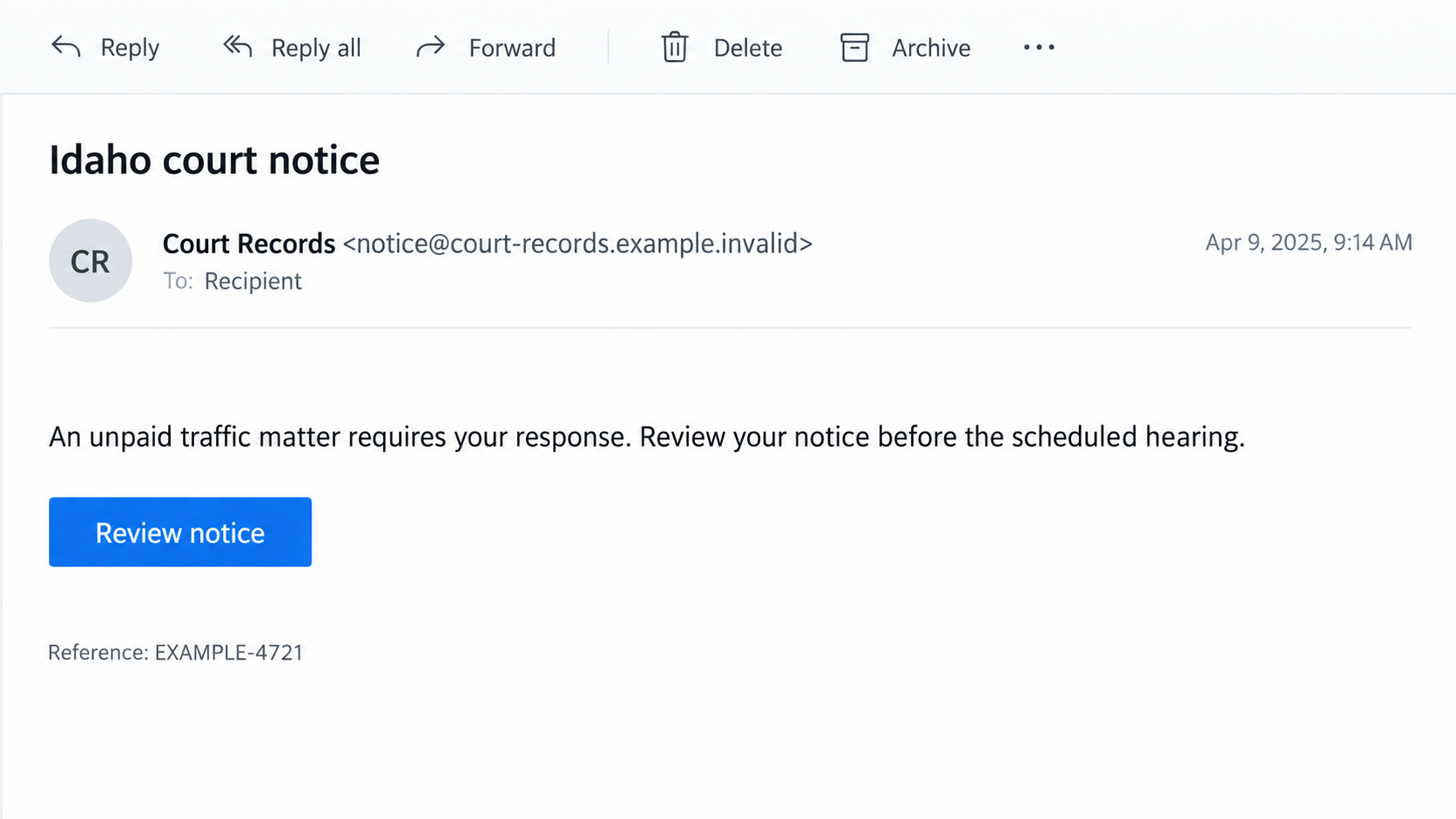
Overview
Real court names are being used for false demands
The Idaho District Court scam uses texts, calls, or emails that pretend to come from the courts or law enforcement.
The hook may be an alleged traffic fine, missed jury service, or paperwork to review. The message borrows the court’s authority without coming from that office.
The illustration above uses fictional contact details. It shows the kind of message being discussed, not an authentic court email or a captured malicious page.
Idaho’s Judicial Branch has documented several variations
An April 2026 court warning describes traffic-ticket texts directing residents to fake websites. The state’s broader alerts also describe fraudulent documents and demands for cryptocurrency.
These variations are related forms of impersonation, not necessarily one operation. A text, a records email, and a live caller can use different methods.
The Idaho Judicial Branch warns against unsolicited court contacts that pressure people into payments, sensitive disclosures, or links supplied by the sender.
Check the requested action before trusting the document
Several warning signs deserve an immediate pause:
- A demand to pay during the current call or face arrest.
- Instructions to use gift cards, prepaid cards, or cryptocurrency for court costs.
- An unexpected text claiming to summon you to a hearing.
- A requirement to remain connected while withdrawing or transferring money.
- A court-branded link that you cannot independently connect to the actual case.
Do not follow the sender’s route to prove you are cooperating. Use the relevant court’s published contact information to check the claim.
The Notice and the Payment Demand Are Different Questions
A frightening document can collapse several questions into one: is this real, do I owe money, and must I act immediately?
Separate them. First verify the source and underlying matter. Only then consider a genuine obligation through the court’s actual process.
A court’s name appearing on a document is a claim about its origin. It is not confirmation that the court created or sent it.
The same applies to a case number, clerk’s name, or apparent seal. Those details can be copied, invented, or borrowed from unrelated material.
You don’t need to determine which explanation applies before refusing to give the sender your bank details.
There may also be a real issue in your life that makes the timing believable. An existing case does not authenticate every message mentioning court.
Keep any genuine hearing or response deadline on your calendar while checking the suspicious contact separately. Avoid both rushed payment and careless dismissal.
How the Idaho District Court Scam Works
Step 1: A court-related problem appears without warning
The message may allege an unpaid traffic ticket or announce a hearing. A caller might instead claim you failed to report for jury duty.
These claims work because most recipients do not routinely deal with the court system. Unfamiliar terminology can sound like a procedure you simply haven’t encountered.
An abrupt deadline encourages you to treat the sender as the person who can explain everything. That gives the same stranger control of the problem and solution.
Pause before volunteering details about a past ticket, an address change, or a family member’s case. Your explanation can make an improvised story more convincing.
Keep a record of what the message actually says. Distinguish the court it names from the court you assume it means.
There is no single office called upon to handle every Idaho court matter. Finding the relevant county and court is part of a reliable check.
A vague statewide label should not push you toward a statewide payment link supplied by an unknown sender.
Step 2: Official-looking details make the request feel settled
The sender may present a formal document, an employee’s name, or a supposed legal reference. Professional formatting can make the notice look harder to question.
Do not confuse the appearance of paperwork with its delivery through an authentic court channel. A convincing document still needs a verified source.
For telephone approaches, the same issue appears in a different form. A confident voice or official-sounding title does not establish employment or authority.
Idaho’s alerts include a business contact in which a caller claimed a senior court role and provided an invalid case number.
The useful lesson is not to memorize that caller’s title. It is to check the asserted case outside the conversation.
If the sender provides a number for verification, do not assume that it is independent. Select contact details from the court’s website yourself.
Nor should a document’s scan quality decide the matter. Both a blurry forgery and a polished forgery can carry the same false demand.
Step 3: A link, attachment, or instruction moves you off balance
A traffic text can direct you to an imitation payment site. A records-themed email can instead invite you to open supposed case paperwork.
One Idaho alert describes fraudulent messages using records-administration language and an alleged Idaho Supreme Court Repository. The name is a lure, not authentication.
You do not need to open the material to establish whether a court knows about the alleged matter. Ask the court through a separately verified channel.
A link can also hide its actual destination behind ordinary button text. The words on the button are not the address it opens.
Do not copy the link into a browser as a workaround. That still follows the route chosen by the sender.
If a page asks for a password, card details, or identification, stop. A form does not become appropriate merely because a court-themed message led there.
Opening a link is not automatically proof of infection. However, any information entered or permission granted needs its own practical response.
Step 4: The sender substitutes an unusual payment process
The conversation may move toward a fine, bail, or another supposed court cost. Some versions frame payment as the only way to avoid immediate consequences.
Idaho’s warnings explicitly reject demands for gift cards and cryptocurrency. A caller cannot turn those methods into official court collection by naming a judge.
In a documented variation, fabricated orders directed people toward cryptocurrency kiosks. The existence of a real kiosk does not authenticate the person directing you there.
A machine can carry out a financial transaction without deciding whether the reason you were given is truthful.
Do not make a small trial payment, buy a card, or open a wallet to demonstrate cooperation. Each action moves you further into an unverified process.
If the instructions conflict with the court’s published procedure, stop following them. Ask court staff about the alleged matter without the caller supervising.
A promise to reimburse you after a hearing does not make the transfer reversible or protect the money.
Step 5: Staying connected becomes another demand
Some court impostors insist that the recipient remain on the telephone while traveling or withdrawing money. That pressure discourages a second opinion.
Idaho’s alerts describe fake orders used to maintain contact and obtain travel or vehicle information. Those instructions are part of the deception, not protection.
You can end the call. You do not need permission from an unsolicited caller to contact the real court, your bank, or someone you trust.
If you are already driving, stop safely before dealing with the situation. Do not let an invented deadline create a real physical hazard.
After contact ends, another number or supposed official might approach you. Treat that person as unverified rather than inheriting the first caller’s authority.
Keep existing evidence, but do not continue interacting to build a stronger case. Your immediate job is to stop exposure and get appropriate help.
How to Verify an Idaho Court Matter Safely
Use the court’s own directory and case resources
Start with the Idaho Judicial Branch’s scam guidance and follow its route to the official court contacts.
For case and payment resources, find iCourt through the Judicial Branch website. Do not enter through an advertisement or a link supplied by the suspicious sender.
Ask which county and court should handle the matter. A person named in a message may not be the person responsible for your actual case.
If an online search does not answer your question, speak to staff. Database searches are useful tools, not a substitute for advice about a particular proceeding.
Do not use a website ending as the entire test
Checking the address matters, but an unfamiliar ending alone is not a complete verdict. Courts may link to authorized services hosted outside their main domain.
The reliable route is to start with the official court site and follow its own resources. Do not guess which service ought to be legitimate.
A secure connection likewise tells you about the connection, not whether the page is entitled to collect your information.
When a message uses a real service name, verify the actual address and purpose. A borrowed name can sit beside an unrelated destination.
Keep legitimate court participation separate
Idaho says jury summonses are mailed and warns against text summonses. That does not mean every email touching an existing legal case is fraudulent.
If you already work with an attorney or court staff, use the contact method you established earlier to ask about a new request.
Do not let the sender’s urgency rewrite an existing arrangement. A surprising change in payment or document delivery deserves confirmation.
For a real warrant, contested fine, or court deadline, obtain appropriate legal assistance. Do not rely on either a stranger’s threats or a general internet guide.
What to Do if You Have Fallen Victim to This Scam
- Break the connection with the impersonator.
Stop replying, leave the supplied page, and end any supervised payment instructions. Do not send another transfer to make the problem disappear.
If you are at a store, bank, or kiosk, tell staff you may be responding to a court impersonation scam before continuing.
- Report the payment to the provider that handled it.
Contact your bank, card issuer, transfer service, or cryptocurrency platform through its established channels. Give the transaction details and explain the false court demand.
Ask what can still be blocked, recalled, flagged, or disputed. Timing matters, but no provider or article can promise recovery in every case.
For a gift card, preserve the card and purchase receipt and contact the issuer. Do not share redemption details publicly while asking for help.
- Secure any accounts or identity details you exposed.
If you entered credentials on the linked page, change them on the genuine service. Replace reused passwords and review account sessions and recovery information.
Tell financial providers about exposed card or banking information even if no charge is visible. A clean statement today does not resolve future misuse.
When sensitive identification was supplied, use IdentityTheft.gov to plan the relevant identity-protection steps instead of guessing which accounts might be affected.
- Check the actual legal question separately.
Use the court directory to ask whether the alleged matter exists. Explain that the notice came from an unverified sender and describe its requested action.
If a genuine issue is found, handle it through the proper process. Do not assume paying the scammer satisfied any real obligation.
- Preserve evidence and make a report.
Save the original message, attachment, sender address, telephone number, and financial records without opening new material. Record the sequence while you remember it.
Report the impersonation to local law enforcement, the Idaho Attorney General’s consumer protection office, or the FTC as appropriate.
Share full documents only through verified reporting channels. Public screenshots should not reveal your address, identification numbers, or account information.
- Review device changes when they actually occurred.
If you installed software, enabled notifications, or opened a suspicious download, address that exposure. A threatening text by itself does not demonstrate malware.
Malwarebytes can help examine possible malicious software. AdGuard can reduce some unwanted advertising exposure, but neither reverses a court-impostor payment.
Be wary of anyone offering guaranteed recovery for a fee. Knowing details of your incident does not make a new caller trustworthy.
Frequently Asked Questions
Can an Idaho court summon me to a hearing by text?
The Idaho Judicial Branch lists text-message court summonses among the things courts do not do. Verify a claimed hearing with the relevant court independently.
What if the notice contains a real judge’s name?
A name can be copied. Confirm the document and underlying matter with the court rather than asking whether the named judge happens to exist.
Are all Idaho court emails scams?
No. Existing cases can involve legitimate electronic services. The warning concerns unverified demands and impersonation, not every message connected with a legal proceeding.
Should I pay through a cryptocurrency kiosk to avoid arrest?
No. Idaho’s court warnings reject cryptocurrency collection demands. Stop following the caller’s instructions and check the alleged matter through official court contacts.
Does receiving a traffic text mean my court account was breached?
The message alone does not establish a breach or prove that the sender accessed your case. Avoid supplying information that would make their story more personal.
What should I do if I already opened the link?
Close it and assess what happened next. Credentials, payments, downloads, and permissions require different actions; merely opening a page does not prove every account is compromised.
The Bottom Line
Do not pay or disclose sensitive information through an Idaho District Court scam message. Verify the alleged case with the actual court outside the sender’s instructions.
If you responded, protect the specific payment, account, or information involved. Preserve the contact and report it without letting the impersonator supervise your next move.

Join the discussion
0 commentsShare your experience or ask a question about this article.
Discussion
Start the conversation
Have a question or something useful to share? Add the first comment.