

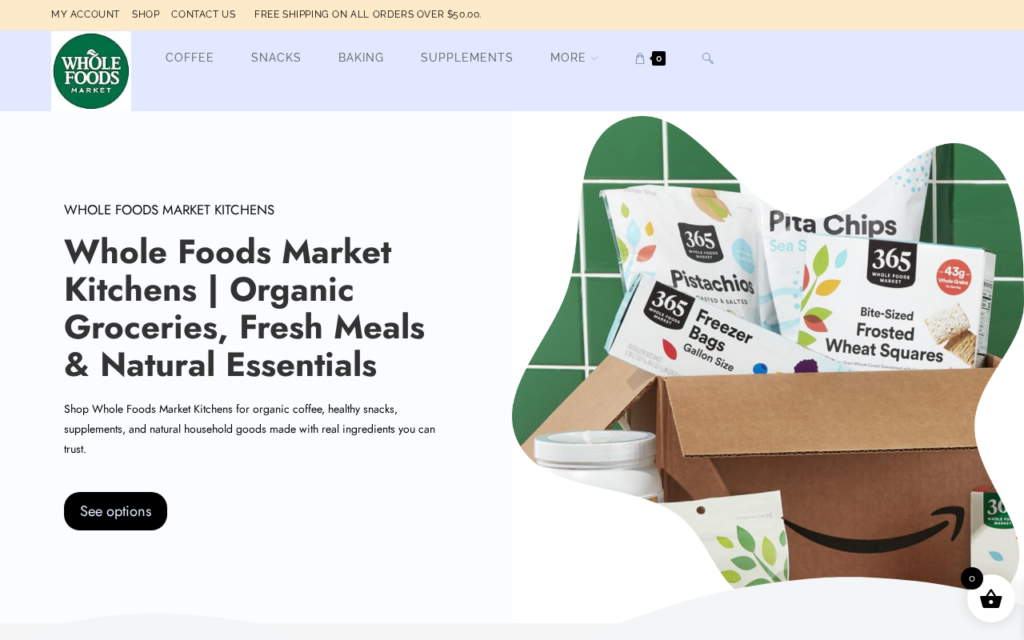
On the surface, Wholefoodsmarketlife.com has the look of a big brand’s official web store: well-shot product photos, detailed descriptions and prices that practically dare you to buy.
Before you put a single item in your cart, find out who’s actually running this site and what usually becomes of the money once you check out.
Overview
Someone else’s catalog on a strange domain
Wholefoodsmarketlife.com copies the catalog, photos and branding of real brands and stores, but you won’t find any of them behind it. The genuine sellers trade from their own websites.
It’s an easy thing to miss on a small screen. Everything looks right, the products seem familiar, and the checkout button works just fine.
Copycats like this one are part of a larger network. It pours money into ads, takes in every order it can, and abandons each domain as the complaints pile on.
Why the deals seem too good to pass up
What reels people in is the discount: $39 for an item that normally sells for $180, often framed by a countdown timer or a “closing sale” banner.
This isn’t a clearance sale. The price is there to keep you moving toward checkout, fast, so you don’t stop to notice the store isn’t who it claims to be.
A real brand’s sale shows up on its own website or at retailers it names. A 70% markdown on everything, from a store nobody can trace, is something else.
What you get for your money
The usual result of ordering from a fake store like Wholefoodsmarketlife.com is one of these:
- No delivery at all. You get a tracking number that never updates, or one tied to somebody else’s shipment.
- You get a knockoff. It’s cheap, the size and finish are wrong, the materials are off, and it isn’t genuine.
- An unrelated item turns up. It’s cheap and has nothing to do with your order. It exists only to produce a delivery record.
- Unknown charges follow. Check the card you used at checkout and you’ll find payments you never made.
Do not shop at Wholefoodsmarketlife.com. This fake store is built on a copied catalog, and its checkout should never see your card details.
What We Found on Wholefoodsmarketlife.com
A few details about Wholefoodsmarketlife.com stand out:
- Wholefoodsmarketlife.com was registered on November 10, 2025, less than a year ago.
- The MalwareTips URL scanner gives Wholefoodsmarketlife.com a Safety Score of 30/100, rated High Risk (full report).
How the Wholefoodsmarketlife.com Scam Works
What makes this worth understanding is the script: it’s reused across hundreds of copycat stores. Know the steps, and the next copycat won’t get your money.
Step 1: Borrowed images in a sponsored ad
A sponsored post shows up on Facebook, Instagram or TikTok. Its images and videos are taken from real brands and stores, so it blends right in.
The caption pushes urgency: an anniversary sale, a warehouse clearance, or a “we’re closing our stores” announcement. Comments may be switched off, or packed with short, glowing replies.
The link opens Wholefoodsmarketlife.com, a page designed to pass as an established shop.
Step 2: A cloned storefront, one piece at a time
What you see is copied from real stores: product photos, descriptions, branding. The menus, guides and “free returns” badges can look identical as well.
A real company is the one piece it can’t lift. In stores like this, the business name, address and customer service usually aren’t there, or they lead nowhere useful.
The cracks usually show in the footer and legal pages. Check them for a generic company name, a missing address, or a free email address.
Step 3: Pressure tactics that rush your payment
Those countdown timers, “only 3 left” badges and “12 people are viewing this” pop-ups aren’t decoration. They keep you moving, because every extra minute would reveal another hole.
To raise the basket, the store offers free-shipping thresholds and “buy 2, get 1 free” bundles. Every card that hits checkout should hand over as much as possible.
Step 4: The order is confirmed, then nothing follows
Once your payment goes through, an order confirmation shows up by email. Nothing about it seems off, and that’s deliberate: it keeps you calm while the store buys time.
A week on, a tracking number may land too. Often it never updates, sits on “label created,” or says the parcel reached a city you’ve never lived in.
Meanwhile, the clock on your card’s dispute window keeps running. Every day of waiting brings it closer to closing, and the store planned it that way.
Step 5: Knockoff goods or an empty mailbox
If anything is delivered, it’s usually a cheap copy sent from overseas. It doesn’t match the product photos, and it isn’t what you paid for.
Some shops ship a cheap accessory or another token item to a real address. Why? Because tracking that says “delivered” lets them argue against your refund.
Step 6: The promised refund disappears
Your emails sit unanswered, or scripted replies keep asking you to wait “a few more days.” Eventually a refund gets mentioned, but only with conditions nobody can meet.
You may be told to return the item to China at your expense, or take 20% back and keep it. Most of your money stays with the store regardless.
Red Flags at Wholefoodsmarketlife.com
Any store can have one odd detail. Stores like Wholefoodsmarketlife.com have several at once, and you can check every one of them yourself in a minute.
The site’s address doesn’t match the brand
A real brand’s products are sold on its own site or by retailers it lists there. You won’t find Wholefoodsmarketlife.com in either place.
A side-by-side comparison does the job. Look the brand up yourself, open its official site, and check that address against your browser’s. A different address means a different store.
The logo hides an anonymous seller
You can rarely verify a registered company, tax number or physical address for stores like this. When something goes wrong, there’s no one to hold responsible for it.
The real brand’s website will usually tell you exactly which company sells to you, in the footer, the terms of service or an imprint page. Find it before paying.
Ways to reach the store that go nowhere
The support options on stores like this are usually thin: a contact form or a generic email address, without any phone number, live chat or local return address.
Check the real brand and you’ll usually see phone support, store locations and a returns center listed. A fake store has no reason to make itself that visible.
Policies borrowed from another shop
Here’s a quick tell: copycat stores often reuse another shop’s refund, shipping and privacy pages, and sometimes those pages still mention a store, country or currency that doesn’t match.
The real return rule on copycat stores is often buried. A generous-sounding headline sits on top, and underneath you might find returns to China at your own cost.
Deals far deeper than the real brand would go
Real, established brands rarely take 70% or more off everything at once. A sale where every single item is discounted that heavily isn’t a real sale.
Often, the “original” price shown next to each deal is invented too. Its only job is to inflate a discount that was never real.
Reviews that lead nowhere
Five-star reviews here rarely come with a real buyer attached. Search the rest of the internet and you usually won’t see those same reviews.
You can check this yourself by searching the store’s address with “reviews.” Copycats usually produce either silence or a trail of complaints about orders that haven’t arrived.
How to Spot These Scam Websites
Fake brand stores have become harder to spot. Many of them now use AI-generated ads, polished product videos and copied checkout pages that look identical to the real thing.
The good news is that the same few checks still catch almost all of them:
- Check the address, not the logo. Open the brand’s official site yourself and compare addresses. One extra word or an odd ending is enough.
- Scan the site before you pay. Paste the address into the MalwareTips Website Scanner. It shows the domain’s age, security results and known warning signs in seconds.
- Look up who owns the domain. A Whois.com lookup shows when it was registered. A brand’s official shop doesn’t sit on a newly registered domain.
- Find the company behind the store. A real brand names its legal company, address and tax details. A copycat store leaves them out or invents them.
- Be suspicious of “closing down” sales. Store-closure, anniversary and warehouse-clearance stories are the most common hooks in fake brand ads.
- Search for outside reviews. Look the store up on Trustpilot and in search results. No history at all is as telling as a wall of complaints.
- Watch the payment options. A checkout that pushes bank transfers, crypto or a payment page on another domain is a reason to stop.
A browser extension can help. Malwarebytes Browser Guard blocks many known scam and phishing sites, and Malwarebytes ScamGuard checks suspicious links and messages before you click.
How to Buy the Real Thing Safely
There’s usually a safe route to the genuine version of whatever caught your eye on Wholefoodsmarketlife.com:
- Head to the official website. Search for the brand yourself and buy there. A link in an ad or comment isn’t the place to start.
- Confirm the store is an authorized seller. Many brands say exactly who those sellers are. Can’t find the store on the list? Then it isn’t one.
- Don’t trust a sale you’ve only seen in ads. A genuine clearance is announced on the brand’s own website or verified social accounts too.
- Try a marketplace that backs its buyers. When the brand sells there through an official storefront, you have a clear way to get your money back.
- Pay with protection on your side. That means a credit card or PayPal, and never a bank transfer, a gift card or crypto.
You might spend more than Wholefoodsmarketlife.com wants, but the product will be real and the seller will honor refunds.
What To Do If You Already Fell For the Scam
If you paid a fake store, move quickly. The sooner you act, the better your chances of getting the money back and stopping further charges.
- Call your bank or card issuer. Say you paid a fake store and ask for a chargeback. Disputes have time limits, often around 120 days, so don’t wait.
- Open a PayPal dispute if you paid that way. Choose “item not received” or “significantly not as described.” PayPal generally accepts claims within 180 days of payment.
- Block or replace your card. If you typed your card details into the site, ask for a new card and turn on transaction alerts.
- Save your evidence. Keep the order email, the tracking number, screenshots of the product page and any messages from the store.
- Watch for follow-up scams. Fake delivery texts asking for a “customs fee” or “address update” often follow these orders. Don’t pay them or click their links.
- Change reused passwords. If you created an account on the store with a password you use elsewhere, change it on those other sites.
- Protect your data. Your name, address and phone number are now in the wrong hands. Malwarebytes Personal Data Remover finds where your details are exposed and helps remove them.
- Cut off the ads. These stores find people through ads. AdGuard blocks many malicious ads and pop-ups in your browser, so fewer of them reach you.
- Report the store. Report the ad on the platform where you saw it. In the US, file a report at ReportFraud.ftc.gov. For cross-border purchases, use econsumer.gov.
If you downloaded anything from the store, such as an “order tracking” app or a file attached to an email, scan your device with Malwarebytes Free.
Frequently Asked Questions
Is Wholefoodsmarketlife.com a legitimate store?
Wholefoodsmarketlife.com is not legitimate. It’s a fake store that copied its catalog, lifting photos and descriptions from real brands that have no role in running the site.
Why does Wholefoodsmarketlife.com look so convincing?
It’s convincing because almost all of it is copied: product photos, descriptions, menus and guides from real brands and stores. A real business behind them is the one thing absent.
Will I receive my order from Wholefoodsmarketlife.com?
Maybe, but probably not the product you paid for. Often, buyers of stores like this get nothing, or a cheap copy that looks nothing like what’s pictured.
I already paid. Can I get my money back?
Often, provided you’re quick about it. Get in touch with PayPal or your card issuer and flag the charge as “item not received” or “not as described.”
Keep copies of the order email and the tracking number, and screenshot the product page. Don’t let the store’s silence hold you up.
Should I replace my card?
Yes, if Wholefoodsmarketlife.com got your card details at checkout. Request a replacement card from your bank and watch your statements closely for small test charges.
Where can I report Wholefoodsmarketlife.com?
Flag the ad on the site or app where it showed up, contact the brand whose photos it copies, and send a complaint to your country’s consumer protection authority.
The Bottom Line
Wholefoodsmarketlife.com borrows its whole catalog, using real brands’ photos and products to sell items you’ll probably never see. The low prices exist to lure you in.
Do not buy anything from Wholefoodsmarketlife.com. Want the item anyway? Buy it through the brand’s official site or a retailer that the brand lists.
Already ordered? Reach your bank by phone or open a PayPal dispute today. Save every email and screenshot too, and ask for a new card if you entered your details.

Reviews & discussion
0 commentsShare a firsthand experience, or ask a question.
Community reviews
wholefoodsmarketlife.com
Moderated reader experiences, not an editorial verdict.
Start the conversation
Have a question or something useful to share? Add the first comment.