

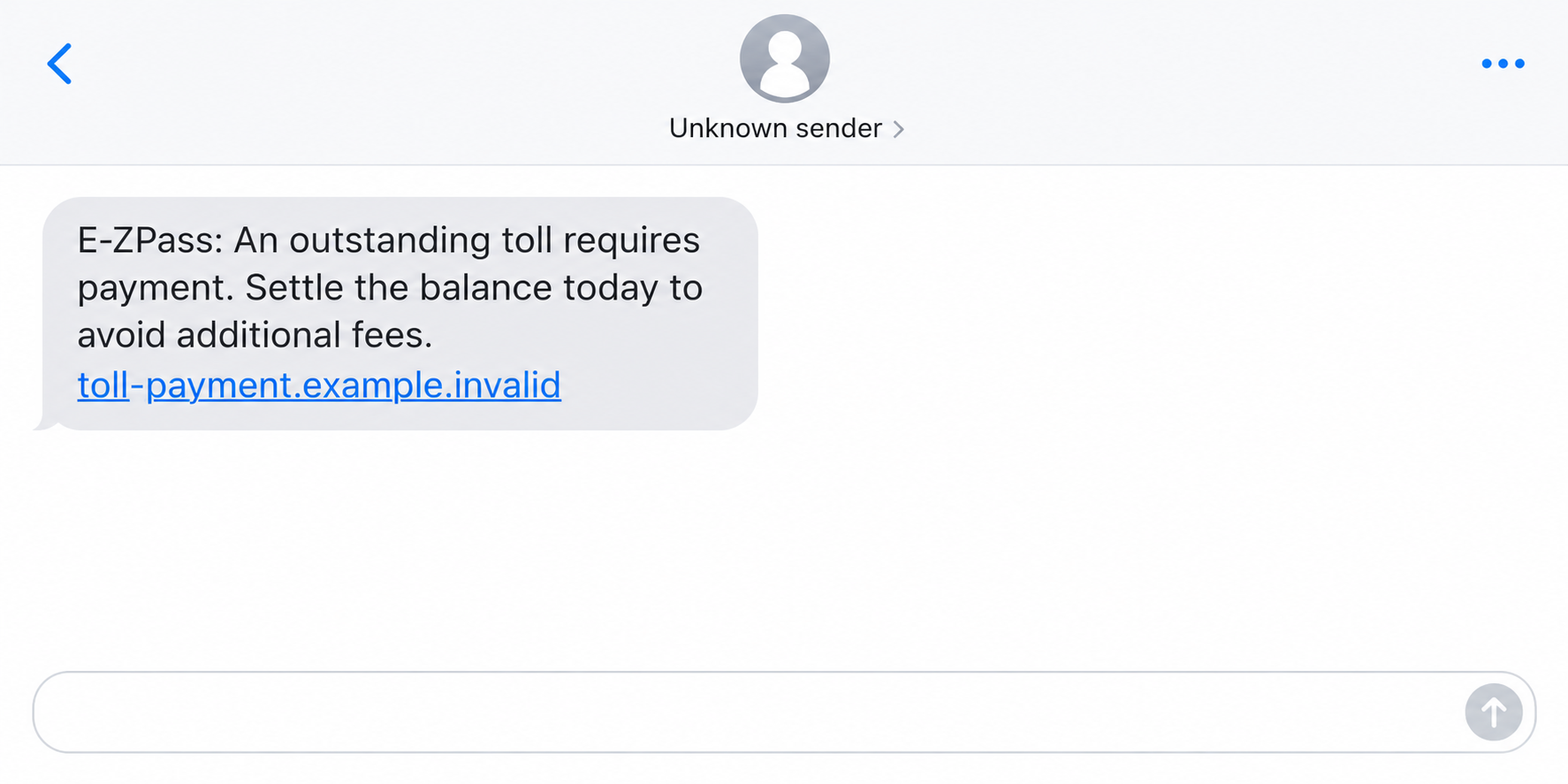
The text arrives between ordinary notifications: an E-ZPass balance, a short deadline, and a link to settle it before more fees appear.
You might have driven through a toll recently. Or you might not even have an account. Either way, checking this message takes a different route.
Overview
An unpaid toll is the excuse for collecting information
E-ZPass scam texts impersonate toll services and direct people to fraudulent payment pages. The claimed balance is the bait; personal and financial details are at risk.
The FBI has warned about texts that imitate toll-service names and create urgency around an alleged debt. Recipients can include people without an E-ZPass account.
The message pictured above is an illustration using a nonfunctional address. It is not a captured bill, an actual account notification, or proof of a specific charge.
Genuine account alerts exist, so blanket rules can mislead
Not every E-ZPass-related text is fraudulent. Different agencies have different communication practices, and some customers choose to receive legitimate account notifications.
E-ZPass New York offers opt-in Mobile Alerts. E-ZPass Virginia also identifies its notification numbers in its published scam warning.
That does not make an unexpected payment link trustworthy. It means the right check is agency-specific, not a slogan that no toll organization ever texts.
The safest check does not use the incoming link
Look at what the message wants you to do and whether you can verify the underlying balance elsewhere:
- Identify the toll agency or account the sender claims to represent.
- Open the established account website or app independently.
- Compare actual travel and account activity with the supposed debt.
- Keep card details out of a page reached through an unverified message.
- Ask the agency about a disputed charge through its own contact channels.
A real journey can produce a real toll, but it cannot authenticate a stranger’s link. Those are two separate questions.
Why a Small Toll Can Be a Large Financial Risk
A modest balance can make the easiest response feel like paying and moving on. It seems cheaper than spending time investigating the message.
That calculation ignores what the page may request. A small alleged fee can lead you to disclose information usable beyond the supposed toll.
The amount shown is not a reliable limit on your exposure. Card details do not become less sensitive because the form displays a low total.
The same is true when a payment supposedly fails. An error screen cannot confirm that information entered earlier was never collected.
There is also a timing trap. A recent drive, a forgotten transponder, or a rental car can make a vague message feel unexpectedly relevant.
Use that recollection to check your genuine records, not to excuse the suspicious route. Travel history is a reason to verify, not a reason to rush.
If someone else manages the household’s toll account, ask them before making a duplicate payment or creating a new account through the message.
How the E-ZPass Text Scam Works
Step 1: A supposed toll balance lands in your messages
The sender uses E-ZPass branding or a regional toll-service name to give the request a familiar context. The debt may be described as overdue or outstanding.
You may receive the text without any existing customer relationship. Virginia’s warning specifically notes that noncustomers have received fraudulent messages too.
Receiving one therefore does not prove that an account was opened in your name or that a toll agency disclosed your information.
Do not reply with your license plate, home address, or account number to find out why you were contacted. That supplies information before the sender is verified.
The incoming number is one clue, not the whole investigation. A plausible local display or familiar-looking sender should not replace an independent account check.
Likewise, an unfamiliar number is not enough to identify a particular criminal or location. Keep reports focused on the message and requested destination.
You can report the contact without knowing who operated it. Attribution is not a prerequisite for protecting your own information.
Step 2: A deadline makes the balance feel dangerous
The message may warn about additional fees or other consequences unless you act promptly. The purpose is to shrink the time available for checking.
A tiny alleged debt paired with a larger threatened penalty can make a quick payment feel sensible. The threat supplies urgency that the amount alone lacks.
Do not treat the deadline as authentic just because the message uses formal language. A sender can invent an enforcement date as easily as a balance.
Real toll agencies have their own billing and dispute processes. Learn the process through the agency you actually use, not through the text’s summary.
If there is a genuine overdue invoice, it still deserves attention through a verified channel. Detecting a scam does not erase a separate real balance.
Write down the claimed agency and amount without following the payment instruction. That gives you something concrete to compare with your account.
A genuine customer-service representative can explain an actual charge. The unverified sender should not be the only source of information about it.
Step 3: The link borrows a trusted name
A destination may contain recognizable words such as E-ZPass, toll, payment, or a state’s name. Those words can appear inside an unrelated domain.
For a fictional example, an address beginning with a familiar brand but ending in example.invalid is still part of the example.invalid domain.
The important question is who controls the actual destination, not whether some part of the text resembles a service you know.
Do not repair spelling, remove suspicious characters, or manually retype the supplied address. Open the official account route you already trust instead.
A shortened address adds another layer of uncertainty because it hides the destination. You do not need to expand it by visiting it.
Secure-looking browser indicators are also insufficient. A fraudulent site can use encryption while asking for information it has no right to collect.
Once you leave the message behind, compare your account activity directly. That is more reliable than judging the link by appearance alone.
Step 4: A payment form gathers details beyond the alleged toll
The destination can imitate a toll payment screen, asking you to identify a vehicle or provide billing and card information.
Each requested detail may seem ordinary in isolation. Together, they give an unverified recipient information you intended to share with a toll agency.
If a form asks for an account password, don’t assume that entering it is necessary to see an invoice. Check the genuine account separately.
A later request for another card, an additional fee, or a one-time bank code should make you stop rather than try harder to complete payment.
Tell your issuer about any credentials or card details you supplied, even if the form never displayed success.
However, don’t assume every recipient suffered the same outcome. Reading a text, opening a page, and entering a card are materially different interactions.
Tell the provider what you actually entered or approved. It can then focus on that exposure instead of leaving you guessing about every account you own.
Step 5: The message leaves you with a false sense of closure
A confirmation screen can make a payment feel resolved. It does not prove that the money reached the relevant toll account.
Check the real account independently after any suspicious interaction. Do not use a receipt from the same unverified site to validate its own transaction.
If a balance remains, ask the legitimate agency about it before paying again. Separate fraud reporting from resolving an authentic toll.
A follow-up message might reference the earlier attempt. Knowledge of that attempt does not make the new sender a genuine employee.
Keep transaction evidence and stop using the questionable page. Do not continue paying to obtain a refund or remove a claimed penalty.
The same rule applies to anyone promising to recover money for an upfront charge. Use the payment provider’s established process instead.
Real Alerts: Why Virginia, New York, and Pennsylvania Differ
Virginia publishes specific notification numbers
E-ZPass Virginia’s warning identifies 844-548-0707 and 844-718-2368 for its notifications and the Virginia Toll Payment Processing Center.
Check those details on the live agency page rather than treating this article as a permanent sender whitelist.
Even a matching display should lead you back to your account, not into an unusual disclosure. A recognized number cannot validate every instruction in every context.
New York allows customers to choose Mobile Alerts
New York’s Mobile Alerts terms describe notifications about account changes, replenishments, payment-method changes, and service updates for customers who opt in.
An expected alert is different from an unsolicited page demanding sensitive information. You can inspect your notification settings from inside your real account.
Do not reply to an unverified text to manage those settings. Choose the account’s established controls after navigating there independently.
Pennsylvania distinguishes its own billing from collection contacts
The Pennsylvania Turnpike says overdue billing begins by mail. Its guidance also acknowledges that collection partners may text people about significantly overdue balances.
That nuance matters: a text is not automatically authentic, but its existence alone is not a complete fraud test either.
Use the Turnpike’s own smishing guidance to confirm current practices and account contacts. Do not apply another state’s notification rules to your account.
A collection company’s name does not independently verify a particular message. Confirm the relationship and the alleged balance with the toll agency through trusted channels.
What to Do if You Have Fallen Victim to This Scam
- Leave the suspicious payment route.
Stop entering details and do not retry a declined payment. Preserve the text and the address it supplied without revisiting the page.
For a message you only received, use your phone’s spam-reporting tools or forward it to 7726 where supported, then block the sender.
- Contact the issuer of any exposed payment card.
Explain that you entered details on a suspected toll impersonation site. Mention failed attempts as well as completed charges.
Ask about replacement, restrictions, and any transaction you need to dispute. Do not wait for a second charge before telling the issuer what happened.
If a bank transfer was involved, ask the bank about its specific recovery process. A fraudulent reason for payment does not guarantee a reversal.
- Protect the genuine account if you disclosed its login.
Change the password through the real account portal, not the original message. Update reused passwords on other services and review available account-security controls.
If you shared a security code, tell the relevant provider which action the code appeared to authorize. Avoid guessing that it was merely a toll confirmation.
Do not change unrelated accounts solely because a text arrived. Target the information actually disclosed and seek help when the exposure is unclear.
- Reconcile the actual toll separately.
Check the legitimate account, a genuine mailed notice, or your established rental-car billing route. Ask the responsible organization about any mismatch.
Keep both records: the suspected fraudulent payment and the real account activity. They may need separate handling by different organizations.
- Report the message and keep private details private.
The FBI’s toll-smishing advisory recommends reporting useful message details, including the sender number and website address, through IC3.
Retain receipts, timestamps, and conversations for your financial provider. Redact account numbers, addresses, and identifying documents before sharing examples publicly.
A complaint supports reporting; it does not replace a direct call to the issuer about money or credentials already exposed.
- Handle technical changes only when they are relevant.
If the page induced a download, app installation, or notification permission, review it. Merely receiving the text does not demonstrate a device infection.
Use Malwarebytes for possible malicious-software exposure where appropriate. AdGuard can help limit some malicious advertising, but neither can recover a toll-scam payment.
Continue monitoring through trusted providers. Ignore unsolicited offers to remove the debt or recover your loss for another fee.
Frequently Asked Questions
Does E-ZPass ever send legitimate texts?
Some agencies offer account alerts, including opt-in New York notifications. Check the agency’s own published practices rather than assuming a universal rule.
Why did I receive the message without an account?
Fraudulent toll messages also reach noncustomers. Receiving one does not establish that you owe money, have an undiscovered account, or suffered an account breach.
Can I ignore it if I recently used a toll road?
Ignore the unverified payment route, not a possible real bill. Check your actual account or genuine invoice independently to resolve any legitimate balance.
Does a small amount make the link safer?
No. The claimed balance does not limit what payment or identity details a fraudulent form might collect. Verify before entering anything.
Should I reply STOP to the suspicious message?
Avoid replying to an unverified sender. Manage genuine notification preferences from your established account and use carrier or device reporting tools for suspected spam.
What if I paid and received a confirmation?
Contact your payment provider and check the real toll account separately. A confirmation generated by the questionable page does not prove the legitimate agency received money.
The Bottom Line
Do not settle an E-ZPass scam text through its link. Open your real account independently, verify the balance, and follow the rules of the agency involved.
If you entered a card or password, protect it through the relevant provider now. Keep the evidence and address any genuine toll as a separate matter.

Join the discussion
0 commentsShare your experience or ask a question about this article.
Discussion
Start the conversation
Have a question or something useful to share? Add the first comment.