

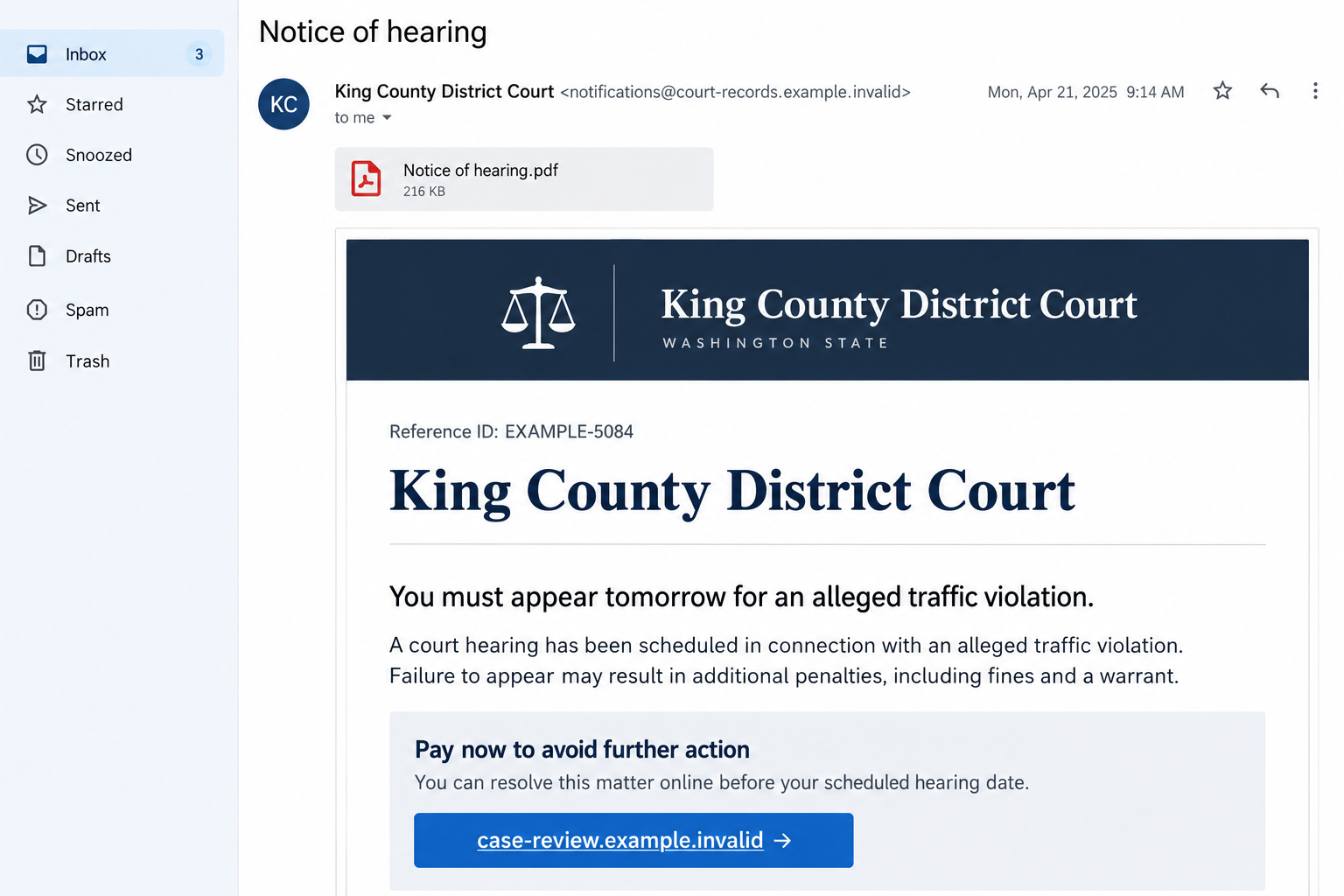
A hearing notice says you must appear in King County tomorrow. There is an alleged traffic matter, a formal-looking document, and a way to pay.
It is enough to interrupt anyone’s day. Before treating the message as a court order, look closely at the route it wants you to take.
Overview
The court’s identity is being used to pressure recipients
The King County District Court scam includes false hearing notices, ticket-related messages, and callers pretending to speak for the court.
A supposed next-day appearance or license consequence can push someone toward a payment link before they have checked whether a real case exists.
The lead image is an educational illustration with invented contact and reference details. It is not an authentic court document or a captured criminal website.
The court describes more than one way the deception appears
King County’s court scam warning identifies spoofed telephone numbers, false hearing notices, and messages using payment links or QR codes.
It also describes juror calls demanding cash or kiosk payments, with an offer to bring a supposed sheriff into the conversation.
The approaches can appear separately. A threatening text and a jury-duty call need not come from the same people or lead to the same destination.
Urgency and borrowed authority replace independent verification
Pay attention when a contact combines court language with any of these instructions:
- Appear tomorrow for a violation you cannot independently identify.
- Follow a payment link or scan a code to avoid a license consequence.
- Use cash or a kiosk because a supposed court employee tells you to.
- Accept another participant on the caller’s conference as proof of authority.
- Trust an incoming telephone display instead of contacting the court yourself.
King County District Court says it does not send tickets by text or email. Use the court’s own resources to check an alleged citation.
A Hearing Notice Can Look Convincing Without Being Genuine
A court-branded document puts pressure on the reader before its details have been verified. Many people worry that questioning it could itself cause trouble.
That worry is understandable, particularly if you have never dealt with the court. It is also why an independent check is worth making.
Look beyond whether the page contains a seal, a reference number, or a familiar address. Those are elements of a document, not proof of its source.
A genuine court name can be copied into an unrelated message. Even an accurate telephone number printed in the document does not validate every other instruction.
Do not let a mixture of true details and unverified demands blend into one trusted package. Check the case and the payment route separately.
If you already have real proceedings, contact the staff member or attorney through the channel you used before this message arrived.
A new document does not automatically replace an existing hearing date, agreement, or official instruction. A surprising change deserves confirmation.
How the King County District Court Scam Works
Step 1: The message creates an urgent court obligation
A text or email may claim you must appear in court the next day for a toll, speeding, or other alleged violation.
The short timeline makes an ordinary verification step feel like a delay you cannot afford. You may begin planning a response before checking the sender.
The notice can also combine different concerns: court attendance, money owed, and driving privileges. That makes the consequences feel broader than one unpaid bill.
Separate what it alleges from what you know. Have you actually received a citation, and can you identify the responsible court independently?
You do not need to click a link to answer those initial questions. Start from your existing records and the court’s published contact routes.
If the message is vague, do not fill in the gaps by supplying a license plate, birth date, or case details to its sender.
An unknown contact is not entitled to that information simply because it uses a legal heading.
Step 2: A document or telephone display supplies borrowed credibility
The next layer can be a formal hearing notice or a call that appears to come from a court number.
King County warns that its telephone numbers have been spoofed. The incoming display therefore cannot serve as an identity check on its own.
Do not ask the caller to prove who they are by repeating a number you can find online. They can read public information too.
For documents, verify the alleged case through an independently selected court resource. Checking whether the named court exists answers a much narrower question.
A polished signature block does not show who sent the message. A realistic attachment name does not establish that the attachment belongs to your case.
The safest verification changes the channel and removes the sender from the process. You choose the contact rather than accepting one they supply.
If a real employee’s name is misused, that employee is another target of impersonation. Do not assume the name identifies the person responsible for the fraud.
Step 3: A link or QR code offers an immediate escape
A payment button or code can make the notice feel actionable. Instead of explaining the alleged violation, the message points directly toward settling it.
A QR code is only another way to present a destination. Scanning it does not authenticate the document or establish that the court controls the page.
Nor does a professional payment screen prove that its operator is entitled to collect a fine. Appearance and authorization are different things.
Do not follow a code to find out whether the notice is real. Check with the court before approaching the destination the sender selected.
If you already opened it, note whether you entered information, downloaded anything, or granted a permission. Those details determine the next practical step.
A link in a fake notice does not, by itself, prove a specific malware infection or password theft. Avoid assuming an outcome you have not observed.
The immediate reason to stop is sufficient: the route has not been verified, and the court warns about these payment demands.
Step 4: A live caller may offer another supposed official
The juror-call variation adds a different credibility trick. The caller may say a sheriff can join the conversation to confirm the demand.
A second voice arranged by the first caller is not independent verification. You still have not selected or reached either official yourself.
Titles, departmental language, or an apparent transfer can make the exchange sound administrative. None establishes that the participants work for the court.
Do not let the conference format pressure you into staying polite while money is demanded. You can end the entire conversation.
Then use the court’s published contact information to ask about the allegation. Do not accept an instruction to verify through an extension the caller controls.
If a family member is handling the call, help them make that separate check. Avoid arguing with the supposed officials while they continue directing the conversation.
The goal is to move your decisions outside their influence, not to win a debate with them.
Step 5: Cash or kiosk instructions move the risk into a payment
King County has specifically described fraudulent juror calls requiring cash or kiosk payments. The payment location can appear ordinary even when the underlying demand is false.
A machine accepting money does not verify that your court obligation exists. The person directing the transaction remains unverified.
Do not withdraw funds or travel to a payment location while relying on an unexpected caller’s instructions. Consult the actual court first.
If you already transferred funds, retain transaction identifiers and receipts. Tell the relevant financial provider what the caller claimed and how the payment was made.
A caller may describe money as refundable or necessary only temporarily. That language does not guarantee a reversal or create an official refund process.
Refuse any additional payment supposedly needed to finish, cancel, or correct the earlier transaction. Contact providers through channels you have verified independently.
Do not keep interacting just to obtain more evidence. The information already available can support a report without extending your exposure.
What Genuine King County Court Services Look Like
Optional text reminders are not tickets delivered by text
The court offers an opt-in SMS reminder service for certain hearing dates. Its form describes reminders as supplemental to the paper notice.
That is different from an unexpected text inventing a ticket and directing immediate payment. It also means a blanket rule against every court-related SMS is misleading.
If you enrolled in reminders, check a surprising message against your established case information. Use the court’s actual resources to manage questions about the service.
Never supply financial details merely because a reminder appears in a familiar thread. Verify an unusual new request independently.
Official payment options exist outside a stranger’s instructions
King County District Court publishes legitimate payment options, including online and telephone routes. The existence of telephone payment does not authenticate an unsolicited collection call.
You select the genuine route after confirming the citation. That is fundamentally different from sending funds to wherever an unexpected caller directs you.
Consult the court’s citation response guidance for the choices relevant to a real ticket. Do not assume a fraudulent notice accurately describes them.
Payment, mitigation, and contesting a citation can involve different decisions. A fake message should not make those decisions for you.
Case searches help, but the correct court still matters
Use the official Case Access Resources page rather than a portal linked from the suspicious notice.
Check that the system covers the court and matter you need. A search that returns nothing is not necessarily a legal determination about every possible proceeding.
If you are unsure, ask the court using its published contact details. Staff can explain the appropriate route without the suspicious sender supervising.
For an actual warrant or contested legal issue, obtain qualified assistance. Do not rely on an article to resolve the legal facts of your individual case.
What to Do if You Have Fallen Victim to This Scam
- Stop the caller or message from directing your actions.
Leave the supplied page, stop responding, and end any conference call arranged by the sender. Do not scan another code or make a test payment.
If you are traveling to a payment location, stop safely and speak with someone you trust before proceeding.
- Contact the service that handled the money.
Explain that an impersonator used a court threat to induce the transaction. Supply the amount, time, destination, and any receipt or reference you retained.
Ask what can still be stopped or recovered. Be accurate about whether you approved the payment yourself after the false claim.
Different payment methods have different recovery options. A report number or the caller’s promise of reimbursement is not a guarantee.
- Secure any information entered through the notice.
Contact the issuer about exposed card details. For a compromised password, change it through the genuine account and review sessions and recovery settings.
If you reused that password elsewhere, replace those copies too. Do not enter new credentials into the page that prompted the concern.
When identifying documents or a Social Security number were supplied, consult IdentityTheft.gov for recovery steps suited to the disclosure.
- Ask the actual court about the alleged matter.
Reach King County District Court through its independently located contact page. Explain what arrived and ask how to verify any underlying citation or hearing.
Do not assume a fraudulent payment changed a real case. Likewise, do not ignore authentic paperwork because the impostor used similar language.
Keep a note of any genuine deadline supplied through the verified channel and seek legal advice when appropriate.
- Keep the evidence and report the impersonation.
Save messages, existing attachments, call details, and financial records. Note any attempted conference call and the instructions for a kiosk or cash payment.
Use the court’s warning page for current reporting resources, and submit a fraud complaint through ReportFraud.ftc.gov where appropriate.
Avoid posting full legal-looking documents without redaction. They may contain your real information even when the notice itself is fabricated.
- Review technical exposure without assuming an infection.
If the destination persuaded you to install software or open a download, assess that change. A threatening document is not proof of a particular malicious program.
Malwarebytes may help with suspicious software exposure. AdGuard can reduce some harmful advertising, but it cannot authenticate a hearing notice or retrieve transferred funds.
Do not engage with unsolicited recovery offers. Keep follow-up work with the court, financial provider, or adviser you selected yourself.
Frequently Asked Questions
Does King County District Court send tickets by text or email?
The court says it does not. An unexpected electronic ticket demanding immediate payment should be checked through its official case and contact resources.
Can a genuine hearing reminder arrive by SMS?
Yes, the court offers an optional reminder service for certain cases. A supplemental reminder is different from an unsolicited ticket or a new payment demand.
Is a QR code on the notice proof of fraud?
A code alone is not a complete verdict. In an unverified payment notice, do not scan it; confirm the case through the court independently.
What if a sheriff joins the call?
A second person introduced by the first caller does not authenticate either participant. End the conference and contact the appropriate office using its published details.
Does the court allow payment by telephone?
It publishes a legitimate pay-by-phone option. That does not make an unexpected caller’s collection instructions genuine; verify the citation and choose the official route yourself.
Can paying the caller cancel a real court obligation?
Do not assume so. Ask the actual court about your case and contact the financial provider about the fraudulent payment as separate issues.
The Bottom Line
Do not follow a King County District Court scam notice into a payment or supervised call. Confirm the alleged matter through the court’s own channels.
If you already responded, protect the money or information involved immediately. Keep real court obligations separate from the impostor’s instructions and report the deception.

Join the discussion
0 commentsShare your experience or ask a question about this article.
Discussion
Start the conversation
Have a question or something useful to share? Add the first comment.