

A video introduces Dr. Takashi Kadowaki and a plant discovery that supposedly changes everything about diabetes. The story sounds personal, hopeful, and surprisingly simple.
For someone tired of managing appointments, food choices, and prescriptions, that is a difficult promise to scroll past.
Overview
A real researcher’s name is attached to an unrelated sales story
Dr. Takashi Kadowaki is a genuine diabetes researcher. His professional record is not evidence that he recommended the plant-extract cure described in these advertisements.
The documented campaign misuses his identity to sell a diabetes-reversal narrative. Its supposed endorsement should not be accepted as an authentic statement from him.
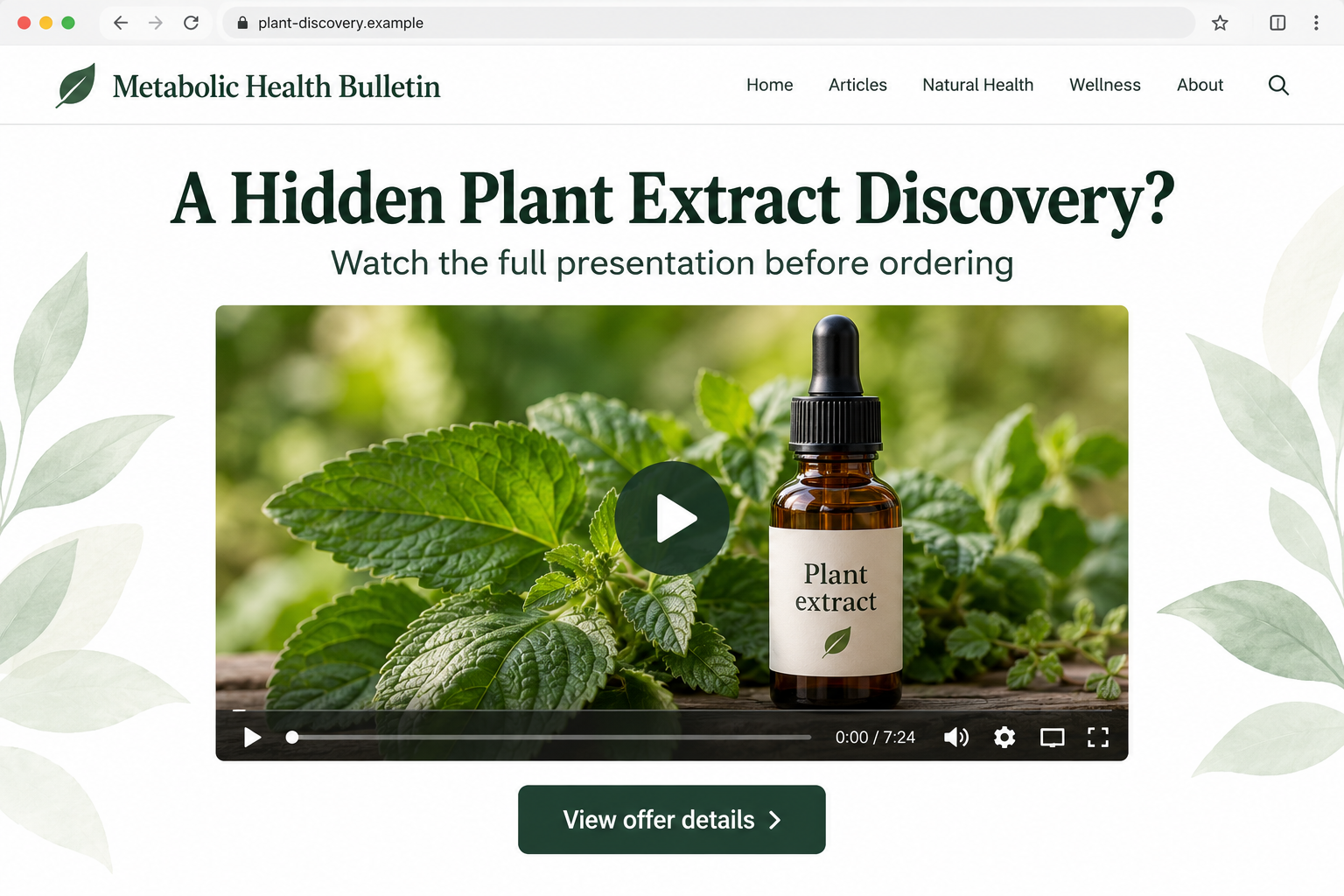
The example screen above illustrates the sales format. It is not an original advertisement, a photograph of Kadowaki, or evidence of a particular transaction.
The footage and the scientific name-dropping create false authority
The campaign record describes a different man being presented under Kadowaki’s name, with manipulated-looking speech used to support the cure story.
References to health agencies and respected journals make the presentation feel established. They do not identify a published trial of the supplement eventually offered.
Exactly whose face was altered, or which software produced it, need not be settled before rejecting the false attribution.
The practical risk is both financial and medical
The presentation leads from a supposedly remarkable discovery toward buying supplements. The plant story is the introduction to a commercial decision.
Payment terms can vary between destinations. No current universal price, refill contract, or refund guarantee has been established for every version.
- The genuine researcher should not be confused with the advertiser using his name.
- A journal logo does not provide a study title, authors, or results.
- A plant-derived ingredient is not automatically a safe or effective diabetes treatment.
- The final product and payment agreement matter more than the opening recipe promise.
- Do not replace established care because a video says a cure has been hidden.
The Real Scientist Is Not the Advertisement
Kadowaki’s name is connected with legitimate diabetes research and the University of Tokyo. That makes it useful to someone seeking borrowed credibility.
The university department’s own news page includes professional recognition associated with him. It is a research context, not a shopping recommendation.
A genuine scientific career can make an unfamiliar sales claim sound plausible. The missing connection is whether that professional actually made the particular recommendation.
Think of the claim as a chain: person, statement, study, formulation, and outcome. Each link needs to connect to the next.
A video can name a real person while inventing the statement. It can cite a real scientific field while selling a formula never tested there.
Readers do not need to disprove Kadowaki’s career. The seller needs to show that this researcher actually recommended this remedy.
A biography pasted beside a purchase button doesn’t make that connection.
Do not send complaints or payment demands to his university merely because the video names it. The institution did not become your merchant.
How the Dr. Takashi Kadowaki Plant Extract Scam Works
Step 1: The advertisement offers relief from a demanding routine
The starting point is understandable frustration. Diabetes management can involve repeated decisions, ongoing costs, and uncertainty about future health.
The advertisement offers a different emotional experience: an overlooked plant, a respected Japanese researcher, and a simple change that supposedly resolves the problem.
That story invites the viewer to keep watching before examining the product. Hope becomes the reason to postpone basic questions.
A more useful first question is whether the promised outcome is supported for someone with your condition, rather than whether the narrator sounds compassionate.
Step 2: A false identity supplies the expert voice
The documented promotion labels a speaker as Kadowaki even though the depicted man is not him. The name performs the work of a professional credential.
Altered or synthetic speech can make a familiar-looking presentation seem continuous. Short clips viewed on a phone may hide obvious inconsistencies.
However, visual oddities alone are not a reliable identity test. Compression, translation, editing, and ordinary dubbing can also change a video’s appearance.
Verify the attributed statement through an authentic professional or institutional source. Don’t conclude that a purchased remedy is endorsed because a face moves convincingly.
Step 3: Scientific references are used as scenery
The campaign invokes names including the CDC and major medical or scientific publications. The effect is to surround the pitch with recognizable authority.
What matters is whether the presentation identifies research that can actually be checked: authors, article title, journal, publication details, and relevant results.
A real journal can publish legitimate diabetes research without recommending the product in the video. Its reputation does not transfer to every nearby bottle.
Likewise, a discovery about a compound in laboratory work does not establish that an oral supplement reverses diabetes in people.
Step 4: The promised explanation keeps the viewer inside the presentation
A lengthy video can repeatedly suggest that the useful part is coming next. Viewers invest attention while waiting for the practical discovery.
By the time the sales offer arrives, leaving can feel like abandoning something already partly earned.
Do not let viewing time become a reason to purchase. You have not agreed to buy anything by listening to a story.
Pause when the presentation first makes a medical claim. Search that exact claim independently rather than waiting for the narrator to supply all the answers.
Step 5: A broad plant story becomes a specific supplement order
The commercial turn matters because a vague natural discovery and a finished supplement are not the same thing.
The bottle may contain different quantities, additional ingredients, or a formulation that was never part of the research mentioned earlier.
Write down the actual product name, seller, and domain. If the destination changes, preserve both pages rather than assuming the original identity still applies.
The same false Kadowaki story could survive a product-name change. An evergreen warning therefore needs to follow the endorsement claim, not just the packaging.
Step 6: The payment decision is separated from the reassuring opening
The checkout is where quantity, total price, shipping, additional offers, and any ongoing billing should become explicit.
Some supplement funnels promote a low unit price that requires several bottles. Others introduce recurring shipments. Neither pattern should be assumed without the transaction evidence.
If a page cannot clearly explain what you are authorizing, stop. A supposedly urgent medical breakthrough is no reason to accept an unclear financial agreement.
Keep the receipt if you already paid. It is more useful for recovery than trying to reconstruct which celebrity appeared first in the video.
How to Check a Plant-Extract Claim Without Getting Lost
Ask whether the study concerns the finished product
An ingredient name can lead to hundreds of papers. Most will not answer whether the bottle being sold produces the promised outcome.
Check the formulation, amount, delivery method, participants, comparison group, and duration. Differences in those details can change what a study means.
A seller cannot substitute an animal experiment for a human treatment trial simply by showing a laboratory photograph.
Publication in a respected journal still requires reading the result. Researchers may describe a possible mechanism without claiming they have discovered a treatment.
Look at who participated. Findings in people without diabetes cannot automatically answer a treatment question for people with an established diagnosis.
Also distinguish a preliminary change from a sustained outcome. The length of follow-up matters when an advertisement promises a lasting reversal.
If the paper itself says further research is needed, a confident narrator cannot remove that limitation. Keep the study’s conclusion separate from the sales interpretation.
Separate glucose changes from a cure
A change in one measurement does not automatically mean a chronic condition has disappeared. Health outcomes need context and appropriate follow-up.
A testimonial may omit other treatment, dietary changes, or the starting measurement. That makes it unsuitable as a forecast for your own care.
The NCCIH guidance on diabetes and supplements explains why unproven products should not replace established treatment.
Read the warning label before the success story
Obtain the complete ingredients and directions from the actual product. A video discussing plants in general does not provide a medication-interaction review.
If the seller withholds those details until after payment, you cannot make an informed health decision beforehand.
A clinician or pharmacist can review the label alongside your existing medicines. Do not experiment with replacing doses based on a marketing presentation.
Keep the Different Risks Separate
The false endorsement is the central deception. It remains a problem even if a parcel arrives and contains an ordinary dietary supplement.
Separately, a purchase may involve misdescription, unwanted quantity, non-delivery, or recurring billing. Each requires its own transaction evidence.
For example, six bottles listed clearly on an approved receipt are different from six bottles charged after authorization for one.
An unexplained later payment is different again. Identify its descriptor and compare it with the original agreement before describing what occurred.
This precision does not soften the warning. It helps a bank, platform, or regulator understand the actual conduct instead of sorting through assumptions.
If someone is helping you assemble the evidence, share copies with sensitive payment details covered. They rarely need your complete card number to understand the complaint.
Keep originals securely. An organized record can show the false endorsement and resulting order without exposing your medical information in a public review.
The original video destination was not recovered as a stable current checkout. Prices, guarantee periods, and manufacturing countries are therefore not presented as universal facts.
A missing page cannot authenticate the earlier story, but it also cannot prove every allegation about the people behind it.
What to Do if You Have Fallen Victim to This Scam
-
Protect your existing diabetes care first. If the advertisement persuaded you to change treatment, contact the professional responsible for your care.
Explain what changed and show the product label. Seek prompt medical help if you feel unwell rather than waiting for an online seller to respond.
-
Preserve the false attribution. Save the page or ad showing Kadowaki’s name, the cure promise, and the route to the product.
Keep the URL and account name visible. A cropped face without its surrounding claim can be difficult for a reviewer to interpret.
-
Find who accepted the order. Look at the invoice, confirmation email, and statement descriptor, then match them to the actual website.
Send the merchant a specific cancellation or refund request. Do not seek reimbursement from the impersonated researcher.
-
Review quantities and future payments. Check whether your receipt describes a bundle, an optional addition, or a recurring agreement.
For any unwanted renewal, request cancellation and confirmation of the effective date. Keep the request even if the seller stops replying.
-
Ask the payment provider about the right remedy. Explain the misleading endorsement and the order it led you to place.
Provide the supporting pages and support history. State accurately whether your concern is misrepresentation, an altered amount, non-delivery, or later billing.
-
Report the promotion where it appeared. Include the original ad account and landing page when reporting an unauthorized medical endorsement.
For a broader fraud complaint, preserve your transaction details for the appropriate consumer-protection or cybercrime reporting service.
-
Address any additional digital exposure. If you downloaded a program from the funnel, use Malwarebytes to check the affected device.
AdGuard may reduce similar advertising. If you entered an account password on an unrelated page, change it through the genuine service and review sessions.
Frequently Asked Questions
Did Dr. Takashi Kadowaki endorse this plant-extract cure?
The documented campaign falsely attributes a supplement-oriented diabetes cure story to him. Treat that endorsement as deceptive, not as an authentic medical recommendation.
His real research background does not validate a sales presentation using his name.
Who is the man shown in the video?
The campaign record describes a different man being labeled as Kadowaki. His precise identity and the production technique are not independently established here.
You do not need to identify the substitute speaker before deciding against an unsupported treatment offer.
Do references to medical journals prove the discovery?
No. A recognizable journal name is not a product-specific study. Request the actual publication and check what was tested and what outcome was measured.
A paper about an ingredient cannot automatically support every claim made for a supplement containing it.
Is a plant ingredient safer than a prescribed medicine?
Plant origin alone does not settle safety, dose, purity, or interactions. Different preparations can contain different amounts and additional substances.
Review the actual label with a health professional rather than deciding from a natural-health slogan.
Will every order create a monthly subscription?
That has not been established. Billing terms belong to the particular offer and checkout, not to the name of the impersonated scientist.
Check your receipt and subsequent statements, and cancel any unwanted continuing agreement explicitly.
Can security software recover the purchase price?
No. Device scanning and ad filtering address different risks from a merchant dispute. Payment recovery starts with transaction evidence and the appropriate financial provider.
A person who only viewed the advertisement should not assume that a malware infection occurred.
The Bottom Line
Reject the Dr. Takashi Kadowaki plant-extract cure pitch. A stolen scientific identity and a persuasive video are not evidence that a supplement reverses diabetes.
Keep your treatment decisions with qualified professionals. If you ordered, preserve the false endorsement, identify the actual merchant, and pursue an order-specific remedy promptly.

Join the discussion
0 commentsShare your experience or ask a question about this article.
Discussion
Start the conversation
Have a question or something useful to share? Add the first comment.