

A memory supplement can feel like a hopeful little purchase when someone you love starts forgetting familiar things. The promise behind Memo Boost speaks directly to that worry.
Before placing an order, pause over the details that a moving story can make easy to miss. They matter long after the video ends.
Overview
One promotion, two product names
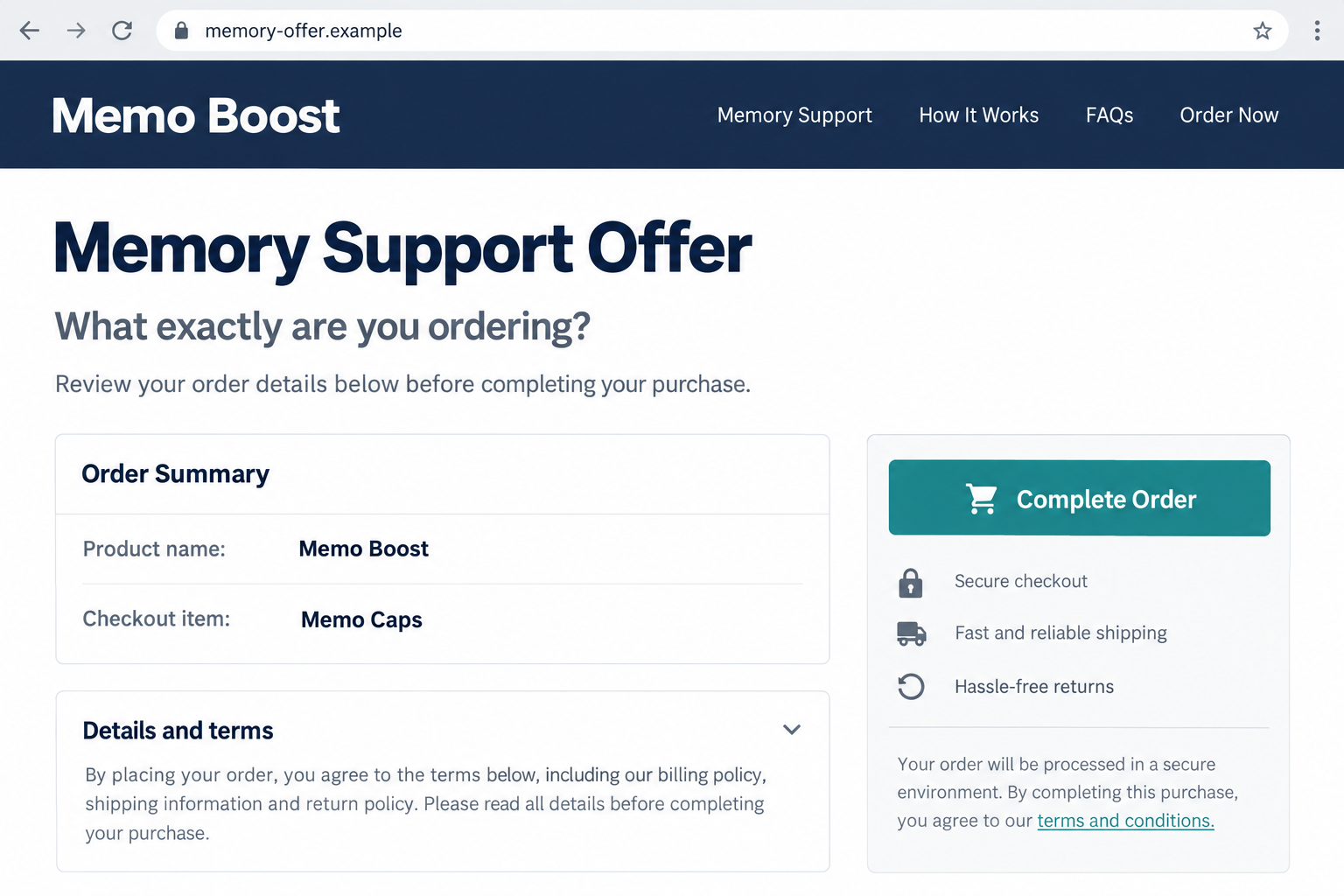
The documented Memo Boost promotion offers dramatic memory recovery, then leads toward a checkout describing Memo Caps. That switch is central to understanding the offer.
Don’t assume the names identify one standard formula. The bottle and order records need to match before anyone can assess what you bought.
The order-summary illustration shows the naming problem, not a recovered payment page. The historical landing path no longer provides the original offer.
A buyer searching for help needs the name on the receipt, not just the name remembered from a long video.
The medical story asks far more than a supplement label can support
The recorded campaign portrays Clint Eastwood regaining independence after severe memory problems. It also invokes Dr. Sanjay Gupta, Dr. Daniel Amen and Harvard research.
Those are promotional claims, not an authenticated medical history or a verified interview. Do not repeat the story as something that actually happened to Eastwood.
The advertised transformation is tied to a roughly three-week period and a supposed increase in BDNF, a protein involved in brain function.
A real scientific term cannot bridge the gap between general biology and evidence that these particular capsules reverse dementia.
- No verified finished-product trial was supplied to substantiate the recovery story.
- The recorded checkout used Memo Caps after the presentation used Memo Boost.
- The historical checkout store now displays a closed-store destination.
- Current ingredients, package prices, return deadlines and recurring terms could not be established for that offer.
Do not order through the memory-reversal pitch
This offer doesn’t provide a dependable basis for buying a treatment. Don’t use it to replace an assessment, prescribed medication or an existing care plan.
The warning is attached to the documented promotion and its purchase trail. It does not accuse every company with “Memo” or “Boost” in its name.
Memo Boost Pro and other similarly named products shouldn’t be treated as the same seller without a verified connection. A search result isn’t that connection.
Why the Eastwood Story Feels So Persuasive
The narrative isn’t simply about forgetting keys. It raises the fear of losing the ability to drive, live independently or recognize family routines.
Then it supplies an emotionally satisfying reversal: the familiar, capable person comes back. For a worried caregiver, that’s an unusually powerful sales promise.
The story also shifts responsibility. Rather than a complicated medical problem, the video presents a hidden cause that ordinary care supposedly missed.
Be careful here. A seller’s account of a celebrity’s diagnosis is not access to that person’s records, and a performance isn’t a clinical demonstration.
The important question is not whether the story moved you. It’s whether the seller can substantiate the medical outcome for the exact finished product.
It would need to identify a relevant human study, who participated, what they took, what changed and how the comparison was conducted.
A reference to scans, prestigious researchers or a protein supplies background at most. It doesn’t document the advertised recovery.
How the Memo Boost Sales Funnel Works
Step 1: Turn an ordinary search for help into a breakthrough story
The promotion addresses people searching for memory support and families frightened by dementia. It offers a much simpler answer than the complicated care they’ve encountered.
News-style narration and recognizable names make the opening feel informative. The reader may not yet realize a retail supplement is the destination.
The product should still be judged as a purchase, however sympathetic the opening feels. An emotional introduction isn’t evidence of effectiveness.
Step 2: Make a famous person’s supposed recovery the proof
The recorded video describes Eastwood losing independence and then recovering rapidly. It attributes explanations to prominent doctors and a major news-style presentation.
No authenticated interview or finished-product study accompanies that account. Treat the purported personal statements as advertising, not as quotations from a verified endorsement.
It is unnecessary to diagnose every frame as AI-generated to reject the claim. The medical and endorsement evidence is missing either way.
Footage can be edited, dubbed, staged or synthetically altered. Identifying which technique was used would require original media and provenance, not a confident guess.
Step 3: Explain the transformation with a scientific-sounding shortcut
The pitch discusses toxins and BDNF as if a single mechanism explains the entire problem. That gives the bottle a plausible role in the story.
But showing that a biological pathway exists doesn’t demonstrate that an oral supplement changes it enough to produce the claimed result.
Dose, absorption, diagnosis and clinical outcomes all matter. A laboratory finding about an ingredient cannot silently become a trial of a retail mixture.
Nor should “memory support” be read as a softer way of saying “reverses Alzheimer’s.” Those are fundamentally different promises.
Step 4: Reveal a bottle where the viewer expected an explanation
The presentation eventually points to Memo Boost capsules. The purchase journey then reaches a page identified as Memo Caps.
This handoff can leave someone unsure which brand to search, what guarantee applies or what the package should say when it arrives.
Before any purchase, the seller should make the identity consistent. An order summary should explain the product, quantity, ingredients and responsible business without detective work.
Do not assume two labels are interchangeable because the same promotion uses them. A mismatch deserves clarification before payment, not an invented explanation afterward.
Step 5: Use impressive ratings and reassurance near the payment decision
The recorded order page claimed a 9.3 rating from 42,534 reviews. No auditable review collection was supplied with that number.
A very precise count can feel authoritative, but it remains a claim. A displayed badge doesn’t establish verified purchasers, review dates or product-specific feedback.
The same recorded page used refund and no-auto-ship reassurance. Those promises should be preserved if they influenced an actual purchase.
They do not prove a subscription secretly existed. Without a completed checkout or billing record, a recurring-charge accusation would go beyond the available evidence.
What can be said is more useful: compare the authorization with the actual charges, and challenge any discrepancy you can document.
Step 6: Leave buyers searching after the sales path changes
The old landing URL now returns a missing-page response, and the cited store redirects to a closed-store page. Those are current availability limits.
They don’t establish why a page disappeared. They do make a receipt and payment descriptor much more valuable than an old bookmark.
Don’t follow random “official” links hoping to find the same business. A replacement website can belong to somebody else and create another risk.
Tracking the Seller Behind Memo Boost and Memo Caps
Start with the party that accepted your order
A checkout platform supplies payment and store infrastructure; its name alone doesn’t identify who developed, advertised or manufactured a supplement.
Cartpanda’s appearance in the historical route is therefore a transaction clue, not proof that the platform authored the medical story.
Use the merchant name, order number and descriptor from your records. Ask the payment provider to help identify an unfamiliar entry when necessary.
Don’t invent a headquarters from a shipping label
No verified corporate or return address could be established for the unavailable offer. A parcel may show a fulfillment location rather than the brand owner’s office.
Keep the label, but don’t treat it as automatic return authorization. Obtain instructions from the merchant connected to your transaction.
A warehouse handling parcels for several businesses doesn’t establish that those businesses share ownership or that the warehouse made the capsules.
Use purchase-specific support, not search-result promises
An email in your receipt is a better starting point than a phone number pasted into a promotional review. Confirm that it matches the transaction.
No contact test was performed, so this article does not claim every support request goes unanswered. It also cannot promise a particular refund outcome.
Ask a clear question with a deadline: has cancellation been accepted, what amount will be refunded, and is an authorized return required?
The delivered label must resolve the formula
The available campaign does not establish a complete, verified formula. Don’t infer ingredients or amounts from the honey-themed story or another product’s packaging.
Photograph the full panel, warnings, lot number and manufacturer information on anything delivered. Those details are useful for a pharmacist and a payment complaint.
No laboratory testing or country-of-origin verification was conducted. The purchase warning should not be inflated into a contamination or manufacturing allegation.
What Counts as Useful Memory Evidence?
Suppose a page mentions an herb studied for cognition. You still need to know whether the trial used the same preparation and dose as the bottle.
You also need to know who was studied. Findings in healthy adults cannot automatically establish treatment benefits for someone diagnosed with Alzheimer’s disease.
A change on a questionnaire isn’t necessarily restored independence. Ask whether the outcome matches the dramatic result the advertisement asks you to expect.
Federal guidance on cognitive supplements explains that evidence for preventing dementia is lacking and advises against delaying medical care.
The FDA also distinguishes supplements from approved medicines. A registration or manufacturing claim is not approval of a dementia treatment.
These distinctions don’t rule out appropriate nutrition or clinician-directed treatment for a deficiency. They rule out treating the sales story as a substitute for evidence.
If a relative has already bought, begin gently. Asking to look at the receipt together is usually more helpful than calling them foolish for wanting hope.
Keep the conversation practical: what was promised, what arrived, what was charged, and what medical advice is being displaced?
What to Do If You Bought Memo Boost or Memo Caps
-
Reconstruct the exact order. Find the confirmation email and payment entry. Write down both product names, the bottle count, total and purchase date.
Photograph unopened packages and labels so an unexpected item or quantity can be documented without relying on memory.
-
Ask the actual merchant for cancellation or a refund. Explain the naming discrepancy and the specific medical claim that influenced your decision.
Request its applicable policy and return instructions. An unavailable sales page doesn’t remove the value of a written request.
-
Check for separate billing commitments. Read confirmations for recurring amounts or schedules. Ask the merchant to cancel any unwanted continuity arrangement expressly.
If there is no evidence of a renewal agreement, don’t invent one. Identify each unexpected charge and ask for its authorization record.
-
Contact the payment service before deadlines pass. Describe the actual issue: misrepresentation, different goods, incorrect total, non-delivery or an unrecognized renewal.
Provide the ad record and merchant correspondence. Don’t wait for a vanished landing page to reappear before asking what dispute options exist.
-
Bring the bottle to a health professional. Discuss ingredients alongside existing medicines, and explain any changes made because of the advertisement.
Persistent or worsening memory symptoms deserve assessment. Don’t use an apparent improvement after a purchase to diagnose or exclude a medical condition.
-
Report the promotion without feeding recovery schemes. Use the advertising platform’s reporting tools and appropriate consumer-protection channels. Keep personal medical and payment details private.
Decline anyone demanding an advance fee to retrieve your money. A refund should not require bank-login credentials, gift cards or remote computer access.
Frequently Asked Questions
Are Memo Boost and Memo Caps the same supplement?
Both names appear in the documented purchase journey, but that doesn’t establish identical contents or manufacturing across every product carrying those names.
Use the receipt and delivered label to identify your purchase. Don’t replace missing information with a formula from an unrelated listing.
Did Clint Eastwood confirm the recovery described in the ad?
The campaign’s account is not an authenticated endorsement or verified medical history. Its narration should not be repeated as a factual diagnosis or recovery.
A celebrity-themed sales performance is not evidence that these capsules produce the claimed outcome.
Does mentioning BDNF prove Memo Boost works?
No. A biological concept is not a clinical trial of a finished supplement. The advertised benefit requires relevant human evidence at the actual product dose.
The dramatic dementia-reversal claim isn’t established by simply naming a protein involved in brain function.
Is the current price or guarantee still the same?
The historical offer is no longer available through the checked paths. Current prices, quantities and deadlines cannot safely be carried over from an older promotion.
If you purchased, use the terms captured at your order date and ask the merchant to confirm the applicable policy.
Will everyone who buys receive automatic refills?
That was not proved for this campaign. The recorded page even used no-auto-ship reassurance, which should be retained if a later charge contradicts it.
Check the actual agreement and statement. An unsupported general subscription claim doesn’t help establish your specific billing dispute.
Is Memo Boost Pro connected to this offer?
No connection was established. Similar branding alone isn’t enough to identify a common seller, formula or owner.
Contact the business on your order records, not a different company that happens to appear when you search for help.
The Bottom Line
Do not buy Memo Boost or Memo Caps through this memory-reversal promotion. Its emotional celebrity story doesn’t establish a trustworthy treatment or a clearly identified product.
Already paid? Match the receipt to the bottle, request a written remedy, and seek payment-provider help promptly if the merchant fails to resolve a documented problem.

Join the discussion
0 commentsShare your experience or ask a question about this article.
Discussion
Start the conversation
Have a question or something useful to share? Add the first comment.