

A doctor with decades of experience and a NASA connection sounds like someone worth hearing out. That is the attraction of the Sam Walters memory pitch.
But what, exactly, does that impressive introduction tell you about the claim being sold? The answer needs more than a familiar institutional name.
Overview
The Story Behind the Sam Walters Search
The promotion connects a memory supplement with Dr. Sam Walters, described through clinical experience, nutritional science and past work associated with NASA.
Searches about an AI video have added another question: is the speaker authentic? That should be investigated without jumping to conclusions about everyone sharing the name.
This article examines the authority story. Youthful Brain is the associated product in this case, but the underlying verification problem extends beyond one bottle.
There Is a Real Sam Walters
Wellspring Clinic publicly lists Sam Walters, NMD, and says he is retired from clinical practice. That is important counterevidence to claims that no such professional exists.
The seller, meanwhile, describes Walters in some places as a practicing physician and elsewhere as a formulator with extensive past clinical experience.
Retirement from clinical work does not prevent someone from consulting or formulating products. The discrepancy requires clarity, not an invented accusation of identity fraud.
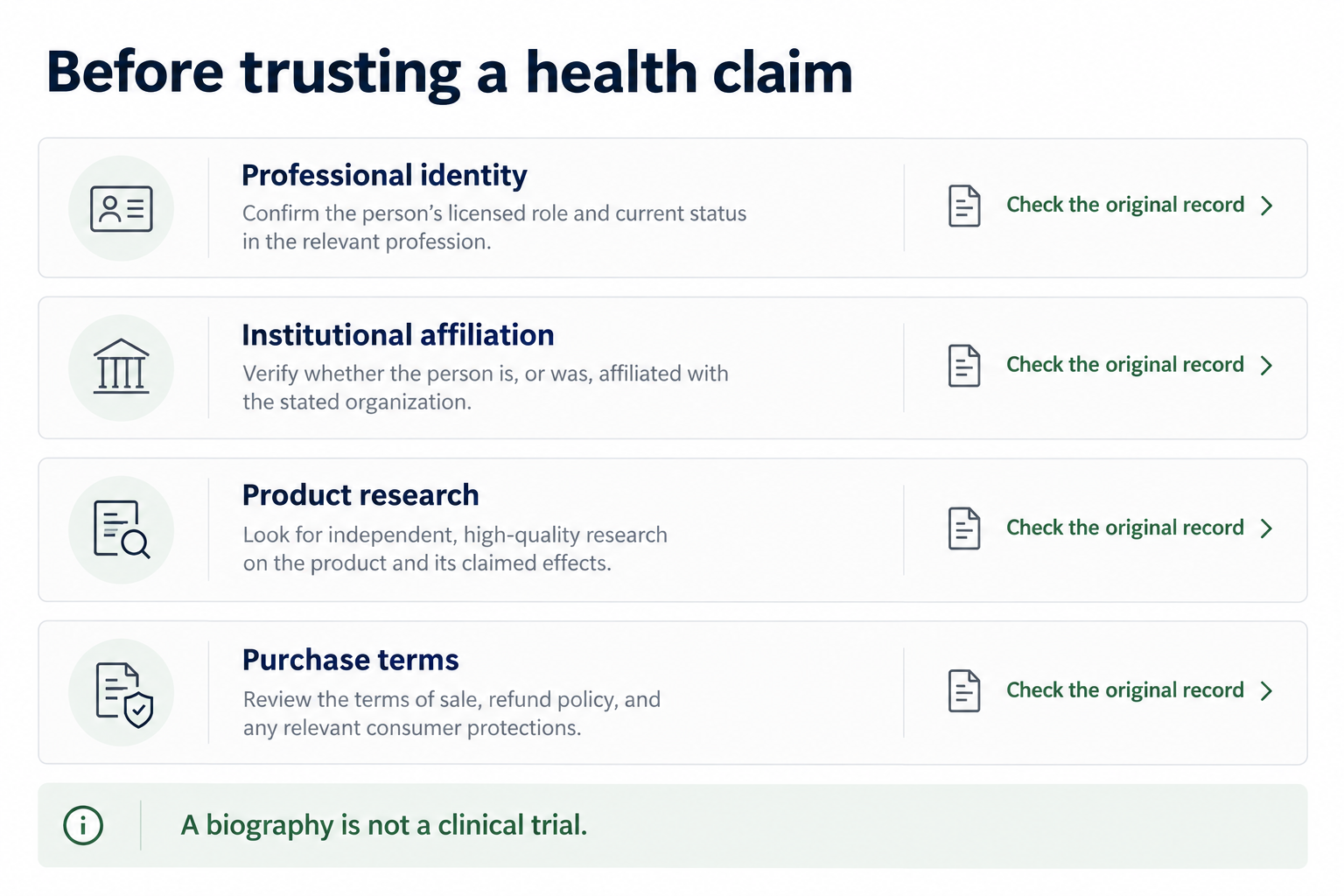
Four Questions the Biography Cannot Answer Alone
- Is the particular video speaker authenticated as the person whose credentials are advertised?
- What documentation supports the precise NASA-related role being described?
- Does research test the marketed product, rather than separate ingredients?
- What purchase and refund conditions apply to the offer being promoted?
The lead illustration separates those checks. It is not a government verification screen or a record showing that a particular credential passed or failed.
A real professional identity answers only the first part of a much larger buying decision. It cannot certify every video, product benefit or checkout promise.
Why the NASA Reference Carries So Much Weight
NASA brings associations with demanding research, precision and unusually high standards. Those associations can make an ordinary shopping page feel like an extension of institutional science.
The buyer may mentally skip several steps: this person worked with NASA, therefore the formula was tested to NASA standards, therefore the product should work.
Those conclusions do not follow from the biography alone. Employment, contract work, consulting, institutional endorsement and product validation are different relationships.
A person can legitimately contribute to an institution without that institution reviewing or approving everything the person later sells.
In this case, the merchant’s own footnote says NASA does not endorse the commercial products. It describes the historical connection as nutrition-related consulting work.
That limitation belongs beside the impressive headline in the reader’s understanding. It should not disappear simply because it appears lower on a long page.
Ask for the actual role, dates, employer or contracting organization and a record supporting the stated connection. A repeated promotional biography is not independent confirmation.
No authoritative NASA record authenticating the exact advertised role was established in this investigation. That is an evidence gap, not proof that no work occurred.
The practical point is simpler than a debate about résumé wording: a historical space-research connection would still not prove a memory supplement works.
A Real Practitioner Is Not the Same as a Verified Video
The Wellspring Clinic team page supplies a concrete starting point: a professional name, credential and statement about retirement.
It does not establish that the clinic approved the supplement promotion, controls the shop or can resolve orders. Do not contact clinic staff about merchant refunds.
Likewise, finding a real person does not automatically authenticate a face or voice appearing in an advertisement. That connection needs its own evidence.
Possible explanations include genuine footage, an authorized spokesperson, a reenactment, synthetic presentation or misuse. They should not be collapsed into a single conclusion without verification.
Odd skin texture, background lettering or lip movement can justify questions. Compression, editing and low-quality footage can also create visual anomalies.
Without original files, production disclosure or reliable authentication, declaring a specific clip AI-generated would overstate what appearance alone establishes.
You do not need to solve that technical question before protecting yourself. An unauthenticated video should not be your deciding evidence for a health purchase.
The more useful test is whether the speaker’s claims can be checked outside the performance. A polished presentation should survive that check.
How the Sam Walters Authority Pitch Works
Step 1: A Common Fear Creates Immediate Relevance
The promotion addresses memory, focus and aging. It reaches people who may be worried about themselves, a spouse or a parent.
That emotional context matters. Someone frightened by an older relative’s decline may be more receptive to reassurance than to a careful discussion of research limits.
The concern itself is legitimate. The sales presentation is not entitled to turn that concern into confidence without adequate support.
Step 2: The Biography Builds Trust Before the Evidence Arrives
Long practice experience, a doctorate and a NASA reference create a strong impression before the reader examines a formula or policy.
Each detail needs its own meaning. NMD identifies a naturopathic credential; a Ph.D. is an academic qualification. Neither abbreviation alone means specialist training in neurology.
The seller’s pages use several descriptions, including nutritional science and clinical practice. Buyers deserve a consistent explanation of the qualifications relevant to the claim.
A family looking for help with dementia should not have to infer specialist expertise from a white coat, title or general nutrition biography.
Step 3: Experience Becomes an Implied Product Recommendation
The presentation moves from the formulator’s history to a promise of sharper recall or clearer thinking. That transition can feel natural enough to escape notice.
But treating patients, choosing ingredients and demonstrating that a finished commercial blend improves memory are three different tasks.
Even extensive clinical experience would not tell a buyer the product’s expected benefit, which patients were studied or how reliably an outcome was measured.
The missing bridge is a suitable study of the marketed formula. Without it, the professional biography remains background information, not the result being advertised.
Step 4: Ingredient Studies Give the Story a Scientific Finish
The linked product presentation uses charts about nootropic ingredients. Its explanatory text says those charts do not represent a trial of the finished supplement.
That disclosure is worth reading. It prevents an inference that the product itself produced the pictured improvement in a controlled study.
It also changes the question to ask the seller. Request research matching the combination, dose, duration and type of person who would actually take it.
References to an FDA-qualified ingredient claim do not fill that gap. An ingredient-level claim has a particular scope; it is not blanket government approval.
The FDA explains the limits of supplement oversight. A professional story should not encourage buyers to mistake a supplement for an approved disease treatment.
Step 5: Trust Transfers to the Purchase Decision
Once the speaker feels credible, shoppers may stop examining bottle quantities, automatic delivery and the wording of a money-back promise.
The associated store offers recurring delivery as well as one-time purchases. The existence of a subscription is clear; whether a particular buyer selected it requires order records.
A respected-sounding name does not change those billing terms. Do not let confidence in a biography replace reading what you authorize.
The same applies to refunds. Friendly personal assurances are not a substitute for clear instructions that remain consistent across the product page and policy.
What Would Actually Strengthen the Claim?
Use consistent identification when comparing records. A full name, credential, location and relevant dates are more useful than a name-only search result.
Be careful with publication searches as well. Finding an author with the same name does not establish that the advertised speaker wrote the paper.
The study must also address the right question. Research about a nutrient’s normal biological role does not automatically demonstrate improvement in people with a particular memory disorder.
A thoughtful seller should be able to explain that difference without treating a request for evidence as hostility. A buyer’s question is not an accusation.
Keep answers attached to the claim they support. Proof of identity does not close the efficacy question, and a quality certificate does not authenticate a video.
Start with documentation tied to a specific assertion. General assurances about integrity or years of experience cannot settle a narrow question about product evidence.
For professional identity, seek a relevant regulator or institution’s current record. Make sure it concerns the same person, not a namesake.
For the historical affiliation, look for a document identifying the person’s role and relationship to the research. Distinguish an employer from a client or contractor.
For a video, request the original source or an explicit explanation of how the presentation was produced and authorized.
For the formula, ask for the complete study, rather than a press release, customer quote or graph with no identifiable publication.
For a quality claim, request a recent batch report connected to the lot on the bottle. An unrelated certificate does not test your shipment.
There is no need to collect private personal information or harass someone to perform these checks. Public professional records and merchant documentation are the appropriate starting points.
If a seller cannot provide a clear answer, you can decline the purchase. Buyers do not owe a health offer the benefit of unresolved assumptions.
The Memory Concern Deserves More Than a Shopping Experiment
Forgetting an occasional name is not the same as a new pattern that affects everyday tasks. The distinction should be discussed with a healthcare professional.
A clinician can consider the person’s symptoms, medicines, sleep, health history and other relevant factors. A video cannot perform that individualized assessment.
Families can help by recording specific examples and when they began. Bring the information to an appointment rather than trying to diagnose from an advertisement.
Do not let an appealing story turn into a six-month delay in seeking help. The possibility of a supplement benefit is not a reason to postpone assessment.
If someone is already taking the product, show a pharmacist the full label and medication list. A familiar ingredient can still matter when combined with other treatment.
Keep prescribed care separate from the promotional narrative. Do not stop or replace medication because an online presenter seems confident.
What to Do If You Responded to the Sam Walters Promotion
-
Preserve the exact version you saw. Save the ad link, sponsor name, landing address and any explicit claim about NASA or disease reversal.
Capture the relevant words with their surrounding context. A shortened screenshot can conceal a disclaimer and make the record less reliable.
-
Pause the health decision. If the presentation prompted concern about memory symptoms, make a medical appointment instead of ordering another bottle to test the promise.
Explain what caught your attention and bring the ingredient label if a purchase has already arrived.
-
Separate the presenter from the seller. Use the merchant identified on your receipt for order questions. Do not ask unrelated clinics or same-name professionals for refunds.
Write down the business name, order number and support channel so later conversations remain tied to the correct transaction.
-
Inspect the agreement you made. Check whether payment covered a single shipment or recurring delivery, and whether the quantity matches your intention.
Request cancellation of unwanted future shipments explicitly. Retain the confirmation rather than assuming a complaint automatically ended the arrangement.
-
Challenge a specific misleading representation. If a claim materially influenced your purchase, state what was promised and why the supplied evidence does not support it.
Attach the relevant advertisement and receipt. Ask your payment provider about options if the merchant does not resolve a documented billing or refund problem.
-
Report responsibly and avoid recovery pitches. Consumer complaints should describe the actual advertisement, amount paid and response received, without accusing unrelated people.
Anyone promising a guaranteed refund for an additional fee creates a new risk. Work through your merchant, payment provider and appropriate official reporting channels.
Frequently Asked Questions
Is Dr. Sam Walters a Made-Up Person?
No blanket claim like that is justified. A real Sam Walters, NMD, appears on a clinic’s public team page, which describes him as retired.
Does a NASA Connection Mean NASA Approves the Formula?
No. Past work connected with an institution does not establish endorsement. The merchant’s own disclaimer says NASA does not endorse its commercial products.
Has the Advertised Video Been Proven to Be AI-Generated?
Not by the evidence established here. Visual suspicions are not authentication. The speaker and production method require independent verification.
Does Retirement Prove the Formulator Story Is False?
No. Someone can retire from clinical practice and still formulate products. The seller should explain inconsistent descriptions rather than leave buyers to infer current clinical status.
What Evidence Matters More Than the Professional Biography?
A well-designed study testing the actual marketed formula is more relevant to product performance than a résumé, institutional reference or ingredient chart.
Should I Contact Wellspring Clinic About My Purchase?
No merchant relationship or order-support role was established for the clinic. Contact the business on your receipt, and keep medical questions with your own clinician.
The Bottom Line
Do not buy a memory product because the Sam Walters/NASA story sounds authoritative. A real professional name does not authenticate every presentation or prove product benefits.
If you already responded, preserve the actual claims and review your order terms. For changing memory, arrange a clinical assessment rather than relying on the sales narrative.

Join the discussion
0 commentsShare your experience or ask a question about this article.
Discussion
Start the conversation
Have a question or something useful to share? Add the first comment.