

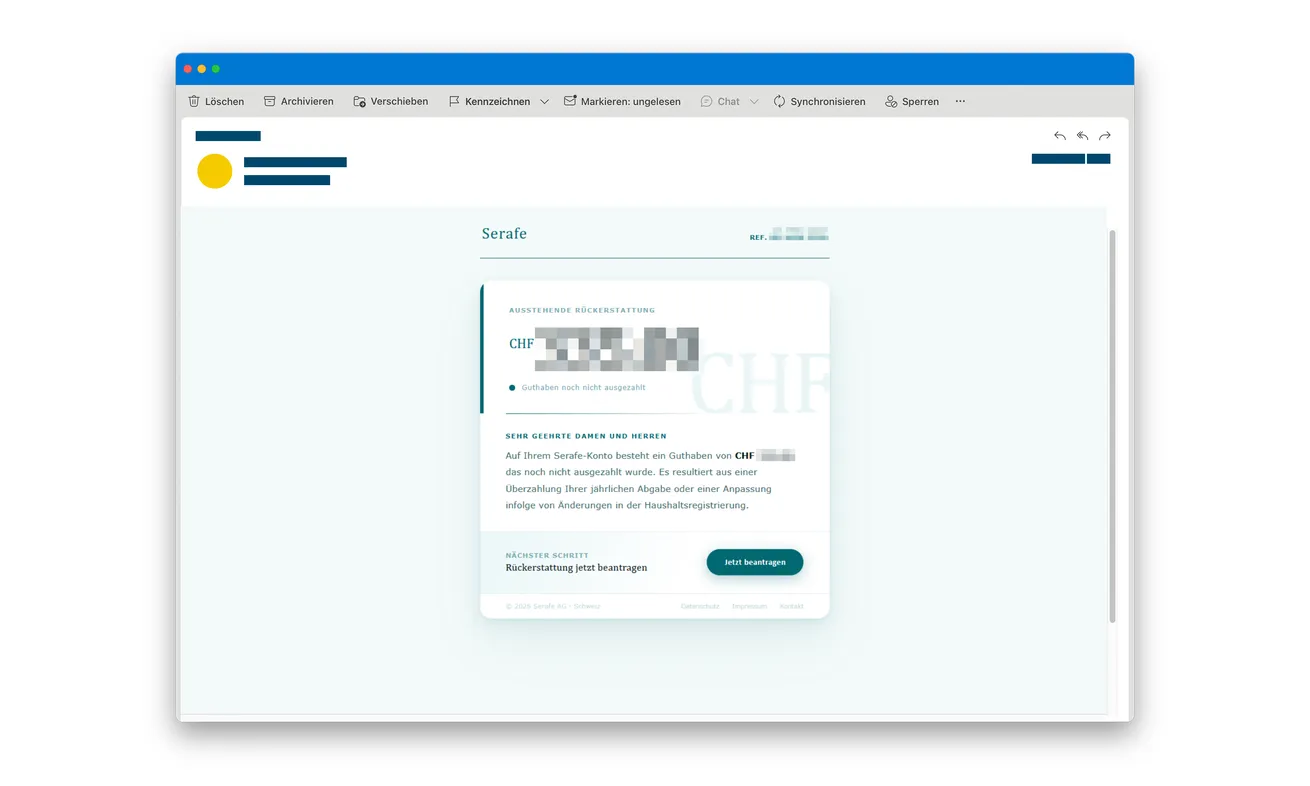
A Serafe email says money is waiting to be returned to you. The message looks like an account update, with a button for requesting the payment.
If you’ve recently dealt with a household bill, the timing may feel perfectly reasonable. Take a moment before turning that apparent credit into a financial form.
Overview
The refund announcement leads to card collection
The Serafe refund email scam uses the collection agency’s identity to advertise a credit and steer readers toward a counterfeit claim page.
Swiss police document the fraudulent messages and linked forms collecting personal and card information. Some versions also seek an SMS security code.
Serafe is the real organization being impersonated. The false email isn’t a genuine decision about your bill or proof that the collection agency is dishonest.
The 24-hour deadline appears in some versions
Police describe messages that pressure recipients to claim within a day. That deadline is part of the fraudulent request, not a reliable refund rule.
The original example shown here advertises an outstanding credit. Its reference and amount remain masked as published by the police; no particular refund figure should be inferred.
The wording can vary while the request stays attractive: provide financial information now to receive money supposedly already owed.
The real agency gives a clear phishing warning
Serafe’s official website warns that it doesn’t send emailed links asking customers to enter account information or request payments by TWINT.
- Check the supposed credit with Serafe independently.
- Don’t use this email’s claim button to enter card details.
- Treat a bank-code request as a financial authorization question, not routine refund paperwork.
- Report any submitted payment details to the relevant issuer.
- Keep genuine household billing questions separate from the phishing response.
Why a Household Credit Can Sound So Plausible
Bills aren’t always simple. You may remember a move, a payment query, or paperwork involving another person in the household.
An unexpected credit can seem like the delayed answer to one of those issues. The email gives an appealing explanation for money you hadn’t been expecting.
You may also feel relieved rather than suspicious. A refund is easier to welcome than a demand, particularly when it appears connected to a real organization.
That reaction doesn’t establish a connection to your actual account. A message can happen to arrive while you’re thinking about a bill.
Check the supposed credit against records you already hold. Don’t fill gaps in the sender’s story with assumptions about what happened in your household.
If you genuinely have a billing question, you can still ask it. Rejecting a false claim page doesn’t mean giving up a legitimate account inquiry.
Use your usual contact route and the real bill reference. You shouldn’t have to accept the email’s new financial instructions to find out whether a credit exists.
First establish whose account the household actually uses. The email recipient and the person named on a genuine bill may not be the same person.
If someone else handles payments, ask them to check the established records. Don’t forward the claim button as a task they should complete for you.
A recent move or change in household arrangements can explain why you have questions. It doesn’t establish that this particular email represents an adjustment.
The same applies to a real announcement about fees. Genuine public news doesn’t authenticate an unexpected form or prove that your household has an individual refund waiting.
Ask Serafe about the actual account and relevant payment. Let the genuine agency explain any adjustment rather than calculating entitlement from the suspicious message.
Keep its reply with the original bill. That gives you a clear reference if another email later claims the credit remains unfinished.
If a shared card was entered, involve its authorized holder promptly. The person managing household paperwork may not be the person who can secure that card.
Divide the jobs clearly: one person can ask about billing, another can preserve the email, and the cardholder can arrange financial protection.
Tell each organization only what it needs for its part. A billing query doesn’t require circulating bank authentication messages among everyone helping with the incident.
How the Serafe Refund Email Scam Works
Step 1: A refund is presented as an existing account fact
The email announces money back rather than asking whether you want to enter a promotion. That makes the claim feel administrative and personal.
A reference number or currency amount can reinforce that impression. Yet both can be written into a false message without a corresponding account entry.
Don’t assume the figure belongs to your household because it looks precise. Ask the real organization about the account rather than treating the email as its record.
Step 2: A limited claim window discourages a separate check
Some versions say the opportunity will disappear quickly. The supposed deadline makes independent verification feel like a risk to the money waiting.
In fact, the sender hasn’t established that the credit exists. You’re being asked to let an unverified deadline control a sensitive decision.
Don’t rush because you’re reading the message late or someone says the claim is almost expired. Reach the real agency through a route outside the email.
A legitimate question can be discussed without using the disputed form. The sender’s urgency doesn’t remove that option.
Step 3: A familiar-looking page asks for personal and card details
The link opens a site resembling the agency’s own presence. That visual continuity helps the claim feel like the next part of one official process.
But the page hasn’t independently identified its operator. A familiar name, color scheme, and form can be copied together.
Pause when the refund request reaches sensitive financial fields. The promise of receiving money doesn’t explain why an unverified destination should collect your card.
If you’ve already entered an address, don’t keep going simply because some information is already disclosed. Stopping can still prevent additional exposure.
Likewise, don’t supply another card to resolve an error. A failed screen doesn’t make the destination more trustworthy.
Step 4: Some versions request a code for the supposed payment
A later security-code request can appear to finish the refund. The code’s real purpose needs to be checked through your financial institution.
Receiving an authentic text while using the false page doesn’t authenticate that page. Someone else may be trying to complete a financial operation.
Read the original request without relying on the site’s interpretation. An authorization for an unfamiliar operation should not be approved just to release the claimed credit.
If you already submitted it, tell the bank. A code disclosure matters even when the website didn’t show a successful payment or an account change.
A Refund Notice Is Not the Same as a Refund Record
Start with your real bill and payment record. Then ask Serafe about the supposed credit without using the email’s form.
If the real account shows no credit, the email’s polished layout doesn’t fill that gap. Ask about the specific payment rather than accepting its claimed balance.
If Serafe confirms a real account adjustment, ask how it should be handled through the established process. Don’t automatically return to the suspicious button.
If your bank shows an unexpected debit, discuss that actual operation. Don’t describe it as a refund merely because the false site used that label.
For a shared household bill, identify which payment and account record the inquiry concerns. Avoid guessing from a generic message that doesn’t reliably identify either.
If you have older correspondence about the account, keep it with the relevant bill. An existing support exchange can help explain the genuine question.
Don’t send an entire bank statement to an unverified sender to prove that money hasn’t arrived. Use genuine support and share only what its process requires.
Serafe’s Warning Doesn’t Mean Every Serafe Message Is Fake
The organization has a real role in collecting Switzerland’s radio and television fee. The fraudulent email borrows that relationship.
Its official warning addresses emailed links requesting account information and TWINT payment requests. Don’t turn that into a claim that all correspondence or billing is fraudulent.
Check real obligations through the actual agency. A scam email doesn’t cancel a genuine bill or establish that your household owes nothing.
Similarly, a real payment dispute doesn’t make an unrelated refund link safe. Handle the billing issue and phishing incident as separate matters.
If you’re helping someone who finds the paperwork difficult, focus on locating the original account records. You don’t need their card security code to organize those documents.
If several household members received the message, tell them not to complete the claim independently. One person’s report won’t protect another person’s exposed card.
Keep the conversation calm. The useful question is what each person entered, not who should have recognized the email first.
Work Out How Far You Went Before Choosing the Response
Reading the email, visiting the page, entering personal details, submitting a card, and providing an approval are different events.
If you only read it, don’t assume your payment account was accessed. Report the message and check any genuine billing question independently.
If you opened a form but supplied nothing, stop there. Don’t return to test which information it asks for next.
If card details were typed and submitted, tell the issuer even without a charge. The absence of a confirmation doesn’t establish that the information stayed private.
If you sent a code, explain what the genuine text said. If you can’t remember, be clear about that rather than inventing the operation.
If the interaction caused a download or installation, record it separately. That creates a device question in addition to the financial one.
A short, accurate timeline helps each provider address its part. It also keeps you from treating a spam report as if it completed every recovery task.
What to Do if You Have Fallen Victim to This Scam
-
Stop using the claim page. Don’t enter another payment method, request another code, or respond to a new link promising to release the credit.
Keep the original email until the useful evidence is preserved. You don’t need another visit to the site to establish what you already submitted.
-
Contact your card issuer after a card disclosure. Explain that a false Serafe refund form collected the information.
Ask about protecting the exposed card and checking attempted or completed transactions. Include any additional cards tried after an apparent failure.
Report actual amounts, currencies, and merchant entries from the financial record. Don’t assume the email’s promised credit describes what happened.
-
Tell the financial provider about codes or approvals. A genuine authentication message may relate to a different operation from the supposed refund.
Describe the request and your response as accurately as possible. Ask what account or payment protection is necessary.
If you find an unwanted transaction, follow the provider’s dispute instructions and deadlines. Don’t assume reimbursement or cancellation is automatic.
-
Ask Serafe about the real account separately. Open its official website independently and use the genuine contact route.
Explain the refund claim without forwarding banking secrets. If an actual billing issue exists, keep following the verified process for that issue.
-
Preserve the original communication and a timeline. Save the sender details, destination, existing screenshots, and relevant account alerts.
Write down whether personal data, a card, a password, or a code was entered. Keep that record private and avoid storing live authentication secrets unnecessarily.
Report the message through your mail provider and the appropriate official reporting channel. Consider a local police report after loss or attempted misuse.
-
Protect related access if it was exposed. Change a password actually supplied to an untrusted form and deal with reused copies on other services.
If an application or file was involved, Malwarebytes can help inspect unwanted software. AdGuard offers some web filtering, not financial recovery.
A refund email alone doesn’t prove infection. Keep device work proportional while the issuer handles the exposed payment information.
-
Verify later contacts through your genuine case. Don’t pay a stranger to unlock the credit, reverse the fraud, or restore an account.
Someone who knows the original refund story may be continuing the deception. Reach your established support contacts yourself before accepting new instructions.
Frequently Asked Questions
Is the Serafe refund email scam confirmed?
Yes. Police document the fraudulent messages, and Serafe independently warns about emailed links requesting account information. The genuine agency is being impersonated.
Does every version have a 24-hour deadline?
No. Police describe that pressure in some versions. A message without the deadline still needs independent verification.
Could there be a real credit on my account?
Ask Serafe through a genuine channel. The false email cannot establish entitlement, an amount, or the correct process for any real adjustment.
Should I approve a bank request to receive the advertised refund?
Not through this unverified route. Read the actual operation and contact the financial provider if its purpose is unclear.
What if I shared a code but haven’t lost money?
Report the disclosure promptly. Waiting for a visible loss isn’t necessary before asking your bank to assess exposed authentication information.
Does this warning mean I can ignore genuine Serafe bills?
No. Verify real billing through the agency. Rejecting an impostor’s refund form doesn’t resolve an unrelated household obligation.
The Bottom Line
Don’t claim a Serafe refund through this fraudulent email. The apparent credit and deadline lead toward personal, card, and sometimes authentication-code collection.
If you submitted financial information, contact the responsible provider promptly. Check any genuine household billing question with Serafe through a separately verified route.

Join the discussion
0 commentsShare your experience or ask a question about this article.
Discussion
Start the conversation
Have a question or something useful to share? Add the first comment.