

A brief doctor’s recommendation can carry more weight than the rest of a long sales video. It seems to answer the question a cautious buyer would ask.
If Dr. Steven Gundry appeared in a baking soda weight-loss presentation you watched, inspect that moment before letting it decide a purchase.
Overview
The Supposed Dr. Steven Gundry Approval
The Dr. Steven Gundry baking soda scam uses an apparent medical endorsement to strengthen a weight-loss supplement pitch. It is not verified approval from Gundry.
In the recorded campaign, a supposed doctor segment claims superior performance over several months. The presentation then moves toward a multi-bottle SodaFit offer.
That arrangement matters: the medical-sounding reassurance arrives close to the purchase decision, when a viewer may be deciding whether the sales story deserves trust.
The relevant deception is an unauthenticated recommendation attached to extraordinary product claims. Gundry’s identity should not be confused with the party accepting the order.
What the Video Does Not Prove
A physician appearing on screen does not establish a clinical trial. Nor does a precise-sounding duration prove that a supplement was independently studied.
To assess a comparison properly, readers would need the actual study, the finished formula, the tested population, and the measured outcomes.
- An apparent testimonial is not a published comparison with prescription treatment.
- A recipe narrative does not identify the contents of a capsule.
- A bundle discount does not establish medical effectiveness.
- A guarantee does not prevent harm or automatically create an easy refund.
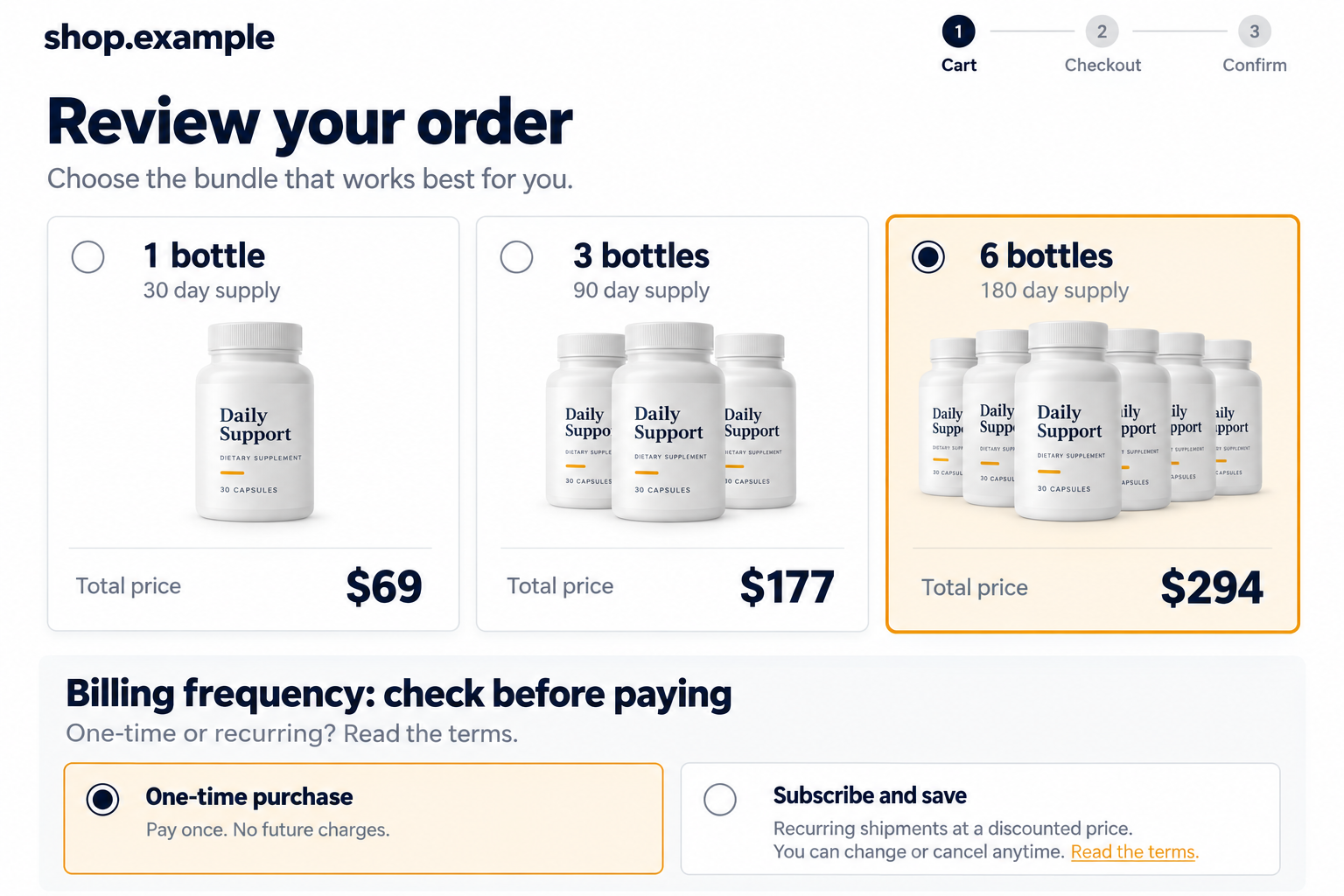
The illustration above demonstrates order checks using invented prices and a fictional store. It is not the campaign’s checkout or evidence of its actual charges.
The Verdict Before You Order
Do not buy because the baking soda video appears to have Gundry’s approval. The deceptive endorsement cannot carry the health claims or justify the transaction.
This is not a verdict on every product bearing his name. Real commercial activity and an unrelated impersonating advertisement must be evaluated separately.
The same distinction applies to SodaFit. A shared label does not prove that every domain sells the same formula or uses the same billing arrangement.
For an existing order, move away from the celebrity story and identify the receipt, merchant, amount, quantity, and any recurring terms.
How the Scam Works
Step 1: The Video Offers a Shortcut Around Familiar Weight-Loss Frustrations
The sales story begins with a routine that sounds cheaper and easier than options viewers already know. Baking soda supplies an inexpensive, recognizable centerpiece.
References to injections, changing body size, and difficult weight maintenance make the pitch emotionally relevant. It seems to understand why someone wants another option.
The problem is the leap from that frustration to a promised solution. Feeling understood does not establish that the proposed method works.
An advertisement should support its strongest claim before requesting trust. A hopeful story cannot establish safety, lasting benefit, or superiority over another intervention.
Do not interpret the household setting as a lower level of risk. Common ingredients can still be misused, and a prepared supplement may contain something entirely different.
Step 2: Familiar Personalities Make the Same Claim Look Independently Supported
The presentation places celebrities and medical figures around one apparent breakthrough. Each new face can feel like another reason to believe.
But the advertiser controls the sequence. Several clips in one promotional video do not constitute several independent investigations or endorsements.
Some material can be generated; other footage may be genuine but stripped of its original context. Both methods can create a misleading commercial connection.
Ask for the complete source of the specific recommendation. A recognizably real person is not proof that the product-related words or implications are authentic.
Also check who published the page. A television-style layout does not make an unfamiliar supplement funnel part of the program it resembles.
Step 3: A Short Doctor Segment Supplies the Missing Reassurance
The Gundry appearance functions as a medical checkpoint. It suggests that someone qualified has already evaluated the product’s performance.
The recorded pitch includes a sweeping comparative statement linked to a period of use. That sounds more substantial than a casual personal impression.
However, the claim is not accompanied by the information needed to judge a real comparison. The doctor’s apparent presence substitutes for those missing details.
A viewer may remember the authority while forgetting the precise wording. That is why it helps to write down exactly what was claimed before buying.
Was the statement about a recipe, a named product, or weight management generally? The advertiser may encourage the audience to treat them as interchangeable.
Step 4: The Recipe Is Reframed as a Complete Commercial Program
At the purchase stage, the household story becomes a supply of capsules and additional material. The order is presented as a complete treatment-like package.
In this version, SodaFit is the supplement name. The durable hook remains the supposed baking soda solution supported by recognizable personalities.
The change from recipe to package is an important stopping point. It introduces a product that needs its own evidence and a merchant that needs its own checks.
A supplement does not inherit clinical proof from a discussion of an ingredient. Nor does a bonus lesson establish the efficacy of the bottle beside it.
Take the promised outcome out of the equation temporarily. Would you buy this unfamiliar product based on its label, seller information, and terms alone?
Step 5: A Larger Package Is Framed as the Rational Choice
Once the medical story has reduced hesitation, the offer can make a larger quantity look like better value. Savings and bonuses become the final persuaders.
A six-bottle package might be entirely visible yet still be misunderstood when the headline emphasizes a unit price. Always calculate the actual payment.
The issue is not that every bundle is fraudulent. It is that an invented endorsement can be used to persuade someone to commit more money.
Ignore the claimed value of extras until you know what they contain. A large crossed-out figure is not evidence of an established market price.
Before payment, verify the selected option, total, delivery charge, and optional services. Do not rely on the package you remember clicking earlier.
Step 6: Refund and Renewal Questions Emerge After the Emotional Decision
A generous-sounding guarantee may remove the last objection to buying. Its actual requirements, however, sit in the merchant’s policy rather than the doctor’s apparent recommendation.
Check when the return clock starts, whether opened bottles qualify, who pays postage, and what evidence the seller requires.
Automatic billing needs a separate check. The recorded advertising does not prove an identical refill policy across all websites using this product name.
If a follow-up caller offers more supplements, treat it as another sales proposal. An order number does not turn the caller into a medical adviser.
Preserve each promise and response. A practical dispute is built around the actual transaction, not speculation about every site in a wider market.
How to Evaluate the Claimed Medical Comparison
Ask What Was Actually Tested
A credible product comparison should identify the finished formulation and serving size. Broad discussion of baking soda or hormones cannot establish results for an unspecified supplement.
It should also explain who participated, what the comparison group received, which outcomes were measured, and how unwanted effects were recorded.
Without those details, a reference to months of experience may simply sound scientific. It gives readers no meaningful way to assess the conclusion.
Do Not Confuse Registration With Approval
The FDA explains that supplements are regulated differently from drugs. A manufacturing-related badge does not prove a weight-loss outcome.
Likewise, words such as natural or doctor-formulated do not establish that a particular doctor approved the offer being shown.
The correct question is whether the specific claim has reliable support. Reassuring labels and a familiar face should not distract from that question.
Keep the Impersonation Finding Separate From Other Debates
People may disagree with a public doctor’s genuine advice or product marketing. That does not authenticate an unrelated advertisement using his identity.
Conversely, identifying a fake endorsement does not require settling every argument about that person’s work. The false commercial connection is enough to reject this route.
This keeps the warning useful. Readers need to know why not to trust the offer in front of them, not navigate an unrelated debate.
Read the Guarantee as a Separate Agreement
Find the Clock Before Relying on the Badge
A return period can run from ordering, shipping, or delivery. Those are different dates, especially when a parcel takes weeks to arrive.
Check the precise rule while you still have the original page. Do not assume that a prominent guarantee badge explains the deadline.
Also establish what the policy expects you to return. A request involving every bottle, original packaging, or prior authorization can affect the practical process.
Calculate the Recovery, Not Just the Refund Percentage
A partial refund may look reasonable until you compare it with the total paid. Shipping charges and return postage can change the result substantially.
Ask for the exact amount in writing. A percentage without a stated calculation can leave room for another misunderstanding.
Do not accept a credit or replacement merely because support describes it as the only option. Ask your payment provider how that choice affects a dispute.
Keep Product Quality and Advertising Truth Separate
A bottle can arrive sealed and correctly labeled while still having been sold through a false endorsement. Conversely, a delivery mistake needs its own evidence.
Describe each issue accurately. Photograph damaged goods, preserve the misleading recommendation, and identify the amount you approved.
This prevents a seller from answering a narrow shipping question while ignoring the reason you trusted the purchase in the first place.
It also keeps the complaint proportionate. Do not allege laboratory findings, a dangerous ingredient, or an offshore manufacturer when you have no evidence for those claims.
The strongest case is not the loudest one. It is the clearest connection between what was represented, what you agreed to, and what happened afterward.
What to Do After Responding to the Fake Gundry Weight-Loss Offer
-
Identify what you actually purchased. Find the confirmation showing the merchant, product format, selected package, and total.
Do not assume the seller is Gundry’s business because the video showed him. Use the entity named in the transaction records.
-
Write down the reason for your complaint. Distinguish a false endorsement from non-delivery, the wrong quantity, a defective product, or an unauthorized payment.
Attach the relevant evidence for each issue. A clear account is easier to investigate than a broad accusation without dates.
-
Request a remedy before support delays accumulate. Ask for cancellation or refund and keep the conversation in a form you can retain.
For a return, obtain the authorized address and conditions first. Photograph the parcel and retain tracking if you send it back.
-
Check future billing independently of the refund request. Search the receipt and account for a membership or refill arrangement.
If one exists, cancel further payments explicitly. Ask the issuer how to handle any charge that falls outside what you approved.
-
Review health implications with an appropriate professional. If you used the product or changed medication, explain what you took and when.
Keep packaging and ingredient information. A generic product name may be shared across different formulations and does not identify the contents reliably.
-
Use the payment provider’s real dispute process. Ask about the available grounds, documentation, and deadlines through its official contact route.
No outcome is guaranteed, but waiting through repeated seller promises can reduce your options. Keep a chronological record of attempts to resolve the matter.
-
Do not accept a second sales pitch as a remedy. Decline packages said to unlock results or speed up a refund.
Report the misleading ad and consider an official consumer complaint. Redact personal and financial information from any public warning you share.
Frequently Asked Questions
Did Dr. Steven Gundry Approve the Baking Soda Offer?
The recorded campaign does not establish genuine approval. Its apparent doctor recommendation should not be treated as a verified statement about the promoted supplement.
The impersonation issue is distinct from Gundry’s legitimate business or publications.
Does the Claimed Period of Use Prove a Clinical Trial?
No. A duration in an advertisement does not identify a study, comparison group, measured outcome, or tested formulation.
Ask for the underlying evidence rather than accepting a precise-sounding testimonial as research.
Why Does the Presentation Include So Many Famous People?
Multiple appearances can make one sales story feel independently supported. The advertiser still controls what the audience sees and how the clips are connected.
Each supposed endorsement needs its own original source.
Is a Six-Bottle Purchase Automatically a Subscription?
No. An upfront bundle and a recurring order are different arrangements. Check the specific terms and subsequent payments.
The illustration uses invented totals to show that distinction, not to report actual campaign pricing.
Can a Money-Back Guarantee Make This Offer Safe?
A guarantee is a seller’s commercial promise, not proof of medical effectiveness or protection against a health problem.
Read its conditions, and do not let a refund badge override a false endorsement.
Should I Contact the Doctor to Cancel an Order?
Start with the merchant listed on your receipt and the payment provider. The person shown in an impersonating advertisement may have no access to your transaction.
Reporting misuse of a name is different from requesting an order cancellation.
The Bottom Line
The Dr. Steven Gundry baking soda scam adds apparent medical approval to a supplement sales story. That endorsement is not a trustworthy basis for purchasing.
Reject the funnel. If you already ordered, trace the real merchant, preserve the misleading claim, and address refunds and unwanted billing as separate practical tasks.

Join the discussion
0 commentsShare your experience or ask a question about this article.
Discussion
Start the conversation
Have a question or something useful to share? Add the first comment.