

A text says an Indiana toll slipped past you. The amount sounds manageable, but the warning makes it feel like something you should clear before tomorrow.
Maybe you traveled recently. Maybe someone else drove the car. Before reaching for a card, take a closer look at how the message wants you to pay.
Overview
The unpaid-toll claim borrows a real road’s identity
The Indiana Toll Road text scam presents an unfamiliar balance as an urgent obligation. A link, callback, or QR code offers an apparently convenient way to settle it.
The real operator has a direct warning: it does not send texts, calls, or emails requesting unpaid toll payments. The demand described here is impersonation.
That warning concerns the unsolicited collection request, not every ordinary account communication. Use the official state directory below to find the correct service.
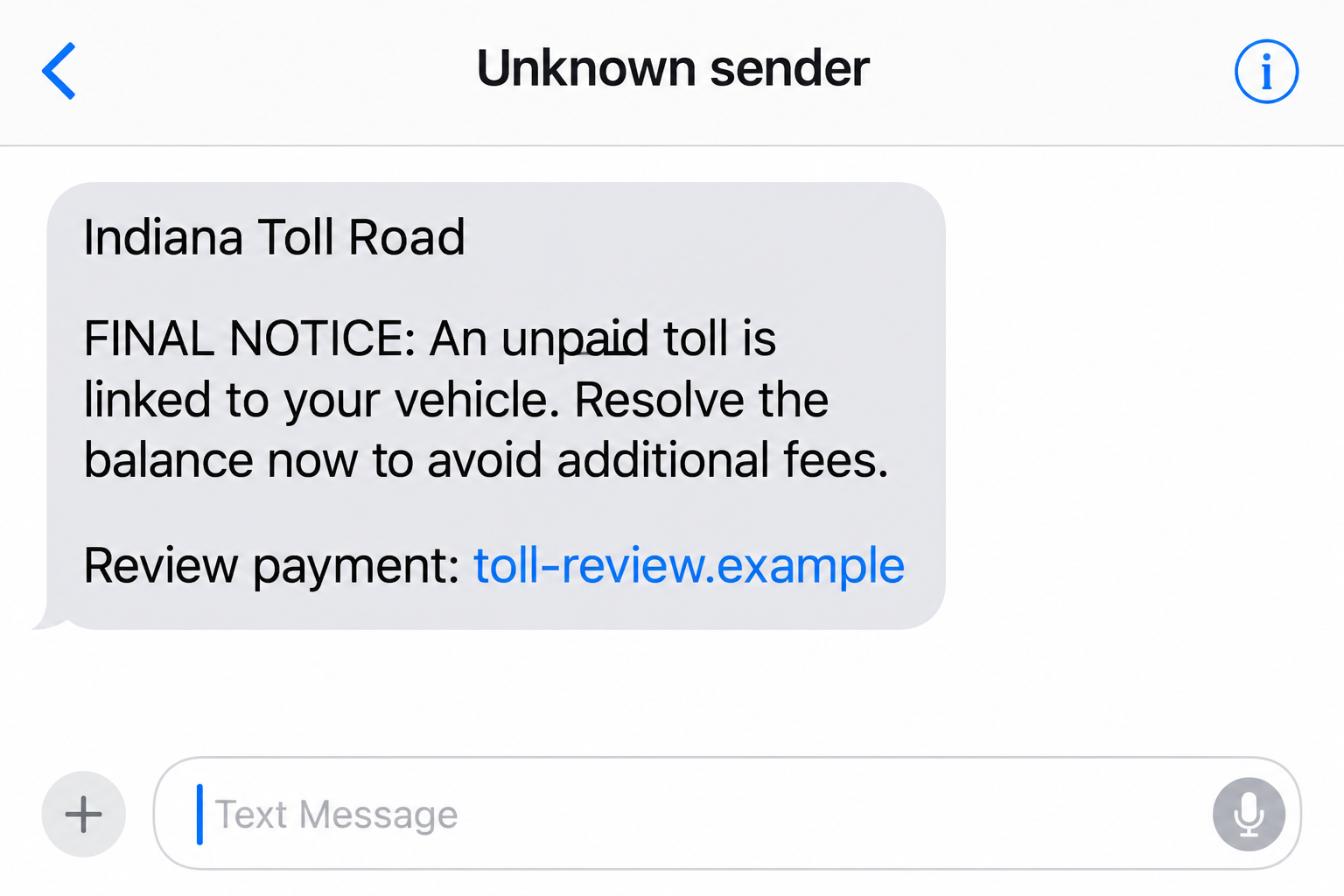
The image above is an illustrative message with a nonfunctional address. It is not an original conversation received by a customer or evidence of one particular sender.
The payment route matters more than a familiar journey
A recent drive can make the story feel plausible. It cannot establish that the person sending the text has permission to collect money.
Likewise, a genuine unpaid balance would not authenticate the message. You need to check the real account without relying on the contact details supplied by the stranger.
You don’t have to ignore a possible bill to reject the text. Check the toll through a separate route, without handing the sender your card.
These details should make you stop before paying
- An unexpected demand to settle an overdue toll through a texted link.
- A deadline paired with threatened fees or restrictions.
- A court-looking attachment that tells you to pay by scanning a code.
- A destination containing familiar road words but reached only through the warning.
- A request for another card or a bank security code after an apparent payment failure.
None of those details requires you to prove who sent the message. You can protect your information first and let the relevant providers investigate.
Indiana Toll Road, RiverLink, and the BMV Are Different Starting Points
Match the road to its actual operator
A message may say Indiana as though one organization handles every driving charge in the state. That shortcut makes the demand harder to question.
INDOT’s toll roads and bridges directory identifies different services, including Indiana Toll Road and RiverLink. Use it to locate the appropriate operator.
If you remember crossing a bridge, don’t automatically assume an Indiana Toll Road text relates to that trip. Start with the route you actually took.
Keep the journey date, vehicle, and any genuine invoice available when speaking to support. You should not need to provide those details to an unidentified texter.
A licensing warning is not a toll invoice
The Indiana BMV handles its own services. A message cannot make the BMV a toll collector simply by placing its name beside a payment demand.
The agency’s consumer scam alerts distinguish opt-in registration reminders from fraudulent payment links. The BMV says it will not ask for fees through a texted link.
That distinction avoids an unhelpful blanket rule. You may have genuine reminders enabled while still receiving a separate impersonation attempt.
For a real licensing or registration concern, start with BMV services. For a toll, use the relevant toll operator rather than a page claiming to combine everything.
How the Indiana Toll Road Text Scam Works
Step 1: A vague balance makes you fill in the missing trip
The message introduces a debt before giving you a reliable way to check it. It may describe an unpaid toll, missed payment, or overdue account.
You supply the personal context yourself: the weekend drive, a borrowed car, a transponder you forgot to check. That recollection can make a generic warning feel specific.
Pause at that point. Remembering travel tells you where to look for a real charge; it does not tell you whether this sender is genuine.
The FTC’s toll-text warning describes this nationwide phishing pattern, including urgent payment requests that lead to bank or card-information forms.
You do not have to supply your plate number to see whether the stranger recognizes it. That would give the unverified sender another useful detail.
Step 2: The threat makes a small payment feel like the sensible choice
The pressure often concerns what supposedly happens next. An additional fee, account restriction, or official-looking enforcement warning can sound more troublesome than the original balance.
Paying starts to feel like an administrative shortcut. The sender wants you thinking about avoiding consequences instead of checking who receives your information.
A final-notice heading can also suggest that you missed earlier warnings. You may feel behind before establishing whether any genuine bill exists.
Write down the claim if it worries you. Then compare it with your own records, without allowing the supplied countdown to choose your next website.
Step 3: The warning supplies the place that supposedly fixes everything
The proposed solution is usually close at hand: follow the link, scan the code, or contact the number in the notice.
Those are different ways of steering you into the sender’s chosen process. A QR code is not an official seal; it can simply conceal a web address.
Some versions dress the demand as a court notice. A formal layout or case reference should be checked with the named authority, not through its embedded payment instructions.
The Marion County Clerk’s Office has warned about fake texts with QR links. Its office does not solicit fines or fees by text.
Don’t photograph a suspicious code with another device just to make it easier to open. Use an independent route to check the alleged matter instead.
A link containing the road’s name can still belong to someone else. The recognizable part may be a label attached to an unrelated destination.
Step 4: Clearing the alleged toll requires information you should protect
The page may look like a normal payment form. But entering a card, password, or identifier gives that information to whoever controls the page.
A small displayed total does not place a ceiling on what exposed card information could be used for. Consider the information requested, not just the alleged fee.
If a form asks for a bank password or security code, stop. Do not let a convenient explanation turn an unrelated account secret into a toll requirement.
The exact destination can change between messages. No live criminal payment form was submitted for this guide, so specific fields and outcomes are not asserted for every version.
If you already responded, begin with what you remember doing. You can tell the bank what you entered without knowing exactly how the site stored it.
Step 5: A failed payment or confirmation can keep you in the trap
An error may tempt you to try again with another card. A confirmation may persuade you to stop checking altogether.
Neither response tells you whether the real toll account was credited. Both screens can come from the same untrusted process that requested the payment.
Keep any receipt you already have, but treat it as evidence for your issuer. Do not use it as independent proof that the toll operator received money.
Further messages may offer to finish processing or correct an issue. Leave those instructions unanswered and continue through the bank or operator you contacted yourself.
How to Check the Toll Without Following the Message
Build the check around your own records
Find your established toll account, original invoice, or previous legitimate correspondence. Use a saved trusted route or the operator identified through INDOT.
Compare the claimed date with travel you can actually account for. If a family member uses the vehicle, ask about the trip before making a duplicate payment.
For a rental or employer-owned vehicle, contact the organization responsible for billing. A forwarded screenshot alone may not show whether a charge belongs to your account.
Ask the genuine provider to explain any unfamiliar transaction. Keep its response separate from the suspicious text, especially if the sender later changes the story.
Do not let a search result become the second shortcut
Searching the sender’s number may produce mixed reports, advertisements, and copied warnings. A quiet result does not certify that the number is safe.
Choose the official agency directory or a contact route already tied to your account. Don’t call a sponsored support listing merely because it promises faster resolution.
If you cannot reach the operator immediately, preserve the message and try its published support channel later. Waiting for genuine support is different from accepting the stranger’s deadline.
Never post a complete invoice, plate image, account number, or payment receipt in a public comment while asking other readers whether it looks real.
What to Do if You Have Fallen Victim to This Scam
Start with the part of the interaction that actually happened. Receiving the warning, entering a card, and installing an app call for different actions.
-
Stop the payment conversation and preserve the useful details.
Save the original message, sender, visible destination, and any transaction record already available. Note when you opened the page and what you supplied.
Do not revisit it to recreate a receipt or finish a report. Avoid replying to ask the sender to delete your information.
-
Check whether a genuine toll needs separate attention.
Contact the actual operator through its established website or account records. Explain that an unsolicited notice prompted your question.
If a real charge exists, ask how to handle it securely. A payment to an impostor does not automatically settle that unrelated balance.
-
Tell your card issuer or bank about the exposure promptly.
Use the banking app you already have or the number printed on the card. Describe whether you entered details, approved a payment, or tried multiple cards.
Ask about protecting the card and disputing any resulting transaction. Keep the provider’s reference number and follow its instructions, without assuming reimbursement is guaranteed.
The FTC’s recovery guidance explains why the payment provider should be contacted quickly. A scam report alone is not a request to your issuer.
-
Secure any account whose login information you disclosed.
Open the genuine service independently and replace the exposed password. Change it on other accounts if you reused it there.
If you supplied an authentication code, approved a login, or lost access, tell that provider. Ask it to review access rather than treating a password change as everything.
Do not send a new security code to someone claiming they need it to cancel the toll payment.
-
Address identity information according to what was shared.
A name and email are not the same exposure as a Social Security or driver-license number. Record the actual information involved.
Use IdentityTheft.gov for an appropriate protection or recovery plan. Contact the issuing agency if a government credential was exposed.
Keep private identifiers out of public warnings. A trusted helper can organize the timeline without receiving copies of every sensitive document.
-
Review device changes only if the interaction went that far.
Reading the message does not establish an infection. If you downloaded software or granted permissions, stop following that source’s instructions and review what changed.
Malwarebytes can help investigate possible harmful software. Choose the appropriate platform and follow its current instructions rather than installing a utility promoted by the text.
AdGuard can reduce some intrusive advertising and risky browsing exposure. It cannot authenticate the alleged toll, reverse a charge, or replace account recovery.
If you allowed remote access, stop using that session and seek trusted technical help. Use a different trusted device for sensitive account recovery when necessary.
-
Report the message through the appropriate channels.
The FBI’s toll-smishing advisory asks for the originating number and website when reporting. Preserve those details without publishing them alongside your own credentials.
Use your messaging app’s junk-report feature or forward the message to 7726 where supported. Keep your financial-provider case moving separately.
Include what actually occurred in a report. Do not guess a criminal’s location, identity, or the amount other recipients may have lost.
-
Be cautious about anyone offering a paid rescue.
An unsolicited helper may promise to remove the penalty or retrieve your money. Do not provide another payment or account code based on that promise.
Return to the providers handling your existing case. Keep one timeline of contacts so a new caller cannot pass off details from the first interaction as authority.
Frequently Asked Questions
Will Indiana Toll Road text me to collect an unpaid toll?
The operator’s published warning says it does not request unpaid toll payments through texts, calls, or emails. Check the actual account independently instead of using the demand.
What if the message mentions a road I really used?
That makes checking your records worthwhile, not the link trustworthy. Verify the journey and any balance through the correct operator’s existing services.
Does an E-ZPass logo mean the payment page is official?
No. A logo can be copied. Find the operator responsible for your account and open its established route without passing through the unsolicited warning.
Should I scan a QR code on a court-looking attachment?
Do not use the code to resolve the claim. Locate the named court through an official directory and ask about the actual matter separately.
I entered my card but the payment failed. Should I still call the bank?
Yes. Explain that the details went into an unverified form. An error message cannot confirm that the information was never received.
Do I need to replace my phone after opening the text?
Receiving or reading it alone is not evidence of compromise. Focus on any information submitted, payment approved, download installed, or permission granted.
The Bottom Line
Do not pay an unsolicited Indiana Toll Road debt request through its link, code, or callback. The operator has rejected that collection method.
Check a possible real toll through the proper account. If you already shared money or sensitive information, contact the relevant provider now and keep the transaction evidence.

Join the discussion
0 commentsShare your experience or ask a question about this article.
Discussion
Start the conversation
Have a question or something useful to share? Add the first comment.