

You weren’t shopping for a gift. Then a text from AT&T says thousands of reward points are about to disappear, and suddenly there’s a deadline.
Maybe you’ve overlooked a benefit on your account. Before choosing a reward, look closely at the journey that starts with that message.
Overview
The message puts a deadline on points you haven’t checked
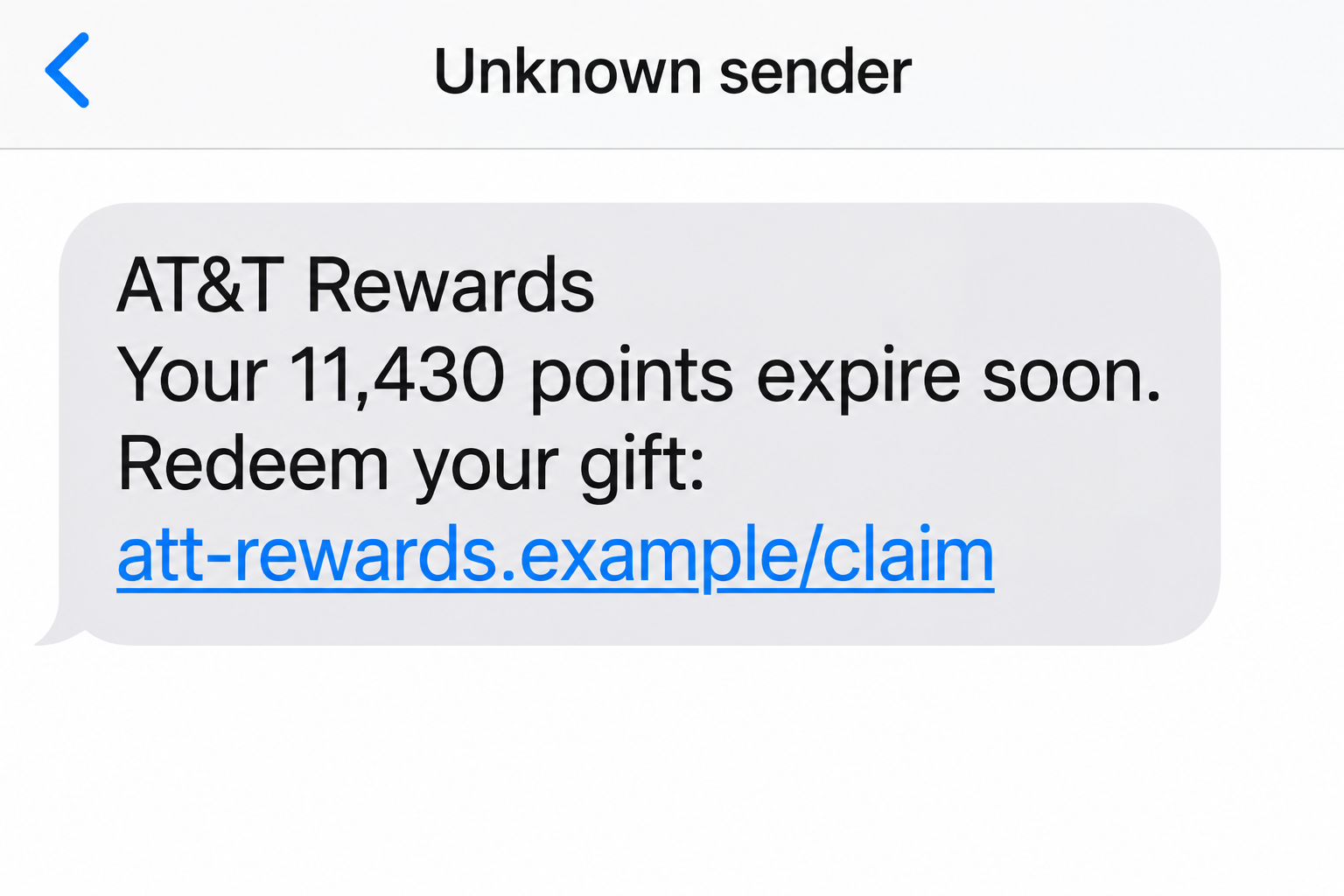
The AT&T reward points text scam claims you have a balance waiting to be redeemed. Unless you act quickly, the message says, you’ll lose it.
A reported January 2026 example named 11,430 points and linked to att.qcuid[.]icu/pay. That address is not a page inside att.com.
The date belongs to that reported message, not your account. A copied deadline does not establish that any benefit is expiring now.
The illustration above uses a fictional example link to show the approach. It isn’t an original recipient’s screenshot or a working redemption page.
A gift selection turns into a request for your details
The central deception is an unauthorized rewards portal borrowing AT&T’s identity. AT&T is a real company and is not operating the fraudulent promotion.
Independent threat researchers have documented phone-number collection, a displayed points balance, attractive gifts, and forms asking where to deliver them.
Related versions add a shipping checkout. The promised gift makes providing contact information and a payment card seem like ordinary order completion.
Watch for this combination:
- An unexpected message assigns you a points balance.
- A short deadline threatens to erase its value.
- The redemption link belongs to an unfamiliar website.
- A gift requires contact details or card information.
- The offer cannot be confirmed through your independently opened account.
Real promotions don’t authenticate this particular text
Legitimate customer benefits, reward cards, and promotional offers can exist. Their existence does not authorize a separate website that arrives in an unsolicited message.
Check the particular offer through AT&T’s own account or support channels. Don’t assume every rewards message is fraudulent, or that every attractive offer is genuine.
The historical examples establish the phishing method. They do not establish a new outbreak, an active destination today, or identical behavior from every later message.
Why the Expiration Warning Gets Your Attention
A reward you never knew about is easy to ignore. A reward you’re about to lose feels different, especially when saving it appears effortless.
The message doesn’t need you to remember earning points. It only needs you to wonder whether overlooking the reminder would waste something valuable.
An exact balance helps that story. A number such as 11,430 looks calculated, but a sender can put the same number in every message.
That is why apparent precision isn’t evidence of account access. The number needs confirmation somewhere the sender doesn’t control.
The text may also mention the official app. Pairing a familiar app name with an unfamiliar link makes both routes sound equally trustworthy.
They aren’t. Opening an app you already installed independently is a different action from following a link whose destination the sender selected.
How the AT&T Reward Points Text Scam Works
Step 1: The text introduces an expiring balance
The opening message claims a customer benefit is already yours. It presents immediate redemption as routine housekeeping rather than a new purchase.
A deadline supplies the reason to act before checking. You may be told the unused points will vanish permanently, making a quick look feel sensible.
Nothing in that message demonstrates how the balance was earned. A generic greeting and a precise total can coexist because neither requires access to your account.
Someone who doesn’t use AT&T may recognize the mismatch immediately. A subscriber has an extra reason to pause, because the familiar name fits their circumstances.
Whether you use the carrier changes how persuasive the message feels. It doesn’t change who owns the link or whether the promotion is authorized.
Step 2: A carrier-looking address opens a copied portal
The link puts an AT&T reference where it is easy to notice. The actual website can belong to an unrelated domain further along the address.
Consider the fictional address att.rewards-check.example. Here, att is only a label before another domain, not proof that AT&T controls the page.
One AT&T lookalike examined by researchers copied carrier branding and included genuine links leading back to att.com.
Those working links supplied reassurance without validating the redemption form. A page can link to a real company while collecting information somewhere else.
A padlock doesn’t resolve that distinction. An encrypted connection can protect data traveling to a fraudulent website just as it protects a legitimate connection.
A reward picture is not an order record, either. The portal must be independently verified before its catalog or checkout can establish anything.
Step 3: A phone number appears to unlock the reward
A modest request can lower your guard. Entering a mobile number seems less consequential than entering a password or paying for something.
In the documented AT&T flow, that step led to a points dashboard and gift choices. It made the supposed account lookup appear successful.
But displaying a balance after a number is entered does not prove the site checked an account. The screen itself is controlled by the operator.
Choosing a gift changes the visitor’s focus. Instead of asking whether the message is genuine, they’re comparing items and imagining which one to receive.
That small commitment matters. The next form now looks like the practical final step in claiming something already selected, rather than an unfamiliar information request.
Step 4: Delivery details create an opening for card collection
A delivery form gives the personal questions an obvious explanation. A gift supposedly needs a recipient’s name, address, email, and telephone number.
That explanation doesn’t make the destination trustworthy. The important question is who receives the form, not whether each individual field looks reasonable.
Whalebone’s investigation of a related multi-carrier rewards campaign documented another stage: payment details requested to cover shipping for an allegedly free gift.
Its walkthrough used a Verizon-themed site within a campaign targeting several carriers. That finding describes a documented variant, not every AT&T message.
A small shipping amount can distract from the information being requested. The complete card record remains sensitive even when the displayed charge seems insignificant.
Do not try another card if the page rejects the first one. A payment error is not evidence that the earlier details stayed private.
Step 5: The submitted information leaves the page
Researchers examining the AT&T example found form data being transmitted to an endpoint on the attacker’s domain. The polished interface concealed that collection.
The visible result can be an error, a confirmation, or another request. None of those screens gives the information back after submission.
Contact details may enable convincing follow-up messages. A later caller who knows which gift you selected may simply be using the same information.
If a different version requests account credentials, those need separate protection. A phone-number form alone does not prove that your password was stolen.
Match your response to what you actually entered. Card data, a password, and an address create different priorities, even when the same text started everything.
How to Check an AT&T Reward Without Using the Text Link
Begin outside the message
Open your existing AT&T app or type att.com yourself. Don’t use a search advertisement or a support button inside the unfamiliar rewards page.
Look for the offer’s actual terms and account information. If you cannot find them, ask support to verify the promotion before supplying anything.
A missing offer is a reason to stop and check, not a reason to reopen the suspicious link for instructions.
AT&T’s text-scam guidance specifically warns about fake reward offers designed to obtain account access or personal information.
Keep separate rewards programs separate
A carrier promotion, a prepaid reward card, and a credit-card points program can have different administrators. An account with one doesn’t authenticate a message about another.
If you recognize a genuine benefit, use the issuer’s previously known contact route. Ask about that exact offer rather than a general question about rewards.
Don’t provide a reward card’s number or PIN to a stranger claiming it needs reloading. AT&T warns about callers who drain cards this way.
Some legitimate benefits have deadlines. The safe response is independent verification, not assuming that every deadline is invented or every unsolicited reminder should be trusted.
Ask about the destination, not just the company name
When contacting support, describe the message and the displayed address. You can copy the address as text without opening the destination again.
Ask whether that specific domain and offer are authorized. A genuine employee’s name or copied logo cannot answer that question on its own.
Do not send your password, account passcode, or verification code with the question. Support can discuss a suspicious promotion without needing those secrets in an email.
What to Do if You Have Fallen Victim to This Scam
You don’t have to solve everything at once. Start with the information that could enable an immediate payment or account change.
-
Stop the redemption and note what you submitted.
Close the page. Write down whether you supplied only a number, contact details, a card, a password, or a verification code.
Save the original message and any existing screenshots. Don’t revisit the portal, complete another form, or provide more information to obtain a cancellation.
-
Contact the card issuer if card details were entered.
Use the banking app or the number printed on your card. Explain that you entered payment details on a fraudulent rewards website.
Ask about securing or replacing the card and disputing unauthorized transactions. Tell the issuer even if the checkout failed or no charge has appeared.
Keep a record of the report and review later statements. A quiet first day doesn’t establish that exposed information will remain unused.
-
Protect any password or account passcode you disclosed.
Change it through the genuine service, starting with the affected account. Replace the same password anywhere else you reused it, particularly email.
Review account contact details and recent activity. If you can’t access the account, use official recovery support instead of the sender’s proposed technician.
AT&T’s account-protection guidance explains why account credentials and security information need to remain private.
-
Tell the carrier about unfamiliar account changes.
Unexpected equipment orders, password resets, or service changes deserve immediate attention. Describe the specific changes rather than assuming a points message caused a completed takeover.
If you also lose mobile service unexpectedly, contact the carrier using another trusted connection. Ask it to investigate, especially if you disclosed account security details.
Ask about Wireless Account Lock, which can restrict some account changes. It doesn’t reverse unauthorized orders or replace changing exposed credentials.
Don’t share a new code with an incoming caller who promises to fix the problem. Independently contact support before approving another action.
-
Respond proportionately to exposed personal information.
A name and delivery address can support targeted phishing. Be cautious about messages referencing the supposed gift, shipping trouble, or a rejected payment.
If you also disclosed sensitive identity information, visit IdentityTheft.gov for a recovery plan matched to that exposure.
Tell a follow-up caller nothing simply because they know your details. Information copied from a form does not establish the caller’s identity.
-
Separate a page visit from a software installation.
Receiving a text, or opening its page without submitting anything, doesn’t automatically mean your device has malware. Keep the browser and operating system updated.
If the page persuaded you to install an app, extension, or profile, stop using it and seek cleanup advice specific to your device.
Use a trusted device for urgent account recovery if you permitted remote access. A security scan cannot cancel a payment or replace a compromised password.
-
Report the message through a separate channel.
Follow AT&T’s smishing reporting instructions. Forward the suspicious text to 7726 rather than replying to its sender.
Use the phone’s spam-reporting option where available, then block the sender. Keep evidence needed for a bank dispute before deleting the message.
The FTC’s recovery guidance also explains how to report fraud and request help from the provider that handled a payment.
-
Reject requests to pay for recovery.
A stranger may promise to reverse the shipping charge, rescue your points, or return the gift if you pay a release fee.
Handle disputes through your bank and verified carrier contacts. No one who approaches you unexpectedly should receive another card number or advance payment.
Frequently Asked Questions
Is the text about 11,430 AT&T reward points genuine?
That figure appears in documented phishing messages. Don’t redeem through the supplied link; verify any benefit through independently opened AT&T account or support channels.
Does AT&T have any legitimate customer rewards?
Genuine benefits and promotions can exist. This warning concerns impersonated redemption messages, not every reward card, carrier offer, or separate credit-card points program.
Why does the website contain working links to att.com?
Fraudulent pages can include authentic navigation links. Those links don’t establish who operates the surrounding website or receives the information entered into its forms.
What if the shipping payment was declined?
Contact your card issuer if you submitted payment details. An error screen doesn’t prove the form failed to transmit them, and another card could also be exposed.
Does entering only a phone number compromise my account?
Not by itself. Expect possible follow-up contact, but don’t assume a password was stolen unless you disclosed one or there is evidence of unauthorized account activity.
Should I answer the sender to ask whether the offer is real?
No. Use a separate, verified AT&T contact route. The sender cannot independently confirm its own offer, and a reply gives it another chance to pressure you.
The Bottom Line
Don’t claim gifts through an unsolicited AT&T reward points text. The documented scheme uses an expiring balance to lead readers toward personal-data and payment forms.
Check genuine benefits independently. If you already submitted a card or account secret, contact the issuer or carrier now rather than waiting for the promised reward.

Join the discussion
0 commentsShare your experience or ask a question about this article.
Discussion
Start the conversation
Have a question or something useful to share? Add the first comment.