

You’ve finally found the NeeDoh Advent Calendar after checking store after store. The pictures look familiar, and the listing says you can order now.
When a holiday gift is difficult to find, that little moment of relief can make the seller behind the listing easy to overlook.
Overview
The calendar is real, but some offers are not
The NeeDoh Advent Calendar scam concerns fake or misleading listings that borrow the genuine toy’s identity to sell substitutes or collect payment without delivery.
NeeDoh is a legitimate Schylling brand. Buying an authentic calendar from a genuine retailer is not the scam described here.
Schylling’s official NeeDoh page warns that counterfeit websites are taking shoppers’ money and delivering nothing. It provides an authorized-dealer directory.
That warning matters more than a familiar logo. Anyone can reproduce the appearance of a listing; authorization and fulfillment require more than matching colors.
Calendar complaints describe a product switch
A BBB Scam Tracker report filed in January 2026 describes a calendar advertised using pictures resembling the real NeeDoh product.
The buyer reported receiving different contents, a dispute over the refund period, and an offer to accept only 15% back. The reported loss was $39.
This is a consumer account, not a court finding or independent laboratory test. Its specific claims should not be applied to every calendar seller.
Together, the brand warning and calendar-specific complaint show why the offer and the seller need separate checks.
What to establish before placing an order
- Whether the listing promises a genuine Schylling product or an unrelated squishy calendar.
- Which business will charge you, ship the order, and handle a refund.
- Whether the seller’s identity can be checked independently of the advertisement.
- What your payment provider can do if the item never arrives or differs from the description.
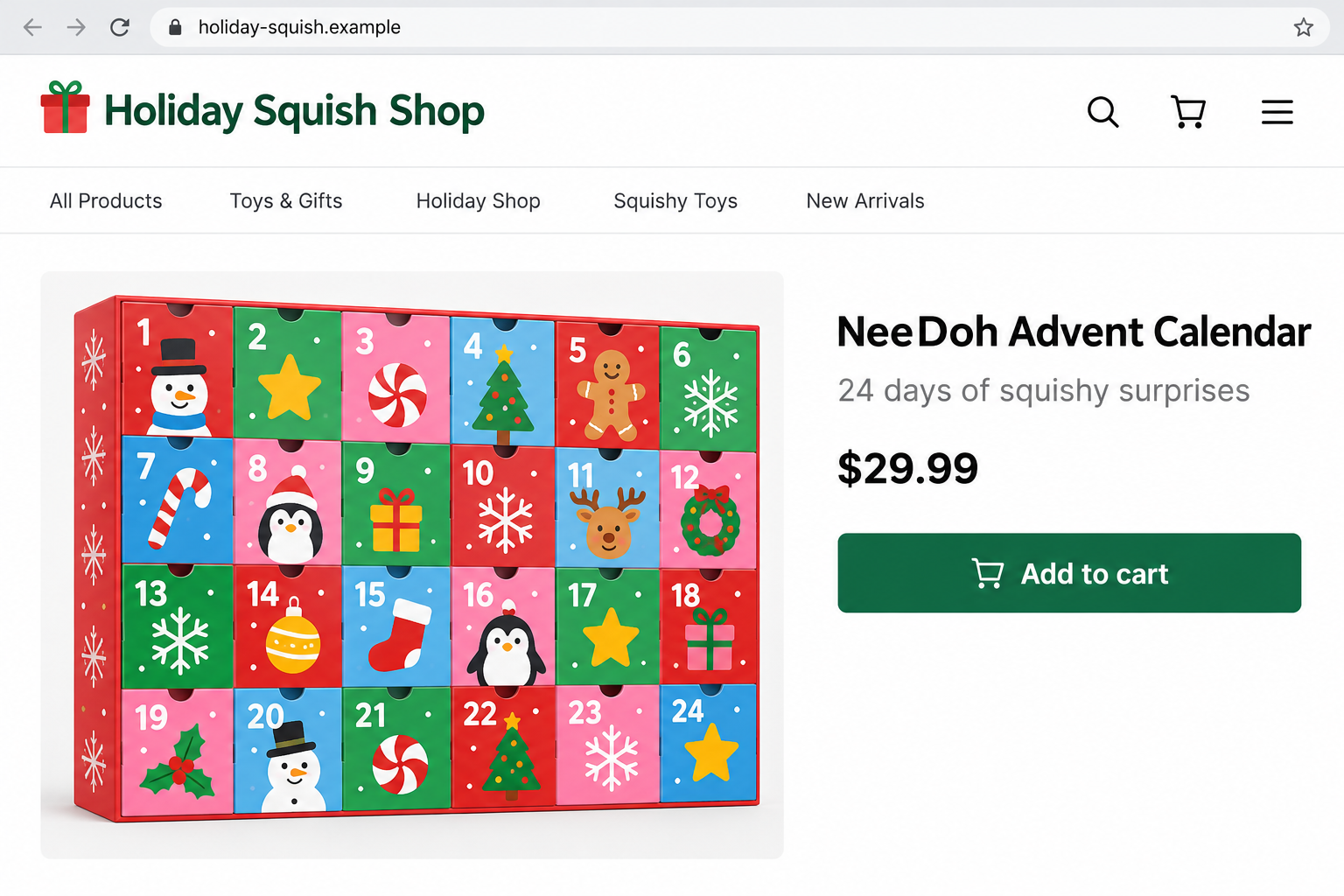
The listing image above is a fictional illustration, including its shop, price, and calendar artwork. It is not evidence against a real merchant.
Why a Sold-Out Holiday Toy Creates Such a Convincing Hook
Finding stock can feel like the hard part
If you’ve already decided what to buy, another product comparison isn’t what you’re looking for. You want a seller that still has it.
That changes how a listing gets read. A shopper may notice the product name, photograph, delivery estimate, and purchase button before looking for the business identity.
The seller can benefit from that shortcut without offering an absurd discount. A believable price may make an unverified shop feel more ordinary.
High prices don’t authenticate a calendar either. A markup can reflect scarcity, opportunistic resale, or something worse. Price alone doesn’t distinguish those possibilities.
The holiday deadline adds pressure
An Advent Calendar is purchased for a particular countdown. A delivery that arrives after the intended start date may no longer serve its purpose.
That pressure can turn a vague shipping promise into something you want to believe. Check the promised dispatch and arrival dates separately.
Do not let a festive design or a claim of limited inventory do the seller verification for you. Neither tells you who will fulfill the order.
How the NeeDoh Advent Calendar Scam Works
Step 1: A listing uses the product name shoppers already want
The offer begins with a recognizable search target: NeeDoh, Squishmas, or a holiday calendar associated with Schylling’s sensory toys.
In a deceptive listing, that recognition is borrowed. The seller presents the offer as the desired branded product while supplying something else or nothing.
A listing may appear on an independent website, in a social advertisement, or through a marketplace seller. The surrounding platform is not the merchant’s identity.
There is no need to assume every search result is fraudulent. The point is to inspect the particular offer before turning recognition into trust.
Step 2: Familiar pictures stand in for proof of genuine stock
Product photographs can make the listing feel settled. You recognize the packaging and assume the seller has the exact item pictured.
But a photograph shows what the page promises, not necessarily what is sitting in the seller’s warehouse or what will reach your address.
The calendar complaint in BBB Scam Tracker describes that gap between the advertised picture and the delivered contents. Keep the distinction central when evaluating an offer.
Ask whether the written description names the manufacturer and matches the pictures. A generic title such as squishy countdown calendar may describe a different product.
An unrelated toy isn’t automatically fraudulent. Passing it off as genuine NeeDoh, or making an unfulfilled branded promise, is the conduct at issue.
Step 3: Checkout turns an uncertain listing into a paid order
The moment of risk is not merely seeing the advertisement. It is sending payment or sensitive information to a seller you haven’t established.
A working cart, confirmation email, or encrypted connection can make the process look professional. None proves that the promised calendar will be shipped.
Before paying, compare the shop name with the business in the terms, receipt information, and payment screen. Unexplained differences deserve an answer.
If payment leaves a marketplace for a personal transfer or private message, stop. You may be leaving the platform’s normal order and dispute process.
You should be able to explain who is taking your money without referring only to the name printed on the toy.
Step 4: The order may be missing or materially different
There are two distinct problems to watch for: an order that never arrives, and a delivered calendar that doesn’t match what was sold.
Schylling’s warning explicitly describes fake websites taking money without delivery. The calendar-specific consumer report describes a substitute arriving instead.
A delivery scan cannot settle whether the contents are authentic. Equally, a late parcel alone doesn’t prove that a legitimate retailer committed fraud.
Compare what arrived with the saved listing: the manufacturer named, number and type of items promised, packaging shown, and any relevant product description.
Keep that comparison factual. It is more useful in a refund request than an accusation based only on a toy feeling different from expectations.
Step 5: Refund friction can make a small loss feel easier to accept
The BBB report describes a buyer seeing one refund promise before purchase and receiving a different explanation after reporting the problem.
That account also describes a partial-refund offer and costly return shipping. These are reported details of that transaction, not universal terms for NeeDoh listings.
A low refund can seem attractive when arguing takes time or the proposed return costs nearly as much as the purchase.
Before accepting, ask whether doing so closes the dispute. Check the platform’s process and your payment provider’s requirements instead of relying on the seller’s explanation.
Don’t send more money simply to unlock a refund. A seller’s promise does not require you to abandon the protections attached to your original payment.
Who Actually Sells and Ships the Calendar?
The toy brand and the seller are different identities
Schylling owns the NeeDoh brand, but an independent seller may be the business taking your order. Identify that seller before judging its promises.
On a marketplace, check the sold-by information for the particular offer. A platform name at the top of the page does not identify every third-party merchant.
Follow Schylling’s own retailer links or dealer directory when checking authorization. Don’t treat a badge added by the seller as independent confirmation.
A return address needs an explanation, not a guess
A dispatch label, business address, and return destination may legitimately differ. One can belong to a warehouse or returns provider rather than the brand owner.
What matters is whether the seller explains the arrangement and honors the offer. An address alone doesn’t prove a company is fake.
Get return authorization and the destination in writing. If the seller changes the country or imposes unexpected costs, preserve both the original promise and the new instructions.
Support must answer the actual mismatch
“Delivered” isn’t an answer when the wrong calendar arrived. Ask for a replacement or refund that addresses the mismatch, not another copy of the tracking record.
Likewise, an automated message is not a refund confirmation. Look for the amount, payment route, reference, and expected processing time.
Keep the conversation on the marketplace when that is where you ordered. Moving it elsewhere can make the original transaction harder to document.
Trace the product without inventing a safety verdict
Keep the packaging, manufacturer markings, barcode, and order details. Schylling may be able to help assess whether a product is genuine.
Do not infer authenticity from a single spelling detail, wrapper style, smell, or texture. Packaging and product variants can change, and photographs cannot test materials.
Country of manufacture is not the verdict either. The issue is traceability and whether the delivered product matches the branded item you were promised.
If the contents are leaking, damaged, or otherwise concerning, keep them away from children while you seek guidance. Don’t experiment with an unknown filling.
What to Do if You Have Fallen Victim to This Scam
You don’t need to solve the seller’s entire operation before reporting your own order. Start with the promise, payment, and problem you can document.
-
Save the offer before it changes. Capture the listing address, product photographs, description, seller identity, delivery promise, and refund terms.
Keep your confirmation email and receipt. If the advertisement led somewhere different from the checkout, save both destinations and explain the connection.
Write down the statement descriptor beside the shop name. That lets your payment provider locate the charge even when the two names differ.
-
Document the parcel or missed delivery. Photograph the shipping label, packaging, calendar, and contents if something arrived. Keep the original packaging.
For a missing order, save tracking records and the date delivery was promised. Avoid describing non-delivery as a counterfeit if no product arrived.
-
Request the appropriate remedy in writing. Tell the seller whether the order is missing, the brand was misrepresented, or the contents differ from the listing.
State the order number, amount paid, and remedy requested. Attach the clearest comparison rather than sending a long, emotional exchange.
Ask for return instructions if necessary, but check with your platform or payment provider before paying expensive return postage or accepting a reduced settlement.
-
Open the marketplace’s order dispute promptly. Use the actual order record, not a refund link sent privately by someone claiming to help.
Follow its deadlines and evidence requirements. Explain why delivery confirmation doesn’t resolve a wrong-item complaint, if that is the issue.
-
Contact your card issuer or payment provider. Describe the transaction accurately, including whether you authorized the purchase but received something materially different.
The CFPB explains refunds and chargebacks. The process can differ for missing goods, defective products, and unauthorized charges.
For U.S. credit-card billing errors, written notice deadlines can be 60 days after the statement was sent. Ask your issuer which procedure applies.
Do not wait for the seller’s promised investigation to consume your deadline. A dispute is a request for review, not a guaranteed refund.
-
Report a suspected counterfeit through the brand’s official channel. Schylling’s NeeDoh page lists info@schylling.com for counterfeit reports.
Send the listing and relevant product pictures, not full payment credentials. The manufacturer can assess authenticity concerns without becoming responsible for another merchant’s sale.
-
Review any information exposed during checkout. If you entered card details on a suspected fake store, ask your issuer whether replacement is appropriate.
Change a password reused from another account. A purchase dispute and account security are separate tasks; resolving one doesn’t automatically resolve the other.
-
Report the deceptive listing and avoid refund impersonators. Use the platform’s reporting function and ReportFraud.ftc.gov for a U.S. fraud report.
Don’t pay a stranger who promises to recover the purchase price. A refund shouldn’t require gift-card codes, remote access, or your banking password.
Frequently Asked Questions
Is the genuine NeeDoh Advent Calendar a scam?
No. The warning concerns deceptive listings and impersonators, not the genuine Schylling product. A real toy can still be used as bait by a dishonest seller.
Does a marketplace listing guarantee an authentic calendar?
No. Identify the particular seller and check the offer’s details. The platform’s order protections and the manufacturer’s authentication are separate questions.
Can a normal price prove the seller is legitimate?
No. A plausible price can make a deceptive listing look ordinary. Verify the seller and product rather than treating a price as an authenticity certificate.
Does a different wrapper automatically mean my calendar is fake?
No single packaging detail should decide the issue. Preserve pictures and ask Schylling to assess the item using its markings, packaging, and purchase details.
What if tracking says delivered but the calendar is wrong?
Report the mismatch, not just the tracking status. Save the advertised description and photographs of what arrived so the seller or payment provider can compare them.
Should I accept a small partial refund?
Only after understanding the terms and whether acceptance closes your claim. Check your platform or payment provider’s options before agreeing under pressure.
The Bottom Line
Don’t buy a supposedly genuine NeeDoh Advent Calendar from a seller you cannot establish. Check the brand’s dealer routes before trusting an unfamiliar listing.
If you paid for a missing or misrepresented calendar, preserve the offer, request a remedy, and contact your payment provider before dispute deadlines expire.

Join the discussion
0 commentsShare your experience or ask a question about this article.
Discussion
Start the conversation
Have a question or something useful to share? Add the first comment.