

Three sisters, coastal Florida style and a final collection priced to clear. Harper, Hazel & Hannah presents a retirement sale that feels like a boutique farewell.
A pretty dress and a familiar small-business story can make ordering feel comfortable. The important details appear when you follow the sale into its policies.
Overview
A boutique identity wrapped around a large discount
Harper, Hazel & Hannah sells clothing, shoes, bags and accessories through harperhazelhannah.com. Its presentation emphasizes three sisters and a connection with Naples, Florida.
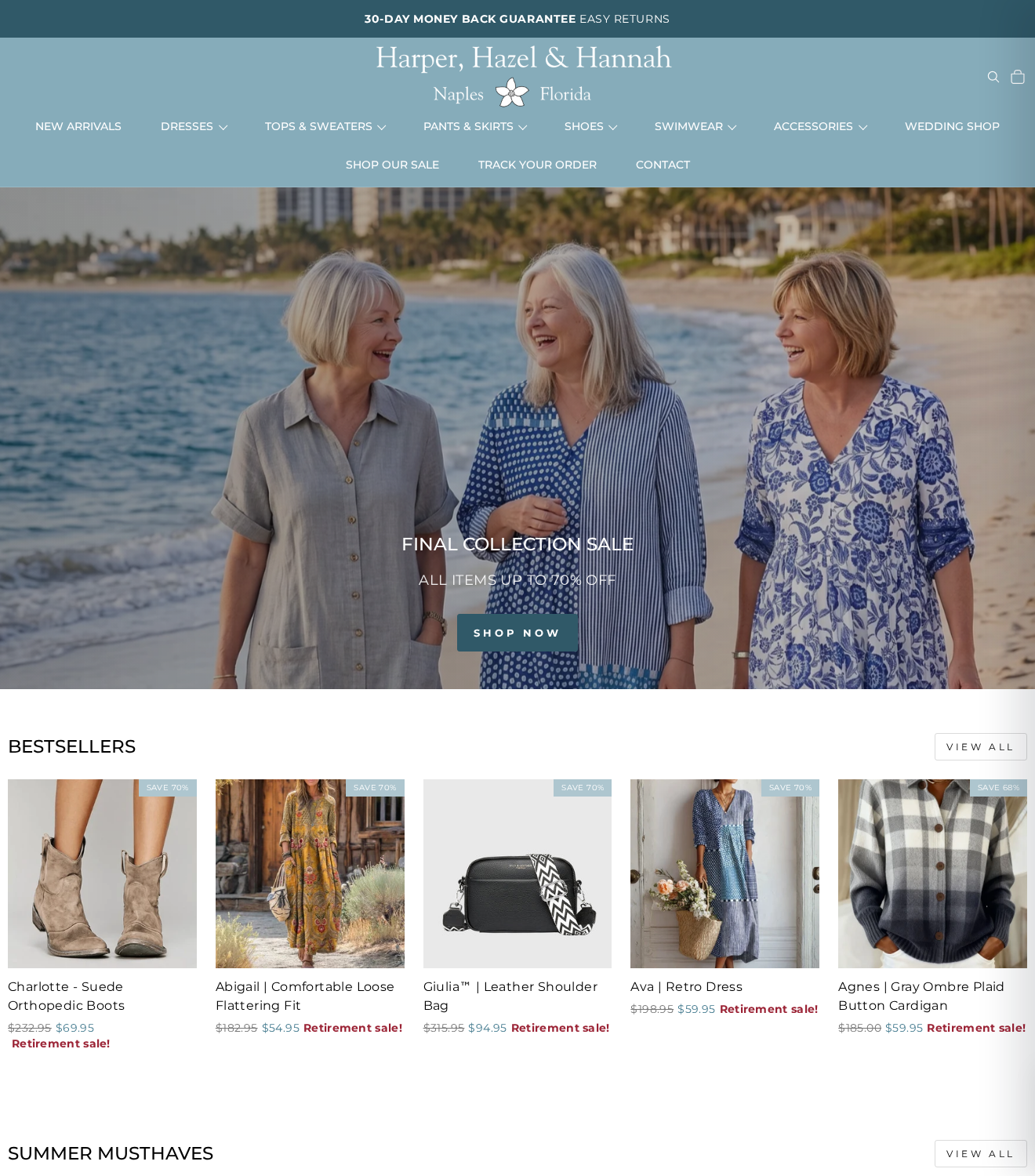
The homepage promotes a final collection with reductions up to 70%. It also highlights a 30-day money-back guarantee and easy returns.
Those reassurances would naturally matter to someone choosing clothing online. Fit and fabric are hard to judge from a photograph, so the way back matters.
The terms describe a much less convenient transaction
The store’s own terms state that orders ship from China through third-party logistics providers. Returns also go to China after authorization.
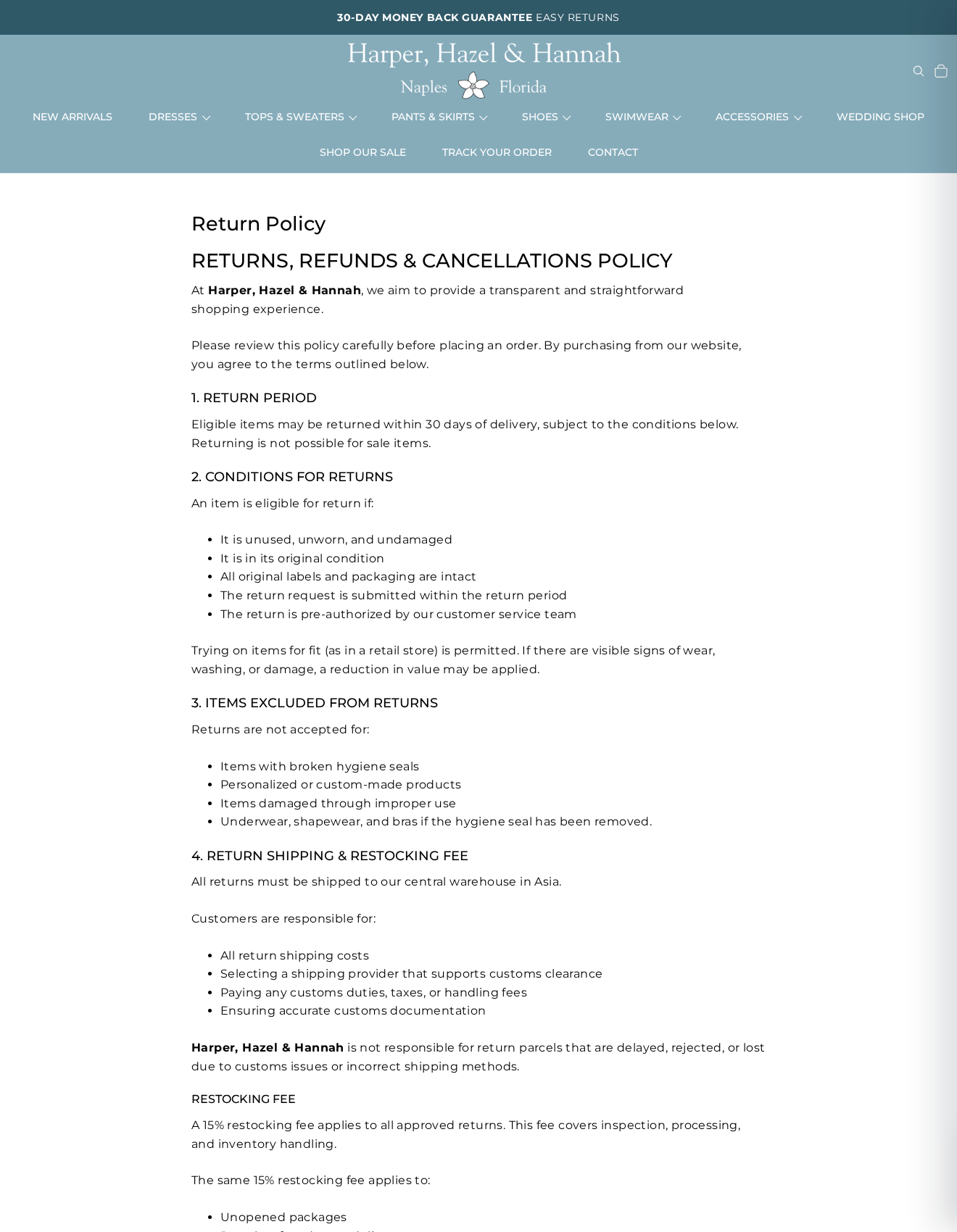
The return policy imposes a 15% restocking fee and buyer-paid return costs. It excludes sale goods while the storefront heavily promotes discounted collections.
The main findings are not guesses about a photograph:
- The legal company name and registered address are listed as available on request.
- The terms and return policy use different thresholds for excluded discounts.
- The cancellation policy refuses cancellation for orders above $100.
- The reassuring return headline leaves out restrictions that could determine the whole purchase.
The practical answer for shoppers
Do not buy through this retirement offer expecting local-boutique fulfillment and a simple refund if the clothes do not suit you.
The company’s published conditions describe an overseas purchase with serious return barriers. Those are concrete reasons for a negative buying recommendation.
This is not a physical inspection declaring every garment worthless. Nor is a China shipment alone proof of fraud. The mismatch between impression and conditions is the issue.
The Retirement Story Should Not Make the Decision for You
A local feeling is not a shipping location
The storefront places Naples, Florida beneath its brand and presents three women against a coastal background.
Its about page describes sisters who began on a Wyoming ranch. Those details could coexist, but they are still the seller’s account of the business.
Neither story changes the actual fulfillment clause. A US-facing brand can use overseas suppliers, and customers need that distinction before deciding whether returns are manageable.
If you expect to send an unsuitable dress back to Florida, these terms are a reason to stop. They identify a different logistical arrangement.
A sale deadline can discourage the most useful questions
The promotion repeatedly invokes final collections and retirement. Those messages encourage shoppers to act before a favorite style disappears.
Ask what would change if the same dress remained available tomorrow. Fabric, fit, delivery and refund eligibility would still determine whether it was worth buying.
A large crossed-out price is not independent evidence that a garment was routinely sold at that amount. Compare similar products by their actual delivered cost.
A low sale price is particularly unhelpful if it removes the return option you thought made the purchase safe.
Recognition and customer counts need context
The site claims a large customer base and recognition in Vogue. Those statements are part of its promotion, not independently authenticated endorsements in this investigation.
A genuine editorial feature should be identifiable through the publication itself. A brand’s mention of a magazine cannot substitute for the article or named recognition.
The same principle applies to satisfied-customer totals. They do not tell you whether the specific sale dress can be returned or who will handle a dispute.
How the Harper, Hazel & Hannah Sales Funnel Works
Step 1: Build confidence through a familiar boutique story
The sisters, the coastal imagery and the clothing collections create a personal retail identity. It feels different from buying an unnamed item from an overseas catalog.
That feeling can be persuasive even when the website itself discloses overseas logistics elsewhere. Most shoppers start with the storefront, not a legal document.
The sensible response is to connect the story to the contract. Find the actual business name, dispatch location and return destination before making a payment.
Step 2: Make heavily discounted items the obvious choice
The homepage’s featured goods carry large reductions. Examples include a $59.95 dress against a $198.95 comparison price and other products discounted by roughly 68% to 70%.
Those prices make the offer look generous. They also place many featured items well beyond both policy thresholds for excluded sale merchandise.
You are not choosing between a modest discount and a flexible return. You may be choosing an item the seller considers ineligible for a refund.
Step 3: Reassure the buyer with a broad return headline
The site advertises a 30-day guarantee and easy returns. That reassures someone who cannot feel a fabric or try a dress before ordering.
But a headline does not explain which purchases qualify, where returns go or what is deducted. Those details substantially change the value of that promise.
For a sale-led store, excluding discounted goods is not an obscure exception. It can affect the products most buyers were encouraged to choose.
Step 4: Fulfill the order through overseas logistics
The general terms state that third-party logistics providers in China dispatch the orders.
The shipping policy gives processing and transit estimates, while the general terms allow a longer outer delivery period. Track dispatch separately from the parcel’s eventual arrival.
Overseas shipping is not inherently wrong. It becomes a buying risk when the local-boutique presentation leaves you expecting a different delivery and returns experience.
Step 5: Apply the restrictions when the shopper wants out
A change of mind meets a short cancellation window. A poor fit meets sale exclusions. An approved return meets international postage and a possible deduction.
That is the point where the reassuring purchase becomes a practical problem. The dress may cost less than the effort and expense required to send it back.
You should know those conditions while deciding whether to order, not only after explaining to support why the garment is unsuitable.
The Return Policy Makes the Sale Much Less Attractive
Two thresholds, neither reassuring for the featured products
The return policy says sale items cannot be returned and specifically excludes items discounted by 50% or more.
The general terms use 40% for final-sale exclusions. Those thresholds do not agree.
Many prominently displayed reductions exceed both. Choosing between the two versions would not necessarily give a buyer of a 70%-off item an ordinary return right.
The site’s policies also preserve applicable statutory rights. A seller’s final-sale label is not, by itself, the last word on defective goods or misdescription.
Nevertheless, do not plan a routine try-on purchase around an easy money-back promise. The merchant’s own terms make that expectation unsafe.
Postage and deductions can swallow the remaining value
For approved returns, the policy applies a 15% restocking fee. It also places return shipping, relevant customs costs and suitable shipping arrangements on the customer.
As an illustration, 15% of a $59.95 garment is about $8.99. That deduction comes before any international return postage.
The actual cost depends on the parcel and destination. Obtain a quote rather than assuming a small clothing package will be cheap to send internationally.
The return policy excludes original shipping and optional insured shipping from refunds. Another terms clause discusses refunding original shipping, adding another inconsistency to resolve.
Orders above $100 face a cancellation exclusion
The policy allows an initial four-hour cancellation period but says orders above $100 are not eligible for cancellation under any circumstances.
That restriction is particularly relevant if a shopper adds another item to take advantage of a promotion or builds a larger outfit order.
It describes the seller’s policy, not a ruling on every cancellation right available in every jurisdiction. Keep the distinction clear when requesting help.
The policy also applies a restocking fee to refused or unclaimed parcels. Refusing delivery is therefore not a dependable way to obtain a full refund.
The Business Behind Harper, Hazel & Hannah
The company name is not disclosed in the identity section
The terms have a section specifically identifying the company. Yet the legal name, registered address and state of registration are all described as available upon request.
That is a significant accountability gap for a store asking customers to trust its history. The trading name does not identify the legal merchant.
Without that name and jurisdiction, a registry search cannot reliably establish which business record belongs to the purchase.
Naples is not a complete business or return address
The footer’s city reference does not supply a street address for a walk-in boutique, a business office or a receiving warehouse.
The terms explicitly identify China for dispatch and returns. The exact authorized receiving address is supplied after a return request is approved.
Do not post an item to an address found through a similarly named retailer. Match the destination to written instructions for your order.
The published contacts have not been response-tested
The site lists info@harperhazelhannah.com and +1 307 220 9435. Its contact page also offers a message form.
These are published channels, not evidence of a successful refund conversation. No call or message was made during the research.
If you use the form, retain a copy of what you sent. Email can be easier to document when no submission receipt is provided.
China fulfillment is established, garment quality is not
The terms provide direct evidence of China-based logistics. They do not identify the factory, prove the manufacturing cost or establish every item’s fiber content.
For a delivered garment, compare its sewn-in composition label, measurements and construction with the actual product description. Photographs alone cannot settle those questions.
A misdescribed fabric is a stronger complaint than simply saying the parcel came from China. Focus on the feature that made the purchase materially different.
What Evidence Helps When the Clothes Arrive Wrong?
Keep the advertisement and the exact listing, not just the homepage. A store can sell many garments with different material and sizing descriptions.
Photograph the delivered item in good light, including the care label and any fault. For a sizing dispute, show measurements against the published chart.
Separate disappointment from a concrete mismatch. A color you personally dislike and a garment materially different from its description are not the same complaint.
Similarly, record what you ordered versus what arrived. Do not assume a generic boutique pattern proves an unauthorized bundle or subscription on this transaction.
There was no verified recurring-billing arrangement here. The documented risks concern sale restrictions, seller transparency, overseas delivery and the difficulty of reversing the purchase.
What to Do If You Ordered from Harper, Hazel & Hannah
-
Send any cancellation request immediately. Include the order reference, total and the time you placed it. Ask the merchant to confirm whether dispatch has occurred.
If support relies on the over-$100 exclusion, retain that response. It may be important when explaining the situation to your payment provider.
-
Preserve the complete shopping promise. Save the product listing, guarantee banner and the policies governing your purchase, including the sale thresholds.
Make clear which reassurance you relied on. An easy-return headline is especially relevant if the merchant later treats the discounted item as entirely non-returnable.
-
Inspect before wearing or washing. Leave labels attached, photograph problems and compare the garment with its advertised composition and dimensions.
Request a remedy in writing, explaining specific differences. Keep your language factual so the strongest part of the complaint does not get lost in accusations.
-
Ask for an exact return calculation. Obtain the authorized China address, the deduction, the expected refund and the deadline for dispatching the parcel.
Then price a tracked service that meets the instructions. Do not accept store credit as equivalent to repayment if you do not want another purchase.
-
Discuss an unresolved payment promptly. Ask the issuer which process fits non-delivery, incorrect goods or a materially misleading description.
CFPB guidance explains that US billing-error notices must be sent in writing within 60 days after the charge appeared on the statement.
Defective goods can require a different dispute process. Ask which deadline applies to your case rather than waiting for the merchant to end the conversation.
-
Keep control of the record until the case closes. Retain correspondence, tracking, refund confirmations and card statements in one place.
Do not let an indefinite promise of future help replace the deadline your payment provider gives you. Confirm that any promised credit actually reaches the account.
Frequently Asked Questions
Is Harper, Hazel & Hannah a confirmed scam?
The own-site evidence supports a strong warning about the offer and refund barriers. It does not independently prove the founders’ identities or every customer’s experience.
Do orders ship from Florida?
The terms say orders ship through China-based third-party logistics providers. The Naples branding should not be read as a promise of Florida dispatch.
Can I return a heavily discounted dress?
The policies restrict sale returns and use conflicting 40% and 50% thresholds. A garment advertised at 70% off exceeds both.
Where would an approved return go?
The general terms specify China. Support supplies the authorized address, while the return policy places shipping and relevant customs responsibilities on the buyer.
Does the store publish its legal company name?
The company-identity section says the legal name, registration state and registered address are available on request. That is not the same as displaying them.
Should I refuse delivery to cancel?
Do not assume that guarantees repayment. The policy assigns a restocking fee to refused or unclaimed parcels. Seek written instructions and payment-provider guidance first.
The Bottom Line
Do not buy Harper, Hazel & Hannah’s retirement offer expecting straightforward boutique returns. Its China logistics, sale exclusions and incomplete company identity make that expectation unreliable.
Already ordered? Request a specific remedy promptly, document any mismatch and check your payment-provider deadlines before spending more money returning the parcel.

Join the discussion
0 commentsShare your experience or ask a question about this article.
Discussion
Start the conversation
Have a question or something useful to share? Add the first comment.