

A hearing notice can make a forgotten parking charge feel like a much bigger problem. Suddenly, a document on your screen appears to require your attention.
If it names Cook County and gives you an easy payment shortcut, pause before using it. The details of that shortcut matter.
Overview
What the Cook County court notice scam promises to resolve
The Cook County court notice scam presents an unpaid parking matter as something requiring a hearing unless you make a payment through the supplied instructions.
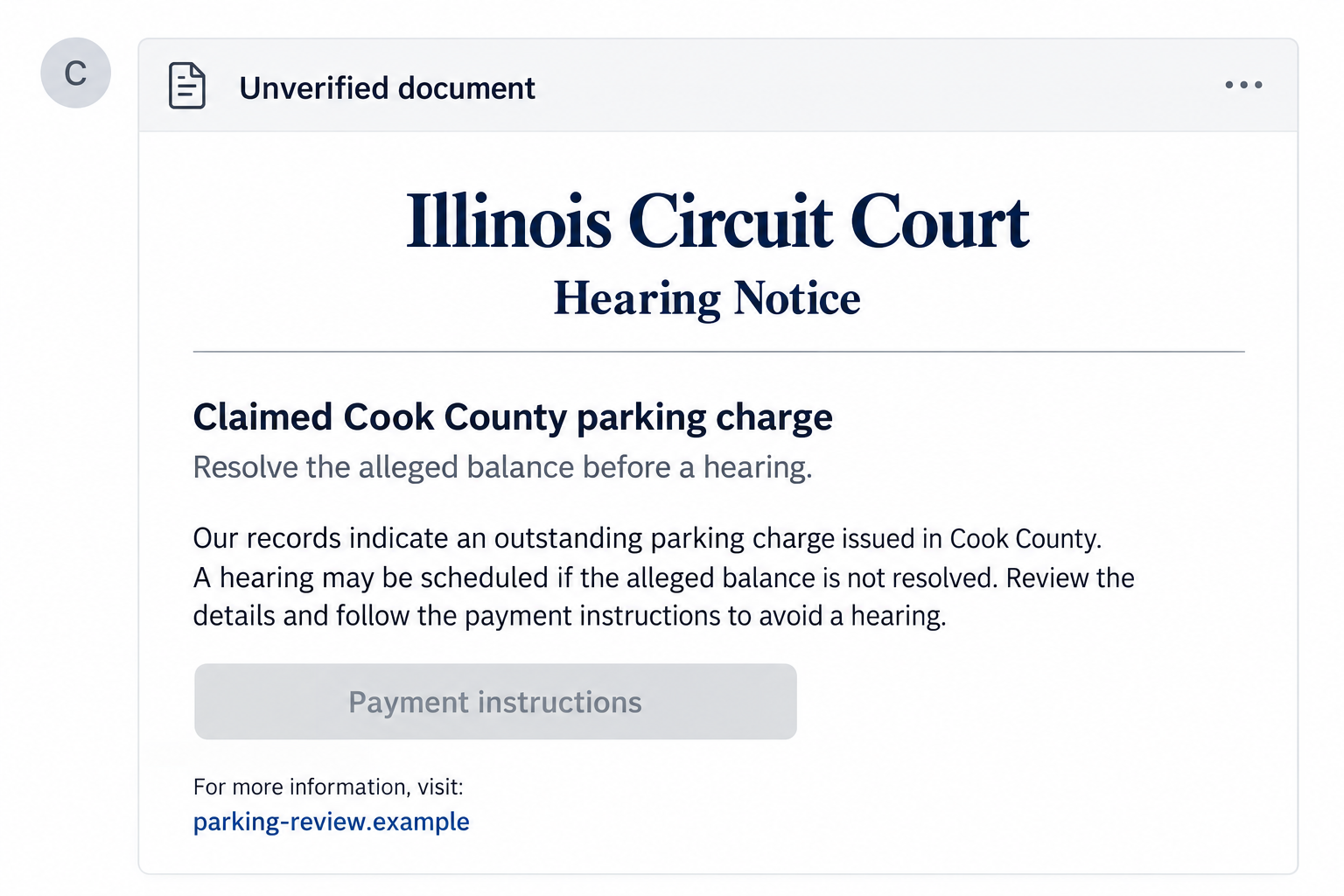
The fraudulent document uses the heading “Illinois Circuit Court” and describes itself as a hearing notice. Its official appearance gives the demand an apparent legal context.
Before paying, confirm which office actually sent the demand. The real court has already warned people about this fraudulent hearing format.
The court has rejected this notice
The Office of the Chief Judge’s fraud warning says the document was not issued by the court.
It identifies the unsolicited QR payment demand and associated court threats. The Clerk’s current website also warns about unsolicited notices asking people to pay through QR codes.
The lead image is a generated illustration of the deceptive format. It is not a received notice, and its destination is a fictional example.
What you are being pushed to trust
The problem is more than an unfamiliar sender. Several parts of the notice work together to make an unverified payment seem necessary.
- A court heading supplies authority before a real case has been established.
- A parking balance gives the demand an everyday explanation.
- A threatened hearing makes immediate payment seem convenient.
- A QR code or link directs you to the sender’s chosen payment route.
Receiving this fake notice does not erase any unrelated genuine ticket. Keep the suspicious document and your actual court or parking records separate while checking.
How the Scam Works
Step 1: A document arrives with court-style presentation
The approach begins with a notice that looks more formal than an ordinary text. It may be delivered as an image or document rather than plain conversation.
A recognizable jurisdiction and legal vocabulary encourage you to read it as paperwork. That can make questioning the sender feel like ignoring an official instruction.
But a document’s layout does not establish its origin. The court warning concerns this very use of a hearing notice to solicit payment.
There is no need to reproduce or complete its form to investigate. Save a copy and move to the real court’s information channels.
Step 2: An alleged parking charge makes the notice plausible
A parking obligation is believable enough to create doubt. You might wonder whether a prior visit, another household driver, or an overlooked letter explains it.
That doubt is not evidence that the amount is owed. The sender still needs a genuine underlying matter and an authorized way to collect payment.
Look at your own records before supplying details to the page. Do not type a vehicle plate or personal information simply to see what the form finds.
If a real citation exists, identify its issuing organization independently. A court-themed payment screen cannot tell you, by itself, who should handle that citation.
Step 3: The hearing threat turns payment into apparent relief
The notice frames payment as the easy alternative to a legal consequence. Someone who would question a random charge may pay to avoid the apparent hearing.
The Chief Judge’s warning specifically rejects this document and the way it threatens court action, arrest, or credit reporting over the supposed parking matter.
Do not let those consequences make the notice self-verifying. A threatening claim should send you to official confirmation, not directly into the attached payment instructions.
If you already have a real court date, check that case through its established route. Do not confuse the fake document’s instructions with the genuine schedule.
Step 4: The QR code moves the demand to a payment page
A QR code is a convenient way to carry a website address. It does not certify that the destination belongs to the court named beside it.
In this scam, the payment shortcut is supplied by the same unverified notice. Scanning it is not an independent way to confirm the alleged debt.
The court’s instruction is direct: do not scan the code or submit information through the unsolicited payment route.
If you already opened the destination, close it without completing fields. Record the address from information you already have; do not revisit merely to investigate.
Step 5: An apparent payment can become an information exposure
The danger extends beyond whatever balance the notice displays. A fraudulent payment form can obtain personal or card information you provide.
The FTC’s warning about fake traffic hearings describes this broader pattern of court-style texts steering people into QR payment demands.
Keep track of what happened in your own interaction: opening a page, entering details, submitting a payment, or approving something through another account.
Those actions call for different responses. An error screen does not undo submitted information, while merely receiving a document does not prove an account was accessed.
Where to Check a Real Cook County Matter
Use the court and Clerk for their actual roles
The court’s fraud announcement explains the problem with the fake notice. The Cook County Clerk’s official website provides case information and payment-related services.
Start with that established website instead of copying a contact or web address from the suspicious document. Look for its case lookup or relevant division.
If you need help understanding a real record, contact the appropriate office using the details on its official site. Explain the exact notice you received.
A court’s media contact is not automatically the right place to resolve an individual parking or traffic issue. Follow the Clerk’s published service route.
Compare the identity of the matter, not just an amount
Ask which case, citation, or issuing authority the demand concerns. A similar amount in another record would not authenticate the incoming notice.
Compare names, dates, vehicle details, and the responsible organization against information obtained independently. Avoid assuming every document mentioning Cook County concerns the same process.
If a family member has the original ticket, speak with them through your normal contact. Do not let the sender arrange a supposed confirmation for you.
Keep genuine receipts and correspondence together. They can help staff understand whether the notice is unrelated to a real matter you already resolved.
Do not turn a failed search into legal advice
A public lookup is useful, but a result may require clarification. Data entry, processing, or a different responsible organization can affect where something appears.
If you have a genuine ticket or formal court paperwork, ask the proper office about it. Do not discard it just because a scam also arrived.
Likewise, do not attend a hearing solely on instructions from the fake notice. Confirm any actual requirement through official case information or staff.
For an existing legal dispute, an attorney can explain your obligations. This fraud warning cannot determine the merits or deadlines of an individual case.
Keep payment verification separate from document verification
Finding a genuine case is only one check. Confirm the authorized payment method and destination through the responsible office before sending funds.
A scammer can refer to a real organization while supplying a different collection route. The legitimate name does not secure the payment instructions beside it.
Ask what receipt or account record should reflect a valid payment. Keep that documentation if you resolve an actual balance through the official process.
Never send an extra “verification payment” to make a suspicious transaction appear in court records. Take any discrepancy to the proper office directly.
What to Do if You Have Fallen Victim to This Scam
-
Put the notice aside and stop using its payment route. Do not continue scanning, replying, or calling the contact it supplies.
Retain the original message and any attached image. If you received paper, preserve it and its envelope instead of throwing away evidence immediately.
Make a private note of the arrival date and any interaction. You do not need to keep the conversation open to preserve those facts.
-
Tell your financial provider about card or payment exposure. Use your banking app or an established issuer contact, not a support link from the notice.
Explain what information you entered and whether a transaction is pending, completed, or absent. Ask which protective actions and dispute options apply.
Do not wait for an unauthorized charge to become larger before reporting disclosed card details. Let the provider assess the risk and appropriate restrictions.
-
Check the alleged court matter independently. Open the real Clerk’s website and use the correct service or office for the question.
State that you received the fraudulent hearing format described in the court’s warning. Ask whether any separate genuine case or citation needs attention.
A payment made to a fake website should not be treated as satisfaction of a real balance. Keep those two issues clearly separated when speaking with staff.
-
Protect any credentials used on the suspicious page. Change an exposed password at the genuine service and replace it elsewhere if reused.
If you also entered a security code, disclosed an identity document, or approved an access request, include that detail when contacting the relevant provider.
Do not supply the same information again to a caller offering to verify the refund. Independent recovery does not require continuing the sender’s process.
-
List the identifying information you shared. A name and address, a license image, and a Social Security number represent different exposures.
Consult IdentityTheft.gov for recovery steps suited to the information involved. Keep records of any protective requests you make.
Ask an issuing organization about a disclosed document rather than assuming a password change protects it. Avoid publishing copies while seeking help online.
-
Report the fake notice through appropriate channels. The court recommends local law enforcement and the Illinois Attorney General’s Office.
Use the official agency link in the court announcement to locate reporting information. Provide the document, payment details, and timeline without inventing the sender’s identity.
The FTC’s recovery page also explains common responses to payments and information disclosure. Recovery is possible in some circumstances, not guaranteed.
-
Check for related messages without engaging. A second notice may repeat the threat, claim payment failed, or promise a refund.
Do not treat a follow-up as genuine because it uses details you already entered. Preserve it and add it to the existing report.
If another household member received the same demand, explain the warning privately. Coordinate a safe official check rather than making separate payments.
What Changes if You Already Scanned the Code?
A destination opened, but you entered nothing
Leave the page and avoid further interaction. Review whether anything else actually happened, such as a file download, application installation, or permission request.
Opening a destination does not tell you that every possible harm occurred. Do not turn the notice’s claims into a diagnosis of your device.
If you notice unusual behavior or accepted an installation, describe that separately to trusted technical support. Keep the payment and device questions distinct.
You submitted a form, but payment failed
Give your issuer the information you supplied and the time of submission. A failed checkout can still leave details in the hands of the page operator.
Keep any error message you already captured. There is no need to repeat the attempted payment to confirm what the screen will say next.
If an unfamiliar transaction appears later, update the provider’s original case. Keep its reference so new information does not become disconnected from your first report.
You paid and received a confirmation
A receipt generated by the same unverified page does not establish a court payment. Confirm any real balance through the Clerk or responsible agency.
Preserve the receipt for the financial investigation, including its timestamp and transaction reference. Do not post sensitive payment details as proof in a public comment.
If a stranger offers guaranteed recovery for another fee, decline. Work with the actual payment provider and authorities instead of starting a second unverified transaction.
Frequently Asked Questions
Was the Illinois Circuit Court hearing notice issued by Cook County?
The court’s warning rejects the fraudulent parking-charge hearing notice discussed here. It was not issued by the court; check unrelated genuine paperwork separately.
Should I scan the QR code to see whether my case is real?
No. The code belongs to the unverified demand. Check case information through the official Clerk’s website or independently contacted staff instead.
Does this mean courts never use electronic services?
No. The warning concerns this fraudulent format and unsolicited payment QR codes. The Clerk provides legitimate online services, including case and payment information.
What if I have an actual parking ticket?
Contact its responsible issuing organization through an official route. A real ticket does not authenticate a separate notice demanding payment through an unknown destination.
Can I ignore a genuine court date after receiving this scam?
No. Confirm your obligations from the real case records or appropriate office. The fake notice does not cancel a legitimate hearing or deadline.
Is a payment confirmation enough to stop further action?
Not when it comes from the fraudulent page. Ask the real office about any actual balance and contact your payment provider about the scam transaction.
The Bottom Line
Do not use the unsolicited Cook County hearing notice to pay a parking charge. The court has rejected this document and its QR payment demand.
Check any genuine matter through the Clerk’s official services. If you already submitted information or money, report the exposure promptly and keep the original notice.

Join the discussion
0 commentsShare your experience or ask a question about this article.
Discussion
Start the conversation
Have a question or something useful to share? Add the first comment.