

A notice about an unpaid traffic matter is unsettling enough. Finding unfamiliar court names on it can turn a quick glance into a much longer worry.
If your message mentions both Oklahoma and St. Louis County, read the details before changing your plans or reaching for a payment card.
Overview
The claim in the St. Louis County Oklahoma court scam
The St. Louis County Oklahoma court scam uses a purported hearing or final notice to demand payment for an alleged traffic-related obligation.
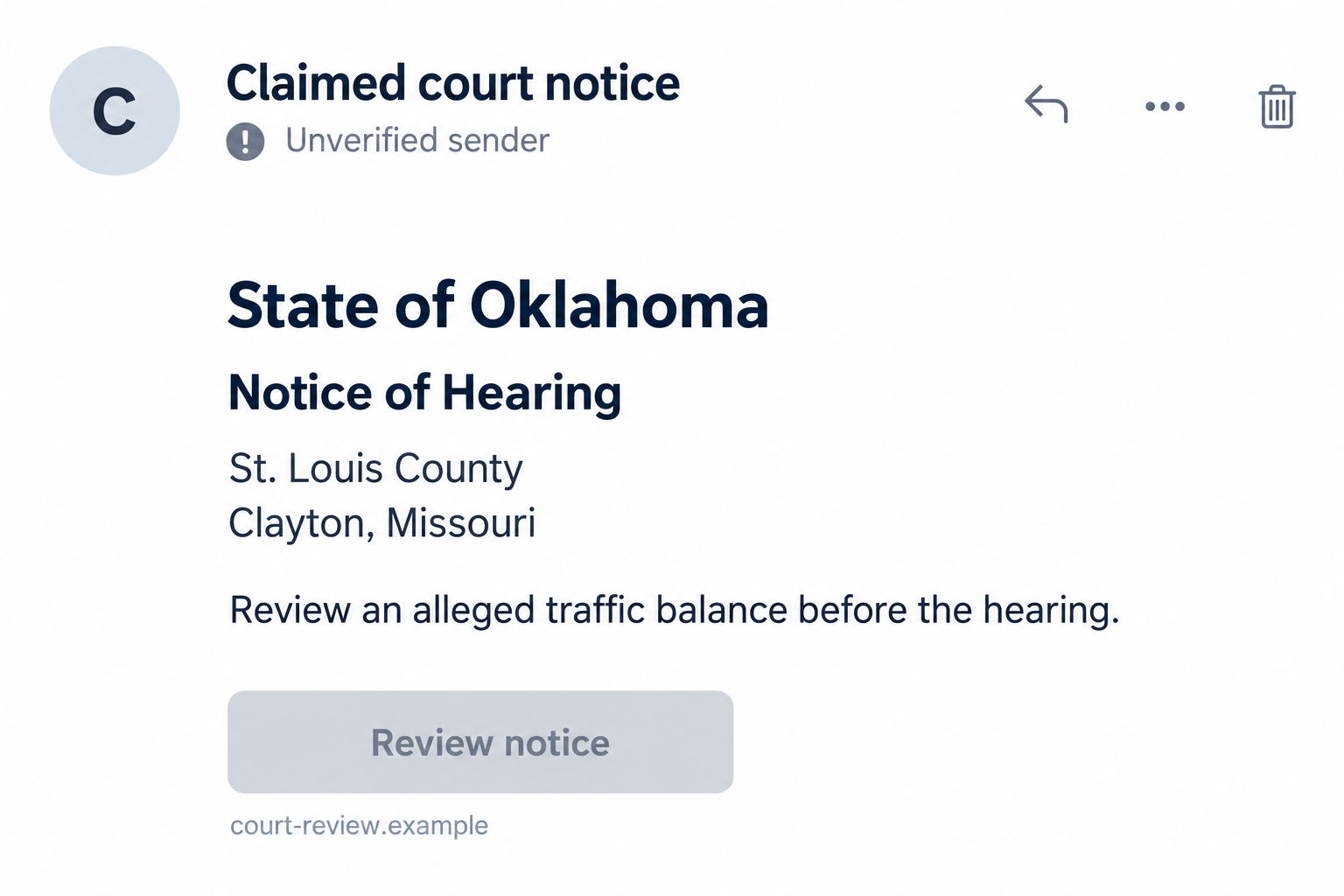
The reported document combines Oklahoma wording with a court location in Clayton, Missouri. That mismatch gives the reader a concrete reason to question its authority.
The demand may refer to parking, speeding, or toll violations and present payment as a way to avoid further legal trouble.
What the real court information shows
The St. Louis County Courts website lists its location in Clayton, Missouri. It provides an independent starting point for checking genuine county court information.
The Missouri court’s location does not become an Oklahoma court because a notice places a different state name above it.
The picture above is a generated illustration of the contradiction, not a captured scam document. No actual case number, payment destination, or hearing date appears in it.
The parts of the notice worth checking
Instead of letting the most alarming sentence control your response, separate the document into claims that can be checked outside it.
- Which state and specific court supposedly issued the notice?
- What actual citation or case is the payment meant to resolve?
- Does the named court match the location and contact information?
- Who supplied the QR code, link, or payment instructions?
Do not use the suspicious notice to answer its own questions. Your verification should begin with records and contacts obtained independently.
How the Scam Works
Step 1: A court-style notice makes a text feel consequential
The message can show a document or flyer rather than a casual request. A heading about a hearing gives it the appearance of something already scheduled.
That presentation encourages action before you have established that a real case exists. It can feel safer to comply than to risk missing official paperwork.
The FTC describes fake traffic-hearing texts using legal-looking notices and QR payment demands. A formal layout is part of the lure.
Keep the original message if you need evidence. There is no reason to complete a form or contact its sender to preserve what arrived.
Step 2: Borrowed place names supply apparent authority
The Oklahoma wording suggests one jurisdiction, while the St. Louis County and Clayton details point toward another. A hurried reader may overlook the conflict.
Real place names are easy to recognize, so they can make surrounding claims feel credible. The difficulty is that the names have been combined inconsistently.
You do not need to prove there is no Oklahoma place anywhere called St. Louis. The relevant question is which court supposedly issued this particular document.
A mailing address is not permission to collect money. Check the court’s identity and the alleged matter before considering any payment route.
Even a corrected address would not be enough. The underlying case and collection instructions would still require verification through the real organization.
Step 3: Consequences make the payment seem urgent
The reported notice threatens serious consequences tied to the supposed violation. For a recipient, the practical fear may be losing driving privileges or facing arrest.
Those are claims made by the notice, not findings this article can make about you. Do not let them stand in for an actual case record.
The real sheriff has issued a separate warning about callers demanding money under arrest threats. It says the office does not collect warrant payments by phone.
That warning concerns phone impersonation, not authentication of every document. It reinforces why you should leave an incoming demand and contact the responsible office yourself.
Step 4: A QR code or link becomes the proposed escape
The notice supplies a convenient way to settle the alleged problem. Paying looks easier than understanding a confusing document or finding out where a hearing belongs.
A QR code does not verify its destination. It is another way of conveying an address chosen by the person who supplied the notice.
Do not scan it to investigate whether the case exists. Begin with the official court’s services and contacts, without carrying over the notice’s payment shortcut.
If you already opened the page, stop before entering information. A convincing logo or polished form cannot resolve the jurisdiction problem.
Step 5: The false balance creates a real information risk
Completing a fraudulent payment form can expose details beyond the amount shown. The relevant harm depends on what the page requested and what you submitted.
A supposed fine, a card disclosure, and an unauthorized transaction are separate facts. Keep them separate when reporting the incident.
Do not assume a failed checkout protected the information entered. Equally, receiving the message alone does not establish that your phone or bank account was compromised.
If you paid, seek help from the payment provider and confirm any genuine legal matter separately. The fraudulent page cannot settle a real obligation for you.
Why Real Missouri Court Texts Need a Different Check
There is a genuine notification service
The court’s Find My Case guidance describes Missouri Case.net and the optional Track This Case service.
People can register for email and text notifications connected with a case. The court explains that those notifications are not official court notices.
This matters because a blanket claim that every court-related text is fake would be misleading. Legitimate reminders and an unsolicited payment demand are different things.
Check a reminder against the service you actually registered for and the underlying case. Do not authenticate it solely from the sender label or message thread.
A recognizable website ending is not the whole answer
The official county court website linked here uses a .com address. It would be wrong to reject it solely because it does not end in .gov.
Likewise, a random address containing government-style words is not automatically official. Obtain the court’s destination through a trusted source rather than the disputed notice.
Follow the court’s own route to case information. Avoid search advertisements, copied payment buttons, or a stranger’s claim that a different portal is needed today.
If you are uncertain about a site, ask the court through an independently found contact. You do not need to submit personal information first.
A case search helps, but may need clarification
Use official instructions to find the right record. Pay attention to whether the information concerns you, the correct court, and the type of matter alleged.
A confusing result should lead to a question for the responsible office. A name match alone does not mean the notice’s claims are accurate.
Do not post another person’s court record publicly while seeking advice. Describe the uncertainty privately to staff or your established attorney.
If you already possess genuine court paperwork, keep following its verified instructions. A separate scam message does not cancel a real hearing or deadline.
A Practical Way to Review the Document
Start with jurisdiction before the threatened consequence
Write down the court name and state exactly as displayed. Then compare them with the independently located court information.
Do not repair the document in your head by assuming the sender meant another state. An unexplained contradiction belongs in the report you make.
If you recently traveled, check your own itinerary and original records. Travel can explain why you have a real obligation elsewhere, but not authenticate this demand.
Separate the sender’s deadline from your actual calendar
Before changing work, arranging transport, or making a payment, ask the proper office whether a real hearing or response requirement exists.
A date printed on an unverified image is not enough to establish that requirement. Confirm through the actual case or independently contacted staff.
If a real deadline is approaching, seek clarification promptly rather than ignoring it. Verification should replace the scam’s route, not delay genuine obligations indefinitely.
Keep the verification route under your control
A sender may offer to explain the mismatch or transfer you to another supposed department. That keeps the same contact in charge of the answer.
Instead, end the interaction and make your own contact. Give the office the document’s claims without adopting them as facts.
Ask how to submit a copy securely if staff need it. Avoid sharing a driver’s license, payment card, or security code merely to discuss the notice.
What to Do if You Have Fallen Victim to This Scam
-
Stop the payment process and save the notice. Retain the original text or document, any destination you already recorded, and messages about the alleged balance.
Do not scan the code again to collect more information. Keep a brief account of what you actually opened, entered, or approved.
If someone else in your household received it, explain the problem before they make a separate payment. Share evidence privately rather than forwarding an active payment link.
Include its sender and arrival time in a screenshot when possible, not just the image of the notice.
If you received a forwarded copy, say so in the report. That distinction helps separate your own experience from someone else’s message.
-
Reach your financial institution if payment details were involved. Use the normal banking channel you trust and describe the fraudulent court demand.
Tell the provider whether a payment completed or whether you only submitted card information. Ask about preventing further misuse and the available dispute procedure.
Save the provider’s case reference and keep checking through your own account. Do not rely on the suspicious page to tell you whether money moved.
-
Confirm whether a separate genuine court matter exists. Use the official county court route for Missouri questions, or the actual responsible court for an Oklahoma matter.
Explain the state and location conflict. Ask staff to clarify the record and appropriate next action without assuming the document established a debt.
If you have an attorney handling an existing case, contact them through the details you normally use. Let them review any real obligation independently.
-
Secure any account access information you disclosed. Replace an exposed or reused password through the real service, not through another link supplied by the sender.
If you entered a one-time code or authorized an access request, describe that when seeking account support. Different disclosures may need different containment.
Protect your email account too if its credentials were involved. Keep recovery details and account-protection codes out of public reports.
-
Respond to exposed identity documents or numbers. List what the form requested and distinguish that from what you actually provided.
IdentityTheft.gov can help organize an exposure-specific recovery plan. For an issued document, ask the relevant organization about protective options.
Do not assume that canceling a card resolves a disclosed identity document. Retain copies of your reports and any replacement or restriction instructions.
-
Report the fraud to the appropriate authorities. The sheriff’s published advice tells victims to notify their financial institution and local police.
The FTC’s scam recovery guidance covers additional payment and information-exposure steps. Report known facts, not guesses about where the sender operates.
Keep the mismatch, payment instructions, dates, and transaction details together. A clear report is more useful than conclusions based on the sender’s display name.
-
Handle follow-up demands as new unverified contacts. Do not pay another fee because someone says the first transaction failed or needs releasing.
A person promising guaranteed recovery should not receive money, passwords, or remote access. Continue through the provider or authority you contacted independently.
Add relevant follow-up messages to your incident record. They may help investigators without requiring you to answer the sender.
Frequently Asked Questions
Why does the notice mention Oklahoma and Clayton, Missouri?
The reported fraudulent notice combines inconsistent jurisdiction details. The real St. Louis County court identifies its location in Missouri; the mismatch is not an official explanation of your case.
Does that mean no Oklahoma place can be called St. Louis?
No. The issue is the court identity and location claimed by this document, not a universal statement about place names. Verify the specific supposed issuing court.
Are all Missouri court-related text messages scams?
No. Track This Case offers optional notifications. Those reminders are not official court notices, and their existence does not validate an unsolicited QR payment demand.
Should I visit the address printed on the hearing notice?
Do not travel solely because the unverified notice tells you to appear. Ask the actual court whether a genuine case or attendance requirement applies.
Is the official court website suspicious because it uses .com?
Not for that reason alone. Website endings are only part of verification; use the real court’s established site and contacts rather than the incoming payment route.
What if I already have a real traffic citation?
Resolve it through its responsible court or issuing organization. A legitimate citation does not authenticate this separate notice, and receiving a scam does not erase genuine obligations.
The Bottom Line
Do not pay the notice mixing Oklahoma with St. Louis County court details. Leave its link or QR code and check the claimed case independently.
If you submitted money or information, tell the relevant provider promptly. Preserve the document and handle any real court requirement through the actual responsible office.

Join the discussion
0 commentsShare your experience or ask a question about this article.
Discussion
Start the conversation
Have a question or something useful to share? Add the first comment.