

A voicemail promising to cut your Spectrum bill in half is easy to replay, especially after another month of paying more than you expected.
The offer sounds simple enough. Before calling back, though, listen closely to what you are being asked to do to qualify.
Overview
The offer behind Spectrum 50% off scam calls
Spectrum 50% off scam calls impersonate the provider and offer a large bill reduction, then make an upfront payment part of receiving it.
The pitch can reach you through a live call or recorded voicemail. A caller may describe a limited promotion or a supposed partnership with a retailer.
Its central promise is savings. Its practical demand is that you hand over money or sensitive information before checking the offer with the real company.
What Spectrum says about the payment request
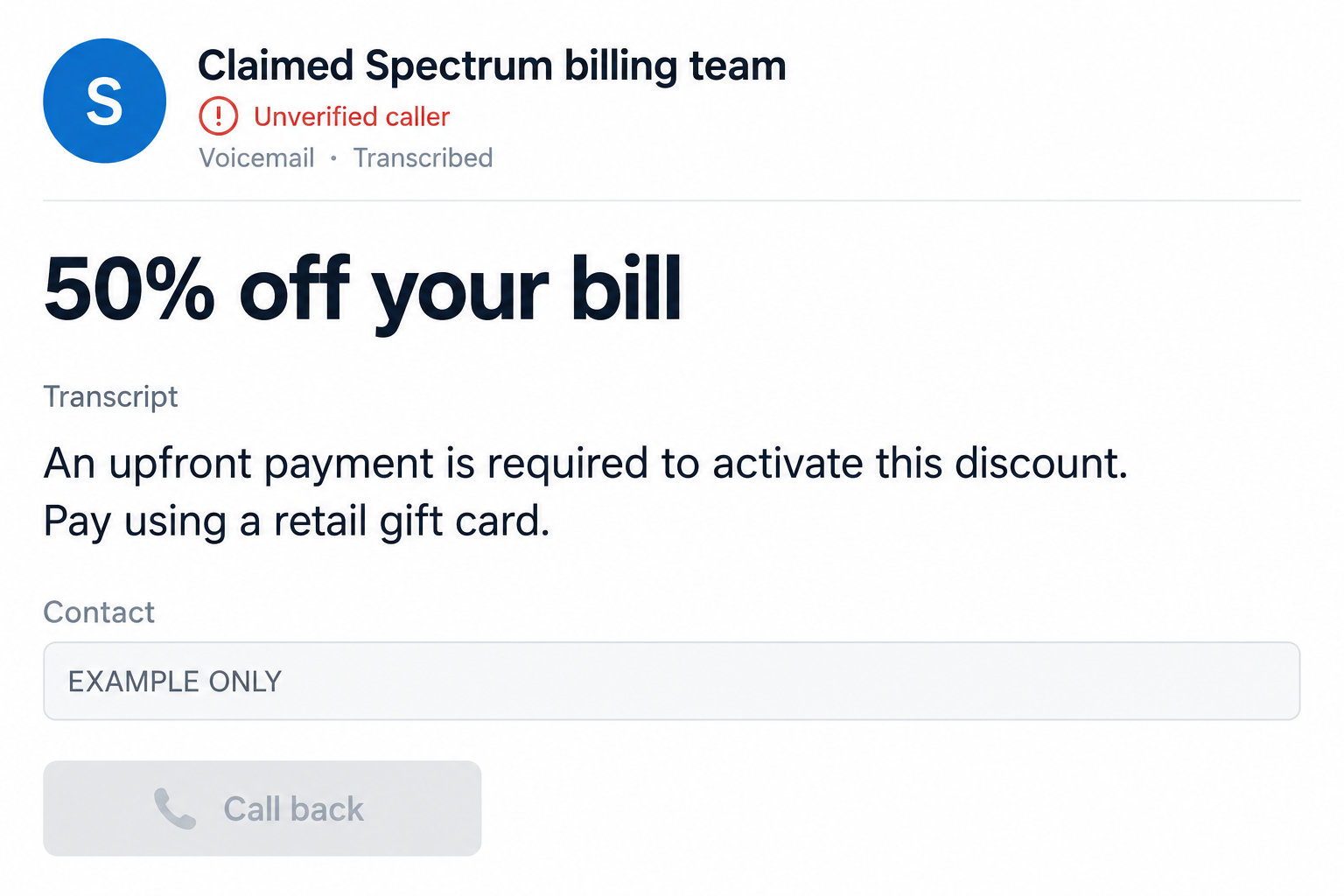
Spectrum’s fraud guidance specifically rejects discount offers requiring a fee. It also warns about impostors requesting payment through retail gift cards.
That is the important boundary. This does not mean Spectrum has no genuine promotions, or that every person discussing a lower bill is dishonest.
The image above is a generated example, not a received voicemail transcript. Its wording is illustrative and the callback details are deliberately nonfunctional.
The details that should stop the conversation
You can evaluate the request without arguing about the caller’s claimed job title. Look at how they expect the alleged discount to be activated.
- A fee must be paid before the lower bill becomes available.
- A retail gift card is presented as a way to pay for Spectrum service.
- The caller wants card codes, account credentials, or financial details.
- A deadline or cancellation threat discourages you from contacting Spectrum yourself.
A familiar caller ID is not enough to override those warnings. Use your existing account or billing statement to check the situation independently.
How the Scam Works
Step 1: A large discount gives you a reason to respond
The first contact offers something immediately understandable: a smaller recurring bill. You do not need to understand a complicated investment or technical problem.
A 50% reduction sounds particularly attractive because you can picture the monthly saving. That can make a callback feel like a sensible household task.
The voicemail may ask you to contact its billing team. Returning that call, however, keeps you inside the contact route supplied by the unknown sender.
You can ask the real provider about discounts without accepting that route. Save the offer’s details and leave the incoming conversation behind.
Step 2: A supposed representative makes the offer feel personal
A person claiming to work for Spectrum can discuss your bill, answer questions, and make the recorded offer sound like a real customer-service arrangement.
The conversation may include requests for information framed as checking eligibility. Be careful about providing account details to establish trust that has not been earned.
A name, employee number, or confident explanation does not let you verify the person independently. The caller can supply all of those details themselves.
Nor does knowing your service address settle the issue. Bring the claim to Spectrum through a channel you already use rather than disclosing more information.
Step 3: Savings become conditional on paying first
The offer changes when the caller says a payment is needed to activate the lower rate. A supposed saving now requires you to send funds.
The payment may be described as a promotion fee or advance service payment. What matters is the demand to pay this unverified caller to obtain the deal.
Spectrum’s warning says it does not charge a fee to get a discount. You do not need to complete a payment to challenge the caller’s explanation.
Ask the real company about any actual account balance separately. An existing bill does not make an unrelated activation demand genuine.
Step 4: A gift card disguises where the money is going
In the retail gift-card version, the caller names a store and explains that its card is part of the promotion.
That turns an unusual payment request into an apparent partnership requirement. The retailer’s familiar name can make the process feel less risky.
But buying a real gift card does not authenticate the person asking for its redemption information. The card and the claimed billing arrangement are separate things.
Do not read out the number and PIN, send a photograph, or enter those details on a site supplied by the caller.
Step 5: A deadline makes checking seem expensive
The supposed promotion may be described as ending today. A recipient who pauses is made to feel they could lose a valuable opportunity.
A verified Spectrum employee’s response rejects a reported 50% promotion involving a threatened cancellation and tells the recipient not to provide payment or information.
Do not accept the caller’s claim that refusing this arrangement will automatically cancel your genuine service. Check any real service warning with Spectrum directly.
The same applies if the person becomes impatient. Their reaction does not create a billing obligation or remove your ability to end the call.
Step 6: The promised discount distracts from the actual account
After a payment, you may be waiting for the next statement to prove the deal worked. That delay can postpone reporting the loss.
Do not wait for a billing cycle if you have already handed an impostor gift-card codes or financial information. Contact the relevant provider promptly.
Check your Spectrum account separately for real payments, plan changes, or unfamiliar activity. A caller’s receipt is not a substitute for those records.
If another payment is requested to fix an error, stop there. Resolve both the scam exposure and genuine service questions through independently reached organizations.
How to Check a Spectrum Discount Without Using the Caller
Start with the bill you already receive
Use the contact information on your established billing statement, or open the My Spectrum app you normally use. Avoid the number advertised in the voicemail.
Explain the promised reduction and the requested payment method. Ask whether your actual account has an offer matching those terms.
You do not have to call the impostor back while waiting for an answer. A genuine account question can be handled without keeping that conversation alive.
Keep a note of the real support interaction. It is useful if a later incoming caller claims the first person misunderstood or canceled your promotion.
Ask what the complete bill would be
For a legitimate offer, ask which services it covers, how long it lasts, and what the account will show after the promotional period.
Check whether equipment, taxes, or other existing charges are included in the quoted figure. A vague percentage is less useful than a clear total.
These questions help evaluate real promotions. They are not instructions to negotiate with an impostor or turn a gift-card demand into an acceptable offer.
If a genuine representative explains a change, keep its written confirmation through the normal account process. Do not rely on a document supplied by the unsolicited caller.
Keep normal billing separate from the scam
Sending money to a stranger does not necessarily pay your real Spectrum bill. Check the balance through the official account and ask about any discrepancy.
Do not cancel a regular payment or ignore an actual notice solely because the caller promised that everything was covered.
If you cannot afford a genuine balance, discuss available options directly with Spectrum. The scam’s false promise should not decide what happens to your real service.
Have the service address and account information ready for the contact you initiate. Supply them only through the genuine organization’s established verification process.
What to Do if You Have Fallen Victim to This Scam
-
End contact and stop any additional payment. Keep the voicemail, displayed number, callback instructions, and messages before blocking the contact.
Do not warn the caller that you are reporting them or attempt to recover funds through another conversation. Concentrate on the organizations that can help.
-
If gift cards were involved, contact the issuer immediately. Keep the card and purchase receipt, even if you already shared its codes.
Explain that an impostor requested the redemption details and ask whether remaining funds can be protected or recovered. Tell the issuer exactly when the codes were disclosed.
If you bought the card but shared nothing, do not send the codes now. Ask the retailer or issuer about the options for your specific purchase.
The store location, purchase time, and transaction reference can help identify the gift card in a follow-up inquiry.
Keep usable card codes private when sending screenshots. Ask the issuer how to provide the information securely instead of publishing it in a complaint.
-
Tell your bank or card provider about other financial exposure. Distinguish a payment you approved from card details you disclosed without a completed transaction.
Ask about protecting the account and investigating any loss. Do not assume that buying a legitimate retail card makes the separate scam payment automatically refundable.
-
Contact the real Spectrum team. Use your established statement or account, describe the impersonation, and check for unrecognized account changes.
Ask how to secure the account if you disclosed credentials or identifying information. Also confirm the actual balance so the fake offer does not cause billing confusion.
-
Replace exposed passwords through the genuine services. Use a unique password and change it elsewhere if it was reused.
If you shared a sign-in code or approved access, report that specifically. A password change is useful, but support may need to investigate other account permissions.
-
Make one clear incident record. List the contact dates, promised discount, requested payment, disclosed information, and transaction references you possess.
Preserve original receipts and messages privately. Avoid putting gift-card codes, account numbers, or identity documents into public complaints where another person could misuse them.
-
Report the fraud and follow exposure-specific guidance. The FTC’s recovery guidance explains options for different payment methods.
If sensitive identifying details were supplied, consult IdentityTheft.gov for appropriate next steps. Reporting helps document the incident; it is not a promise of reimbursement.
-
Reject another fee to recover the first payment. Someone promising guaranteed results may be seeking a second loss rather than solving the original one.
Keep recovery discussions with the payment issuer, real provider, and appropriate authorities. A stranger knowing the amount you lost is not enough to establish trust.
Three Questions That Make the Next Call Easier to Handle
Did you initiate this account conversation?
If not, you can move it to a trusted channel. You do not need to prove the incoming person is dishonest before deciding not to continue.
That approach also avoids judging someone by an accent, location, or friendly manner. The payment request and independent account confirmation are more useful checks.
Spectrum’s spam and scam guidance explains how unsolicited contacts differ and how to respond without engaging further.
Is the supposed saving asking for something unrelated?
A retailer’s card code and a broadband service discount belong to different systems. A caller’s partnership explanation does not securely connect them.
Put the request into ordinary words before acting: you are buying a card and giving an unknown person its spending information.
That description makes the immediate risk clearer than a long explanation about promotional credits, activation procedures, or a limited billing opportunity.
Can another household member check before money moves?
Agree on a simple household rule for unexpected service offers: verify through the regular account before buying anything or disclosing private information.
If someone else handles the bill, check with them privately using their usual contact details. The caller should not manage that conversation.
Keep the same rule for later voicemails with different numbers. Blocking one contact can reduce interruptions, but it does not authenticate the next offer.
Frequently Asked Questions
Is every Spectrum discount fraudulent?
No. The warning concerns impostors demanding a fee or retail gift-card payment to activate savings. Check genuine promotions through your normal Spectrum account or official support.
Will Spectrum accept a Target or other retail gift card for this deal?
Spectrum warns that it does not request gift-card payments. Do not give the caller a card number or PIN because they claim a retailer sponsors the discount.
What if the voicemail says my discount expires today?
A short deadline is not verification. Leave the supplied callback route and ask the real company about the alleged offer through your bill or established app.
Does a caller knowing my address prove they work for Spectrum?
No. Personal information does not authenticate an incoming caller. Let independently contacted Spectrum support verify the account and investigate the request.
Should I wait for my next bill after sharing gift-card codes?
No. Report the disclosure to the card issuer promptly and contact Spectrum separately. Waiting for a statement can delay attempts to protect remaining funds.
Will a security scan get the gift-card money back?
No. This payment scam requires financial and account actions. Device cleanup is a separate issue if you also installed software or allowed computer access.
The Bottom Line
Do not pay an unsolicited caller to unlock a Spectrum discount, and never send retail gift-card codes for the promised 50% savings.
Check the offer through your real account. After a payment or disclosure, speak with the issuer and Spectrum promptly; the promised discount is no reason to wait.

Join the discussion
0 commentsShare your experience or ask a question about this article.
Discussion
Start the conversation
Have a question or something useful to share? Add the first comment.