

The offer sounds unusually generous: keep the same AT&T service, cut the bill by 50%, and lock in the savings before a limited promotion closes.
The AT&T 50% discount scam reveals its catch only after the caller has built trust. The offer depends on a code, an upfront payment, or gift cards that send control and money in the opposite direction.
Overview
A familiar monthly bill makes the offer easy to believe
The AT&T 50% discount scam usually begins with an unexpected call, voicemail, or text. The sender claims to represent AT&T, a loyalty department, a promotional partner, or a billing team with access to a special rate.
A 50% reduction is large enough to get attention but can still sound plausible when it is framed as a customer-retention deal. The caller may mention a long relationship, a new plan, or a partnership with a well-known retailer.
The discount is used to steal access or demand irreversible payment
Some versions ask for an AT&T passcode or a temporary security code sent by the real company. That code can help the criminal reset a password, enter the account, order devices, or change contact details.
Other versions say several months of discounted service must be prepaid with gift cards. AT&T warns that it does not ask customers to pay for service or promotions using gift cards, prepaid cards, cryptocurrency, or money transfers.
The campaign changes its script without changing the trap
The claimed partner, callback number, discount period, and payment method can rotate. One call may promise 50% off for two years, while another offers a free device plus a lower monthly rate.
Common requests include:
- An AT&T account password, PIN, or security passcode
- A temporary code sent by the legitimate AT&T system
- Payment for several months using retail gift cards
- Card or bank details for a supposed promotional enrollment
- A remote-access app for help applying the discount
- Approval for a device order or shipping-address change
- Personal details used to answer account-security questions
The promotion is only the story that starts the transaction. The real objective may be immediate payment, an account takeover, valuable devices, or enough identity information for a later attack.
What the Fake AT&T Discount Pitch May Sound Like
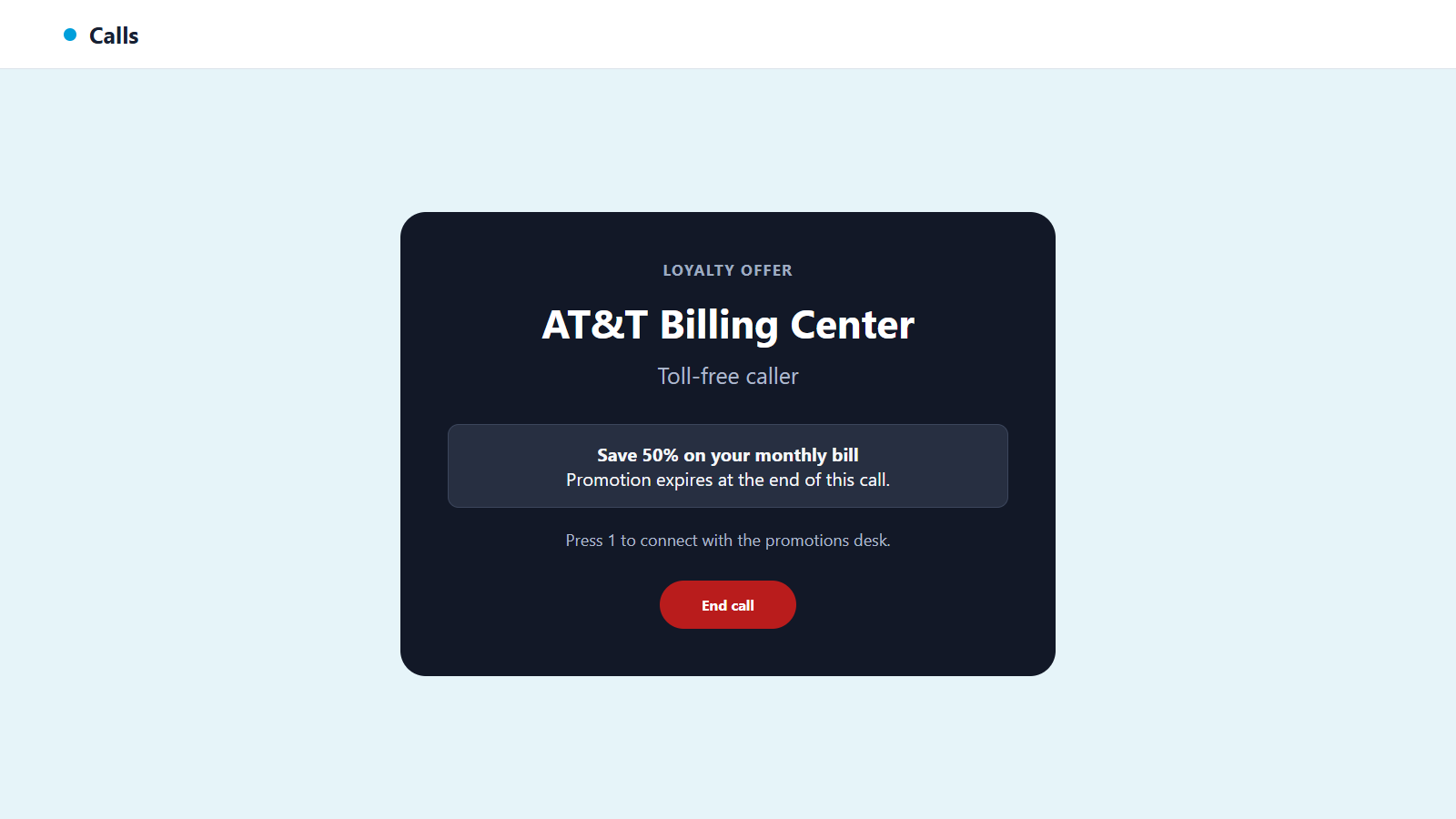
A recorded message may say an existing account qualifies for a 50% loyalty discount and instruct the customer to call a special billing number. The greeting can include hold music, menu prompts, and professional language copied from a real support experience.
A live agent may know the customer’s name, approximate monthly bill, telephone number, or service address. Those details can come from stolen records, a previous breach, public sources, or another marketing list.
The caller then creates a reason the offer cannot be completed in the normal account. The discount may supposedly be sponsored by a retailer, processed by an outside promotions desk, or available only through a separate payment system.
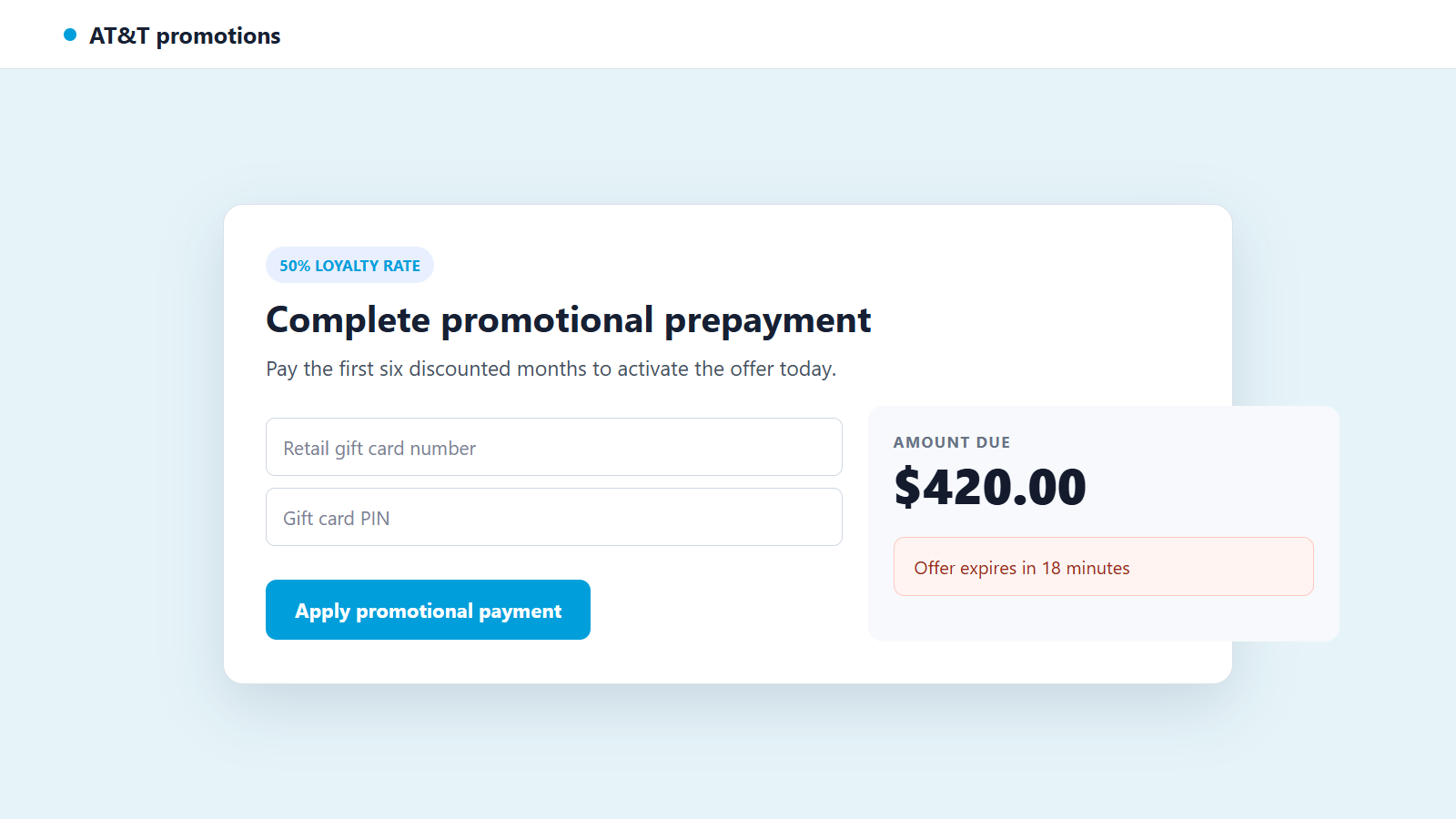
A common gift-card version asks the victim to buy cards for several months of service at the reduced rate. The caller requests the card numbers and PINs, claims to apply the value to the account, and promises the lower bill will appear later.
Another version sends a genuine AT&T one-time code. The agent calls it a promo code or identity check, although it may actually authorize a password reset, account change, eSIM action, or purchase.
Why Real Account Details Do Not Prove the Call Is Genuine
People often assume a criminal could not know the carrier, plan type, or recent bill. In reality, a mobile number itself reveals the likely context, and stolen customer data can make the script far more specific.
A caller may also trigger genuine system messages while on the line. A real text from AT&T does not authenticate the person who caused it to be sent.
Read the entire message. If it says not to share the code, the caller is not allowed to ask for it under a different name.
Caller ID is also weak evidence. A displayed AT&T name or toll-free number can be spoofed, and a lookalike callback number may differ from the official one by a single digit.
Warning Signs of the 50% Promotion Trap
- The offer arrives through an unexpected call or prerecorded voicemail.
- The discount must be accepted before the end of the call.
- The caller asks you to read a PIN or temporary code aloud.
- Several months must be paid in advance to activate the rate.
- Payment is requested with gift cards, crypto, or a money transfer.
- The agent tells you not to use the normal AT&T app or support number.
- A retailer is described as the sponsor without written terms in your account.
- The caller already knows details and uses them as proof of employment.
- You are asked to install screen-sharing or remote-control software.
- The promotion does not appear in your authenticated account or official offer documents.
A legitimate discount can be explained in writing and verified through AT&T independently. It does not disappear merely because a customer ends an unsolicited call.
How the AT&T 50% Discount Scam Works
Step 1: A call or voicemail announces exceptional savings
The operation contacts large numbers of people, knowing that many use AT&T or have used it before. The message may claim the account was selected because of loyalty, payment history, age, or a new nationwide promotion.
The exact number does not need to belong to AT&T. Spoofing can make the call appear local or place a familiar company name on the screen.
Step 2: The agent turns a broad pitch into a personal offer
Once someone responds, the agent asks about the monthly bill, number of lines, and current plan. The answers are repeated as though they came from an internal customer file.
If stolen data is available, the agent may begin with correct information. That makes the later request for a code or payment feel like an ordinary final step.
Step 3: A deadline prevents independent verification
The victim is told that the promotion expires today, belongs to a limited group, or will be released if the call ends. The purpose is to prevent a check through the real app or number on the bill.
A second agent or supervisor may join to make the offer appear formally approved.
Step 4: A real security code is relabeled as a promo code
The criminal enters the victim’s telephone number or username into an AT&T login or recovery process. The legitimate service sends a one-time code to the customer.
The caller asks the victim to read it back, sometimes saying the number applies the discount. In fact, it can complete the attacker’s account access or authorize a sensitive change.
Step 5: The account is changed behind the conversation
With access, the criminal may replace the password, modify recovery details, add authorized users, order expensive devices, activate a new line, or redirect a shipment.
A changed SIM or eSIM can also interfere with telephone service and expose codes sent by text.
Step 6: An upfront payment is added to the promotion
The agent says the 50% rate requires prepayment. Gift cards are often described as part of a retail partnership, while card or bank payments may be collected through a fake portal.
Gift-card values can be redeemed immediately. Once the victim reads the card number and PIN, the physical card is no longer protection.
Step 7: A temporary bill change can deepen the illusion
In some account-takeover scams, the criminal may use stolen payment methods or unauthorized credits to make an account appear paid. The victim sees a lower balance and assumes the promise worked.
When the fraudulent payment is reversed, the original bill returns. By then, the gift-card money and any ordered devices may be gone.
Step 8: Follow-up calls demand more money
The operation may claim that one card failed, a tax was added, or an account error blocked activation. Each explanation creates a reason for another payment.
Victims who refuse may receive threats of service suspension or loss of the money already paid. That pressure is designed to turn the first loss into a larger one.
Company, Address, and Fulfillment Checks
The promotion name is not a legal business identity
Labels such as loyalty desk, billing center, or promotions partner are not proof of an AT&T department. Ask where the offer appears in the authenticated account and request written terms.
Do not rely on a caller’s employee number. A criminal can invent one instantly.
The callback number may lead directly to the scam
A polished menu and hold music can operate on any internet telephone line. Verify through the number on the bill or inside the official app, not the number left in a voicemail.
Search advertisements can also display fake support numbers, so typing a query and calling the first result is not enough.
Real support will not need a secret code from you
AT&T says it will not unexpectedly ask a customer to provide a PIN or code. A support worker can authenticate through approved account processes without borrowing the customer’s login proof.
End any call that asks for a one-time code and contact AT&T independently.
The payment and delivery trail must match the account
A legitimate payment appears on the AT&T account and regular statement. It is not made by reading unrelated gift-card numbers to a promotions agent.
Review device orders, shipping addresses, new lines, and authorized users. Account takeover may create physical deliveries long after the discount call ends.
How to Verify a Real AT&T Offer
Open the myAT&T app or type the official site address yourself. Look for the offer under the account, plan, or billing section without using any link from the message.
Call the number printed on the regular bill and ask whether the promotion exists. Give the representative the claimed offer name, terms, callback number, and any case number, but never repeat a code sent for sign-in.
Ask for the total monthly price, duration, line requirements, fees, device obligations, and what happens when the promotional period ends. A real offer has terms that can be reviewed before payment.
AT&T’s prepaid-card scam guidance specifically warns that fraudsters may promise a discount or upgrade, request months of advance payment on gift cards, and ask for a temporary PIN.
What to Do if You Have Fallen Victim to This Scam
- Stop communicating and do not buy another card. A supposed activation problem is likely an attempt to extend the loss.
- Contact AT&T through the official account. Report the impersonation, ask support to freeze suspicious changes, and review recent account activity.
- Change the AT&T password and passcode. Use a trusted device, choose a unique password, remove unfamiliar authorized users, and verify recovery details.
- Inspect lines, SIMs, eSIMs, devices, and shipping addresses. Cancel unauthorized orders and ask whether a number-transfer or SIM change was requested.
- Call the gift-card issuer immediately. Keep the card and receipt. Ask whether unused value can be frozen, but do not trust anyone who guarantees recovery.
- Notify the bank or card issuer. Report any payment or exposed card details, replace compromised cards, and dispute unauthorized transactions.
- Secure the linked email account. Change its password, review forwarding rules and sessions, and strengthen multifactor authentication.
- Preserve evidence. Save the voicemail, caller number, texts, receipts, gift-card packaging, callback details, and screenshots of account changes.
- Report the fraud. Use AT&T’s official reporting route, forward suspicious texts to 7726, and submit the details through ReportFraud.ftc.gov.
- Scan any device used for remote help. Remove unknown access software and run a full Malwarebytes scan if the caller had you install an app or file.
- Reduce repeat exposure. AdGuard can help block known phishing pages and malicious advertising, but account passwords and codes still require careful protection.
Frequently Asked Questions
Is AT&T really offering every customer 50% off?
No broad unsolicited offer should be assumed genuine. Verify the exact promotion inside the authenticated account or through the number printed on the bill.
Why did the caller know my AT&T account details?
Information may come from stolen data, earlier phishing, public records, or questions answered during the call. Accurate details do not prove employment.
Is a code sent by AT&T safe to share with support?
No unexpected caller should receive a one-time sign-in or recovery code. The message may be genuine while the person who triggered it is a criminal.
Will AT&T ask for gift cards to activate a discount?
No. AT&T warns that it does not request gift cards, prepaid cards, crypto, or money transfers for service or promotional payment.
What if the discount appeared on my account temporarily?
Do not assume it is permanent. An unauthorized payment or credit may later be reversed. Ask official support to explain every adjustment.
Can I recover money loaded onto gift cards?
Contact the issuer immediately with the cards and receipts. Recovery is uncertain, but prompt reporting may help if the value has not been redeemed.
The Bottom Line
The AT&T 50% discount scam turns a desirable bill reduction into a demand for account codes, gift cards, or other payments that genuine support does not require.
End the call and verify the offer independently. A real promotion will still exist inside official AT&T channels after the caller’s artificial deadline has passed.

Join the discussion
0 commentsShare your experience or ask a question about this article.
Discussion
Start the conversation
Have a question or something useful to share? Add the first comment.