


A post in your Threads feed appears to show credit card details anyone can use. Below it, people seem to be thanking the account for helping them make money.
By the time the conversation moves off Threads, the offer looks different. The useful question is who gets paid first.
Overview
A credit card post advertises something else
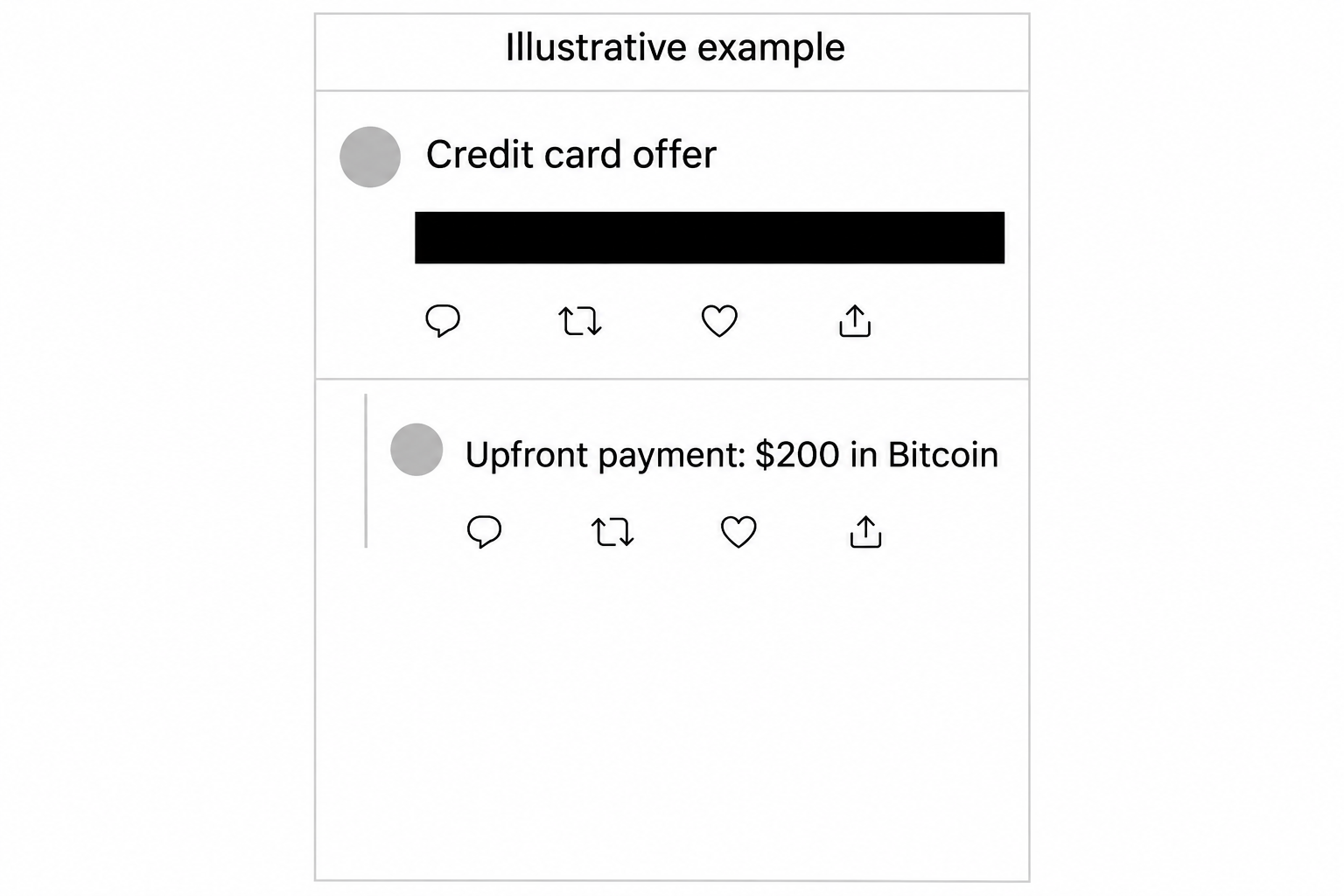
The Threads credit card scam starts with posts that claim to give away payment card details. In the case documented in July 2026, the public post was bait.
The trail led to Telegram, where an operator promoted a paid guide allegedly connected to Cash App.
The price was $200, requested in Bitcoin before the promised material was delivered.
The offer wasn’t issued by Threads, Telegram, Cash App, or a card network. A platform can host a post or conversation without approving the claims someone makes there.
The screenshots don’t show an independently verified payout
The public posts presented card details as evidence that the offer worked. The private channel used screenshots to suggest that other people had made money.
The researchers reported that some supposed transaction evidence contained invalid wallet identifiers. That undermines those examples; it doesn’t tell us how many people paid or what every buyer received.
A screenshot of a balance is especially weak evidence here. The image doesn’t establish who owns the account, where the money came from, or if it was ever available.
The entry fee isn’t necessarily the last demand
The reported campaign followed the $200 offer with extra charges for supposed tools or assistance.
Buying in didn’t establish a reliable way to earn money or recover the first payment.
Some of the evidence looked like financial records. We aren’t reproducing any card details, payment destinations, or contact handles. Readers don’t need them to recognize the scheme.
These are the details that matter:
- A public post makes someone else’s payment card information look like a free resource.
- The offer changes when the discussion moves from Threads to Telegram.
- Stories about Cash App payouts are backed by screenshots, not verifiable earnings.
- The operator asks for $200 in Bitcoin before the buyer sees the guide.
- When the promised outcome doesn’t materialize, the operator asks for more money.
How the Threads Credit Card Scam Works
Step 1: The post makes the bait look free
The opener is easy to mistake for a giveaway or an odd bit of internet bravado. There’s something that looks valuable on-screen, and it costs nothing to look.
Card details make the post feel specific. A claim that someone found easy money is easy to dismiss.
An image that appears to contain real financial data can feel harder to ignore.
That appearance isn’t proof that the data works. It could be fabricated, copied, inactive, or tied to a real person who has no idea it’s being circulated.
There is no safe version of testing a stranger’s card. If the details really belong to someone, trying them would put that person at risk. Report the post instead.
Step 2: The conversation moves to Telegram
The value of the Threads post is reach. The Telegram channel gives the operator somewhere to show a sequence of posts, screenshots, and offers away from that public conversation.
A reader who moves there has already taken one small action. The next request can seem like a continuation of the same offer, even though the terms have changed.
The people posting praise may be difficult to identify.
Silence from dissatisfied buyers is just as uninformative: it doesn’t reveal who could comment, whose messages stayed visible, or who left.
Telegram is widely used for legitimate conversations. In this case, the combination of supposed stolen data, a private sales pitch, and an irreversible payment request is the warning.
Step 3: The operator turns screenshots into a sales pitch
Pictures of balances and transactions can make the next offer look like a small bet on a proven idea.
They are presented as evidence before the buyer can ask ordinary questions.
In the July case, researchers found problems in some of the displayed transaction details. A trustworthy payment record shouldn’t have to be taken on the seller’s word.
There is not much to learn from asking the channel for another screenshot. The same person can control both the claim and the image offered to prove it.
A legitimate payment you received appears in your own transaction activity.
A screenshot sent by a stranger never becomes a credit to your account, however many times they forward it.
Step 4: The free offer becomes a $200 Bitcoin payment
By this point, the post that brought the reader in is no longer the thing being offered. The seller is charging for access to a purported method.
The price is attached to a promise about future earnings. The immediate transaction, however, has only one clear beneficiary: the person requesting Bitcoin.
Buying Bitcoin and sending it are separate events. A person who merely bought it may still control it.
Sending it out to the operator is what changes the recovery options.
An exchange receipt can prove that you obtained Bitcoin. It cannot prove a stranger delivered a service, credited a Cash App balance, or agreed to refund you later.
Step 5: A second fee takes advantage of the first
After payment, the operator can send a document or explanation.
The mere fact that something arrived doesn’t establish that the promised earnings existed or that the seller can deliver them.
The reported follow-ups put a new price on getting the scheme to work.
The seller framed the next expense as what the buyer needed to finish what they had started.
That’s an uncomfortable moment. Walking away means admitting the first payment may be gone.
Paying again feels like doing something to fix it, which is exactly why the demand works.
Put both amounts on a piece of paper. If nothing has come into your own account, the new fee adds to the money at risk.
It doesn’t unlock the first payment.
What to Do if You Have Fallen Victim to This Scam
The right response depends on whether you viewed a post, purchased Bitcoin, sent a transfer, or shared account information.
Start with what actually happened, not what the seller says happened.
-
Stop talking to the operator. Don’t pay for a refund, verification, or missing tool. Keep the conversation available long enough to preserve evidence, then use the platform’s block controls.
-
Check the payment status in the official app or exchange. If you bought Bitcoin but never sent it, don’t follow any transfer instructions. Ask the provider about pending payments immediately.
-
If you sent Bitcoin, contact the service you used. Share the amount, date, transaction ID, and destination privately with support or investigators. Keep their case number with your records.
-
Contact Cash App if that account was involved. Open the app yourself and use official support. Explain whether you approved a payment, noticed an unauthorized one, or shared account information.
-
Protect any account whose details you shared. Secure the associated email, review the payment account’s activity and authorized devices, and follow support’s instructions if you gave away a sign-in code.
-
Call your card issuer using its official number if your card information was exposed or you see a charge you didn’t make. Describe the purchase and any unrecognized activity separately.
-
Report the Threads post and related Telegram messages using in-app reporting. Don’t repost the card images. Tell moderators what was displayed without circulating someone’s private financial information.
-
Report the loss using the FTC’s fraud reporting site or the FBI’s Internet Crime Complaint Center in the US. Use secure channels when supplying sensitive evidence.
Keep the purchase and the transfer separate
When you call support, say whether you’re looking at a card purchase, an exchange deposit, or an outbound Bitcoin transfer.
The same amount may appear in more than one place.
Tell support what you recognize and what you don’t.
A payment you made because of a false promise isn’t the same event as a charge someone made without your permission.
An outbound transfer already confirmed on the Bitcoin network generally can’t be canceled. The FTC’s cryptocurrency scam guidance explains why to report it to the payment service anyway.
A fast report preserves details that could become harder to find later.
It does not obligate anyone to reimburse the loss, and it isn’t a reason to pay a recovery agent.
Save enough evidence without spreading private data
Useful details include the date and time the offer appeared, a screenshot of the demand with other people’s details covered, and payment records from your own app.
If an authority asks for the unredacted record, follow its secure submission instructions. Don’t attach someone else’s card details to a public post, community warning, or ordinary group chat.
Even a picture of a fake card can include a real name or phone number.
Keep your warning to the pattern: the public giveaway, private chat, and upfront Bitcoin charge.
Write down which account you reported before the profile disappears or changes its name.
A timestamp can help support find the right activity without asking you to reopen the channel.
If you opened a file or shared a code
The July investigation reported a paid PDF offer. That doesn’t mean every copy of an attachment is dangerous or that receiving the PDF alone proves a device infection.
Don’t try an unfamiliar program or install an extension because someone in the channel says it fixes the problem.
If you ran something, tell support or your IT team exactly what.
If you entered account details while testing the offer, review settings from a trusted device.
An unexpected code approval is worth reporting even if your current balance still looks normal.
Look for new linked accounts, withdrawals or funding changes. Use Cash App’s security guidance if the offer touched that service. Don’t trust another direct message claiming to be support.
What a Real Transaction Record Can Tell You
A screenshot can start a conversation with support, but your own activity screen is the better record.
It can show whether you sent a payment, whether it remains pending, and when.
It can’t tell you that the person selling the guide was legitimate.
The correct question is not whether the Bitcoin transaction exists. It’s whether what you paid for was real.
When someone sends an image of a transaction supposedly made for you, don’t scan anything or use a link in the image.
Open your account independently and look for the credit.
That distinction matters for friends or family helping after a loss. Start by locating the genuine receipt together.
Let the account holder handle the password and open the official support conversation.
Warn them about the next message, too. Someone who knows the price and payment time can sound convincing when promising recovery.
Knowledge of a transfer doesn’t establish the power to reverse it.
If your own card appears in the post
Use your card issuer’s fraud number rather than messaging the person who posted it. Even an old or partially covered image can contain enough information to warrant a call.
Tell the issuer whether you recognize the pictured card and whether you can see unfamiliar activity in your account. It can advise whether to lock or replace the card.
You don’t need to prove where the image came from. A replacement card and a fraud report address the immediate exposure while the platform investigates the post.
If you warn others, describe the offer without showing the picture. You can explain that the apparent giveaway turns into a paid pitch without helping the image circulate.
Frequently Asked Questions
Is the Threads credit card giveaway real?
In the documented offer, the public card posts led to a $200 demand for a supposed Cash App earnings guide. They weren’t a verified giveaway you could safely redeem.
Does an actual card number make the offer legitimate?
No. It may belong to a real person, have been canceled, or be entirely fabricated.
None of those possibilities grants permission to use it. Don’t test it or send it onward.
Can a screenshot prove someone made money on Cash App?
It can show what an image claims, not who earned anything or how.
If someone says they paid you, confirm the transfer in your own account rather than their screenshot.
What if I bought Bitcoin but didn’t send it?
Check that it remains in the account you control and ignore requests to transfer it or share a code.
If there’s a pending instruction you don’t recognize, contact the provider promptly.
Can I recover the Bitcoin I sent?
A completed Bitcoin transfer usually can’t be reversed. Report it quickly and preserve the transaction ID.
Treat any promise of guaranteed recovery for another upfront payment as a fresh warning.
What if I just saw the post without opening anything?
Report it if you can do so safely, then move on.
Seeing the post doesn’t give its operator access to your payment accounts. You don’t need to test what it claims.
The Bottom Line
The Threads credit card scam turned supposed free card details into a private $200 Bitcoin demand. The screenshots offered no reliable proof of earnings.
Don’t buy the guide, try the cards, or pay someone to get the first payment back.
If money moved, use the activity records and support channels of the service you paid through.

Join the discussion
0 commentsShare your experience or ask a question about this article.
Community experiences
Did this happen to you?
Your experience could help someone recognize the same scam. Submit a private report for our team to review.
I experienced this tooReports are reviewed before publication. Sharing publicly is always your choice.
Discussion
Start the conversation
Have a question or something useful to share? Add the first comment.