


Polar Tensor presents a polished answer to a difficult question: can automated crypto trading produce steady results without the usual stress of managing every decision?
The website talks about neural networks, fast execution, and controlled risk. Before treating those claims as a reason to deposit, look at the records behind the presentation.
Overview
A final Georgia order concerns unlicensed money transmission
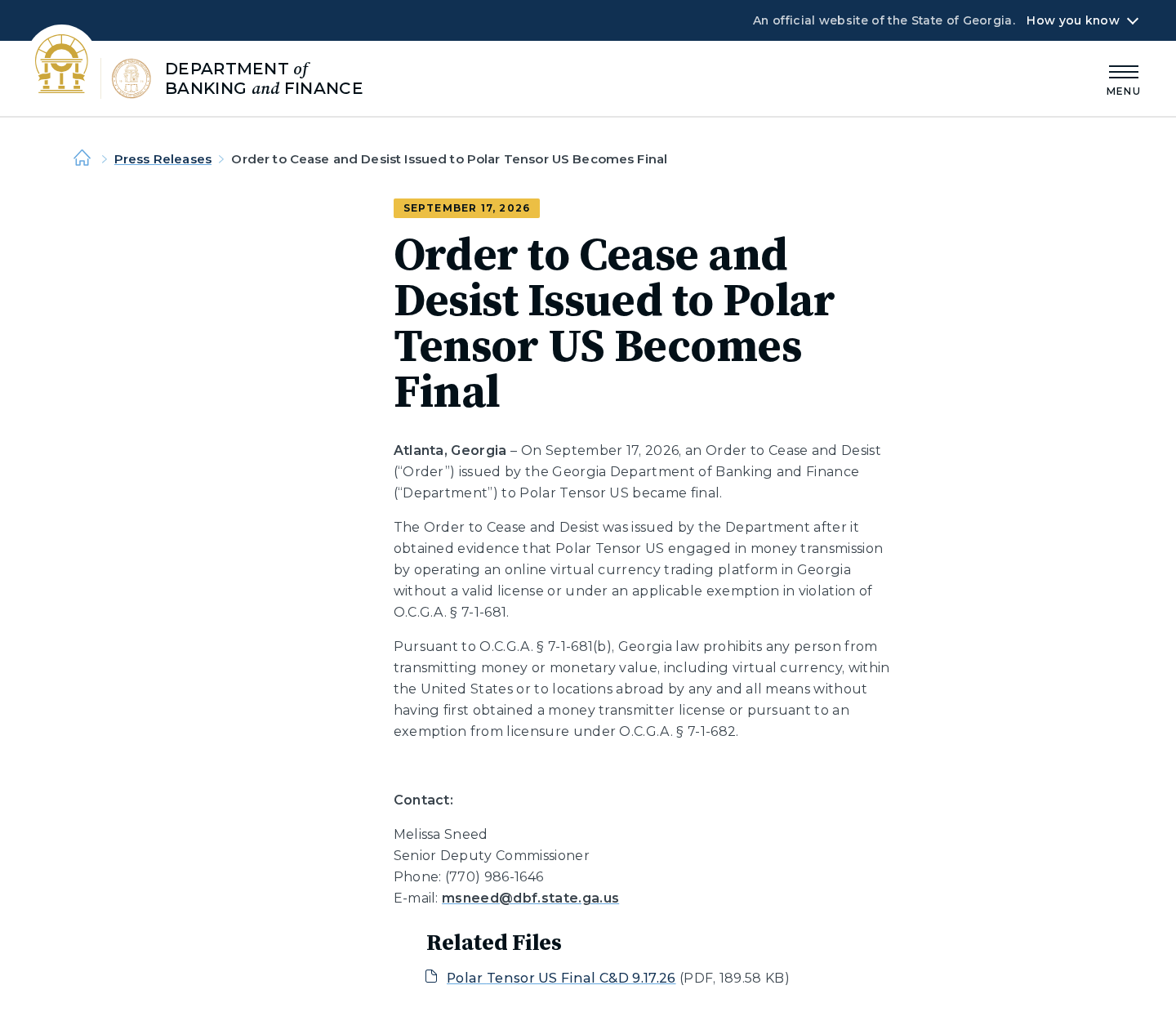
Georgia’s Department of Banking and Finance announced a final cease-and-desist order against Polar Tensor US on September 17, 2026.
The department says it obtained evidence of an online virtual-currency trading platform transmitting money in Georgia without the required license or applicable exemption.
That is a specific regulatory finding. It should not be inflated into a criminal conviction, proof of every reported loss, or a worldwide prohibition.
Alberta identifies both Polar Tensor and Polar Money
The Alberta Securities Commission’s caution entry names Polar Tensor and associates polar-tensor.com with polar-money.com. It says the operation also uses Polar Money.
The entry warns that the named operation is not registered to trade or advise on securities or derivatives in Alberta.
This connection comes from the regulator, not a guess based on similar branding. Check both names when examining an offer or preparing a report.
The website’s licensing claims need independent confirmation
Polar Tensor’s own disclosures describe several entities and claim registrations or permissions for different activities. They also describe an EU authorization as being pursued.
- A claimed registration is not the same as a verified current permission.
- Authorization must cover the relevant entity, service, and customer location.
- Trading statistics need a defined period and independently reviewable evidence.
- An app-store presence does not resolve a regulatory warning.
Do not deposit on the strength of this offer. The official warnings and unresolved verification of its current authorization make it unsuitable to recommend.
What the Official Order Actually Says
The Georgia document is addressed to Polar Tensor US, care of director Felix Bick, at 30 N Gould St Ste R, Sheridan, Wyoming.
It was issued July 30, 2026. The department subsequently announced that it became final on September 17. Those dates describe separate procedural events.
The subject is money transmission, including virtual currency. The department’s finding concerns activity requiring a license or an applicable exemption under Georgia law.
That is narrower than proving how a trading algorithm performed. A money-transmission order is not an audit of every customer account.
It also is not a refund order guaranteeing that investors will receive money. Someone seeking recovery still needs to document their transaction and approach appropriate institutions.
The accurate reading is already serious enough: a state regulator issued an order over unauthorized financial activity, and publicly confirmed its final status.
Anyone dismissing that record should supply a current, independently checkable regulatory answer. A new brochure or reassurance from a promoter does not overturn an official order.
Do not confuse the regulator’s contact address with the company’s address. The issuing authority is a source for the order, not the operator receiving customer funds.
The AI Trading Claims Need More Than Impressive Numbers
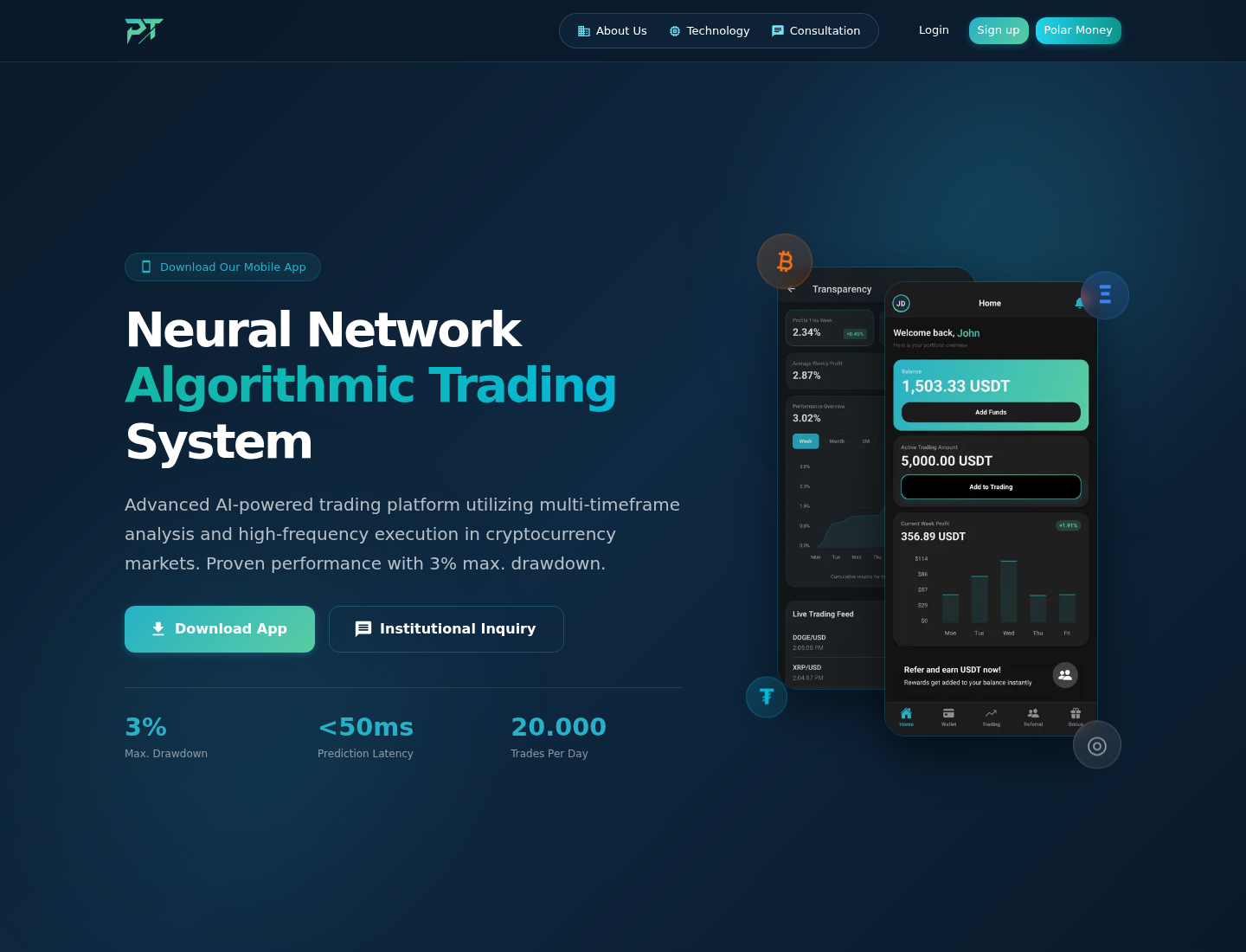
The public site advertises a 3% maximum drawdown, prediction latency below 50 milliseconds, and 20,000 trades per day. It also describes a 1.15 profit factor.
These figures sound precise, but precision in a sales statement does not establish an independently audited result. Each number needs context before it means much.
Maximum drawdown needs a period and a calculation
Drawdown describes a decline from an earlier peak. A quoted maximum depends on the account, dates, sampling, fees, deposits, and withdrawals included in the calculation.
It is not automatically a promise that your balance cannot fall further. A historical result, even if verified, does not cap a future loss.
Ask whether the figure concerns live customer accounts, a model portfolio, or a simulation. Without that distinction, the number can create more confidence than understanding.
Execution speed does not tell you whether a strategy is profitable
Fast predictions and order handling measure aspects of infrastructure. They do not establish whether a prediction is correct or whether an execution produces a net gain.
A strategy can trade frequently and still lose money after spreads, fees, slippage, and unfavorable price moves. More trades are not inherently better trades.
Likewise, a profit factor needs the underlying calculation and observation period. A standalone ratio does not reveal the size of losses or the money customers can withdraw.
Blockchain records do not authenticate every account claim
The site emphasizes blockchain transparency. Public transaction records can help document a transfer, but they do not automatically establish the accuracy of a private dashboard.
A wallet transaction does not, by itself, show beneficial ownership, an audited strategy, or why funds moved. Those questions require additional records.
Keep those distinctions intact. Technical language should help you understand the investment, not make you stop asking where your money will be held.
How to Assess the Polar Tensor Offer Before Any Transfer
Step 1: Identify the exact name and website you were given
Start with the offer in front of you. Save its domain, app link, promoter messages, and proposed contracting entity.
The Alberta warning links Polar Tensor with Polar Money and lists the two domains. Use that primary record when comparing names rather than assuming unrelated spellings belong together.
A changed domain would not automatically erase the underlying concern, but a connection must be established. Do not accuse another similarly named business without evidence.
Step 2: Match the contract to the activity being offered
The site separates technology, custody, payment processing, and other functions across a group structure. That separation makes the actual customer agreement especially important.
Find the entity that would receive or hold your assets. Then identify who can execute trades, process withdrawals, and answer a complaint.
A promotional explanation cannot replace the agreement governing your account. If documents conflict, do not resolve the ambiguity by sending a deposit.
Step 3: Check the permission independently, in the correct jurisdiction
A Wyoming permission, if genuine and applicable, would not automatically settle the Georgia order or authorize securities activity in Alberta.
Check the relevant regulator’s current record using the complete legal name and identifier. Ask whether the permission covers the actual activity offered to you.
An application for authorization is not a granted authorization. The site’s statement that a MiCA process is underway should not be presented as completed approval.
Step 4: Demand verifiable performance and asset-handling information
A useful performance record identifies dates, methodology, fees, and the accounts included. A useful custody explanation identifies who controls the assets and under what agreement.
Compare those documents with the advertising. A headline suggesting controlled downside should not be accepted without understanding the risk disclosure beneath it.
Do not install remote-control tools or send a wallet recovery phrase to obtain clarification. Neither is needed to explain an investment product before purchase.
Step 5: Refuse to use another payment as a verification test
If you already have an account problem, a further transfer is not a reliable test of legitimacy. It increases your exposure while leaving the original concern unresolved.
Ask for an explanation in writing, preserve the evidence, and involve the institution that sent the funds where appropriate.
This article does not verify a particular withdrawal failure or claim that every account is frozen. It identifies the records that already justify stopping new deposits.
Operator, Custody, and Regulatory Identity
Keep a copy of the agreement version attached to your account. A later website revision does not tell you what terms governed an earlier transfer.
When asking for assistance, identify that version and the business named in it. This can prevent a complaint from being redirected between similarly branded entities.
A clear timeline also separates an older regulatory action from a newer licensing claim. Both dates matter, and neither should be silently substituted for the other.
The legal disclosures describe several different businesses
The group document assigns roles to a US client-facing entity, a European entity, a technology company, a payments business, and other corporate functions.
Those are the site’s statements. They do not independently verify each entity’s existence, ownership, authorization, or responsibility for a particular customer’s balance.
Preserve the exact name in your own agreement. A response from someone using the brand name should still identify the business handling the complaint.
The Wyoming address identifies an order recipient, not a verified headquarters
The address in Georgia’s order helps identify the named respondent. It does not establish where trading, customer support, or asset custody physically takes place.
Do not present a mailing address as proof of an operating office or label it fake without checking its actual role.
For a customer, the relevant question is where a formal complaint can be directed and which entity has the contractual obligation to respond.
Published licensing statements are claims until matched to records
The regulatory page claims FinCEN MSB registration and a Wyoming money-transmitter license for its US entity. Those claims require independent verification.
No current registry match clearing the Georgia issue was established for this article. The operator’s own statement cannot be substituted for that missing check.
The official Georgia and Alberta records are therefore preserved with their exact scope, rather than overwritten by a broad claim that everything is now licensed.
Custody and withdrawal responsibility must remain understandable
The site assigns customer custody and withdrawals to different entities by region. Customers need an agreement that clearly implements that explanation.
Do not assume an app distributor, referral contact, technology developer, and custodian all carry the same responsibility. Their roles can differ substantially.
If nobody can identify which business holds your assets, that is a reason to halt further participation, not to buy another service tier.
What to Do If You Deposited With Polar Tensor
-
Put additional transfers on hold. Do not add funds because of a deadline, a promised account upgrade, or a request to prove commitment.
Also avoid bringing another person into the offer while authorization and account questions remain unresolved. Share the exact official records if someone asks why.
-
Build a clear payment chronology. Record each amount, currency, date, recipient, and transaction reference, together with the promise attached to that payment.
Preserve original statements rather than relying only on a total displayed in the app. Distinguish deposited funds from promotional credits and claimed trading gains.
-
Send a precise written account request. Ask the entity identified in your agreement for the account statement, withdrawal procedure, fees, and applicable complaint process.
Keep its response, or the absence of one, with the date of your request. Do not supply unnecessary identity documents through a new unsolicited contact.
-
Tell the sending institution if you suspect fraud or cannot retrieve funds. Contact the bank, payment service, or exchange through its genuine support channel.
Give the recipient details and transaction identifiers. Ask what protective, tracing, recall, or reporting options exist without assuming that an irreversible transfer can simply be canceled.
-
Use the relevant regulator’s reporting route. Georgia’s financial regulator and the Alberta Securities Commission publish their own contact and complaint information.
Readers elsewhere should report to the appropriate local authority. Explain the exact offer, your location, and the entity involved so the report can be assessed correctly.
-
Protect information already disclosed. If a password was shared or reused, change it through the genuine affected service and review available account protections.
If someone accessed your device remotely, obtain trusted assistance and warn your financial providers. A licensing dispute alone does not demonstrate a device infection.
-
Screen recovery approaches carefully. Do not give a stranger a seed phrase, private key, signing permission, or remote banking access.
A demand for upfront payment to release allegedly recovered funds needs independent scrutiny. Keep using known institutional channels rather than moving into another private group.
Frequently Asked Questions
Is Polar Tensor proven to be a Ponzi scheme by the Georgia order?
No. The order concerns unlicensed money transmission. It should not be described as a criminal Ponzi conviction or a complete accounting of customer funds.
What is the connection between Polar Tensor and Polar Money?
The Alberta Securities Commission identifies Polar Money as another operating name and associates polar-tensor.com and polar-money.com with the warning.
Does a claimed Wyoming license answer every warning?
No. Authorization depends on the entity, activity, location, and current record. A permission in one jurisdiction cannot simply be treated as permission everywhere.
Does a 3% maximum drawdown mean my loss is capped?
No. A quoted performance statistic needs its period and methodology. Even a verified historical drawdown would not guarantee a maximum future loss.
Is being in the MiCA application process the same as approval?
No. Pursuing authorization is different from receiving it. Verify any claim of completed permission directly with the relevant authority before relying on it.
Should I put money into Polar Tensor now?
No. Do not deposit based on the documented offer while official warnings and unresolved authorization checks remain. Existing customers should preserve records and pursue appropriate assistance.
The Bottom Line
Do not fund Polar Tensor on the strength of AI terminology or a performance graphic. Official regulatory action is a concrete reason to stop and check the offer.
If you already deposited, preserve the contract and payment trail, request clear written answers, and contact the sending institution or relevant regulator. Do not pay again to test recovery.

Join the discussion
0 commentsShare your experience or ask a question about this article.
Discussion
Start the conversation
Have a question or something useful to share? Add the first comment.