


A security warning mentions Heisenberg RAT, but the computer still looks normal. Your documents open, your browser works, and nothing obvious explains the alarming name.
That gap between a detection and what you can see makes deciding what to do next difficult. Start by separating the evidence from the malware’s reputation.
Overview
Heisenberg is described as a criminal Windows toolkit
Heisenberg RAT is publicly described as part of a malware platform marketed to criminal operators. Its advertised components combine remote control, information theft, and delivery of additional software.
RAT means remote access trojan. The concern is covert access arranged by an attacker, not every legitimate application that lets a technician help remotely.
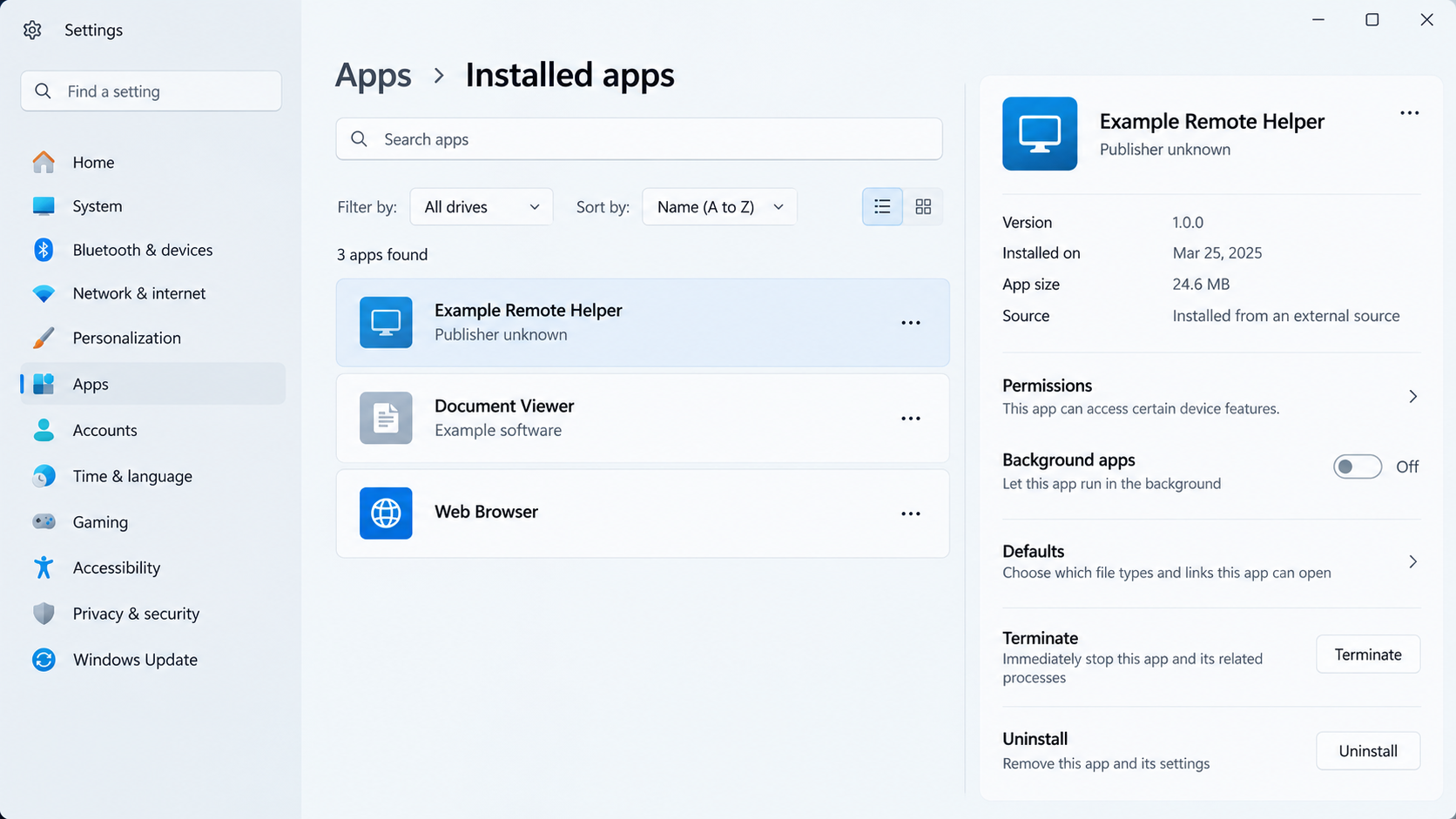
The illustration shows a fictional Windows app list. Neither its example application nor its displayed details identify Heisenberg, and it is not a security scan result.
Hidden-desktop access is a central advertised feature
The seller’s pitch includes hidden-desktop tools, browser-data theft, wallet targeting, and file management. Those features would make an infected workstation valuable beyond its visible screen.
A hidden desktop can let an operator interact with applications outside the view you are watching. That is different from an ordinary support session you knowingly authorized.
- Remote commands can affect files and software under the compromised account.
- Browser sessions and saved credentials may create account exposure beyond the device.
- Additional components can change the scope after the initial installation.
- A quiet desktop does not settle whether unauthorized access occurred.
Marketplace promises are not independent capability tests
Much of the detailed public description comes from an underground sales advertisement. Claims about evasion and effectiveness should remain claims, not guarantees that ordinary defenses cannot work.
No Heisenberg sample was executed for this guide. There is no universal filename, app icon, process, or visible symptom established here as a reliable diagnosis.
Use a genuine security detection or an incident responder’s findings to establish exposure. A browser pop-up mentioning a trojan is not equivalent evidence.
First Establish What Actually Reported Heisenberg
Start with the source of the name. A result inside an installed security product, a workplace investigation, and a webpage advertising urgent repairs deserve different treatment.
If the name appeared only on a website, do not call its support number or install its recommended cleaner. Open your existing security application independently.
If a real endpoint product raised the alert, keep its detection name, file location, timestamp, and action taken. Those details matter more than an alarming screenshot alone.
A quarantine notice means that product acted on something it detected. It does not establish what happened before detection or certify that no other component remains.
Workplace machines need special care. An administrator may want logs or a memory investigation before an employee uninstalls programs or deletes suspicious files.
Also distinguish this RAT from similarly named threats. The word Heisenberg in an older ransomware report does not establish that the same malware or recovery method applies.
A ransom note and encrypted files require their own assessment. Do not assume ransomware happened merely because a remote-access toolkit can deliver other payloads.
What Hidden Access Could Mean for Your Accounts
The visible desktop is not the whole workstation
Most people expect remote control to move the pointer or open a window in front of them. Hidden-desktop tools can challenge that expectation.
That does not mean every ordinary Windows background process is hostile. Windows and legitimate software routinely perform work without showing a visible application window.
The meaningful difference is unauthorized control. A trusted technician’s approved tool and an attacker-controlled component can both operate quietly, but the permission and purpose are entirely different.
Do not diagnose the machine by waiting for the cursor to move. If a credible detection exists, contain the device and investigate the account context it exposed.
A saved session can matter as much as a password
A browser may already be signed into email, cloud storage, shopping, or a business portal. Access to that environment can create risks without a new login prompt.
Multifactor authentication remains valuable. It is not a reason to dismiss an attacker using a device or session that was already authenticated.
For example, a business mailbox can contain live invoice discussions and recovery messages. Investigating only the computer leaves those connected accounts outside the response.
Check the accounts you actually used and the privileges they had. You can protect an exposed login promptly without assuming every advertised feature was used against you.
Modular delivery can leave more than one problem
The advertised toolkit includes a loader as well as remote access. Removing one detected file may therefore be only one part of investigating a compromise.
Additional software could have different persistence, permissions, and network destinations. That is why a detection report and timeline help more than a guessed list of filenames.
Do not delete every Python, Rust, or unfamiliar executable you find. Programming languages and legitimate runtimes are not malware indicators on their own.
Likewise, an advertised $5,000 monthly price concerns a seller’s claimed service. It is not a fee an affected user owes to remove an infection.
Turn the Detection Into a Useful Timeline
A few concrete timestamps can make support much more effective. Begin with the last time the PC behaved normally and the first credible alert.
Add the downloads, installer approvals, remote-support sessions, and account prompts you remember between those points. Mark uncertain times as approximate rather than guessing.
Then compare account notifications from a separate device. An unfamiliar session appearing before the alert may change which period the provider should investigate.
Keep attempted access separate from successful access. A rejected sign-in and a completed session are different events, even when both appear alarming in an email.
If a bank or employer gives you a case reference, keep it with these notes. That saves repeating the incident from memory whenever someone follows up.
Do not publish a raw log collection to get faster help. Review what it contains and use the responder’s approved upload method for potentially sensitive records.
This record also helps after cleanup. New unexplained access can be compared with the original incident instead of being dismissed as an old notification.
What to Do if You Suspect Heisenberg RAT
You can take useful protective steps without accepting every claim in a malware advertisement. Give priority to credible device evidence and the accounts accessible from it.
Take the suspect PC off the network. Disconnect its network cable and turn off Wi-Fi. Avoid opening banking, email, or wallet applications there while assessing it.
For a managed workstation, contact the real security team using another device. Ask what evidence it needs before you restart or clean the machine.
Save the original detection details. Record the security product, detected item, path, time, and whether it was blocked, quarantined, or allowed.
Do not restore the sample to see what happens. Do not upload private business documents as though they were ordinary malware samples.
Secure important accounts somewhere trustworthy. Begin with email and accounts used while the PC was suspect. Replace exposed or reused passwords and examine recovery settings.
End unfamiliar sessions and review connected applications. A password replacement alone may leave an existing session or separately authorized application active.
Notify financial providers about relevant exposure. If banking sessions, payment accounts, or financial files were accessible, contact the actual provider through established channels.
For cryptocurrency, disclosed keys require a wallet-specific response. An antivirus result does not cancel a transfer or make a copied recovery phrase secret.
Investigate how access began. List recent downloads, installers, support conversations, and programs added before the alert. Preserve the suspicious message if one exists.
No single delivery route is established for every Heisenberg incident. Do not invent an email attachment or assume a particular person installed the malware.
Arrange device cleanup and a confidence check. Use a reputable scanner and, where warranted, professional incident response. Follow the Windows sequence below for a personal PC.
Keep account recovery separate from the scan. A quiet result cannot establish that credentials were never copied or that an attacker made no changes earlier.
Watch for paid repair impersonation. Do not contact someone merely because their advertisement repeats the threat name. Avoid unsolicited remote sessions and demands for cryptocurrency.
If the computer keeps showing credible detections after remediation, seek trusted assistance rather than installing a succession of unknown cleaners.
Is Your Device Infected? Run a Free Malware Scan
Slow performance, constant pop-ups, or strange behavior? These are classic signs of a malware infection. A quick way to check is to scan your device with Malwarebytes Free, one of the most trusted malware removal tools available. If you only visited a scam page and didn’t download or install anything, this scan is optional.
The free version detects and removes the most common threats, including:
- Adware — the cause of those annoying pop-ups
- Browser hijackers — unwanted redirects and changed homepages
- Trojans and spyware — hidden programs stealing your data
- Potentially unwanted programs (PUPs) — software you never asked for
👉 Select your device below — Windows, Mac, or Android — then follow the simple steps to download Malwarebytes, scan your system, and remove any threats it finds. The scan usually takes 5 to 20 minutes.
Run a Malware Scan with Malwarebytes for Windows
Malwarebytes is one of the most popular and trusted anti-malware tools for Windows — and it’s completely free for removing infections. It catches threats that many antivirus programs miss, including adware, browser hijackers, and trojans. Follow the steps below to scan your PC and remove what Malwarebytes finds.
Download Malwarebytes
Click the button below to download the latest version of Malwarebytes for Windows from the official source. The free version is all you need — it will scan your computer and remove adware, browser hijackers, and other malicious software at no cost.
Download MalwarebytesOfficial installer for Windows 11 and 10. Your download starts right away.Want real-time protection? See Malwarebytes Premium Malwarebytes Free for WindowsScans and removes malware at no cost
-
Install Malwarebytes
When the download finishes, open your Downloads folder and double-click the MBSetup file. If Windows shows a User Account Control pop-up, click “Yes” to allow the installation.

Follow the On-Screen Prompts to Install Malwarebytes
The setup wizard will walk you through a few quick screens:
-
Choose where you’re installing the program — “Personal Computer” or “Work Computer” — then click Next.

-
Malwarebytes will now install on your device. This usually takes under a minute.

-
When installation is complete, the “Welcome to Malwarebytes” screen will open automatically.

-
On the final screen, click Open Malwarebytes to launch the program.

-
Optional: Check for rootkits with a Custom Scan
You don’t need to change any settings for a normal scan. The standard Threat Scan in the next step is enough for most problems, so you can go straight to it.
If you also want to check for rootkits, use a Custom Scan. In current versions of Malwarebytes, rootkit scanning is only available there:
- On the Scanner tile, click the three-dot menu and select Advanced Scan.
- Choose Custom Scan. In its options, check Scan for rootkits.
- Select your system drive (usually C:\) as the location to scan, then start the scan. It takes longer than a Threat Scan.
- When it finishes, review and quarantine the results as described in the steps below.
Rootkit scanning isn’t available on Windows devices with ARM processors.
Start the Scan
Click the blue Scan button. Malwarebytes will automatically update its virus database and start checking your computer for malware.

-
Wait for the Scan to Finish
The scan checks your entire system for browser hijackers and other malicious programs, so it can take 5 to 20 minutes depending on your computer. Feel free to do something else — just check back occasionally to see the progress.

-
Quarantine the Detected Threats
When the scan is done, you’ll see a list of everything Malwarebytes found — malware, adware, and potentially unwanted programs. Click the “Quarantine” button to remove all of them at once.

Malwarebytes will now remove the malicious files and registry entries and move them safely into quarantine.

-
Restart Your Computer
Some threats can only be fully removed after a reboot. If Malwarebytes asks you to restart, click Yes. Once you’re logged back in, Malwarebytes has finished removing the threats it found.

When the scan is done, check whether the problems you noticed have stopped. If they continue, see the options below.
If you are still having problems with your computer after completing these instructions, then please follow one of the steps:
- Run a computer scan with ESET Online Scanner
- Ask for help in our Windows Malware Removal Help & Support forum.
Run a Malware Scan with Malwarebytes for Mac
Malwarebytes for Mac is a free on-demand scanner that removes the malware other security software tends to miss — adware, browser hijackers, and unwanted programs included. Cleaning an infected Mac with Malwarebytes has always been completely free, and it’s our go-to recommendation. Follow the steps below to scan your Mac and remove what Malwarebytes finds.
-
Download Malwarebytes for Mac
Click the button below to download the latest version of Malwarebytes for Mac.
Download MalwarebytesOfficial installer for macOS. Your download starts right away.Want real-time protection? See Malwarebytes PremiumMalwarebytes Free for MacScans and removes malware at no cost -
Open the Malwarebytes setup file
When the download finishes, open your Downloads folder and double-click the setup file to begin the installation.

-
Follow the On-Screen Prompts to Install Malwarebytes
The Malwarebytes for Mac Installer will guide you through a few quick screens. Click “Continue” and keep following the prompts until the installation completes.



When the installation is complete, Malwarebytes opens to the Welcome to Malwarebytes screen. Click “Get started“.
Malwarebytes needs Full Disk Access to check your whole Mac. When it asks, open System Settings > Privacy & Security > Full Disk Access, turn on Malwarebytes (it may be listed as Malwarebytes Protection), and confirm with your password or Touch ID. Then return to Malwarebytes. On macOS Monterey and earlier, this setting is in System Preferences > Security & Privacy > Privacy.
-
Select “Personal Computer” or “Work Computer”
Malwarebytes will ask what type of computer you’re installing it on. Click either Personal Computer or Work Computer, whichever applies.

-
Start the Scan
Click the “Scan” button. Malwarebytes will automatically update its detection database and begin checking your Mac for malware.

-
Wait for the Scan to Finish
Malwarebytes will scan your Mac for adware, browser hijackers, and other malicious programs. This can take a few minutes, so feel free to do something else — just check back occasionally to see the progress.

-
Quarantine the Detected Threats
When the scan is done, you’ll see a list of everything Malwarebytes found. Click the “Quarantine” button to remove all the threats at once.

-
Restart Your Mac
Malwarebytes will now remove all the malicious files it found. Some threats can only be fully removed after a reboot — if Malwarebytes asks you to restart, allow it. Once you’re logged back in, check whether the problems you noticed have stopped. If they come back, save the scan report and ask for help in our forum.

If the problems you noticed continue after the scan, see the options below.
If you are still experiencing problems while trying to remove a malicious program from your computer, please ask for help in our Mac Malware Removal Help & Support forum.
Run a Malware Scan with Malwarebytes for Android
Malwarebytes for Android scans your phone or tablet for malware, adware, and potentially unwanted apps. The free version scans only when you start a scan. Real-time protection, which checks apps automatically, is part of the paid Premium version.
-
Download Malwarebytes for Android.
You can download Malwarebytes for Android by clicking the link below.
Get Malwarebytes for AndroidOpens Google Play in a new tab.Want real-time protection? See Malwarebytes Premium for AndroidMalwarebytes for AndroidScans your phone and removes malware at no cost -
Install Malwarebytes for Android on your phone.
In the Google Play Store, tap “Install” to install Malwarebytes for Android on your device.

When the installation process has finished, tap “Open” to begin using Malwarebytes for Android. You can also open Malwarebytes by tapping on its icon in your phone menu or home screen.

-
Follow the on-screen prompts to complete the setup process
When Malwarebytes opens, it walks you through a short setup. Tap Get started and follow the prompts. If you see an offer for a trial or a paid plan, read it before you accept. You can skip it and keep using the free scanner.
Malwarebytes will ask for permission to access the files on your phone so it can scan them. Tap Allow, or turn on the permission in the Android screen that opens, then return to Malwarebytes.
-
Run a scan with Malwarebytes for Android
On the main screen, tap Scan now. In some versions, you open the menu, tap Scanner, and then tap Run a scan.
-
Wait for the Malwarebytes scan to complete.
Malwarebytes will now start scanning your phone for adware and other malicious apps. This process can take a few minutes, so we suggest you do something else and periodically check on the status of the scan to see when it is finished.

-
Remove the detected apps.
When the scan has been completed, you will see a list of the threats that Malwarebytes for Android has detected. Next to each detected item, tap the menu icon (three dots), then choose to uninstall the app or delete the file. Android then asks you to confirm. Tap OK or Uninstall to remove the app.
-
Restart your phone.
When the detected apps are removed, restart your phone if Malwarebytes asks you to. Then check whether the problems you noticed have stopped.
If the problems you noticed continue after the scan, see the options below.
If you are still having problems with your phone after completing these instructions, then please follow one of the steps:
- Ask for help in our Mobile Malware Removal Help & Support forum.
- Only as a last resort, reset your phone to factory settings. Read the warning below first.
- Back up your photos, videos, files, and messages, for example to your Google account or a computer.
- Make sure you know your Google account email and password. The phone asks for them after the reset. If you changed the password recently, Google recommends waiting 24 hours before you reset.
- On a Samsung phone, also make sure you know your Samsung account password.
- If you use an authenticator app for two-step verification, move your accounts to another device or save your backup codes first.
Stay Protected: Block Ads and Malicious Sites
No scan can prove a device is completely clean, so it helps to block threats before they reach you. Most infections start with a malicious ad or a fake download button — so blocking them at the source is your best defense.
We recommend AdGuard, which blocks malicious ads, phishing pages, and dangerous redirects before they can reach you.
👉 Download AdGuard and browse safely
How to Remove Heisenberg RAT From Windows
Step 1: Decide whether personal cleanup is appropriate
If this is a company computer, stop at containment and follow the organization’s incident process. Uncoordinated cleaning can remove evidence while leaving affected business accounts unresolved.
For a personal PC, keep the detection report before proceeding. Use another trusted device to reach support if the suspect machine cannot be used safely.
Do not turn off antivirus protection to make an installer or cleaning command run. A security warning should be investigated, not bypassed on a stranger’s instructions.
Step 2: Review applications using evidence, not unfamiliar names
Open Windows Settings, choose Apps, and review Installed apps or Apps & features. Compare recent additions with the timeline and the security product’s findings.
Uninstall an application confirmed as unwanted or malicious. Do not remove an employer’s management agent or a legitimate runtime simply because you do not recognize it.
The fictional app in our illustration is not a Heisenberg indicator. Malware may have no ordinary uninstall entry, so an empty-looking app list does not resolve the incident.
Step 3: Run a current, appropriately configured malware scan
Install or update Malwarebytes from a trusted source. Its free and paid plans differ; an optional paid protection offer is not required proof of successful cleanup.
For a free Custom Scan, open the Scanner tile’s three-dot menu, select Advanced Scan, and choose Custom Scan. Select the locations you need checked.
Start Custom Scan and review the results. Quarantine relevant detections, keeping the report, and restart if requested. Do not exclude an alert merely to make it disappear.
The current feature table distinguishes free Custom scanning from paid Threat scanning. A completed scan reports what that scan detected, not everything that could have happened.
Step 4: Check persistence and account access after remediation
Let a qualified responder investigate unexplained startup items, tasks, or remote-management services. Do not delete scheduled tasks or registry entries solely because they look technical.
Install applicable Windows and application security updates. Keep the device isolated from sensitive accounts until you have a reasonable basis to trust it again.
Review account sessions separately from the computer. If an intruder obtained email access or a wallet key, deleting malware will not undo that disclosure.
Step 5: Escalate when you cannot establish trustworthy recovery
Repeated detections, unknown administrative access, or signs of broader compromise call for trusted professional help. A clean rebuild may be appropriate after assessment.
Before any reset or reinstall, plan backups and account recovery. Preserve needed personal documents, but do not automatically restore unknown installers or the entire suspect software environment.
Device cleanup and account containment should finish together. Reconnecting a rebuilt PC to accounts still controlled by an attacker leaves part of the incident open.
A Practical Way to Reduce Another Exposure
Keep a short list of trusted software sources and support contacts. That makes an unexpected installer easier to compare with an established process.
Verify helpdesk requests through a separate known channel. A program being described as a repair tool does not explain who published it or who will control it.
If advertising led to the questionable download, AdGuard can reduce some future unwanted web content. It does not remove a running RAT or validate a support technician.
Use unique passwords and stronger authentication where available. Those habits reduce some consequences but do not replace investigating a credible device compromise.
Frequently Asked Questions
Is Heisenberg RAT the same as Revenge of Heisenberg ransomware?
Do not assume so from the shared name. Match the actual detection and behavior. Encrypted files or a ransom demand require a separate ransomware assessment.
Can I recognize it from the application shown in the image?
No. That image is an illustrative app-management view with fictional software. It supplies no real Heisenberg filename, detection signature, or diagnostic result.
Does a hidden desktop defeat every bank security control?
No such universal conclusion is established. Access from an already trusted device can create risk, but individual account protections and the attacker’s actual permissions still matter.
Are all the advertised capabilities independently verified here?
No. Detailed marketplace claims should not be presented as our own testing. This guide separates that advertising from evidence needed to assess an affected PC.
Is uninstalling an unfamiliar remote-support app enough?
Not necessarily. Verify whether the installation was authorized and whether other components or account access remain. A legitimate employer-managed support tool should not be removed blindly.
What if the scan finds nothing after the initial alert?
Keep both results and examine the original detection, timing, and account activity. A later clean result cannot prove that earlier access or information theft never occurred.
The Bottom Line
Take a credible Heisenberg RAT detection seriously, but do not mistake marketplace boasting or a fake browser warning for a complete diagnosis.
Contain the suspect Windows device, secure exposed accounts elsewhere, and arrange evidence-led cleanup. Do not pay an unsolicited repair operator or treat one scan as a guarantee.

Join the discussion
0 commentsShare your experience or ask a question about this article.
Your progress
Did these steps help?
Let us know how the guide worked for you.
Describe what you see and the step you reached. Keep passwords and other private information out.
Discussion
Start the conversation
Have a question or something useful to share? Add the first comment.