


The first person sounds like technical support. The next introduces themselves as a bank investigator. A third seems to confirm that your savings need urgent protection.
When several people tell the same story, questioning it gets harder. That carefully arranged agreement is one reason scam call centers can be so convincing.
Overview
A scam call center can manufacture an entire emergency
Scam call centers use coordinated impersonation to turn an invented problem into payments, account access, or the surrender of valuables.
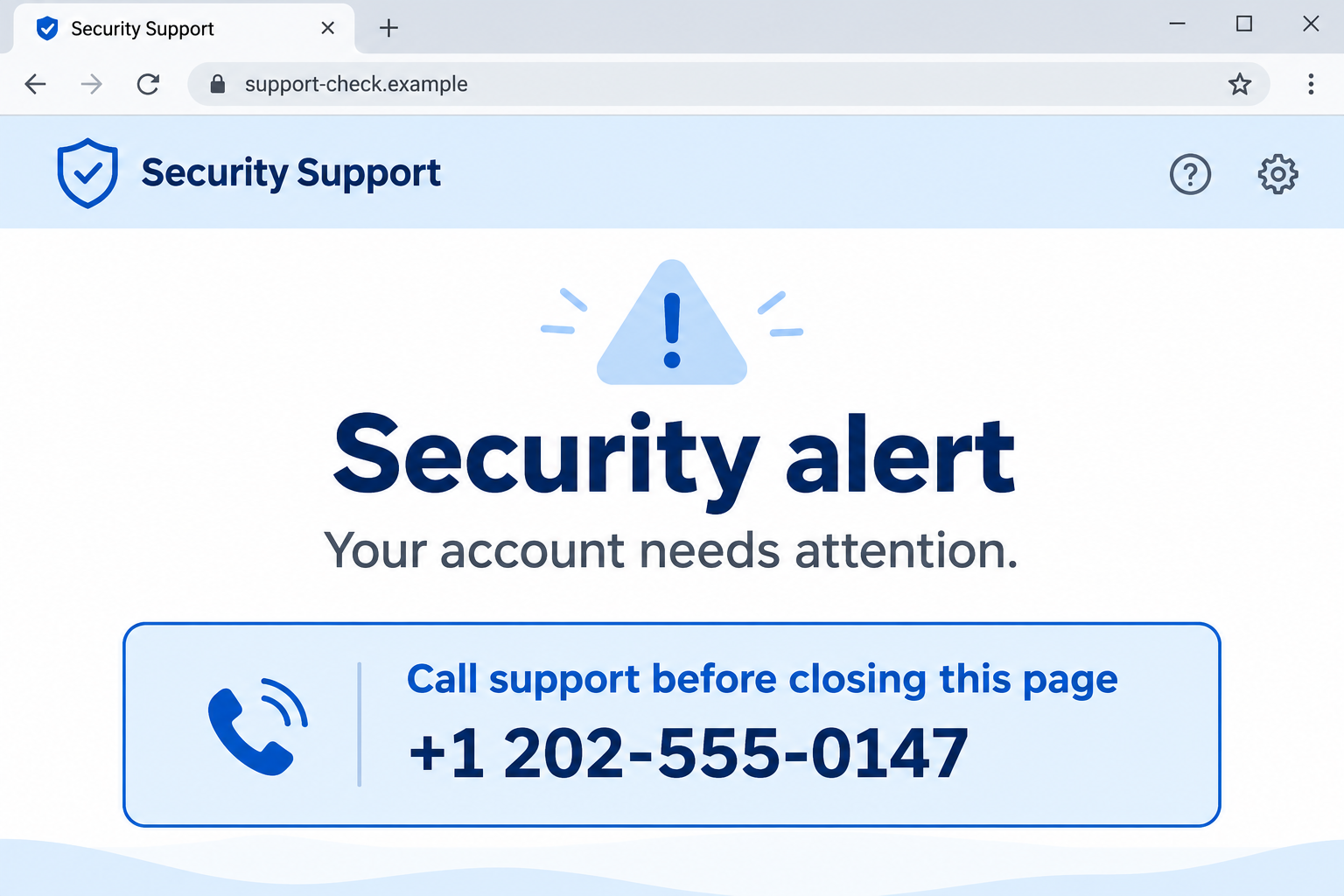
The opening contact may be an email, a browser warning, or an unsolicited call. The screen illustration above represents that opening tactic, not a captured victim’s message.
Once someone responds, different operators can play different roles. A transfer between supposed departments may keep the victim entirely within the same fraudulent story.
The person taking the call may not collect the money
Some operations use separate participants to receive transfers or physical cash. That separation helps explain why a local delivery address doesn’t authenticate an overseas caller.
A genuine shipping company, rental property, or payment service can be misused without its ordinary staff being part of the fraud.
Judge the requested action, not the apparent size of the organization. An elaborate chain of helpers can still end with a stranger taking your savings.
The safest interruption happens before money moves
End the conversation and contact the institution through a channel you already trust. Do not let the supposed investigator choose the number, website, or next person.
- A security warning is not permission to inspect your bank account remotely.
- A caller’s claimed department and case number need independent confirmation.
- Cash deliveries, gift-card codes, and cryptocurrency are not protective account procedures.
- Instructions to hide the conversation from bank staff are a reason to stop immediately.
A Documented Case Shows How the Collection Network Fits Together
This isn’t just a theoretical arrangement. In an October 26, 2026 Justice Department announcement, prosecutors described guilty pleas in a $65 million fraud network.
According to that announcement, call-center operators impersonated technical support, banks, or government officials. Victims were instructed to conceal cash in packages and send them to supplied addresses.
Members used fictitious recipient names and short-term rentals arranged around temporary collection hubs. The addresses changed as the operation moved.
The case demonstrates a specific cash-collection method. It doesn’t mean every suspicious call belongs to that network or that every rental property is connected to fraud.
The address can be real while the reason for mailing cash is invented. A recognizable carrier doesn’t make the caller an authorized recipient of your savings.
How the Scam Call Center Scheme Works
Step 1: An alarming message creates a reason to call
The opening message claims something has already gone wrong: an unauthorized purchase, an infected computer, a compromised account, or trouble involving your identity.
A phone number appears to offer an immediate solution. Instead of asking whether the warning is authentic, you start thinking about how quickly you can cancel the problem.
That’s the first change the criminals want. They don’t need you to believe the entire story yet, only enough of it to enter their conversation.
If the contact began on a website, close the page rather than using its help button. For a billing concern, open the actual account independently.
Step 2: A helpful operator gathers information and establishes control
The first operator may sound patient and reassuring. They ask what you saw, which bank you use, and whether anyone else can access the account.
Details volunteered during this conversation can make later claims sound informed. Knowing your bank’s name doesn’t mean the caller has a legitimate relationship with it.
A remote-access request can deepen the problem. Seeing your screen may expose messages, balances, browser sessions, or information that helps shape the next part of the script.
Don’t install a program or approve a connection because a stranger says it is needed to cancel a charge. Cancellation doesn’t require handing over your computer.
Step 3: A second supposed authority makes the emergency feel verified
The operator introduces another department, a bank specialist, or an official investigator. The new person repeats details and treats the first caller’s claims as established facts.
That can feel like independent confirmation. It isn’t independent if both contacts came through the same unverified conversation.
The FTC describes this escalation: a fake technician may pass someone to a supposed government helper who claims their money is in danger.
Disconnect before checking the story. Use a number from your bank card, trusted app, or the agency’s genuine website, not one provided during the handoff.
Step 4: Secrecy and a deadline shut out ordinary checks
The story may become confidential. You’re told that telling family, a bank employee, or another official could interfere with an investigation or put your money at risk.
This removes the people most likely to question the request. It can also explain away sensible warnings as evidence that someone else is involved.
An urgent timetable then makes verification feel dangerous. The caller wants action before you have room to compare their claims with an independent source.
You don’t owe an unexpected caller uninterrupted access to your attention. A real concern can be checked after you leave a conversation you didn’t initiate.
Step 5: The supposed solution moves value out of your control
The demanded action may involve a transfer, gift-card codes, cryptocurrency, cash shipment, or a collector. Different schemes use different payment paths.
In the documented cash-shipping case, victims were directed to package money for recipients chosen by the criminals. The ordinary delivery process concealed an extraordinary request.
Keep the basic question in view: why would protecting your account require giving its value to someone you cannot independently identify?
Don’t follow instructions to misdescribe the transaction to bank staff or a shipping clerk. Explain the full situation instead, including the call that prompted it.
Step 6: More problems keep the conversation and payments going
After a first payment, the caller can claim that another account needs protection, a transfer failed, or one final step remains.
Having already committed money may make stopping feel harder. But a previous payment doesn’t make the next instruction safer or create an obligation to keep cooperating.
The operation may also retain useful information for another approach. A later caller could pose as a recovery specialist, investigator, or representative of the service previously impersonated.
Start any recovery effort yourself through verified institutions. Don’t treat a stranger’s knowledge of the earlier loss as proof they are authorized to help.
Why Several Small Details Can Feel Like Proof
A case number is easy to invent
A reference number gives a conversation structure. It can help the operator sound organized while telling you nothing about whether a real institution created the case.
Write the number down if useful, but verify through the institution’s own channel. Don’t let a professional-sounding reference replace that check.
A familiar caller ID does not identify the person speaking
The name or number displayed on an incoming call should not be your authentication method. The same caution applies when someone claims to transfer you securely.
Look up contact details separately. If a bank concern is genuine, its actual support team can explain the account without relying on a stranger’s introduction.
An official-looking screen is still just screen content
A logo, progress bar, account balance, or warning message can influence how urgent a problem feels. None authorizes the person presenting it to receive money.
Check financial movements inside your genuine banking app from a device the caller isn’t controlling. A document or shared-screen display isn’t your bank’s independent record.
A local recipient does not validate the wider story
Domestic addresses can make a scheme feel less remote. Yet a local collection point may have no legitimate connection with the institution the caller claims to represent.
Don’t investigate that address yourself or confront someone collecting a package. Give the details to the relevant carrier and law enforcement through verified channels.
How to Help Someone Who Is Still on the Call
Begin with the immediate action, not an argument about whether they were fooled. Ask them to pause any transfer, package shipment, or pickup while you check independently.
A calm question often helps: did this bank or agency ask you to hide the conversation, install software, or move savings somewhere new?
Offer to contact their bank together using the number on their card. Don’t call back the supposed investigator to debate the story.
If they’re already at a bank or shipping counter, encourage them to explain the caller’s complete instructions to staff rather than repeat a prepared cover story.
If a remote session is active, disconnect the affected device from the internet. Use another trusted device for banking and official calls.
If a collector is expected, don’t arrange a confrontation or impersonate police. Share the immediate circumstances with local authorities and follow their instructions.
Avoid blame. Someone who feels embarrassed may hide further contact, leaving the caller with more influence and the family with less information.
What to Do if You Have Fallen Victim to This Scam
-
Break contact and stop pending instructions. Hang up, stop replying, and don’t approve another transfer or verification request. Block the contacts after preserving useful evidence.
You can act without persuading the caller that the scam has failed. Warning them may simply give them time to change the story.
-
Call your bank’s fraud team immediately. Describe what happened, which accounts were visible, and every payment you made or were instructed to make.
Ask about halting pending transactions, securing affected accounts, and recovery options. Explain that the instructions came from an impersonator, even if you personally authorized a payment.
-
If cash was shipped, contact the carrier urgently. Supply the tracking number, shipment time, destination, recipient name, and the fact that fraud prompted the shipment.
Ask whether delivery can still be stopped. Recovery is uncertain, but a package still in transit creates a more urgent opportunity than a retrospective complaint.
-
Report other payment methods to their providers. For gift cards, retain the card and receipt; for cryptocurrency, preserve transaction identifiers and the destination address.
Don’t pay another fee to release a supposed refund. A displayed recovery balance can be part of a second deception.
-
Contain any remote access. Disconnect the affected computer and keep banking off it. On a work device, notify your IT or security team before changing settings.
For a personal device, get trusted technical help to remove unauthorized access, examine persistence, and assess whether a rebuild is warranted. Ending one session isn’t a complete assessment.
-
Secure exposed accounts from a trusted device. Prioritize email and financial services. Replace compromised passwords, review recovery contacts, and revoke unfamiliar sessions where the service allows it.
Tell your bank if codes, identity documents, or security answers were disclosed. Password changes alone don’t undo payments or necessarily invalidate every previously established session.
-
Build a concise incident record. Save emails, phone numbers, screenshots, dates, payment receipts, remote-access program names, and shipping records without reopening suspicious links.
Keep originals privately. Share sensitive account details only through the institution’s secure process, not public comments or unsolicited recovery messages.
-
File appropriate fraud reports. In the US, report the incident to the FBI’s IC3 and the FTC. Use local equivalents elsewhere.
Include the payment trail and any collection arrangements. Contact local law enforcement promptly if a physical pickup, threat, or other immediate safety issue is involved.
-
Tell someone you trust. Ask them to help screen further calls and review urgent financial instructions while the situation is being resolved.
Keep records of follow-up attempts. An apparent investigator who demands payment, remote access, or secrecy should not inherit your trust from the original incident.
Frequently Asked Questions
Can a scam call center transfer me to a fake bank employee?
Yes. A handoff can stay within the fraud operation. Hang up and contact the bank yourself rather than relying on the transferred person’s claimed role.
Does an overseas accent prove a support call is fraudulent?
No. Legitimate services employ people worldwide. Evaluate the contact route and requested action, especially secrecy, remote access, and demands to move money.
Can police ask me to mail cash for protection?
A caller directing you to surrender savings for safekeeping is describing a scam, not an account-protection procedure. Verify any claimed investigation independently.
Does the shipping address reveal who runs the scheme?
Not necessarily. Collection points and recipient names may conceal the organizers. Preserve the address for investigators; don’t confront occupants or publish private identifying details.
What if the caller already knows my balance?
That knowledge doesn’t authenticate them. Information may have been disclosed during the conversation or remote session. Contact your bank independently and explain what was exposed.
Can I get money back after cooperating?
Sometimes an institution can interrupt or recover a payment, but no outcome is guaranteed. Prompt reporting is more useful than continuing the caller’s supposed recovery process.
The Bottom Line
Leave the call before acting on the emergency. Scam call centers can supply several convincing voices without supplying a single independent source of confirmation.
Verify through your bank or the real agency, and never hand over savings because an unexpected caller calls it protection.
If money or access has already changed hands, involve your financial institution immediately and preserve the collection trail for investigators.

Join the discussion
0 commentsShare your experience or ask a question about this article.
Discussion
Start the conversation
Have a question or something useful to share? Add the first comment.