

ADWARE/Adware.Gen2 is a specific detection used by Avira Antivirus and other antivirus products to indicate and detect an adware program.
ADWARE/Adware.Gen2 is a program that contains adware, installs toolbars or will display pop-up advertisements on the computer.
ADWARE/Adware.Gen2 it’s technically not a virus, but it does exhibit plenty of malicious traits, such as rootkit capabilities to hook deep into the operating system, browser hijacking, and in general just interfering with the user experience. The industry generally refers to it as a “PUP,” or potentially unwanted program.
The ADWARE/Adware.Gen2 infection is designed specifically to make money. It generates web traffic, collects sales leads for other dubious sites, and will display advertisements and sponsored links within your web browser.
ADWARE/Adware.Gen2 got on your computer after you have installed a freeware software (video recording/streaming, download-managers or PDF creators) that had bundled into their installation this browser hijacker. This Potentially Unwanted Propgram is also bundled within the custom installer on many download sites (examples: CNET, Brothersoft or Softonic), so if you have downloaded a software from these websites, chances are that ADWARE/Adware.Gen2 infection was installed during the software setup process.
ADWARE/Adware.Gen2 is an ad-supported (users may see additional banner, search, pop-up, pop-under, interstitial and in-text link advertisements) cross web browser plugin for Internet Explorer (BHO) and Firefox/Chrome (plugin) and distributed through various monetization platforms during installation. The browser extension includes various features that will modify the default or custom settings of the browser including the home page, search settings and in some cases will modify Internet Explorer’s load time threshold, place a lock file within Firefox to prevent competing software from changing its settings as well as disable the browser’s Content Security Policy in order to allow for cross site scripting of the plugin.
Besides showing harmless ads, ADWARE/Adware.Gen2 may also collect user specific information with or without the user’s consent. This infection sends the collected user information to a central server for the purpose of delivering targeted advertising.
You should always pay attention when installing software because often, a software installer includes optional installs, such as this ADWARE/Adware.Gen2 browser hijacker. Be very careful what you agree to install.
Always opt for the custom installation and deselect anything that is not familiar, especially optional software that you never wanted to download and install in the first place. It goes without saying that you should not install software that you don’t trust.
How to remove ADWARE/Adware.Gen2 (Virus Removal Guide)
This page is a comprehensive guide, which will remove ADWARE/Adware.Gen2 from Internet Explorer, Firefox and Google Chrome.
Please perform all the steps in the correct order. If you have any questions or doubt at any point, STOP and ask for our assistance.
STEP 1: Remove ADWARE/Adware.Gen2 adware with AdwCleaner
STEP 2: Remove ADWARE/Adware.Gen2 browser hijacker with Junkware Removal Tool
STEP 3: Remove ADWARE/Adware.Gen2 virus with Malwarebytes Anti-Malware Free
STEP 4: Double-check for the ADWARE/Adware.Gen2 infection with HitmanPro
STEP 1: Remove ADWARE/Adware.Gen2 adware with AdwCleaner
The AdwCleaner utility will scan your computer for ADWARE/Adware.Gen2 malicious files and registry keys, that may have been installed on your computer without your knowledge.
- You can download AdwCleaner utility from the below link.
ADWCLEANER DOWNLOAD LINK (This link will automatically download AdwCleaner on your computer) - Before starting AdwCleaner, close all open programs and internet browsers, then double-click on the AdwCleaner icon.
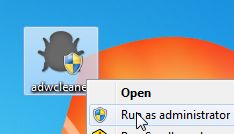
If Windows prompts you as to whether or not you wish to run AdwCleaner, please allow it to run. - When the AdwCleaner program will open, click on the Scan button as shown below.
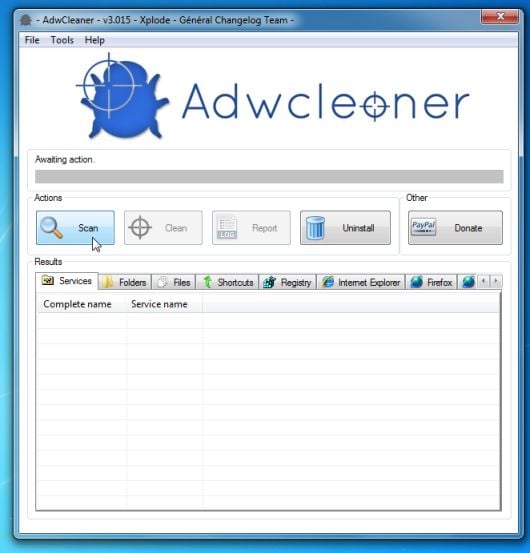
AdwCleaner will now start to search for the ADWARE/Adware.Gen2 malicious files that may be installed on your computer. - To remove the ADWARE/Adware.Gen2 malicious files that were detected in the previous step, please click on the Clean button.
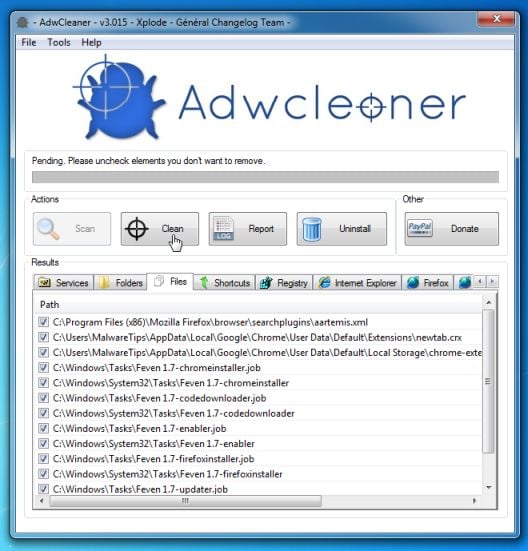
- AdwCleaner will now prompt you to save any open files or data as the program will need to reboot the computer. Please do so and then click on the OK button. AdwCleaner will now delete all detected adware from your computer. When it is done it will display an alert that explains what PUPs (Potentially Unwanted Programs) and Adware are. Please read through this information and then press the OK button. You will now be presented with an alert that states AdwCleaner needs to reboot your computer.
Please click on the OK button to allow AdwCleaner reboot your computer.
STEP 2: Remove ADWARE/Adware.Gen2 browser hijack with Junkware Removal Tool
Junkware Removal Tool is a powerful utility, which will remove ADWARE/Adware.Gen2 virus from Internet Explorer, Firefox or Google Chrome.
- You can download the Junkware Removal Tool utility from the below link:
JUNKWARE REMOVAL TOOL DOWNLOAD LINK (This link will automatically download the Junkware Removal Tool utility on your computer) - Once Junkware Removal Tool has finished downloading, please double-click on the JRT.exe icon as seen below.
![[Image: Junkware Removal Tool]](//malwaretips.com/blogs/wp-content/uploads/2013/06/Junkware-icon.jpg "Double-click on the Junkware Removal Tool utility")
If Windows prompts you as to whether or not you wish to run Junkware Removal Tool, please allow it to run. - Junkware Removal Tool will now start, and at the Command Prompt, you’ll need to press any key to perform a scan for the ADWARE/Adware.Gen2.
![[Image: Junkware Removal Tool scanning for ADWARE/Adware.Gen2 virus]](//malwaretips.com/blogs/wp-content/uploads/2013/06/junkware-removal-tool.jpg "Junkware Removal Tool scanning for ADWARE/Adware.Gen2")
Please be patient as this can take a while to complete (up to 10 minutes) depending on your system’s specifications. - When the scan Junkware Removal Tool will be completed, this utility will display a log with the malicious files and registry keys that were removed from your computer.
![[Image: Junkware Removal Tool final log]](//malwaretips.com/blogs/wp-content/uploads/2013/06/Junkware-log.jpg "Junkware Removal Tool final log")
![[Image: Junkware Removal Tool]](http://malwaretips.com/blogs/wp-content/uploads/2013/06/Junkware-icon.jpg "Double-click on the Junkware Removal Tool utility")
![[Image: Junkware Removal Tool scanning for ADWARE/Adware.Gen2 virus]](http://malwaretips.com/blogs/wp-content/uploads/2013/06/junkware-removal-tool.jpg "Junkware Removal Tool scanning for ADWARE/Adware.Gen2")
![[Image: Junkware Removal Tool final log]](http://malwaretips.com/blogs/wp-content/uploads/2013/06/Junkware-log.jpg "Junkware Removal Tool final log")
STEP 3: Remove ADWARE/Adware.Gen2 virus with Malwarebytes Anti-Malware Free
Malwarebytes powerful technology to detect and remove all traces of malware including worms, trojans, rootkits, rogues, dialers, spyware and more.
- You can download Malwarebytes Anti-Malware Free from the below link, then double-click on the icon named mbam-setup.exe to install this program.
MALWAREBYTES ANTI-MALWARE DOWNLOAD LINK(This link will open a download page in a new window from where you can download Malwarebytes Anti-Malware Free) - When the installation begins, keep following the prompts in order to continue with the setup process, then at the last screen click on the Finish button.
![[Image: Malwarebytes Anti-Malware final installation screen]](//malwaretips.com/blogs/wp-content/uploads/2013/01/malwarebytes-installation.jpg "Malwarebytes Anti-Malware installation screen")
- On the Scanner tab, select Perform quick scan, and then click on the Scan button to start searching for the ADWARE/Adware.Gen2 malicious files.
![[Image: Malwarebytes Anti-Malware Quick Scan]](//malwaretips.com/blogs/wp-content/uploads/2013/01/malwarebytes-quick-scan.jpg "Run a Quick Scan with Malwarebytes Anti-Malware")
- Malwarebytes’ Anti-Malware will now start scanning your computer for ADWARE/Adware.Gen2 as shown below.
![[Image: Malwarebytes Anti-Malware scanning for ADWARE/Adware.Gen2 virus]](//malwaretips.com/blogs/wp-content/uploads/2013/01/malwarebytes-scan.jpg "Malwarebytes Anti-Malware scanning for ADWARE/Adware.Gen2")
- When the Malwarebytes Anti-Malware scan has finished, click on the Show Results button.
![[Image: Malwarebytes Anti-Malware scan results]](//malwaretips.com/blogs/wp-content/uploads/2013/01/malwarebytes-scan-results.jpg "Malwarebytes when the system scan has completed")
- You will now be presented with a screen showing you the computer infections that Malwarebytes Anti-Malware has detected. Make sure that everything is Checked (ticked), then click on the Remove Selected button.
![[Image: Malwarebytes Anti-Malware removing ADWARE/Adware.Gen2]](//malwaretips.com/blogs/wp-content/uploads/2013/01/malwarebytes-virus-removal.jpg "Malwarebytes Anti-Malwar removing ADWARE/Adware.Gen2")
![[Image: Malwarebytes Anti-Malware final installation screen]](http://malwaretips.com/blogs/wp-content/uploads/2013/01/malwarebytes-installation.jpg "Malwarebytes Anti-Malware installation screen")
![[Image: Malwarebytes Anti-Malware Quick Scan]](http://malwaretips.com/blogs/wp-content/uploads/2013/01/malwarebytes-quick-scan.jpg "Run a Quick Scan with Malwarebytes Anti-Malware")
![[Image: Malwarebytes Anti-Malware scanning for ADWARE/Adware.Gen2 virus]](http://malwaretips.com/blogs/wp-content/uploads/2013/01/malwarebytes-scan.jpg "Malwarebytes Anti-Malware scanning for ADWARE/Adware.Gen2")
![[Image: Malwarebytes Anti-Malware scan results]](http://malwaretips.com/blogs/wp-content/uploads/2013/01/malwarebytes-scan-results.jpg "Malwarebytes when the system scan has completed")
![[Image: Malwarebytes Anti-Malware removing ADWARE/Adware.Gen2]](http://malwaretips.com/blogs/wp-content/uploads/2013/01/malwarebytes-virus-removal.jpg "Malwarebytes Anti-Malwar removing ADWARE/Adware.Gen2")
STEP 4: Double-check for the ADWARE/Adware.Gen2 infection with HitmanPro
HitmanPro is a second opinion scanner, designed to rescue your computer from malware (viruses, trojans, rootkits, etc.) that have infected your computer despite all the security measures you have taken (such as anti virus software, firewalls, etc.).
- You can download HitmanPro from the below link:
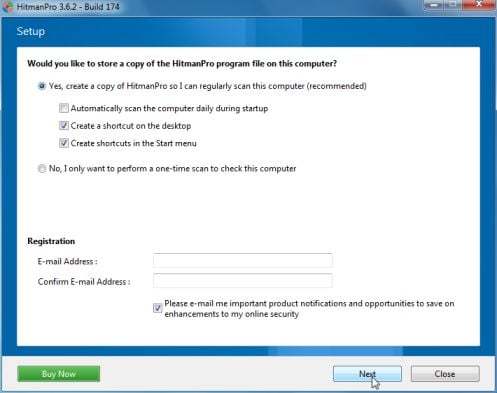
HITMANPRO DOWNLOAD LINK (This link will open a web page from where you can download HitmanPro) - Double-click on the file named HitmanPro.exe (for 32-bit versions of Windows) or HitmanPro_x64.exe (for 64-bit versions of Windows). When the program starts you will be presented with the start screen as shown below.
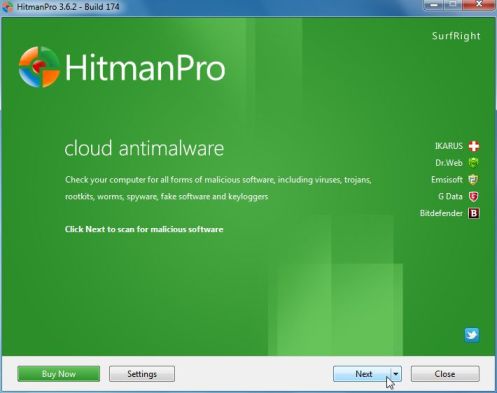
Click on the Next button, to install HitmanPro on your computer.
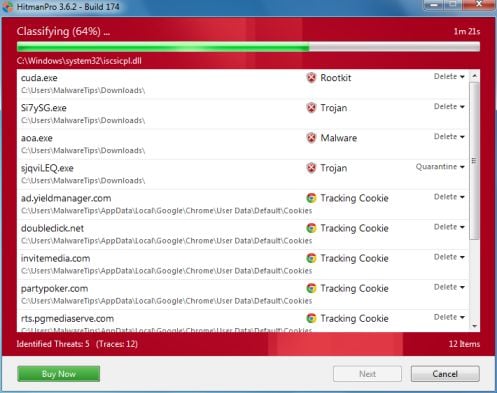
- HitmanPro will now begin to scan your computer for ADWARE/Adware.Gen2 malicious files.
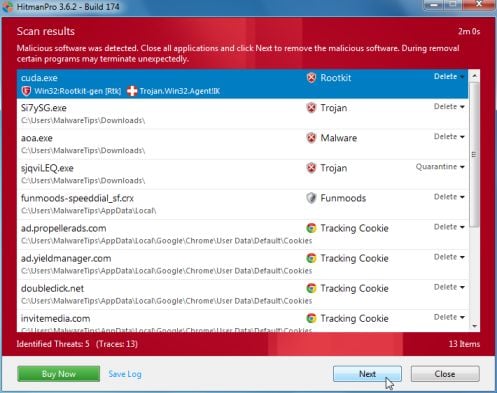
- When it has finished it will display a list of all the malware that the program found as shown in the image below. Click on the Next button, to remove ADWARE/Adware.Gen2 adware.
- Click on the Activate free license button to begin the free 30 days trial, and remove all the malicious files from your computer.
![[Image: HitmanPro 30 days activation button]](//malwaretips.com/blogs/wp-content/uploads/2012/11/hitmanpro-activation.jpg "HitmanPro free 30 days trial")
![[Image: HitmanPro 30 days activation button]](http://malwaretips.com/blogs/wp-content/uploads/2012/11/hitmanpro-activation.jpg "HitmanPro free 30 days trial")
Your computer should now be free of the ADWARE/Adware.Gen2 infection. If your current anti-virus solution let this infection through, you may want to consider purchasing the PRO version of Malwarebytes Anti-Malware to protect against these types of threats in the future, and perform regular computer scans with HitmanPro.
If you are still experiencing problems while trying to remove ADWARE/Adware.Gen2 from your machine, please start a new thread in our Malware Removal Assistance forum.








