

Facebook is filled with scam ads promising free rewards like $100 Amazon gift cards. Unfortunately, these too-good-to-be-true offers are actually ploys to steal your personal information or sign you up for unwanted services. This article will provide an in-depth exposé on how the $100 Amazon gift card Facebook scam works, how to identify it, and most importantly, how to protect yourself.
Overview of the $100 Amazon Gift Card Facebook Scam
The $100 Amazon gift card scam on Facebook relies on classic social engineering tactics to lure unsuspecting victims. Here’s a quick rundown of how it works:
- Scammers create fake ads or sponsored posts that pop up in your Facebook feed, promising a free $100 Amazon gift card. Often the ads claim you can get the gift card by clicking a link and taking a “short survey”.
- If you click on the link, you are taken to a fake website that looks like an Amazon survey page. You are prompted to log in with your Amazon credentials to claim your “reward”.
- Once you enter your login info, the scammers capture your credentials. They now have access to your Amazon account, including your personal details, saved payment methods, and order history.
- In other variations of the scam, instead of collecting your Amazon info, the scammers sign you up for unwanted paid subscriptions, services, or even download malware to your device.
- You never receive the promised $100 Amazon gift card because the offers are completely fake. Meanwhile, the scammers make off with your personal information or make money from fraudulent sign-ups.
This scam takes advantage of people’s desires to get something for nothing. The lure of free rewards like gift cards is used to override common sense. Unfortunately, these scams can result in identity theft, fraudulent charges, and the compromise of personal data.
How the $100 Amazon Gift Card Facebook Scam Works
The $100 Amazon gift card Facebook scam is orchestrated in a series of steps that play on human psychology. Here is a detailed breakdown of exactly how the scam unfolds:
Step 1 – You See the Ad on Facebook
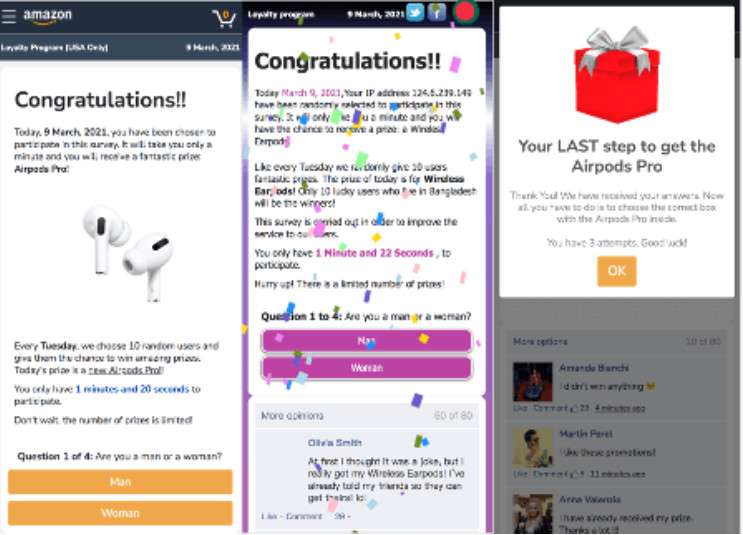
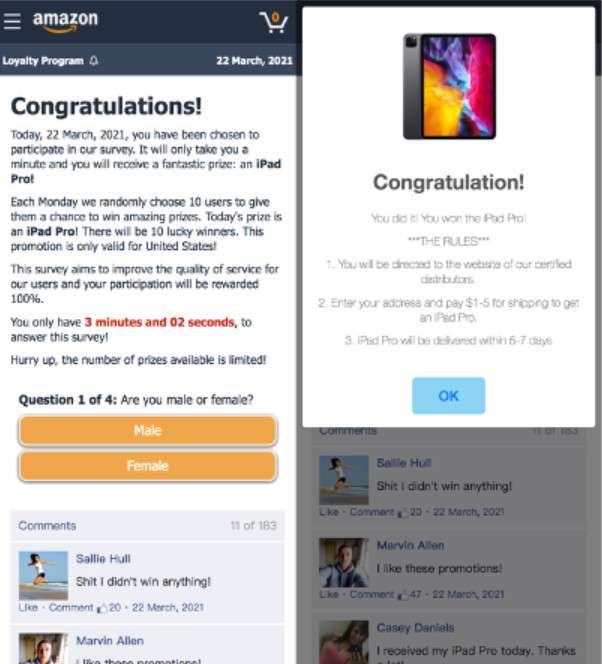
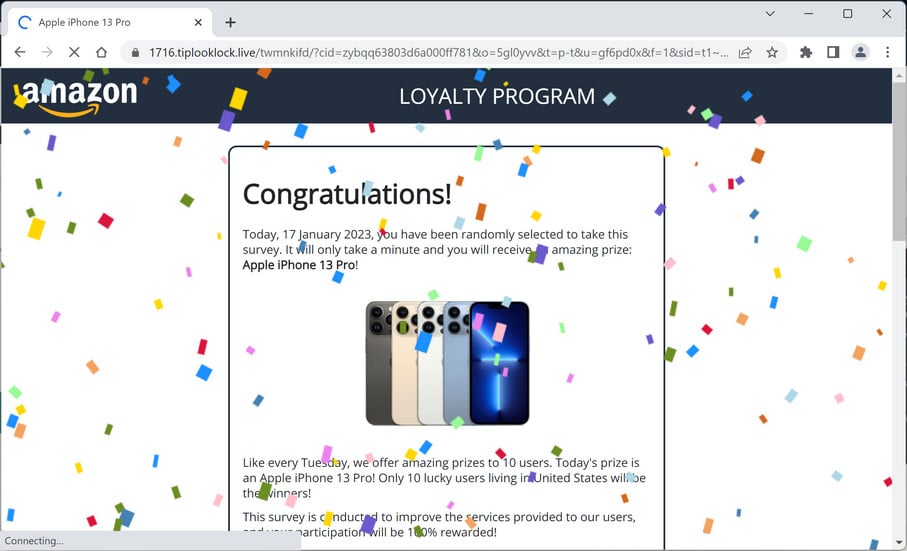
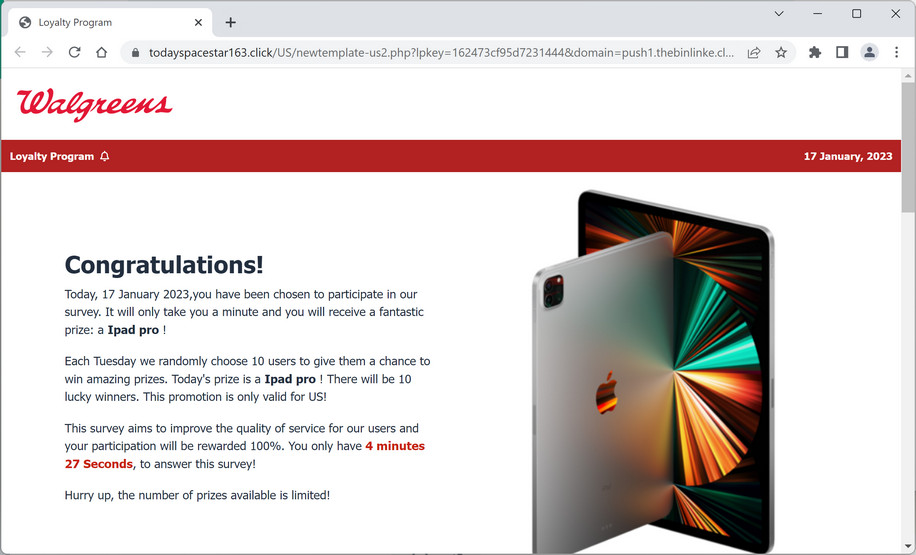
The scam starts with a sponsored ad or post in your Facebook feed advertising a free $100 Amazon gift card. The ad is made to look official and will often use Amazon logos and gift card imagery. The text entices you to take a short survey to claim your free gift card.
Sometimes the ad will say the gift card is in celebration of an Amazon anniversary or as a thank you for being a loyal customer. Other versions claim you were randomly selected to win the gift card.
The key tactic is making an unbelievable offer (get $100 for free) that piques interest without raising alarm bells.
Step 2 – You Click on the Link in the Ad
Once your interest is sparked by the promise of a $100 Amazon gift card, the next step is getting you to click on the link. The scam relies on your desire for something free overriding your caution about links from ads.
The link will typically lead to a website designed to look like an Amazon customer survey page. Sometimes you are first sent to another intermediary page before reaching the fake survey page. The scammers try to mimic Amazon’s branding to look official.
Step 3 – You Attempt to Claim Your “Reward”
When you reach the website, you are greeted with text reinforcing that you have been selected to receive a $100 Amazon gift card. All you need to do is take a short survey.
You are instructed to log in with your Amazon account to verify your identity and claim your reward. This is where the real scam occurs.
Step 4 – You Enter Your Amazon Login Credentials
Once you enter your email/username and password on the fake website, you have fallen into the scammer’s trap.
Your Amazon login details are captured and sold or used by the scammers to access your account. They now have the keys to order items on your account, access your personal information, or even change your login credentials.
In other cases, by entering your information, you may be automatically signed up for unwanted subscriptions the scammers make money from.
Step 5 – Your Amazon Account is Compromised
After entering your information, you soon realize you were tricked. The promised $100 Amazon gift card never arrives.
Instead, you may discover unknown charges on your saved payment methods from the scammer’s purchases. Your personal information may be compromised. Or you may find that you were signed up for various paid services without your consent.
The scammers quickly monetize your stolen account details or make money from services you were unwittingly subscribed to. Meanwhile, you are left to deal with the aftermath.
Warning Signs of the $100 Amazon Gift Card Facebook Scam
While the $100 Amazon gift card scam can be convincing, there are usually some red flags that can tip you off:
- Too good to be true offer – Free $100 gift cards are always going to be a scam. Amazon does not give these away randomly or for filling out basic surveys.
- Sponsored ad format – Amazon does not advertise real promotions as sponsored ads or posts. Tread carefully with gift card offers in paid ads.
- Request for personal info – Amazon never asks for your password or full account info to deliver a promotion. This is always a scam tactic.
- Website URL looks suspicious – Check the URL you are directed to carefully. Scam sites often have a misspelled or slightly different URL.
- Spelling and grammatical errors – Scam websites often contain typos, bad grammar, and other clues that something is amiss.
- Page design looks unprofessional – Check that font, colors, branding, and page layout look crisp and professional. Scam sites are usually sloppy.
- No secure checkout process – Legitimate Amazon login pages use HTTPS and have their certificate on display. Lack of this indicates a scam.
Stay vigilant for these red flags whenever you see gift card offers on Facebook or other platforms. If it looks at all suspicious, it is best to avoid clicking entirely.
What to Do If You Fell for the $100 Amazon Gift Card Scam
If you entered your Amazon account info into a scam website, here are the steps you should take to secure your account and personal information:
1. Change your Amazon password immediately
If scammers have your current login credentials, the first thing to do is change your password. Enable two-factor authentication as well for extra security. This will lock out the scammers.
2. Check your account activity for unauthorized changes
Sign into your Amazon account and thoroughly check recent orders, payment methods, account info, and subscriptions. Look for any unauthorized changes made by scammers.
3. Remove any unauthorized payment methods
Scroll through your saved credit cards, bank accounts, and gift cards. Remove any you don’t recognize or that were added without your permission after falling for the scam.
4. Cancel unwanted subscriptions or memberships
Check if the scammers signed you up for any subscriptions, Premium memberships, or other services without authorization. Immediately cancel any you did not agree to.
5. Contact your bank if you see suspicious charges
If the scammers used your Amazon account to make unauthorized purchases with your payment methods, report the charges to your bank or credit card company. Dispute the transactions as fraudulent.
6. Contact Amazon customer service for help securing your account
Alert Amazon of the scam and that your account was compromised. They can help lock it down and add extra protections. Provide any details about unauthorized access or changes.
7. Run anti-virus software to check for malware
Some gift card scams try to download malware onto your device when you click the link or submit your info. Run a full system scan using updated antivirus software to check for malicious programs.
8. Report the scam ad or website to Facebook
Help protect others by reporting the Facebook ad, page, or scam website to Facebook. Provide details on how the scam works so they can remove it.
9. Reset passwords on other accounts if you reused them
If you reused your Amazon password elsewhere, reset the passwords on those other accounts as well to protect them. Never reuse passwords between accounts.
Follow these steps as soon as possible after realizing you fell victim to the scam. Quick action is key to contain the damage and secure your accounts.
Is Your Device Infected? Run a Free Malware Scan
Slow performance, constant pop-ups, or strange behavior? These are classic signs of a malware infection. The fastest way to find out is to scan your device with Malwarebytes Free — one of the most trusted malware removal tools available.
The free version detects and removes the most common threats, including:
- Adware — the cause of those annoying pop-ups
- Browser hijackers — unwanted redirects and changed homepages
- Trojans and spyware — hidden programs stealing your data
- Potentially unwanted programs (PUPs) — software you never asked for
👉 Select your device below — Windows, Mac, or Android — then follow the simple steps to download Malwarebytes, scan your system, and remove any threats it finds. The scan usually takes 5 to 20 minutes.
Run a Malware Scan with Malwarebytes for Windows
Malwarebytes is one of the most popular and trusted anti-malware tools for Windows — and it’s completely free for removing infections. It catches threats that many antivirus programs miss, including adware, browser hijackers, and trojans. Follow the steps below to scan and clean your PC in just a few minutes.
Download Malwarebytes
Click the button below to download the latest version of Malwarebytes for Windows from the official source. The free version is all you need — it will scan your computer and remove adware, browser hijackers, and other malicious software at no cost.
Download MalwarebytesOfficial installer for Windows 11 and 10. Your download starts right away.Want real-time protection? See Malwarebytes Premium Malwarebytes Free for WindowsScans and removes malware at no cost
-
Install Malwarebytes
When the download finishes, open your Downloads folder and double-click the MBSetup file. If Windows shows a User Account Control pop-up, click “Yes” to allow the installation.
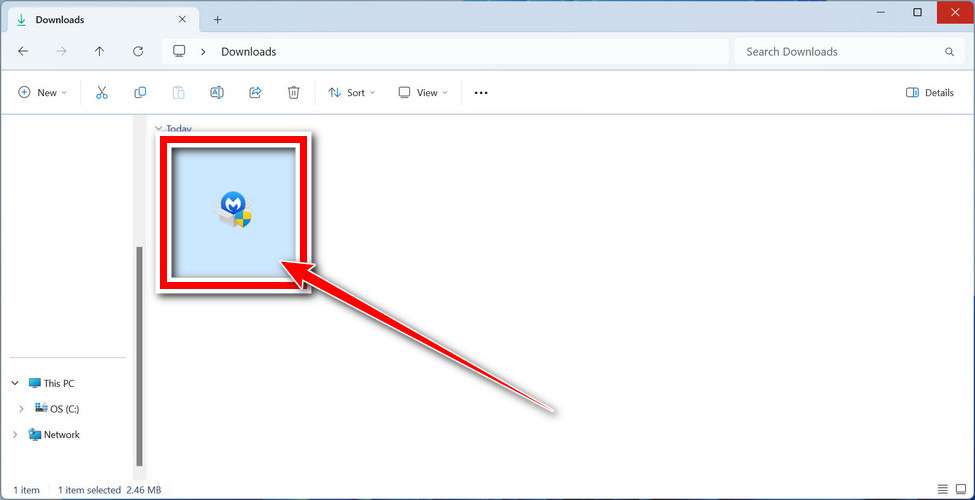
Follow the On-Screen Prompts to Install Malwarebytes
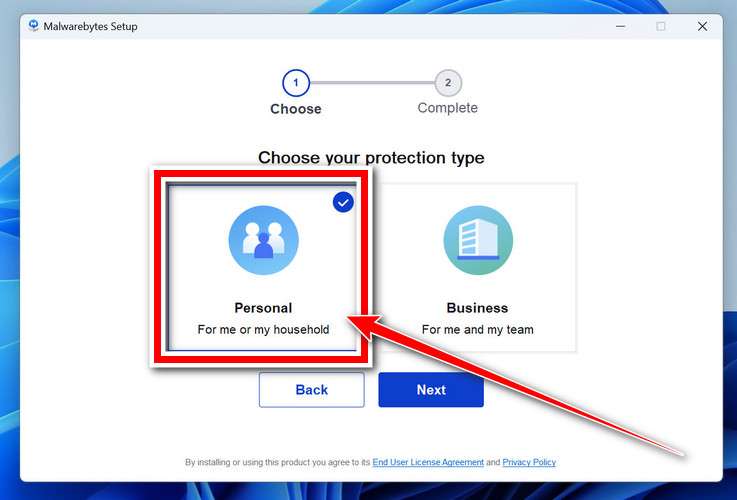
The setup wizard will walk you through a few quick screens:
-
Choose where you’re installing the program — “Personal Computer” or “Work Computer” — then click Next.
-
Malwarebytes will now install on your device. This usually takes under a minute.

-
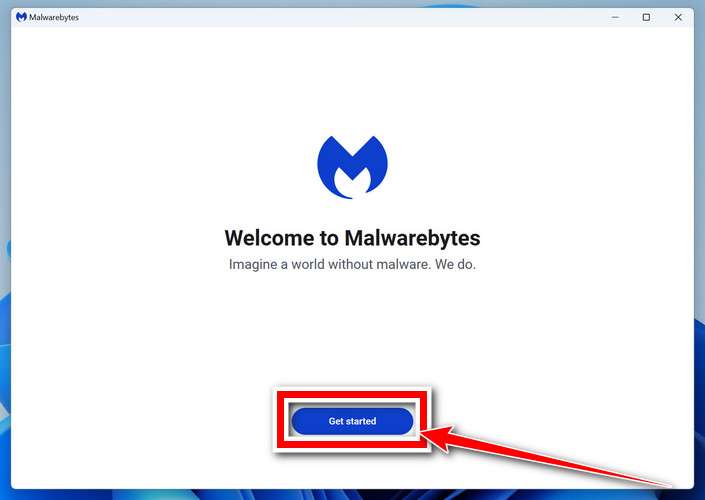
When installation is complete, the “Welcome to Malwarebytes” screen will open automatically.
-
On the final screen, click Open Malwarebytes to launch the program.

-
Enable “Scan for Rootkits”
Before scanning, turn on rootkit detection so Malwarebytes can find even the most hidden threats. Click the Settings gear icon on the left side of the screen.
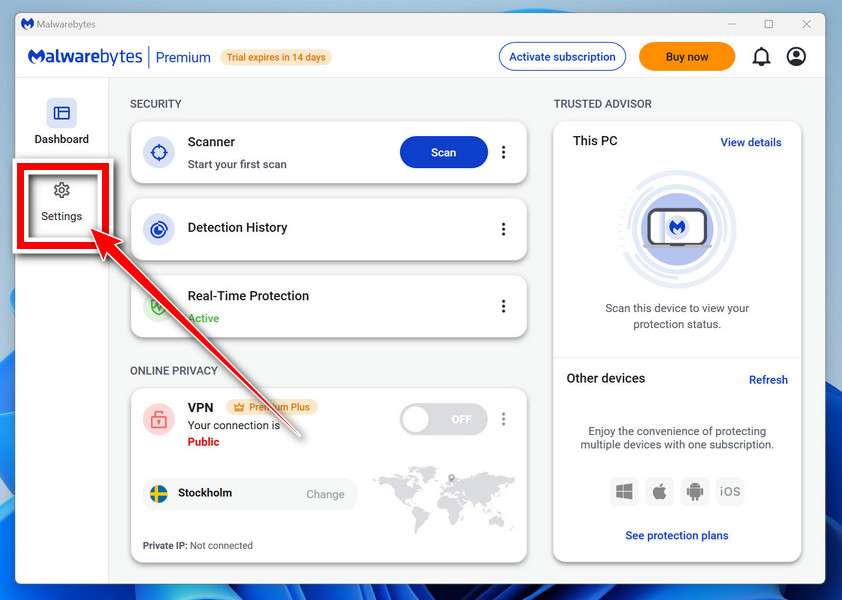
In the settings menu, find “Scan for rootkits” and click the toggle so it turns blue.

Done? Click “Dashboard” in the left pane to return to the main screen.
Start the Scan
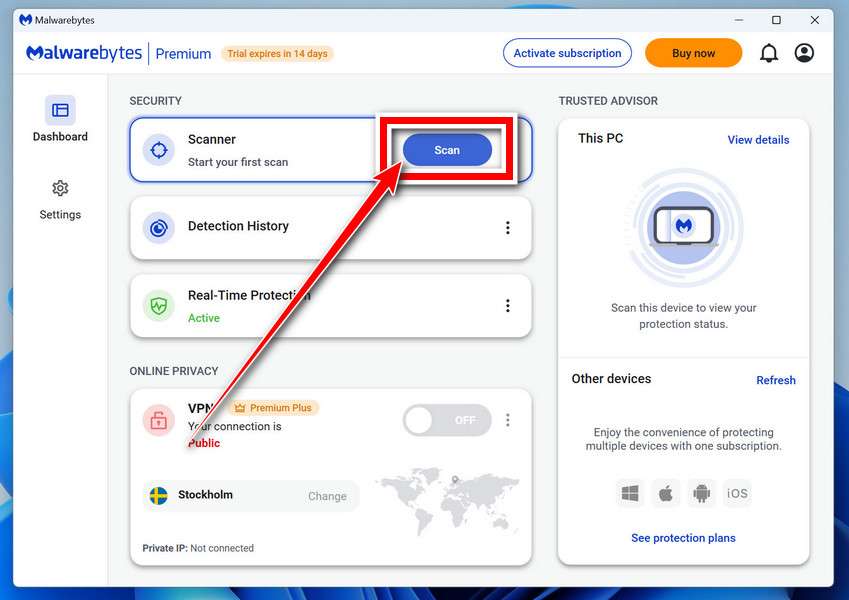
Click the blue Scan button. Malwarebytes will automatically update its virus database and start checking your computer for malware.
-
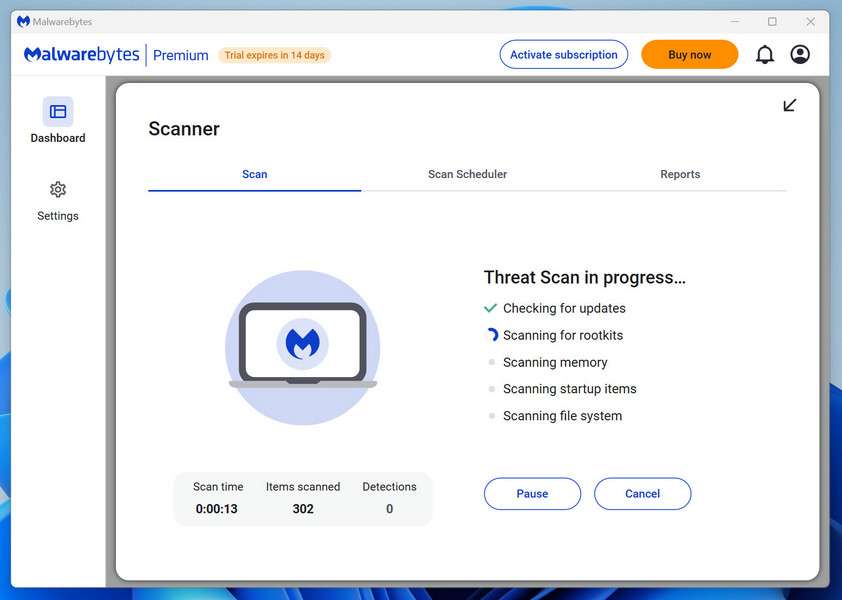
Wait for the Scan to Finish
The scan checks your entire system for browser hijackers and other malicious programs, so it can take 5 to 20 minutes depending on your computer. Feel free to do something else — just check back occasionally to see the progress.
-
Quarantine the Detected Threats
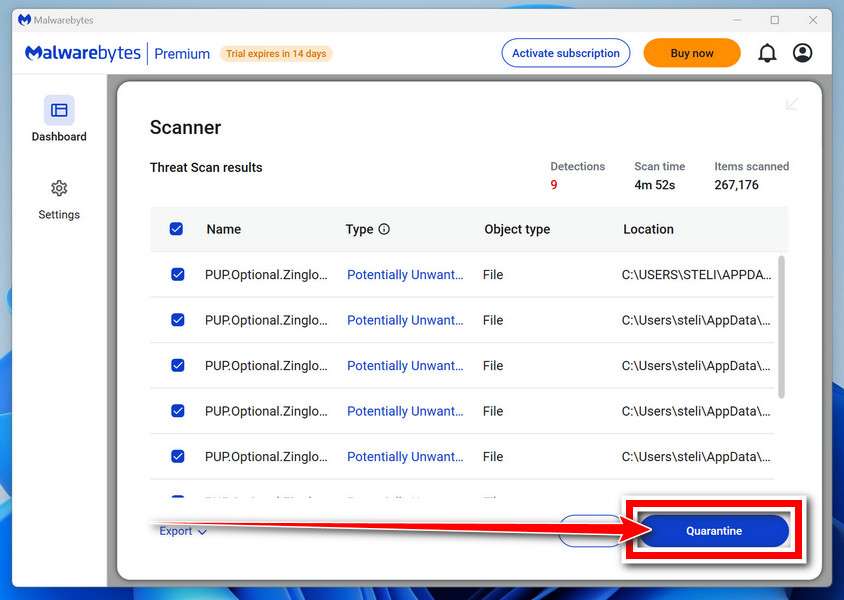
When the scan is done, you’ll see a list of everything Malwarebytes found — malware, adware, and potentially unwanted programs. Click the “Quarantine” button to remove all of them at once.
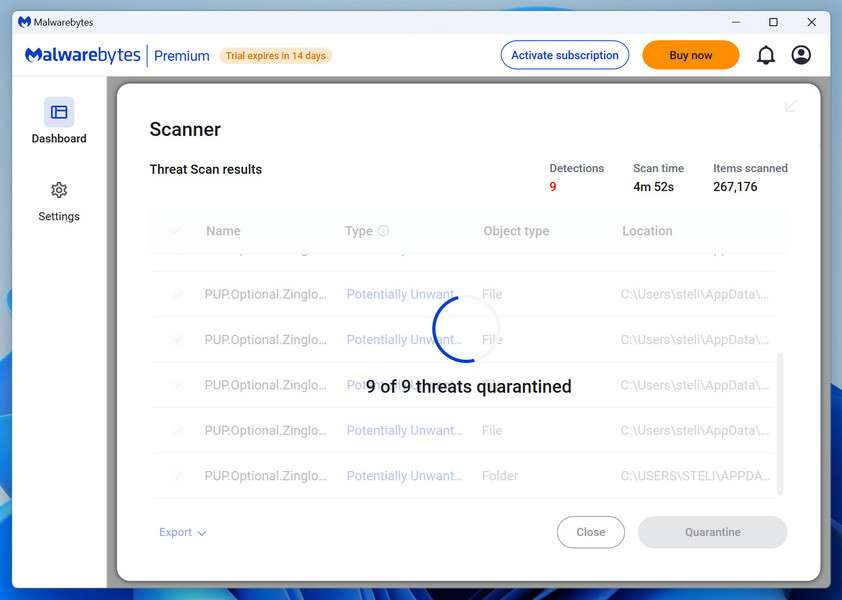
Malwarebytes will now remove the malicious files and registry entries and move them safely into quarantine.
-
Restart Your Computer
Some threats can only be fully removed after a reboot. If Malwarebytes asks you to restart, click Yes. Once you’re logged back in, Malwarebytes has finished removing the threats it found.
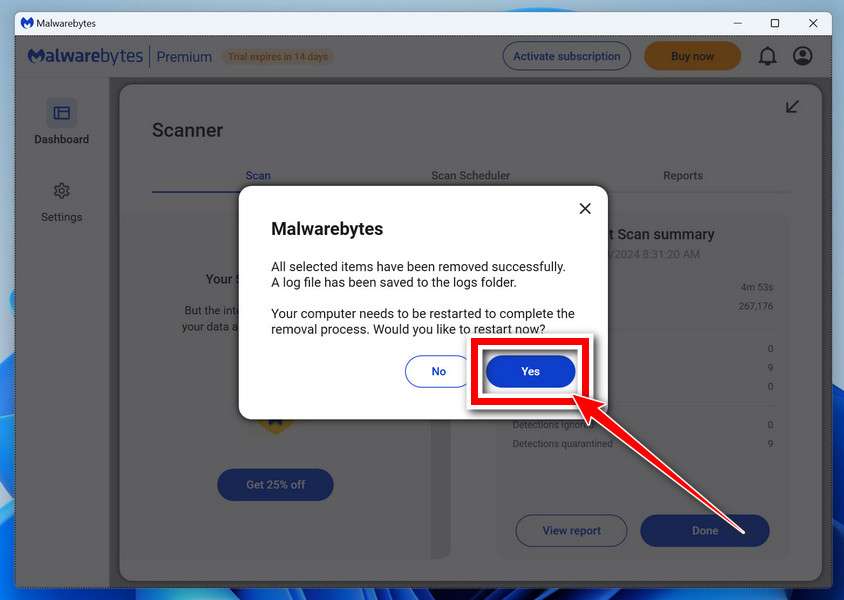
That’s it — your Windows PC is now clean of trojans, adware, and other malware, and should be back to running smoothly.
If you are still having problems with your computer after completing these instructions, then please follow one of the steps:
- Run a computer scan with ESET Online Scanner
- Ask for help in our Windows Malware Removal Help & Support forum.
Run a Malware Scan with Malwarebytes for Mac
Malwarebytes for Mac is a free on-demand scanner that removes the malware other security software tends to miss — adware, browser hijackers, and unwanted programs included. Cleaning an infected Mac with Malwarebytes has always been completely free, and it’s our go-to recommendation. Follow the steps below to scan and clean your Mac in just a few minutes.
-
Download Malwarebytes for Mac
Click the button below to download the latest version of Malwarebytes for Mac.
Download MalwarebytesOfficial installer for macOS. Your download starts right away.Want real-time protection? See Malwarebytes PremiumMalwarebytes Free for MacScans and removes malware at no cost -
Open the Malwarebytes setup file
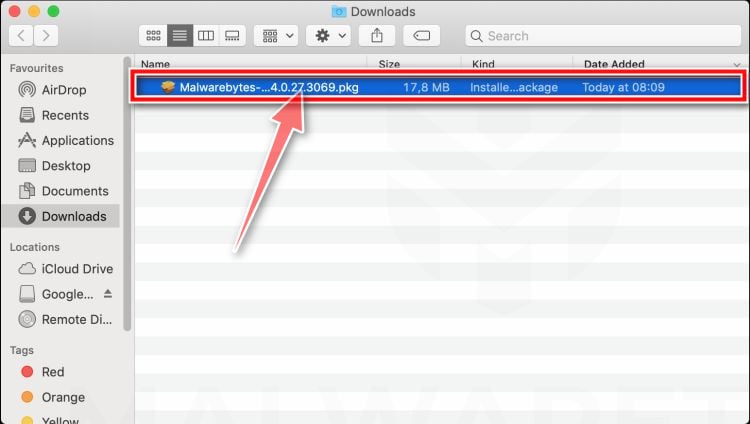
When the download finishes, open your Downloads folder and double-click the setup file to begin the installation.
-
Follow the On-Screen Prompts to Install Malwarebytes
The Malwarebytes for Mac Installer will guide you through a few quick screens. Click “Continue” and keep following the prompts until the installation completes.
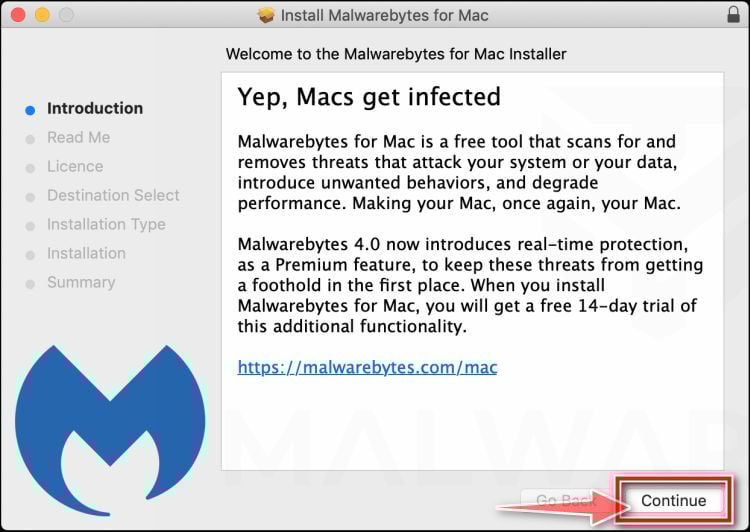
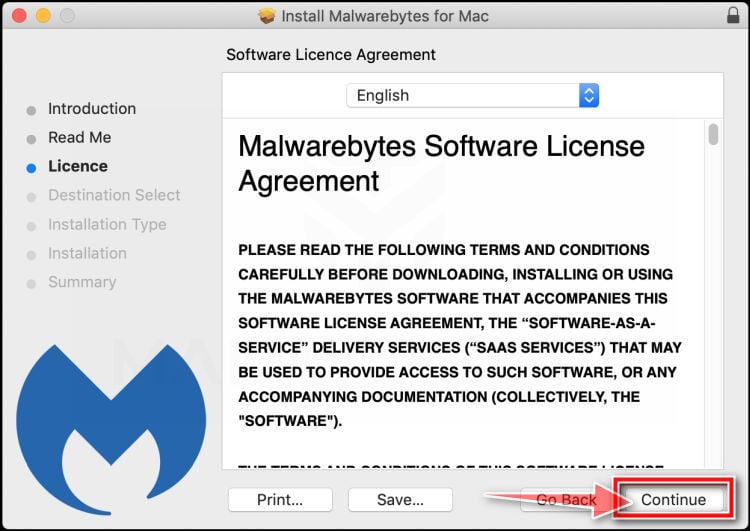
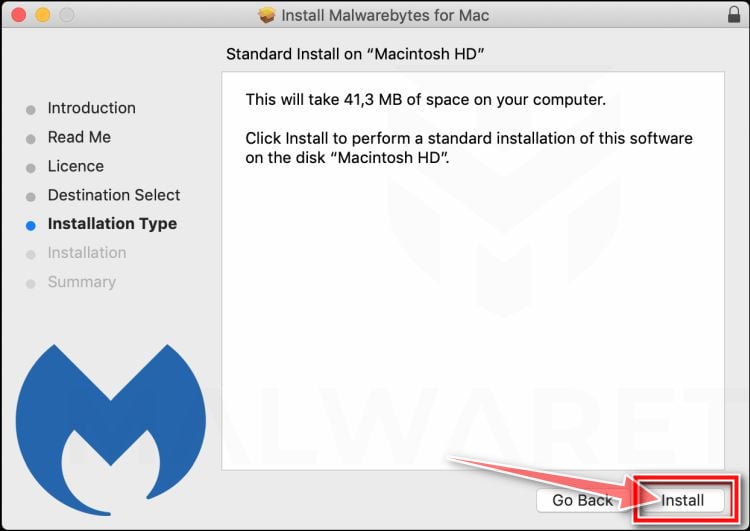
When the installation is complete, Malwarebytes opens to the Welcome to Malwarebytes screen. Click “Get started“.
-
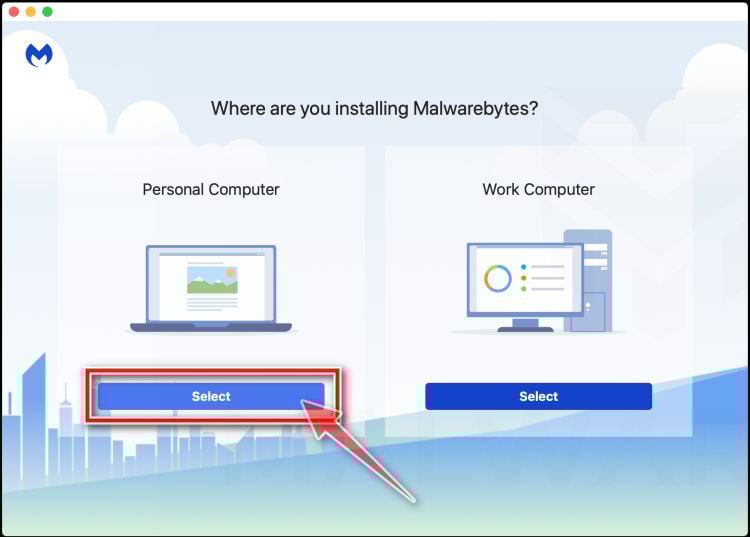
Select “Personal Computer” or “Work Computer”
Malwarebytes will ask what type of computer you’re installing it on. Click either Personal Computer or Work Computer, whichever applies.
-
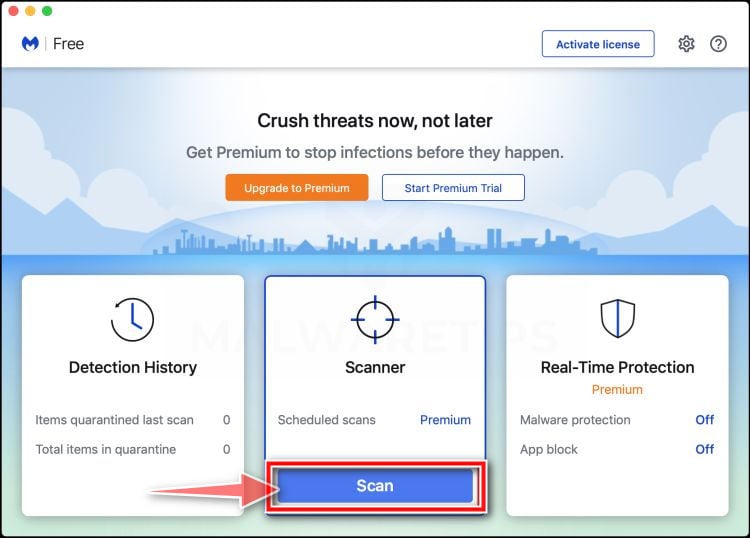
Start the Scan
Click the “Scan” button. Malwarebytes will automatically update its detection database and begin checking your Mac for malware.
-
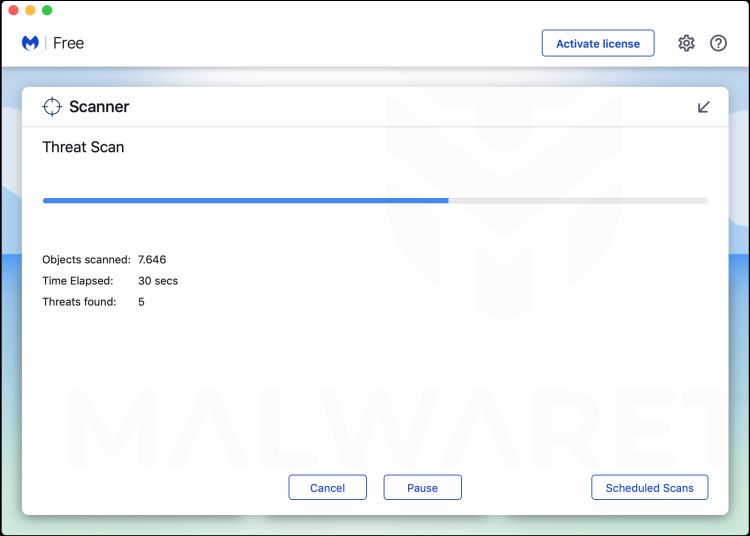
Wait for the Scan to Finish
Malwarebytes will scan your Mac for adware, browser hijackers, and other malicious programs. This can take a few minutes, so feel free to do something else — just check back occasionally to see the progress.
-
Quarantine the Detected Threats
When the scan is done, you’ll see a list of everything Malwarebytes found. Click the “Quarantine” button to remove all the threats at once.
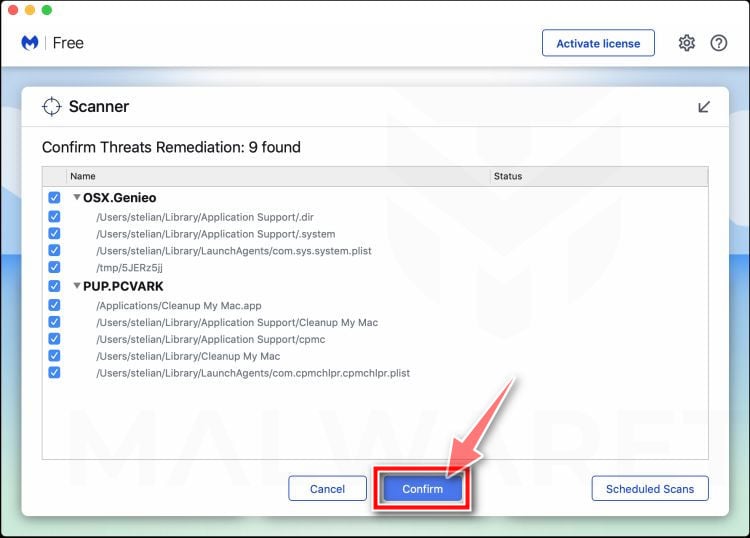
-
Restart Your Mac
Malwarebytes will now remove all the malicious files it found. Some threats can only be fully removed after a reboot — if Malwarebytes asks you to restart, allow it. Once you’re logged back in, your Mac is clean.
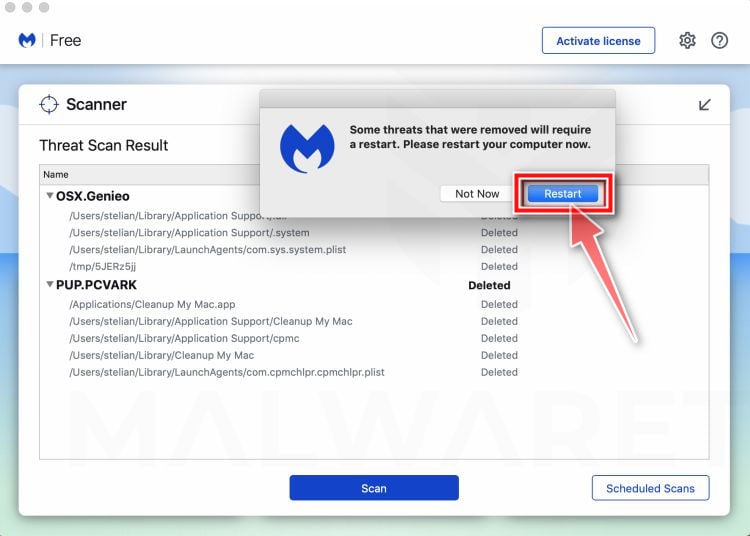
That’s it — your Mac is now free of adware, rogue browser extensions, and other potentially harmful software.
If you are still experiencing problems while trying to remove a malicious program from your computer, please ask for help in our Mac Malware Removal Help & Support forum.
Run a Malware Scan with Malwarebytes for Android
Malwarebytes for Android automatically detects and removes dangerous threats like malware and ransomware so you don’t have to worry about your most-used device being compromised. Aggressive detection of adware and potentially unwanted programs keeps your Android phone or tablet running smooth.
-
Download Malwarebytes for Android.
You can download Malwarebytes for Android by clicking the link below.
Get Malwarebytes for AndroidOpens Google Play in a new tab.Want real-time protection? See Malwarebytes Premium for AndroidMalwarebytes for AndroidScans your phone and removes malware at no cost -
Install Malwarebytes for Android on your phone.
In the Google Play Store, tap “Install” to install Malwarebytes for Android on your device.

When the installation process has finished, tap “Open” to begin using Malwarebytes for Android. You can also open Malwarebytes by tapping on its icon in your phone menu or home screen.

-
Follow the on-screen prompts to complete the setup process
When Malwarebytes will open, you will see the Malwarebytes Setup Wizard which will guide you through a series of permissions and other setup options.
This is the first of two screens that explain the difference between the Premium and Free versions. Swipe this screen to continue.
Tap on “Got it” to proceed to the next step.
Malwarebytes for Android will now ask for a set of permissions that are required to scan your device and protect it from malware. Tap on “Give permission” to continue.
Tap on “Allow” to permit Malwarebytes to access the files on your phone.
-
Update database and run a scan with Malwarebytes for Android
You will now be prompted to update the Malwarebytes database and run a full system scan.

Click on “Update database” to update the Malwarebytes for Android definitions to the latest version, then click on “Run full scan” to perform a system scan.

-
Wait for the Malwarebytes scan to complete.
Malwarebytes will now start scanning your phone for adware and other malicious apps. This process can take a few minutes, so we suggest you do something else and periodically check on the status of the scan to see when it is finished.

-
Click on “Remove Selected”.
When the scan has been completed, you will be presented with a screen showing the malware infections that Malwarebytes for Android has detected. To remove the malicious apps that Malwarebytes has found, tap on the “Remove Selected” button.

-
Restart your phone.
Malwarebytes for Android will now remove all the malicious apps that it has found. To complete the malware removal process, Malwarebytes may ask you to restart your device.
That’s it — your Android phone is now clean — no more malicious apps, adware, or browser redirects.
If you are still having problems with your phone after completing these instructions, then please follow one of the steps:
- Restore your phone to factory settings by going to Settings > General management > Reset > Factory data reset.
- Ask for help in our Mobile Malware Removal Help & Support forum.
Stay Protected: Block Ads and Malicious Sites
Now that your device is clean, keep it that way. Most infections start with a malicious ad or a fake download button — so blocking them at the source is your best defense.
We recommend AdGuard, which blocks malicious ads, phishing pages, and dangerous redirects before they can reach you.
👉 Download AdGuard and browse safely
Frequently Asked Questions about the $100 Amazon Gift Card Scam
1. How do I recognize the $100 Amazon gift card scam on Facebook?
The most common red flags include an ad promising a free $100 Amazon gift card, claims you must complete a survey or provide personal information to get the gift card, and links to suspicious or sketchy-looking websites. The ads are designed to look like real Amazon promotions. Always be wary of “free” gift cards requiring you to submit sensitive information.
2. What happens if I click on the link in the $100 Amazon gift card ad?
The links usually take you to a fake website disguised as Amazon and asking for your login credentials or sign-up information. Providing any personal or account information will allow scammers to steal your Amazon identity or sign you up for unwanted services. Never enter your Amazon login on unfamiliar websites.
3. How do the scammers profit from the fake $100 Amazon gift card ads?
Most commonly, they steal your Amazon account login details to access your account, personal info, and payment methods. Others sign you up for subscriptions, services, or even install malware. The scammers make quick money from either stealing your Amazon identity or making money off unauthorized sign-ups.
4. What should I do if I entered my Amazon account info into one of these scam websites?
Immediately change your Amazon password and enable two-factor authentication. Check your account for unauthorized changes, cancel any unknown subscriptions, remove unfamiliar payment methods, and contact Amazon customer service. You may also need to contact your bank about any fraudulent charges.
5. How can I get a real free $100 Amazon gift card?
Unfortunately, Amazon does not give away $100 gift cards for free legitimately. If you see ads offering this, it is always a scam attempt. Any promotions for free Amazon gift cards will never ask you to provide your Amazon credentials or other sensitive info. Always be leery of these.
6. What steps can I take to avoid the $100 Amazon gift card scam?
Be skeptical of any offer that seems too good to be true, look closely at the ad and landing page URL for red flags, avoid clicking questionable links, never provide your Amazon login or financial details, use unique passwords, and enable two-factor authentication on your accounts.
7. Where should I report fake $100 Amazon gift card scams?
You can report the ads or landing pages to Facebook and Amazon directly to get them taken down. Provide screenshots and details on the scam tactics used. Also report to the FTC to help warn others and support scam investigation efforts.
8. How do I recover or cancel if I was signed up for unwanted services?
If you provided your payment information, contact your credit card company or bank to reverse the charges and cancel payments to any unauthorized subscription services. You can also contest them directly with the companies by phone, email, or on their websites.
9. Could scammers do more harm to me than just stealing my Amazon account?
Yes, they can use your email and passwords to access other accounts if you reused them elsewhere. Always use unique passwords for every site. The scammers may also have obtained enough personal info from your Amazon account to engage in identity theft.
10. What are some other “free gift card” scams I should look out for?
Scammers use similar tactics for fake gift cards from Target, Walmart, Best Buy, Starbucks, and other brands. Be vigilant and never provide your login or financial information to unfamiliar sites promising free gift cards. If it seems questionable, it’s best to avoid entirely.
The Bottom Line on the $100 Amazon Gift Card Facebook Scam
The promise of free money via an Amazon gift card is powerfully tempting. But any offer like this on Facebook should raise immediate red flags.
Scammers rely on the principle that people will toss caution aside for a big potential payoff. By mirroring official branding and creating a convincing facade, they trick unsuspecting victims into giving up login credentials or signing up for unwanted services.
The result is accounts being compromised, identities being stolen, and unwanted charges occurring. But armed with the insights on how this scam works, you can identify the red flags early and avoid being ensnared. Always be wary of unbelievable free offers. If it seems fake, it almost always is.








