

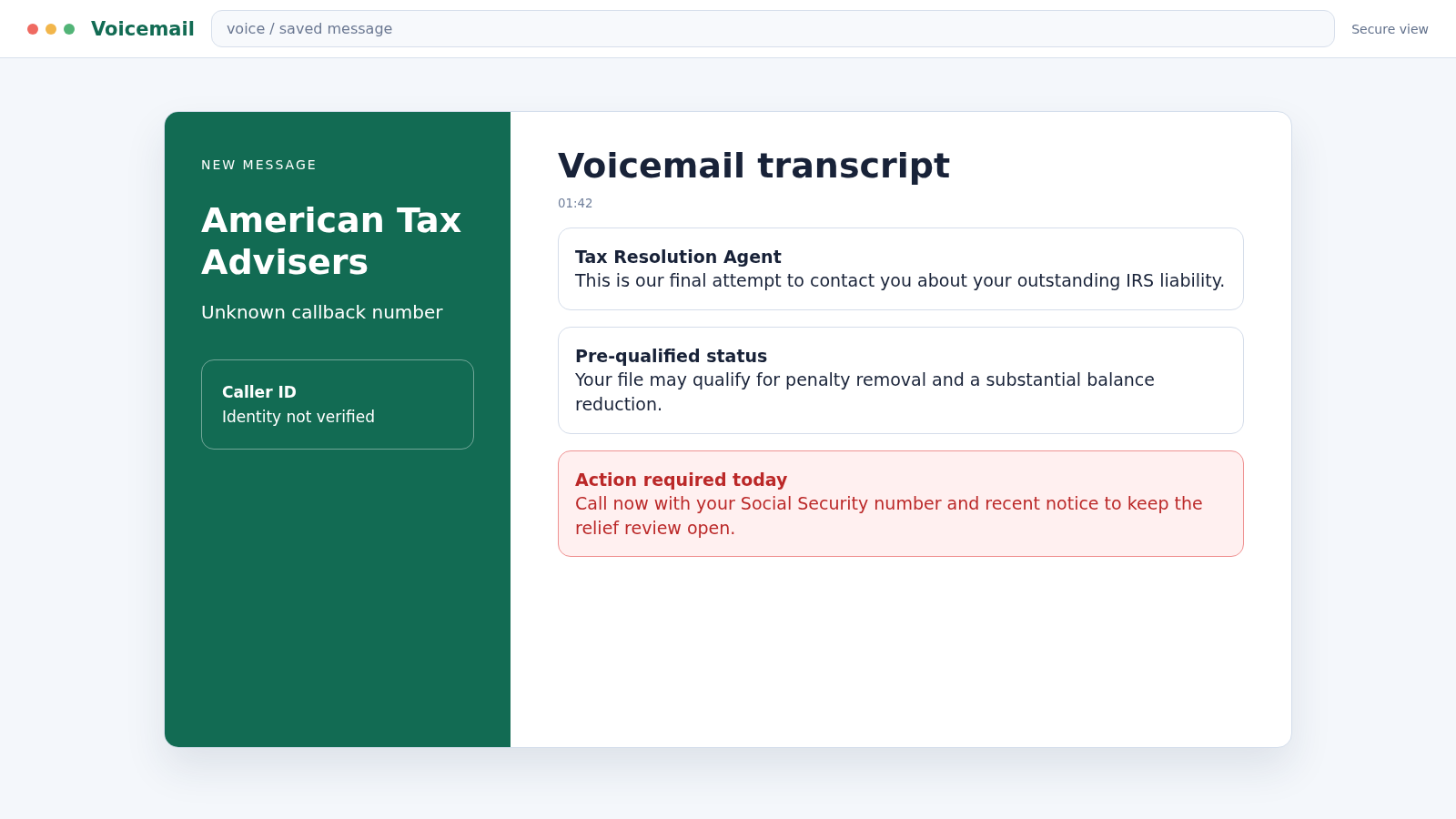
The voicemail says this may be the final attempt to reach you. A review supposedly found that you qualify for an IRS liability reduction, penalty waiver, or tax settlement that could disappear if you wait.
The caller’s name sounds official enough to return the call. American Tax Advisers scam calls depend on that vague authority, while leaving the real company, program, and cost just out of view.
Overview
The name sounds official without identifying a government agency
American Tax Advisers scam calls use names such as American Tax Advisors, Tax Resolution Department, Tax Mediation Agency, or IRS Relief Team. These labels can sound governmental while remaining generic enough to avoid a clear identity.
Legitimate tax professionals and businesses may use similar words. This article concerns unsolicited callers using those names to misrepresent a tax problem or relief offer, not every real firm with a comparable name.
The offer appears before any genuine financial review
A prerecorded message may say the recipient is “pre-qualified” for a reduction, hardship program, penalty removal, or settlement. The caller has not examined income, assets, expenses, filing history, or the actual IRS account.
Real IRS options have eligibility rules. No unknown caller can guarantee an Offer in Compromise or liability reduction from a phone number alone.
The conversation moves from fear to data and fees
The callback agent may ask for information supposedly needed to confirm the file:
- Social Security number, birth date, and filing status
- Employer, income, bank balance, and property information
- IRS notice numbers and tax-account credentials
- Card or bank details for an evaluation or retainer
- Copies of returns, identity documents, or authorization forms
- One-time codes sent by email, a bank, or an online account
The objective may be identity theft, an illegal upfront fee, a high-pressure service sale, or a direct payment scam. The recipient should identify which one is happening before sharing anything.
What the IRS Actually Says About Tax-Debt Calls
The IRS says its first contact is normally made by mail. It does not unexpectedly call to demand immediate payment, threaten arrest, or announce a refund that requires personal or financial information.
The IRS can use authorized private collection agencies for certain inactive debts, but the taxpayer receives written notice first. The IRS sends Notice CP40, followed by a letter from the assigned agency.
Those letters contain a taxpayer authentication number that helps both sides verify the contact. The current authorized agency list is published by the IRS, and payments are made through approved IRS methods rather than to an individual caller.
A real tax problem should therefore leave an independent trail: a notice in the IRS account, mailed correspondence, a published agency, and a verifiable payment route. A cold voicemail alone is not that trail.
Real Relief Programs Are Not Instant Approvals
The Offer in Compromise program can settle qualifying tax debts for less than the full amount, but eligibility depends on ability to pay, income, expenses, and asset equity. The IRS provides a pre-qualifier and application information directly.
Other options may include installment agreements, temporary collection delay, penalty relief, or help from an enrolled agent, CPA, attorney, or Low Income Taxpayer Clinic.
A legitimate professional should explain credentials, services, price, cancellation rights, and realistic outcomes in writing. They should not guarantee acceptance before reviewing the facts.
The FTC has warned about unexpected back-tax calls using official-sounding agency names and supposed “IRS liability reduction programs.” These calls may seek sensitive information or illegal upfront fees without delivering meaningful help.
How the American Tax Advisers Scam Calls Work
Step 1: A robocall or voicemail announces an urgent tax opportunity
The campaign contacts large lists of numbers and says a review has identified possible tax debt, penalties, or unclaimed relief. The message may call itself a final notice to encourage a quick callback.
The sender does not need access to an IRS record. Tax anxiety is common, and some recipients will have filed late, received mail, or worried about a balance recently.
Step 2: A generic department name creates borrowed authority
The caller introduces a tax mediation, resolution, compliance, or advisory department without clearly stating whether it is a government agency, law firm, lead generator, or private service.
Words such as American, federal, relief, and IRS can create an official impression. The name may change between the voicemail, callback agent, paperwork, and card charge.
Step 3: The agent confirms a problem the victim has not verified
The operator asks leading questions about unfiled returns, tax debt, liens, penalties, or recent notices. Information the victim supplies is repeated back as if it came from a government file.
If the person says there is no debt, the story may switch to a refund, credit, identity issue, or free eligibility review. The script is designed to keep a broad range of callers engaged.
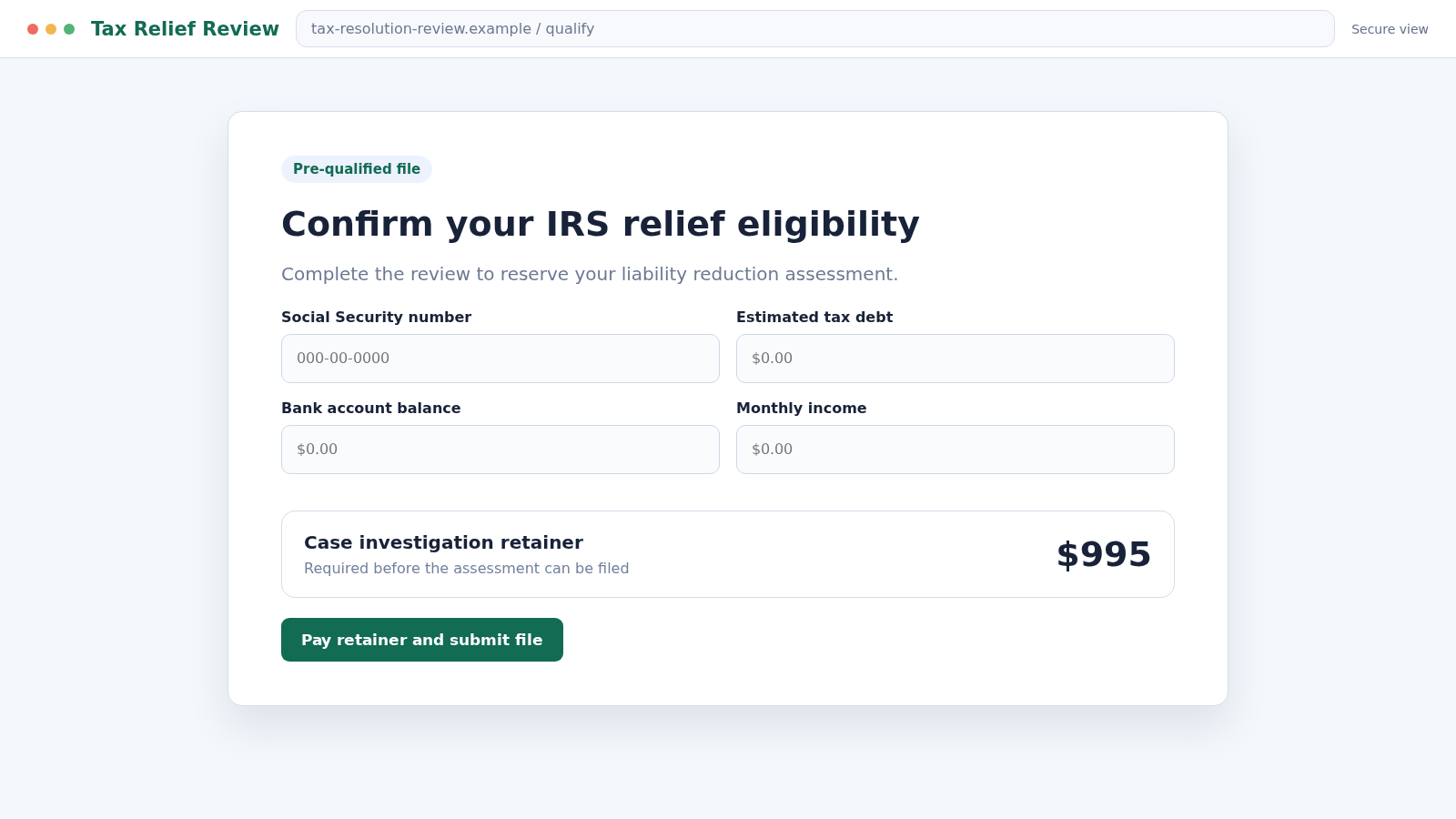
Step 4: A false pre-qualification creates hope
The agent claims that a special program could reduce the balance by a large amount or remove penalties. They may cite a changing deadline, new law, local initiative, or limited enrollment period.
No complete financial analysis has occurred. The “qualification” is a sales device that turns uncertainty into a reason to pay for the next step.
Step 5: Sensitive information is collected as verification
The caller requests a Social Security number, birth date, bank information, income, employer, and IRS notice details. A linked portal may ask the victim to upload returns or identity documents.
This information can support tax identity theft, account access, credit applications, or targeted impersonation even if the victim refuses to pay.
Step 6: A fee or payment is demanded before results exist
The agent may request an evaluation charge, investigation fee, retainer, enrollment payment, or deposit. High-pressure versions demand gift cards, cryptocurrency, wire transfers, or payment to an individual.
Other operations use a card contract with recurring or staged fees. The victim may believe the money pays the IRS when it actually goes to a private seller or lead network.
Step 7: Paperwork creates delay without proving progress
The customer may receive questionnaires, authorization forms, generic reports, or repeated requests for documents. These materials can make the service appear active while no filing, negotiation, or resolution is confirmed.
A legitimate authorization form has a defined purpose, but signing one without understanding the company and scope can give an unknown operator access to sensitive tax information.
Step 8: More fees or a recovery pitch follow
When the promised result fails, the caller may blame missing records, a new IRS deadline, or an additional compliance problem. Another payment is presented as the only way to preserve the case.
If the victim complains, a different caller may promise a refund or recovery for another fee. The new contact may be connected to the same lead list.
Company, Address, and Fulfillment Checks
The caller’s trading name is not a legal identity
Ask for the exact legal business name, physical address, website, supervising professional, and written engagement agreement. Search state business and professional records independently.
Do not assume that a legitimate company with a similar name made the call. Impersonators deliberately choose generic labels that are difficult to distinguish.
An address must match the firm and its credentials
Compare the contract, website, payment receipt, caller disclosure, and registry record. A mailbox, virtual office, or unrelated suite does not prove fraud, but unexplained mismatches require answers.
Verify the professional’s license or enrollment through the appropriate official directory. Do not rely on a badge image, certificate, or registry link supplied by the salesperson.
Support should survive an independent callback
Look up the organisation yourself and call its published number. Ask whether it made the outreach, employs the named agent, and recognizes the proposed service and fee.
If the firm cannot be reached except through the robocall number, the customer has no dependable route for cancellation, records, or complaints.
The promised tax work needs measurable fulfillment
A real engagement should state which returns, forms, negotiations, transcripts, or filings will be handled, who is responsible, and how progress will be documented.
Do not accept vague claims that a case is “with compliance.” Confirm any IRS submission through the professional, your IRS account, and official correspondence.
Warning Signs of a Tax Relief Call
- The call is unexpected and described as a final attempt.
- The caller knows little but says you are already pre-qualified.
- A generic name sounds governmental without naming a real agency.
- The offer guarantees a settlement or penalty removal.
- The agent refuses to provide a written identity and complete price.
- A Social Security number or bank account is requested immediately.
- Payment must go to the caller, gift card, wallet, or individual.
- You are told not to contact the IRS or another tax professional.
A legitimate adviser should welcome verification and careful review. Pressure to stay on the line is not a substitute for credentials, records, and a written engagement.
How to Check a Tax Professional Before Hiring
Ask who will perform the work and what credential that person holds. Attorneys, CPAs, and enrolled agents have different licensing authorities, but each credential should be independently verifiable.
A paid federal tax-return preparer generally needs a valid Preparer Tax Identification Number. A PTIN does not by itself prove experience or authorize every type of representation, so review qualifications and disciplinary history as well.
Read the complete engagement before signing. It should identify the client, legal firm, responsible professional, services, exclusions, payment schedule, cancellation terms, record handling, and method for returning documents.
Be cautious if the salesperson will not let you speak with the professional, cannot name the forms to be filed, or treats a large retainer as proof that relief is guaranteed.
What to Do if You Have Fallen Victim to This Scam
- End the call and stop submitting documents. Do not send another payment or sign additional forms until the caller and claimed tax problem are independently verified.
- Check your real IRS account and correspondence. Visit IRS.gov directly and review notices, balances, and authorized representatives. Call an official IRS number if the account does not explain the claim.
- Contact the bank or card issuer. Report misleading or unauthorized charges and ask how to block additional transactions. Explain whether the seller promised government payments or specific tax work.
- Secure exposed tax and identity information. If a Social Security number, return, or identity document was sent, follow the IRS identity-theft guidance and create a recovery plan at IdentityTheft.gov.
- Change affected account passwords. Secure email, IRS, tax-software, cloud-storage, and banking accounts. Remove unknown recovery details and enable multifactor authentication.
- Review any authorization you signed. Ask a qualified independent tax professional whether a power of attorney or tax-information authorization should be revoked. Do not rely on the caller to cancel it.
- Demand a written accounting. Request the legal business name, contract, payments, work performed, documents filed, and refund policy. Preserve the response or failure to respond.
- Scan the device if software was installed. If the agent requested remote access, opened a portal download, or sent an attachment, disconnect access and run Malwarebytes. It can help detect malicious software left on the system.
- Block repeat scam pages and advertisements. AdGuard can reduce access to known malicious domains, deceptive ads, and trackers. It does not verify tax professionals, so check credentials separately.
- Report the solicitation. Record the calling number and report suspicious tax-debt relief calls through the IRS-listed channels, TIGTA, the FCC, and the FTC.
- Choose real tax help carefully. Use IRS resources, a Low Income Taxpayer Clinic if eligible, or a verified enrolled agent, CPA, or attorney. Get the scope and price in writing.
Frequently Asked Questions
Is American Tax Advisers a government agency?
The phrase is a generic business-style name, not the name of the IRS. Ask for the exact legal entity and verify it independently before assuming who called.
Does the IRS ever use private collection agencies?
Yes, for certain inactive debts, but the IRS sends Notice CP40 first and the assigned agency sends another letter. Both contain information used to authenticate later contact.
Can a caller know that I owe taxes?
A legitimate professional may know after authorization, but a cold caller can guess or use leaked data. Confirm every balance through your IRS account and official notices.
Can anyone guarantee an Offer in Compromise?
No. Acceptance depends on IRS rules and the taxpayer’s financial circumstances. A guarantee before a complete review is a serious warning sign.
Should I give a tax-relief caller my Social Security number?
Not during an unsolicited call. Verify the professional, company, need, privacy practices, and written engagement before sharing sensitive tax information.
What if I signed an authorization form?
Review it with the IRS or an independent qualified professional. Determine what access it grants and whether it should be revoked, then secure related accounts.
The Bottom Line
American Tax Advisers scam calls use vague authority, a final-notice voicemail, and an instant relief promise to pull people into a high-pressure conversation. A real tax option cannot be confirmed from a cold-call script.
Check the IRS record yourself, verify the exact professional and legal company, and demand a written scope before paying or sharing data. If the caller resists those basic checks, end the contact.

Join the discussion
0 commentsShare your experience or ask a question about this article.
Discussion
Start the conversation
Have a question or something useful to share? Add the first comment.