

Have you ever received an email that claims you have won a huge amount of money in a lottery you never entered? If so, you may have been targeted by the Asian Continental Lottery Scam Email, one of the most common and persistent online frauds. In this blog post, we will explain what this scam is, how it works, and what to do if you have fallen victim to it.
What is the Asian Continental Lottery Scam Email?
The Asian Continental Lottery Scam Email is a type of advance-fee fraud, where the scammer asks for money or personal information from the victim in exchange for a promised reward that never materializes. The scammer pretends to be from a legitimate lottery organization, such as the Asian Continental Lottery Commission, and informs the victim that they have won a large cash prize in a random draw. The scammer then asks the victim to pay a fee or provide personal details to claim the prize.
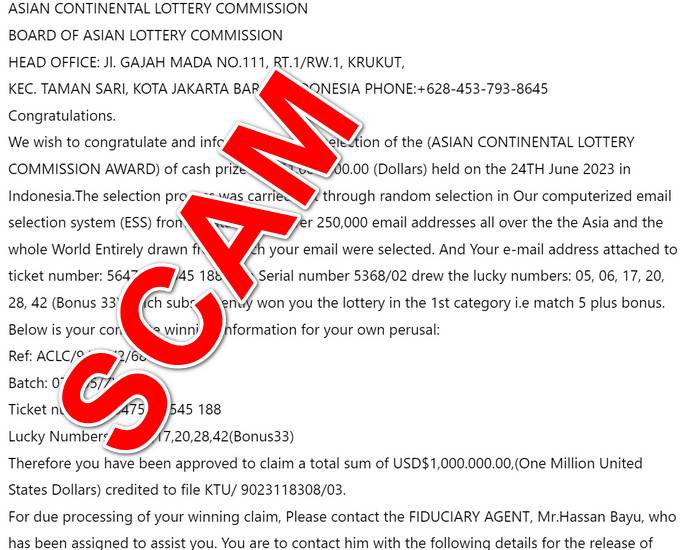
This is how a typical Asian Continental Lottery Scam Email looks like:
Subject: Re: Congratulations…You have won USD$1,000.000.00
ASIAN CONTINENTAL LOTTERY COMMISSION
BOARD OF ASIAN LOTTERY COMMISSION
HEAD OFFICE: Jl. GAJAH MADA NO.111, RT.1/RW.1, KRUKUT,
KEC. TAMAN SARI, KOTA JAKARTA BARAT, INDONESIA PHONE:+628-453-793-8645
Congratulations.
We wish to congratulate and inform you on the selection of the (ASIAN CONTINENTAL LOTTERY COMMISSION AWARD) of cash prize USD$1,000,000.00 (Dollars) held on the 24TH June 2023 in Indonesia.The selection process was carried out through random selection in Our computerized email selection system (ESS) from a database of over 250,000 email addresses all over the the Asia and the whole World Entirely drawn from which your email were selected. And Your e-mail address attached to ticket number: 56475600545 188 with Serial number 5368/02 drew the lucky numbers: 05, 06, 17, 20, 28, 42 (Bonus 33),which subsequently won you the lottery in the 1st category i.e match 5 plus bonus.
Below is your complete winning information for your own perusal:
Ref: ACLC/9420X2/68
Batch: 074/05/ZY369
Ticket number:56475600545 188
Lucky Numbers: 05,06,17,20,28,42(Bonus33)
Therefore you have been approved to claim a total sum of USD$1,000.000.00,(One Million United States Dollars) credited to file KTU/ 9023118308/03.
For due processing of your winning claim, Please contact the FIDUCIARY AGENT, Mr.Hassan Bayu, who has been assigned to assist you. You are to contact him with the following details for the release of your winnings.
Agent Name: Mr.Hassan Bayu
Email: bayuhassan1@gmail.com
Phone: +628-152-785-8820
Note Please:Contact him as soon you get this notification and provide him with the following Requirements below along with your winning information:
1.Name in full———
2.Address—————-
3.Nationality—————–
4.Copy of your International passport——————-
5.Occupation——
6.Sex ————-
7.Phone/Fax———–
8.Present Country——
If you do not contact your claims agent within 5 working days of this Notification, your winnings would be revoked. Winners are advised to keep their winning details/information from the public to avoid Fraudulent claim (IMPORTANT) pending the prize claim by Winner.
*Winner under the age of 18 are automatically disqualified. *Staff of the Asian Continental Lottery are not Authorize to partake in this Lottery.
Accept my hearty congratulations once again!
Note that you are not to reply to this E-mail, please contact your claims officer directly to start the processing of your claims application form
Thank you for your understanding and cooperation.
Yours faithfully,
Mr Niran Moor
LOTTERY CORDINATOR.
How does the Asian Continental Lottery Scam Email work?
The scammer usually sends an unsolicited email to the victim, claiming to be from the Asian Continental Lottery Commission or a similar entity. The email congratulates the victim on winning a cash prize of $1,000,000 or more, and provides a ticket number and lucky numbers that allegedly won the lottery. The email also states that the selection was made through a random email selection system, and that the victim’s email was chosen from a database of over 250,000 addresses.
The email then instructs the victim to contact a fiduciary agent, who is supposedly assigned to assist with the winning claim. The email includes contact details of the agent, such as name, phone number, email address, and fax number. The email also requests the victim to provide personal information, such as name, address, nationality, copy of an international passport, occupation, sex, phone/fax, and present country.
The email warns that if the claims agent is not contacted within five working days, the winnings may be revoked. It also emphasizes the importance of keeping the winning details private to avoid fraudulent claims by other parties.
If the victim contacts the agent, they will be asked to pay a fee or provide more personal information to process the claim. The fee may be described as a tax, insurance, transfer charge, or legal fee. The scammer may also ask for bank account details or credit card information to deposit the prize money. The scammer may provide fake documents or certificates to convince the victim that the lottery is real and legitimate.
However, no matter how much money or information the victim pays or provides, they will never receive the prize money. The scammer will either disappear with the money or information, or keep asking for more fees or details until the victim realizes they have been scammed or runs out of money.
What to do if you have fallen victim to the Asian Continental Lottery Scam Email?
If you have fallen victim to this scam, you should take immediate action to protect yourself and your finances. Here are some steps you can take:
- Stop all contact with the scammer and do not send any more money or information.
- Report the scam to your local authorities and online fraud agencies, such as the Internet Crime Complaint Center or Scamwatch.
- Contact your bank and credit card company and inform them of the scam. They may be able to reverse any transactions or block any unauthorized charges.
- Change your passwords and security questions for your online accounts and email.
- Monitor your credit reports and bank statements for any suspicious activity.
- Seek professional advice from a lawyer or financial counselor if you have lost a large amount of money or are in debt because of the scam.
- Seek emotional support from your family, friends, or a counselor if you feel distressed or ashamed because of the scam.
Conclusion
The Asian Continental Lottery Scam Email is a common and dangerous online fraud that can cost you money and personal information. You should always be wary of any unsolicited emails that claim you have won a lottery you never entered. Remember that legitimate lotteries do not ask for fees or personal details to claim prizes. If you receive such an email, delete it immediately and do not reply or click on any links. If you have already fallen victim to this scam, take action as soon as possible to protect yourself and report it to the authorities.

Join the discussion
0 commentsShare your experience or ask a question about this article.
Discussion
Start the conversation
Have a question or something useful to share? Add the first comment.