It looks warm, familiar, and perfectly timed for the winter season.
Soft sweaters, handmade cardigans, and “mother–daughter love” branding fill the homepage.
But behind the charming facade of Ava & June, many shoppers are discovering a harsh truth — what arrives at their door is nothing like what they were promised.
So, is Ava & June really a heartfelt fashion brand run by a mom and daughter, or just another fake online boutique in disguise? Let’s unpack what’s really happening behind this trending store and how this scam operates under the comforting illusion of trust.
Scam Overview
At first glance, avaandjune.com looks entirely legitimate. The site’s aesthetic feels elegant and modern, with fonts and layouts similar to high-end lifestyle retailers. Everything is crafted to make visitors feel they’re shopping from a long-established boutique based somewhere in California or Europe.
But dig a little deeper, and the illusion starts to unravel.
A Too-Perfect Story
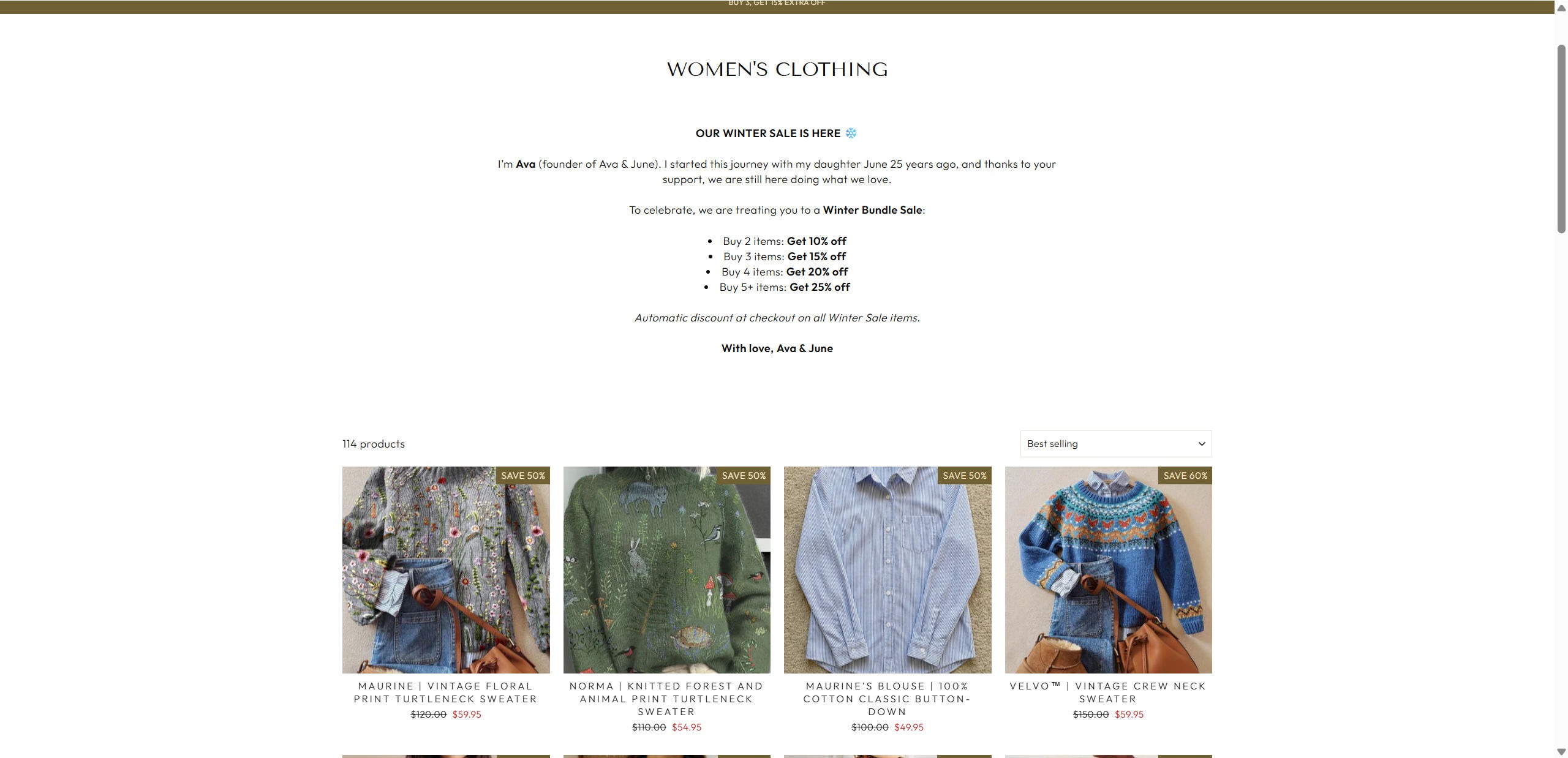
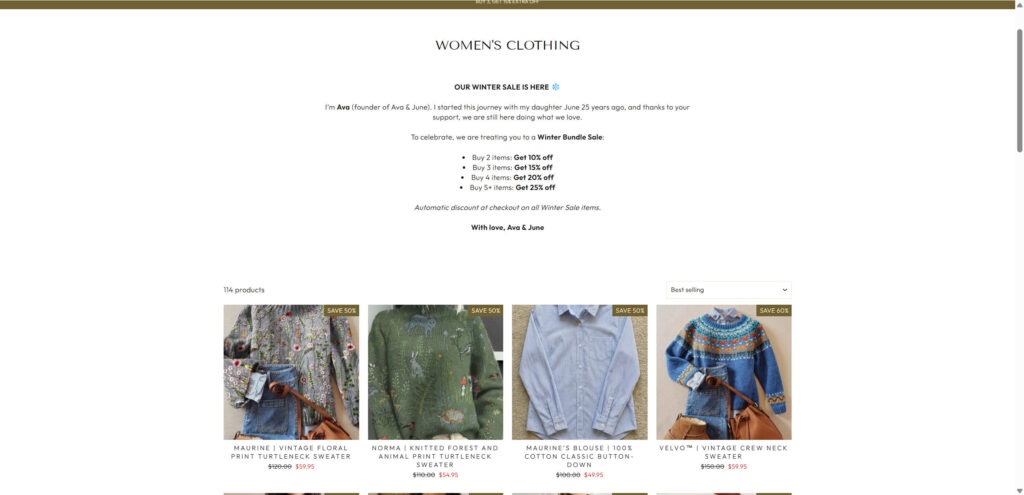
The homepage opens with a personal touch — supposedly written by “Ava,” who claims she started the brand with her daughter “June” 25 years ago. The text feels sentimental:
“I started this journey with my daughter June 25 years ago, and thanks to your support, we are still here doing what we love.”
This story feels sincere — but it’s not unique. Nearly identical “mother-daughter” narratives appear across dozens of nearly identical websites, including Vera California, Luca & Eloise, Aria & Lou, and Isla & Rose — all registered recently and using the same templates, tone, and pricing structure.
These recurring backstories are part of a broader network of cloned e-commerce storefronts, built to appear genuine while quietly funneling customers toward disappointing, low-quality products.
A Suspiciously New Domain
The domain avaandjune.com was registered on September 30, 2025 — not 25 years ago, as the site’s About section suggests. That alone is a red flag: a supposedly long-standing fashion brand doesn’t suddenly appear online under a brand-new domain just weeks ago.
It uses Google Domains and a privacy shield to hide ownership information — another clue often seen in fake retail operations trying to avoid accountability once complaints start piling up.
Familiar Design, Familiar Deception
The website design is almost identical to veracalifornia.com, clairearlojewelleryco.com, and pelvini.com — all part of the same scam pattern:
- Neutral colors and minimalist fonts for a “premium” look
- Stock photos of smiling models in cozy settings
- Heavy use of emotional storytelling (“crafted with love”)
- False urgency banners (“Holiday Sale Ends Today,” “Limited Stock,” “Final Restocks”)
- Copy-pasted product pages featuring AI-generated product names and fake original prices (like “$150 → $59.95 Save 60%”)
Every element is designed to build emotional trust, appealing especially to middle-aged women who value warmth, craftsmanship, and boutique fashion experiences.
Fake Prices and Imaginary Discounts
The site constantly advertises “Winter Sales” or “Up to 60% Off.” But those “discounts” are meaningless — the original prices were never real. These are arbitrary markups to create the illusion of luxury value.
For example, sweaters listed at $120 “original” and discounted to $59.95 are in reality $5–$8 fast-fashion items sourced from AliExpress or 1688 suppliers in China. Some listings even reuse supplier photos with minimal edits.
When customers receive their order (if they do), they often find thin, synthetic garments, printed instead of embroidered designs, and inconsistent sizing — nothing like the beautiful imagery they saw online.
The “Boutique” That Doesn’t Exist
The storefront image of “Ava & June Augusta” — complete with a charming European street background — is stock photography. There’s no registered business under this name, no traceable store address, and no corporate filings anywhere in the United States or UK.
The company only provides an email contact:
support@avaandjune.com
No phone number, no registered address, no company number — just a contact form and a promise of “24/7 support.” Victims often report that after complaints, the responses become generic, repetitive, and evasive, typically ending with partial refund offers.
The Refund Trap
Most customers who try to return products are shocked to learn that they must ship the items back to China, at their own expense — even though the website appears to be based in the US or Europe.
The return instructions reveal the real fulfillment source: warehouses in Guangdong, Shenzhen, or Yiwu, China, where these items are shipped directly from low-cost suppliers.
Returning the product costs more than the item itself, effectively trapping the buyer into accepting a 15% to 30% “partial refund” — the same tactic used across this growing network of scam stores.
A Pattern Across Dozens of Sites
This is not an isolated case. Ava & June appears connected to the same web of drop-shipping scam sites that include:
- Vera California
- Claire & Arlo Jewellery
- Pelvini Watches
- Elora Boutique
- Isla & Rose
- The Serene Studio
All of them use similar storytelling, identical discount logic, and domain patterns registered between September and November 2025.
The consistency in design, wording, and return policy points to a coordinated operation, not an independent brand.
How The Scam Works
The Ava & June website follows a predictable formula used across this scam network. Every stage of the customer journey is carefully optimized to appear trustworthy while minimizing the chance of accountability.
Step 1: Emotional Branding
The site doesn’t start by selling — it starts by connecting.
The “Ava and June” narrative paints a wholesome story of a small family business. It uses emotional triggers like motherhood, nostalgia, and artisan craftsmanship. This builds instant rapport with shoppers, especially those who prefer supporting small, ethical boutiques over big chains.
Phrases like:
“Handmade with love and inspired by timeless style.”
and
“Thank you for supporting our small family business.”
create an illusion of intimacy — even though the entire operation is automated and mass-produced overseas.
Step 2: The “Limited-Time” Sale Pressure
The homepage immediately activates urgency:
- “Winter Sale Ends Today”
- “Buy 3, Get 15% Off”
- “Final Restocks”
- “Selling Out Fast”
This false scarcity tactic makes visitors act impulsively before verifying legitimacy. In reality, these sales run indefinitely. The banners simply reset daily to maintain pressure.
Step 3: AI-Generated or Stolen Product Images
Most of the product photos are AI-generated composites or lifted directly from social media and design blogs. You’ll notice textures, folds, and lighting inconsistencies typical of AI renders, or photos cropped to hide watermarks.
Some sweaters even appear in AliExpress listings under generic names for $6–$10 each — the same ones “Ava & June” sells for $59.95.
Step 4: Order Fulfillment from China
Despite branding itself as a Western boutique, Ava & June doesn’t keep local stock. Orders are automatically forwarded to suppliers in China through bulk drop-shipping platforms.
This means:
- Long shipping times (2–6 weeks)
- Low-quality replicas instead of what’s shown
- No quality control before dispatch
- Difficult or impossible returns
Many victims report that their tracking numbers don’t update for weeks, and when the items finally arrive, the quality is drastically inferior — thin fabrics, wrong sizes, synthetic materials, and poor stitching.
Step 5: Refund Denial and Partial Offers
When customers contact support for a refund, they receive replies that sound polite but are strategically manipulative:
“We’re sorry you’re unhappy. We can offer a 20% refund so you can keep the item as compensation.”
This approach is deliberate. By offering small partial refunds, the company avoids paying for international return shipping, which would reveal their true business address in China.
Those who insist on full refunds are told to ship at their own expense to a Chinese warehouse, where packages are often “lost” or never acknowledged.
Step 6: Review Manipulation and Fake Social Proof
Ava & June — like other sites in this network — populates its product pages with fake reviews written in the same grammatical tone, using names like “Emily R.” or “Karen D.” and phrases such as “I love how soft it feels!” or “Perfect fit and quality.”
Some reviews even reference seasons or holidays that don’t match the store’s launch date — another clue that they were copy-pasted from older template sites.
These reviews are designed to build confidence for first-time buyers, especially on social media ads where consumers rely on quick scanning rather than in-depth research.
Step 7: The Constant Rebrand Cycle
Once complaints accumulate or a domain receives too many bad reviews, the operators shut down the site and immediately open a new one under a different name — often reusing the same “family story” and templates.
This is why we now see Vera California, Ava & June, and other clones emerging within weeks of one another.
Each site is registered under a new domain (using Google Domains, Namecheap, or Alibaba Cloud), with hidden WHOIS data to conceal ownership. The goal is to stay one step ahead of consumer awareness and search engine penalties.
Step 8: Targeting Through Facebook and Instagram Ads
The majority of their traffic comes from social media ad campaigns, primarily on Facebook, Instagram, and TikTok. These ads feature:
- Emotional short captions (“Our cozy winter cardigans are finally back!”)
- Soft color palettes and warm lighting
- Fake engagement (comments from fake accounts praising the “quality”)
The operators spend heavily on these platforms, knowing that the high conversion rate from impulse buyers outweighs the refund percentage.
Victims are often women aged 35–65, attracted by the wholesome branding and limited-time discounts.
What To Do If You Have Fallen Victim to This Scam
If you placed an order at avaandjune.com and realized afterward that it may be a scam, don’t panic. You still have several practical steps to minimize damage and potentially recover your funds.
1. Contact Your Bank or Card Issuer Immediately
- Explain that you made a purchase from an online store that turned out to be fraudulent.
- Request a chargeback or dispute based on “goods not as described.”
- Provide screenshots of the website, product listing, order confirmation, and any correspondence.
Credit card companies and PayPal often side with the buyer in cases of misleading advertising.
2. Do Not Ship Returns to China
If the store insists that you return items to a Chinese address, don’t send them back — you’ll pay high shipping costs and likely never receive confirmation or a refund.
Keep all items as evidence for your bank claim.
3. Keep All Documentation
Save:
- Order confirmations
- Shipping receipts
- Email exchanges
- Photos of received products
This evidence strengthens your refund request and can also help alert consumer protection agencies.
4. Leave Honest Reviews
Warn others by posting reviews on:
- Trustpilot
- Reddit (r/Scams, r/ShopifyStores, r/OnlineShopping)
- Facebook Scam Alert groups
Include photos and your order details (without personal data). This helps others find your report through Google search.
5. Report the Website
You can submit reports to:
- FTC (reportfraud.ftc.gov) – for US-based consumers
- Internet Crime Complaint Center (IC3.gov)
- European Consumer Centres (if you’re in the EU)
Also, flag the site with your browser’s “Report deceptive site” feature — this helps Google and Meta reduce ad visibility.
6. Watch for Clone Sites
Once one domain fades, another usually appears. Stay alert for similar names, layouts, or marketing tactics. Bookmark reputable stores and avoid clicking on social media ads promising extreme discounts.
The Bottom Line
Ava & June isn’t the heartfelt family-run brand it pretends to be. It’s part of a wider web of cloned online boutiques using emotional storytelling, fake scarcity, and AI-generated imagery to sell cheap fast-fashion items under the guise of craftsmanship and love.
Everything — from the “25 years of experience” line to the staged storefront photo — is designed to make you trust the story, not question it.
If you’re ever drawn to a brand like this, take a moment before buying. Check the domain age, look for real company information, and search for reviews outside the site itself.
FAQ: Ava & June Sale Scam
Is Ava & June a legit boutique or a scam?
Based on the repeated “boutique story” template, the newly registered domain, and the common China-return refund trap pattern seen across similar sites, Ava & June shows many signs of a scam-style drop-shipping operation rather than a real established boutique.
Why are Ava & June items so discounted all the time?
These sites often use permanent “sale” banners and inflated “original” prices to create urgency and make the deals look dramatic. The discounts are typically marketing theater, not real markdowns from normal retail pricing.
Where do Ava & June orders ship from?
Many buyers report long delivery times and return instructions pointing to China, which strongly suggests fulfillment is handled through overseas suppliers rather than a local boutique warehouse.
Can I return my order for a full refund?
In many cases, the “return” requires shipping to China at your expense, which can be expensive and slow. Customers commonly report being offered only a partial refund (often 15% to 30%) to keep the product instead.
What should I do if the product is not as described?
Take photos immediately, save your order confirmation and emails, and file a dispute or chargeback with your card issuer or PayPal using “item not as described.” Avoid spending money shipping returns internationally unless your bank specifically advises it.
How can I spot similar fake boutique sale sites next time?
Look for red flags like a brand-new domain, no real business address or company registration, overly emotional founder stories, endless “sale ends today” pressure, and return policies that quietly route you to an overseas address.