


Caven wraps its offer in a cinematic AI experience, with a private account, six membership levels, and a polished interface that looks built for something sophisticated.
If someone has pitched caven.online as a way to earn from artificial intelligence, the details behind that presentation deserve attention before you create an account or deposit anything.
Overview
The app describes fixed compound profit from AI sessions
The current publicly delivered app code contains English explanations for six Caven plans. They describe compound interest of 6%–8.5% per completed AI session.
The explanations say sessions are started manually, at least 24 hours apart. The level and rate depend on the deposit, not a disclosed market result.
These are the app’s own explanatory strings, not a successful investment test. They are enough to make the AI-income presentation a serious financial warning.
A credited balance is not independently verified profit
The interface includes deposits, withdrawals, referral rewards, and messages announcing that profit has been credited. None establishes an independently audited source of revenue.
A database can credit a number without a trade taking place. A professional-looking login does not tell you who controls customer assets or can honor a withdrawal.
The decision should not wait for a larger test deposit
- The advertised plan calculations are extraordinary and require verifiable financial backing.
- The public entrance does not identify a clearly accountable investment operator.
- Domain registration and encryption do not verify a profit-generating business.
- The source code is evidence of the pitch, not proof that every described feature currently works.
- No account was opened, payment sent, or withdrawal tested for this investigation.
Do not deposit into Caven on the strength of this AI-profit story. The missing financial substance matters more than the production value of the website.
What Caven’s Own App Actually Says About the Plans
The public home page is a dramatic introduction to Caven ID and digital access. The money-related detail is easier to understand in the app’s delivered explanations.
Caven Start covers deposits labeled $10–$49.99 and describes 6% compound interest per completed session. Core covers $50–$99.99 with 6.5%.
Advance lists $100–$499.99 at 7%; Prime lists $500–$999.99 at 7.5%. Elite describes $1,000–$4,999.99 at 8%.
Signature starts at $5,000 and describes 8.5%. These thresholds are labeled in USD in the English strings; do not confuse that display with a verified bank balance.
The calculation base is described as the deposit plus profit not withdrawn or reserved for withdrawal. Retaining the supposed profit therefore increases the next calculation.
The app even supplies examples: Start moves $10 to $10.60 and then $11.24 after two sessions. Signature moves $5,000 to $5,425 and then $5,886.13.
Those examples are calculations inside a sales explanation. They do not show a broker statement, a settled trade, or money received outside the platform.
There are also development-style strings describing earnings connections at a later stage. That makes it especially important not to assume every shipped description is an operational feature.
The distinction does not make the offer safe. It means a promoter should not sell you functioning, dependable income on the strength of an interface or its embedded text.
The Compounding Story Is the First Reality Check
A 6% credit can sound manageable when attached to a small starting amount. Repeating it on a growing balance produces an entirely different proposition.
At a purely mathematical 6% per session, $10 becomes roughly $57 after 30 sessions, ignoring rounding, fees, withdrawals, and any failure to pay.
That is not a forecast for Caven. It illustrates how quickly the promise expands if a customer leaves the displayed earnings inside.
The app’s own $5,000 example claims an increase of $886.13 after only two completed Signature sessions. A serious explanation needs much more than the phrase AI.
Where does that money come from? What asset is held? Who owes it? What independent party verifies the account and the ability to withdraw?
The captured public material does not answer those questions with audited accounts, identified counterparties, or a verifiable custody arrangement.
Real market activity has losses, costs, execution risk, and changing prices. A predetermined rate attached to membership cannot itself demonstrate that an algorithm earned the credited amount.
Do not mentally spend the balance shown on a platform. Until funds are received through an independently controlled account, the screen remains a claim about money.
A Higher Balance and a Higher Plan Are Different Claims
The app says the membership level is determined by the deposit. Its compounding base, however, also includes retained profit. Those are two separate calculations.
A balance growing through credits therefore should not automatically be read as proof that the customer reached a higher deposit tier.
This matters when a recruiter points to a projected balance and then recommends an upgrade. Ask whether the proposal requires sending additional money rather than merely leaving credits untouched.
Do not agree to that extra exposure because the account’s earlier arithmetic appeared consistent. Correct multiplication says nothing about the source or availability of the credited funds.
The app also excludes amounts reserved for withdrawal from its stated calculation base. A pending withdrawal can therefore affect the figure used in the next illustration.
Keep your own records of deposits, requested withdrawals, and actual receipts. Otherwise, an internal balance may blend your original money with hypothetical earnings and pending amounts.
A credible explanation would reconcile those categories with external records and identify the responsible business. A screenshot of the combined total cannot do that.
If support offers to reverse a withdrawal request so that the displayed balance can compound again, remember what changes: the account entry, not verified money in your control.
There is no need to keep testing larger amounts to answer that question. The operator should substantiate the financial proposition before accepting your funds.
Clicking an AI Button Does Not Explain a Revenue Source
The app’s English stage labels describe starting an AI process, calculating the membership rate, and confirming profit. That describes an account-crediting sequence.
It does not describe a verifiable customer buying an AI service or an executed trade generating a specific profit.
A button can start useful software. It cannot make an unexplained financial return credible simply because an animation or spoken explanation follows.
The delivered app includes financial and referral interfaces. Their presence confirms that this is not just a decorative AI landing page with no money-related functionality described.
However, client code is not the server’s accounting record. It cannot prove how a particular deposit is used, whether a withdrawal was paid, or where the operators live.
Someone asking you to fund this activity should identify the business and substantiate its revenue. Production quality cannot answer either question.
Likewise, a paid-out amount shown by a recruiter does not establish that trading funded it. An early payment and a sustainable business are different propositions.
Be especially wary when the proposed proof is to deposit more, retain earnings longer, or recruit others. None independently verifies the promised source of profit.
How the Caven AI-Income Pitch Works
Step 1: The production quality supplies credibility
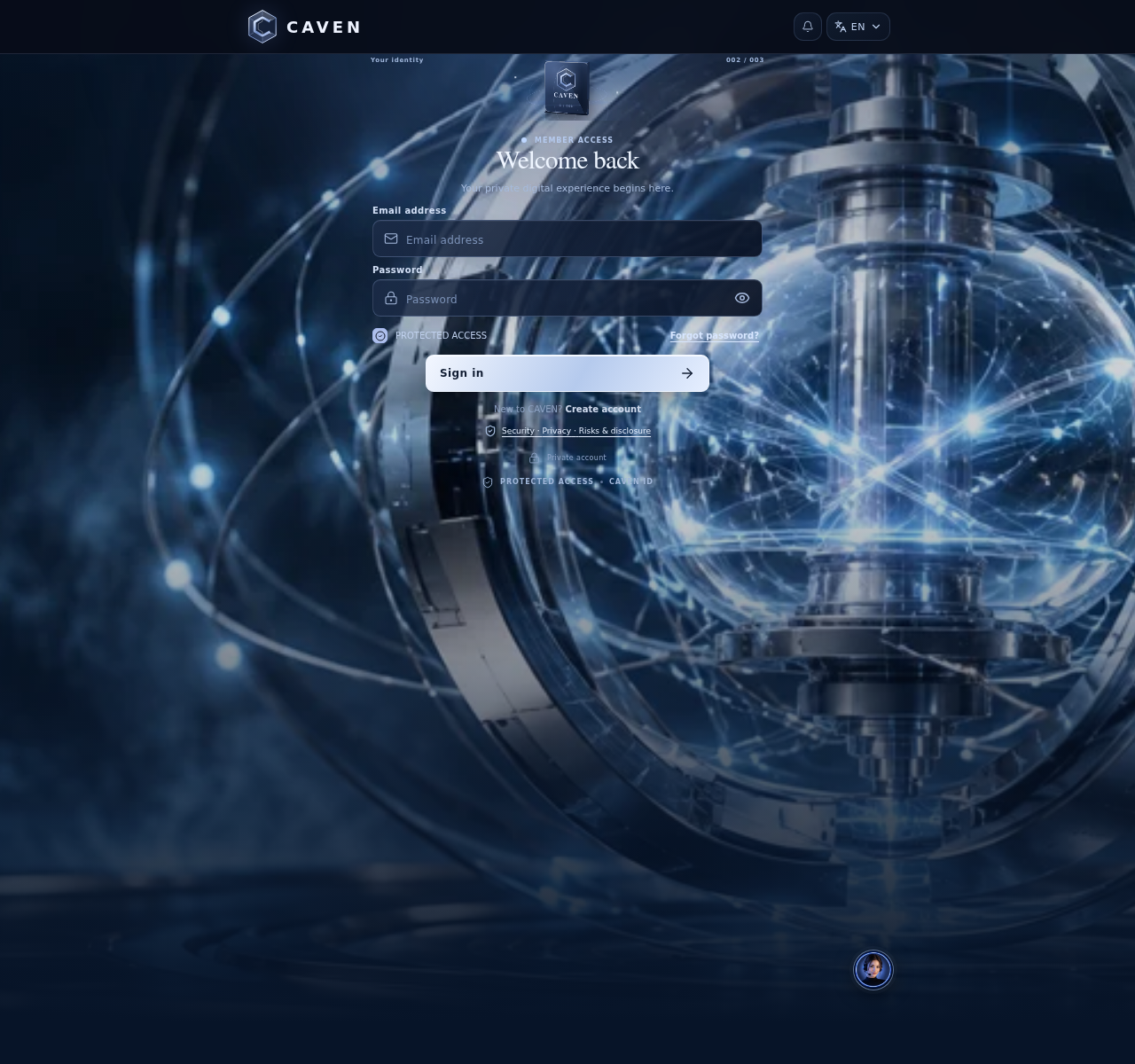
The public entrance uses a futuristic visual identity and language about a new digital dimension. The account screen presents private member access and security controls.
Those features can make the site feel established. They are interface choices, not evidence of a regulated financial business or adequate reserves.
Step 2: Deposits determine the level
The plan explanations associate larger deposits with higher session rates. The jump from Start to Signature is therefore also an invitation to increase financial exposure.
A larger level does not solve uncertainty about custody, legal responsibility, or the underlying activity. It makes the same unresolved questions more expensive.
Step 3: The session turns participation into an apparent return
Manual starts and a 24-hour spacing rule give the user a routine. The credited-profit message can then make the account feel productive.
But completing a routine is not the same as generating external revenue. Check whether the claimed result can be reconciled with independently verifiable records.
Step 4: Retained earnings increase the next calculation
The compound-interest explanation encourages attention to a growing base. Withdrawing reduces that base, according to the app’s own text.
That creates a reason to leave displayed earnings in place. Do not let a compounding illustration distract you from whether you can actually recover your money.
Step 5: The customer bears the unresolved withdrawal risk
A withdrawal request, a pending status, and an on-screen success message are not interchangeable with a completed external payment.
If a later demand introduces a tax, activation payment, upgrade, or release fee, stop. Do not send fresh money merely to test whether earlier funds can be released.
Who Would Be Responsible for Your Money?
Caven is the brand, not a complete legal identity
The captured entrance and account page show Caven branding. They do not supply a clearly identified, independently verified investment company responsible for the promised credits.
This article concerns caven.online and its current app. An unrelated business with a similar name must not be treated as its operator.
A domain record does not identify a custodian
A registrar, hosting provider, or certificate issuer supplies infrastructure. None becomes the company holding customer funds merely because its name appears in a technical lookup.
Nor does a language found in the app establish an operator’s nationality. The financial accountability gap cannot be filled with speculation about where the code was written.
Support access is not a repayment guarantee
The app describes support and account-management functions. A chat response or a reassuring administrator is still not independent evidence that a payment can be made.
No message was sent or response tested here. If you have an existing transaction, preserve the actual support identity and correspondence linked to it.
Authorization must match the actual business
Any regulatory claim needs the exact legal name, identifier, website, and relevant permission. A screenshot of a registration number or another firm’s certificate is insufficient.
The absence of an identified permission in these public materials is not a finding that every jurisdiction has adjudicated the case. It is no basis for trusting the offer.
What to Do If You Have Already Responded to Caven
-
Stop increasing the exposure. Do not add another deposit to reach a level, restore access, or improve a supposed withdrawal priority.
If a promoter has requested a release payment, save the exact demand. Keep the amount, destination, stated reason, and deadline together.
-
Preserve the financial trail. Save the promotion, account identifier, displayed balance, deposit record, withdrawal request, and any external transaction reference.
Record the actual asset and network if cryptocurrency was involved. Do not relabel a platform’s USD display as the precise cryptocurrency amount transferred.
-
Check an external payment independently. Use records from your own bank or exchange, not only an image supplied by the person promoting Caven.
For a transaction reference, an appropriate public explorer may show movement on the specified chain. It does not authenticate the platform’s business or promised profits.
-
Contact the sending provider promptly. Give its fraud or support team the genuine payment details and explain the representation that induced the transfer.
Ask what assistance is possible. Cryptocurrency transfers often cannot be reversed by the sender, and a report is not a promise of reimbursement.
-
Protect any separately exposed credentials. If you reused a password, replace it on the affected legitimate account and review its security settings.
Do not give support your wallet recovery phrase, banking password, or remote access. Creating a Caven account alone does not establish that your device is infected.
-
Report the exact approach and avoid paid recovery pitches. Share transaction evidence with the appropriate police or financial authority through independently located official channels.
A stranger claiming to recover the funds for an upfront fee is another risk, not an answer to the missing financial evidence.
Frequently Asked Questions
What is Caven on caven.online?
It presents private AI-related account access. Its publicly served app also describes deposits, six plans, compound session credits, withdrawals, and referrals.
Are the advertised 6%–8.5% rates verified returns?
No. They are rates stated in the app’s English explanations. No deposit, live balance, trading performance, or completed withdrawal was verified for this investigation.
Does starting an AI session prove a trade happened?
No. A session animation and a credited amount do not identify an executed market transaction, an external customer, or an independently audited revenue source.
Is a small test payment enough to establish safety?
No. An early payment does not establish reserves, sustainable revenue, or future withdrawals. Do not increase a deposit because a recruiter shows a successful transaction.
Should I pay a fee to unlock an existing balance?
Do not send fresh money on that promise. Preserve the demand and ask the sending provider or an appropriate authority about the existing transaction.
Who is legally responsible for the investment?
The captured public entrance does not establish a verified investment operator. Do not fill that gap with an unrelated same-name company or a recruiter’s assurance.
The Bottom Line
Do not fund Caven’s AI-profit offer. Its extraordinary compound-credit explanations are not backed in the captured public material by a clearly accountable operator or independently verified financial activity.
If you already paid, stop adding money, preserve the transaction trail, and seek help through your provider and official reporting channels. Do not buy another promise to release the first.

Join the discussion
0 commentsShare your experience or ask a question about this article.
Discussion
Start the conversation
Have a question or something useful to share? Add the first comment.