


An investment can have the word “exchange” in its name without answering a simple question: who gets the money when you transfer it?
That question is at the heart of the CBI Exchange Namibia case. It is also a good place to start if you still have old payment records.
Overview
What the Bank of Namibia says it found
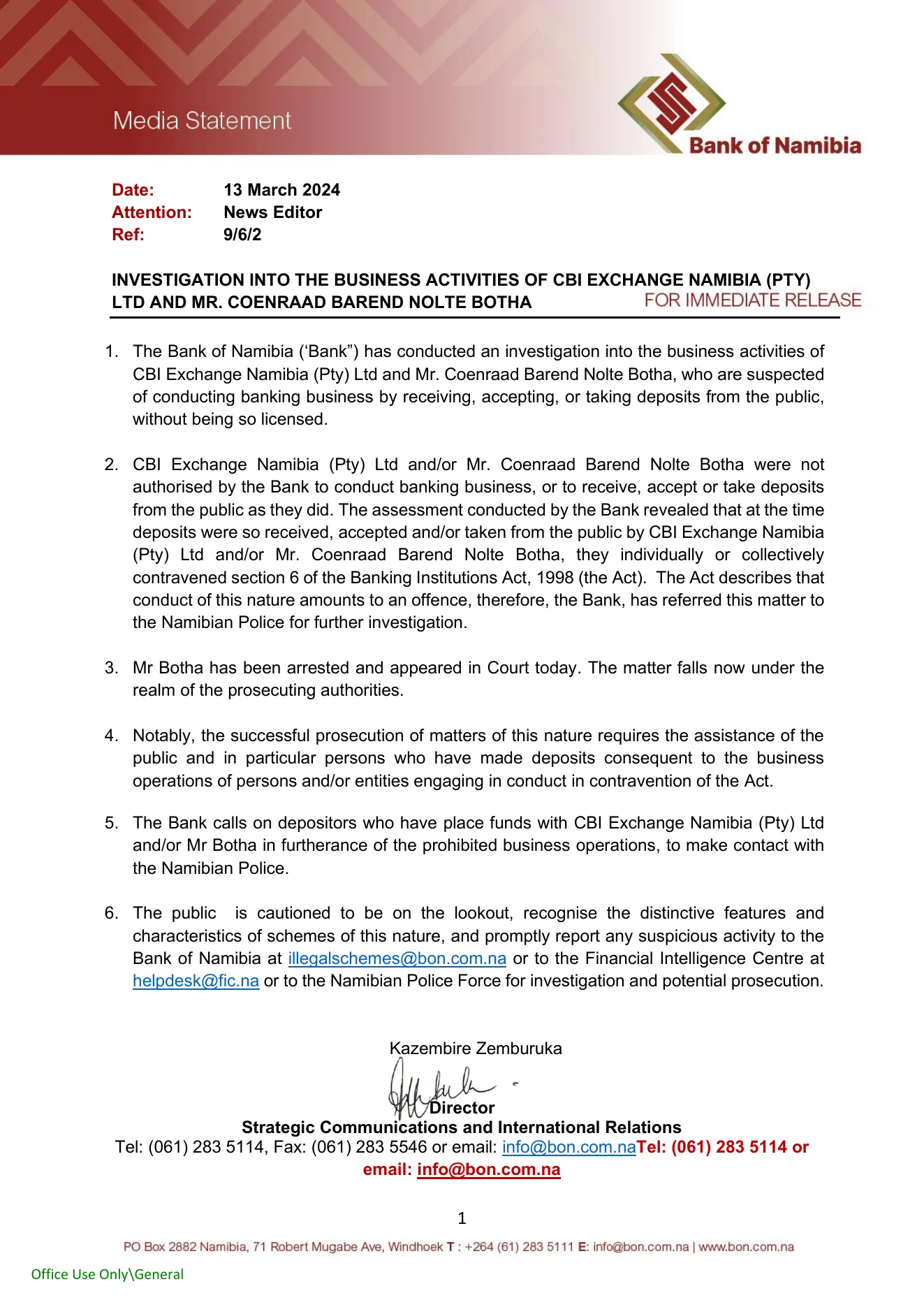
In a March 2024 statement, the Bank of Namibia named CBI Exchange Namibia (Pty) Ltd and Coenraad Barend Nolte Botha in an investigation into public deposits.
The bank said the company and Botha did not have its authorization to take deposits as described in the notice. It referred the matter to the Namibian Police.
That is a specific statement about the authorization they lacked for the activity described. It does not depend on a reviewer guessing from a company name.
The regulator also asked people who placed money with the company or Botha under those operations to contact the police. It did not offer a private route to withdraw funds.
The August 2026 decision was about a police search
The Windhoek Observer reported that on August 5, 2026, the High Court dismissed an application by Botha, CBI Exchange Namibia and two others challenging a search and seizure.
The application concerned the police action. Even if property was lawfully seized, that does not establish which assets belonged to depositors or what each one lost.
That ruling should not be read as a criminal conviction, a finding about every transfer, or an announcement that money is now available for distribution.
If the news sends you looking for an update, use the court and police details from independent sources. Do not rely on a screenshot forwarded by someone asking for money.
Which records are worth finding now?
Start with the entity that received your payment. CBI can refer to a brand in a message, but the bank statement may name a company or individual instead.
The balance you remember may not be an amount you could withdraw. A clearer record shows what you paid, what came back and what was only reported to you.
Set aside three kinds of information before speaking to a bank, exchange or investigator:
- Who asked for the transfer: Save their messages and the name they used, without assuming the person who contacted you controlled the company.
- Who received the money: Keep the beneficiary or transaction ID and the date, amount and currency from a record issued by your own provider.
- What you were meant to receive: Retain the pitch, agreement, terms about access to the money and any messages about attempting to withdraw.
How a CBI Exchange Namibia Deposit Raised Regulatory Concerns
Step 1: The offer is presented as a cryptocurrency opportunity
The CBI matter was reported as a crypto investment operation. For a prospective customer, that label alone does not show whether the business was selling an asset or taking deposits.
Compare receiving a specific asset in your own account with paying a business that holds the money and promises access or returns later.
Those arrangements can look similar at the payment screen but leave you depending on very different people. That is why the bank focused on what the operators actually accepted.
Ask where your money will go before you transfer it. If the answer is that a person will sort out the investment afterward, you have not verified the transaction.
Step 2: The company name and the transfer recipient may not tell the same story
The Bank of Namibia statement names both the company and Botha. The regulator’s description is more useful than treating every business with similar initials as the same recipient.
Read the beneficiary instructions alongside the agreement. If the names do not match, save both and ask for a written explanation instead of just changing the name in your records.
The difference can matter once you report a payment. An investigator needs to see who got the money, not only the name associated with the advertisement or chat.
A business registration document is not the authority to accept public deposits. If that is the only document shown to you, it does not answer the question the bank raised.
Step 3: The regulator checks authorization for the activity itself
The 2024 notice describes an assessment of deposit taking under Namibia’s banking law. The bank said the entity and Botha were not authorized to receive deposits the way it described.
The word “crypto” does not make the destination of a payment irrelevant. It does not show who controls the asset, how it can be withdrawn or what rules apply.
Namibia also has official rules for virtual asset services. If a new offer claims a license, read which entity and activity the authority actually approved.
The bank has explained in other published licensing notices that provisional approval is not permission to begin operating. Ask about the scope and date, not only the word “approved.”
Do not use the 2024 warning as a statement about every licensed exchange. It concerns the named people and company in an identified investigation.
Step 4: A police referral and a court challenge happen on separate tracks
A regulator can give depositors reporting instructions before a court determines criminal liability. Those instructions are useful even when the case is still working its way through the system.
In the later search challenge, the question was whether the applicants could successfully contest a police action. News about the outcome does not resolve the terms of your deposit.
Do not infer that devices described in the news contain funds you can claim. An account balance, a device and an order distributing assets are very different pieces of evidence.
If anyone refers to a ruling as proof that payment is imminent, ask where the authority published the distribution instructions. Find the notice yourself instead of accepting their copy.
What to Do If You Transferred Money to CBI Exchange Namibia
- Hold off on sending any further payment. Stop if somebody asks for an unlock fee, a migration deposit or a payment to release a balance after the court news.
- Preserve the records without editing them. Export correspondence and statements where possible. Keep original files separately if you mark up a copy to explain a payment or highlight a date.
- Contact the Namibian Police through an official route. The Bank of Namibia’s notice directs affected depositors to the police. Start with NAMPOL’s official site or a police station you know.
- Notify your bank or exchange about recent payments. Give it the genuine beneficiary details and references. Ask what information it can preserve and whether any intervention is still available.
- State what you actually got back. List completed withdrawals separately from requested withdrawals, credits and amounts still shown in an account. If you are unsure, label the entry accordingly.
- Protect any credentials you shared with a supposed case agent. If a login was exposed, contact its provider directly. Never provide a wallet recovery phrase as proof of ownership.
- Keep copies of official replies and reference numbers. Use those references for follow-up, not an investment group or a stranger claiming access to an inside case worker.
How to Document a Payment When the Old Portal Is Gone
Start with your statement, not someone’s spreadsheet
You do not need the original portal to show a wire or transfer. Ask the bank for a statement and, where available, a payment confirmation with more beneficiary detail.
Try to record the person who supplied the details and the channel they used. Do not assume the person whose name appears on the bank record sent those instructions.
If family members each paid, keep each person’s evidence and account reference separate. An investigator can join the reports later without guessing who authorized which payment.
Different payment dates may explain why people have different records or outcomes. Separate an initial deposit from later additions instead of combining them into one estimate.
Keep the details for crypto and ordinary transfers separate
A bank transfer used to buy crypto may be different from the transaction that sent it. Show both records if you can link them without guessing.
For a virtual asset transfer, retain the transaction ID, network, asset, amount and timestamp. If the exchange can produce a statement of the transfer, preserve that too.
Do not attribute a wallet to someone solely because a group says it belongs to them. You can report the address and the message that told you to use it.
If you are asked for a total in Namibian currency, say where your conversion came from. Do not silently value the asset at today’s price for a much older transfer.
Keep your report useful even if there is no confirmed refund route
Write down any fixed return you were promised, but do not count projected earnings as money you sent. Keep the original promise as evidence.
If a transfer was returned, keep the original and the return together. Report the charges and fees separately so the numbers do not imply more money is missing.
Tell the authorities if a new person contacted you after reading about the case. Save the new request as a separate incident rather than attaching it to the old payment.
Do not publish your full bank statement in a support group. If you share a warning, keep out your name, account details and unrelated transactions.
Keep the names of the businesses as written in your documents, including country and legal suffix. A familiar acronym from another country can send a report in the wrong direction.
If you only heard the pitch and declined, tell the authorities that if you report it. The date and sender can still help without implying you lost money.
When someone claims the police need your wallet phrase, do not send it. Transaction evidence can help show what happened without giving anybody the means to move your remaining funds.
For an old account you cannot access, list the last confirmed login and the last bank transfer. Date your notes so somebody can distinguish remembered events from saved documents.
If a bank or investigator asks why you believed the offer, answer plainly. A description of who vouched for it can be more useful than a theory about the operator.
When someone offers a replacement account
People can hear about an old case from a friend and then get another offer carrying similar branding. Check who made the second offer separately from the original.
A new account that shows your old balance may simply contain a number somebody copied. Ask for an independent source that explains how any real funds were transferred.
The more closely someone ties payment to a deadline, the more important it is to stop. Ask the police about the request before handing over money or documents.
For an actual official follow-up, use the case reference and the authority’s published channels. A legitimate reply does not need a private token transfer to demonstrate that it exists.
Do not put a bank contact and the person asking for a transfer in the same chat. Give sensitive documents only through the channel the institution confirms for that purpose.
Make sure anyone helping you knows which payments are recent. A fresh transfer has a different timeline for reporting than a deposit made while the earlier business was active.
If you have an independent professional helping with a claim, keep the agreement and fee terms. That is different from paying a message sender who guarantees access to seized assets.
Write down whether you were told money was being held for you or immediately exchanged. The distinction can be more revealing than the name at the top of a screenshot.
Frequently Asked Questions
Was CBI Exchange Namibia authorized to accept public deposits?
The Bank of Namibia said the company and Botha were not authorized to take public deposits as described in its 2024 statement. That is the relevant official finding.
Did the August 2026 court decision convict anyone of fraud?
The reported decision dismissed a challenge to a police search and seizure. It was not a conviction in the underlying matter or an order deciding individual losses.
Is a business registration the same as a banking license?
Registering an entity does not give it permission to accept deposits. Check the authorization for the actual transaction directly with the Bank of Namibia.
Should I contact police if I no longer have my CBI login?
The bank’s advice is directed at people who placed money. You can still gather statements, transfer details and correspondence without being able to log into the old site.
Does a news report about seized equipment mean I can withdraw?
It does not show that you have a confirmed claim or that anyone can release money to you. Look for official instructions before sharing personal records or taking any action.
Do these findings apply to another business called CBI?
The notice identifies a particular Namibian entity and Coenraad Botha. Check the full legal name before assuming it describes a different institution or offer.
The Bottom Line
Do not send money into a CBI Exchange Namibia offer or pay anyone to restore an old balance. The central bank’s statement on unauthorized deposits is enough reason to stop.
If you already transferred money, contact the Namibian Police and your payment provider through official channels. Bring your own transfer records rather than relying on a balance or a headline.

Join the discussion
0 commentsShare your experience or ask a question about this article.
Community experiences
Did this happen to you?
Your experience could help someone recognize the same scam. Submit a private report for our team to review.
I experienced this tooReports are reviewed before publication. Sharing publicly is always your choice.
Discussion
Start the conversation
Have a question or something useful to share? Add the first comment.