


To anyone on a budget, Chipodealclub.com looks like a lucky find. Do a few quick steps, it says, and you’ll get a big gift card from a famous store.
Look closely and the steps are vague, the button bright. That button leads to a deal very different from anything on the screen.
Overview
What you’re told on Chipodealclub.com
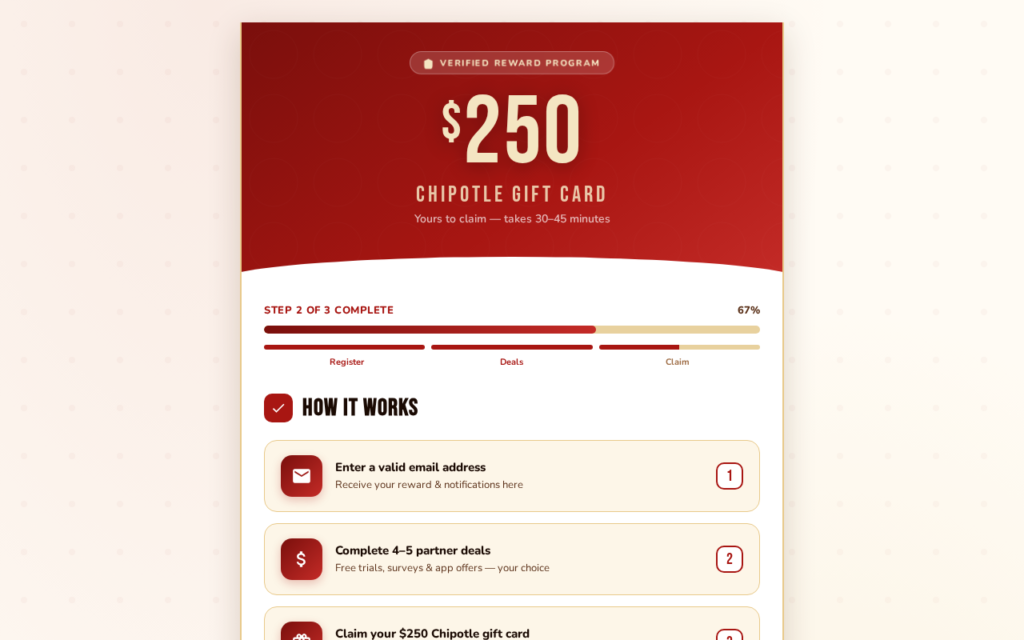
Chipodealclub.com’s pitch is simple: a big gift card headline and a claim button. Pages like it usually add a famous retailer’s logo and numbered steps ending in “claim your card.”
First your email, then a few questions, then a few “recommended deals.” On pages like this, every step sounds small, and the deals stay vague until you’re already inside.
This deal isn’t coming from the retailer
Running the offer, approving it, mailing the card: the named retailer does none of it. The site leans on that name because it can’t earn trust alone.
Look at the address bar: this isn’t the retailer’s website. The claim button skips the retailer too, opening a tracking link from an affiliate network instead.
What the “steps” actually involve
The card is bait, and the funnel behind it is built to generate leads. Buttons like this one typically lead to:
- Tracking links built to pay the operator per sign-up.
- Forms asking for your email, phone number, address and date of birth.
- Sponsored offers like paid trials, subscriptions, app installs and credit applications.
- Conditions that keep shifting, so the card always sits one more deal out of reach.
- A reward with no named company responsible for delivering it.
That missing name tells you plenty. Chipodealclub.com is a gift card scam: skip the form, skip the deals, and don’t expect a card at the end, whatever the page claims.
What We Found on Chipodealclub.com
Here’s what stands out about Chipodealclub.com:
- The page’s title reads "Claim Your $250 Chipotle Gift Card Reward".
- Its claim button opens a tracking link on giftclick.org, an affiliate network domain, not the website of the store it names.
How the Chipodealclub.com Gift Card Scam Works
Swap the store name, the amount and the domain, and you’ve got the next page. Reward funnels like Chipodealclub.com all follow one script.
Step 1: You’re singled out by a message
A text message, an email or a social media ad is how most visitors arrive. It says you’ve been “selected” to claim a famous store’s reward or to test products.
A number that big is hard to scroll past. Because the message wears a famous store’s name, it also gets trust an unknown website can’t build by itself.
To look personal, some messages use your first name or bring up a recent purchase. That detail can come from a data leak that happened earlier, not from the store.
Step 2: The landing page keeps the steps looking short
Most of the time, pages like Chipodealclub.com show a few numbered steps and a bright claim button. “Complete a few deals” sounds like a short chore with a clear end.
You’ll find countdown timers on many of these pages, plus “only a few cards left” banners and counters of people who “already claimed.” There’s no way to check those numbers.
Step 3: One click opens an affiliate network
Tap “Claim” or “Start now” and you won’t land on the store. You pass through a tracking link that logs the operator’s affiliate ID along with the offer you picked.
Affiliate links are standard stuff. What they show in this case is simple. You aren’t a winner being rewarded; you’re a lead being sold, right from the first click.
Step 4: Your personal data turns into the product
The next screens begin by collecting your email. Name, phone number, home address and date of birth come next, with “survey” questions about income and shopping habits often tacked on.
Marketers value you more with every answer you give. Even if you stop halfway, those details can go on generating emails, texts and calls for months.
Don’t skim past pre-ticked boxes on the way through. Left checked, they mean a single “Continue” click can share your details with dozens of “marketing partners.”
Step 5: The deals aren’t free
The card sits behind sponsored deals, and you’re told to clear them: free trials, streaming plans, insurance quotes, credit applications, or mobile games played to a set level.
Many of them demand a payment card. From there, a missed trial deadline can mean a full-price subscription, and a credit application can mean a hard inquiry.
Step 6: Your card never arrives
The page keeps the reward just out of reach. A few deals later, it says you need more, a deal “didn’t track,” or your claim is “pending review.”
That’s fine for the operator, who has been paid for every sign-up by then. You, though, have no one to contact, because the card was never the product.
Red Flags of Offers Like Chipodealclub.com
Almost every reward funnel shows these signs. Just the first is enough to settle the question.
The card requires completing “deals” first
A store’s own giveaway doesn’t ask you to begin paid trials or apply for credit. When a page says “Complete a few deals,” you’re in an affiliate funnel.
Huge rewards in exchange for almost nothing
Think about what’s being asked: a form. Stores do run giveaways, but not with cards worth hundreds for that little. The size of the prize is part of the lure.
It’s not the store’s website
A famous store’s name slipped into an unfamiliar address means an advertiser is using the brand. It isn’t the store. Read the address bar before anything else on the page.
The claim button heads elsewhere
Hovering tells the truth here. Point your mouse at the claim button on a desktop, and you’ll see it leads to a tracking domain instead of the retailer.
No one is on the hook
Who sends the card? Who answers for it? The page names no company, address or support contact, and a tiny “not affiliated” line in the footer doesn’t fix that.
A message from nowhere
When a sender you don’t know emails or texts that you’ve “won” or been “selected,” treat it as the start of the funnel, not proof of a prize.
Rushed by a timer or a “last cards left” banner
Hurry tactics work by stopping you from checking. A legitimate store promotion doesn’t care if you take a day; it stays the same.
Why the Store’s Name Isn’t Proof
Scammers don’t need to convince you of much when a famous store’s name does it for them. Costco, Target, Walmart and Amazon cards are common, but any trusted brand works.
Retailers this size regularly warn about fake surveys and reward messages misusing their name, and they ask customers not to enter any details through links they didn’t expect.
The US Federal Trade Commission sued operators of “free gift card” text campaigns back in 2013. Those campaigns pushed people into paid offers, and the script hasn’t changed much since.
Seeing a famous brand in the headline proves nothing on its own. Check the store’s website: if the offer isn’t mentioned there, it doesn’t belong to the store.
What a Real Store Promotion Looks Like
Still, real stores give away gift cards too. Compare a genuine offer with a fake one and the differences are easy to spot.
- It shows up where the store actually speaks: its own website, app or verified social accounts.
- Official rules spell out who runs it, what the prize is and when it ends.
- You won’t be asked to start trials, install apps or apply for credit.
- Surveys tied to a purchase use the address on your receipt. Loyalty rewards stay in your account with the store or in its app.
- A random text isn’t how winners find out. They’re contacted through the same account or channel they entered with.
Treat the gift card as bait whenever an offer misses even one of these. Real promotions don’t need to keep their conditions behind a “claim” button.
What the “Deals” Can Cost You
Chasing the card has real costs, even though the card itself never arrives. These come up most often:
- Recurring charges. Free trials and discounted plans renew at full price once you miss the cancellation window.
- Credit inquiries. Every loan or credit card application in the chain can add a hard inquiry to your credit file.
- More spam, more robocalls. The email, phone number and address you typed in get passed along to marketing partners you never chose.
- Follow-up scams. The next scammer wants a list of who answered the last “you won” offer. Plan on more phishing and fake delivery texts.
- Unwanted apps. Installing mobile games and apps to “unlock” the reward can leave you with software that keeps tracking you or showing ads after you quit.
- Lost time. Every survey, game and offer takes time, adding up to hours spent on a reward that never existed.
Even with no card in sight, these costs are genuine. The operator cashes in on every sign-up, leaving the visitor to cover the bills.
Same Funnel, New Domain
A page like Chipodealclub.com takes little money to build, often with an off-the-shelf website builder. Many near-identical ones exist, and they usually vanish within days of being reported.
Look closely at the claim links, and the same affiliate ID often appears on several domains, which points to one operator behind many pages at once.
Set these pages side by side and you’ll spot the same fingerprints:
- A big gift card amount paired with a famous store name in the headline
- Three or four numbered steps where the final one says “claim your card”
- A line saying you must “complete a few deals” to qualify
- An affiliate tracking link hiding behind the claim button
- Counters and timers that nobody can verify
See those features together? Then the store name and the amount tell you nothing. It’s the same funnel with a fresh address.
How to Check a Gift Card Offer Before You Click
Genuine promotions pass a simple two-minute check without trouble. Reward funnels fail it.
- Leave the link alone and visit the store’s official website or app directly. Then search for the promotion there.
- On a computer, check where the claim button really goes by hovering before you click. A tracking domain instead of the store’s address answers it.
- Run a search for the site’s name plus “scam” or “review.” No history at all is a warning in itself, and new funnels often have none.
- Check the small print. If it mentions “deals,” “offers” or “participation requirements,” the card has strings attached.
If the offer trips any of these checks, walk away. That page isn’t worth your email address, so it’s definitely not worth your card details.
What to Do If You Have Fallen Victim to This Scam
Started deals or shared details through Chipodealclub.com? Move quickly. Most of the harm can still be limited, as long as you act before the trial periods run out.
- Shut down every trial and subscription. Revisit each deal you signed up for and cancel it while the trial is still running. Hold on to each cancellation confirmation.
- Read your statements closely. Small test charges count, and so do recurring payments. Dispute anything you don’t recognize with your bank or card issuer.
- Replace the exposed card. Contact your bank for a new card number if you entered card details on any page in this funnel.
- Review your credit. Any loan or credit card application you submitted is a reason to pull your credit report and look for inquiries or new accounts that aren’t yours.
- Treat follow-ups as scams. That goes for every text and email about “your reward” or “a problem with your claim.” Don’t tap or click the links inside.
- Lock down your device. Revoke the notification permissions these pages have. Installed something? Malwarebytes Free can scan for it. AdGuard blocks many ads that lead to them.
- Change passwords you reused. A password you typed into a new account on the site needs replacing on every other account where you use it.
- Cut off the contact. Unsubscribe from companies you recognize and nothing else. The rest goes to spam, and any number that starts calling or texting gets blocked.
- Report it. Let the retailer whose name was borrowed know, flag the ad or message, and file at ReportFraud.ftc.gov in the US or with your national fraud service elsewhere.
The clock matters here. If a charge or subscription won’t cancel, your bank or card issuer can usually dispute it, but most card issuers allow only a few months.
Frequently Asked Questions
Is the Chipodealclub.com gift card real?
No. Chipodealclub.com is a gift card scam. Its affiliate funnel is built to grab your information and nudge you toward paid deals, and you’ll never receive a card.
Is Chipodealclub.com connected to the store it names?
No connection exists. The page simply uses the store’s name and often its logo to seem trustworthy. Real promotions from that retailer live on the retailer’s own website.
How does Chipodealclub.com make money?
Affiliate commissions. Every time you give an email address, answer a survey or complete a deal, an advertiser pays, and the operator keeps a share of that payment.
I completed some deals. Will I get the gift card?
The answer is no. Don’t start another deal. Instead, cancel the trials and subscriptions you joined, check your statements, and ignore any note saying your reward is “pending.”
Why do I keep seeing the same offer on new websites?
Rebuilding costs the operators very little, and reports arrive quickly. So instead of one long-lived site, you get the same funnel rotating through new domains and store names.
What should I do if I get one of these offers by text?
Leave the link unopened. Forward the text to 7726 (SPAM), which in the US or the UK helps your carrier block similar messages, and then get rid of it.
The Bottom Line
The big gift card at Chipodealclub.com is a decoy. Along with a famous store’s name, it pulls you into a paid affiliate funnel, where the deals are the actual business.
Share nothing and sign up for nothing here. A site that asks you to complete offers to claim a free gift card should get closed, not filled in.
Did you already take part? Don’t wait for the renewals. Cancel every trial before they hit, look over your statements, and treat any reward message as the next scam.

Reviews & discussion
0 commentsShare a firsthand experience, or ask a question.
Community reviews
chipodealclub.com
Moderated reader experiences, not an editorial verdict.
Start the conversation
Have a question or something useful to share? Add the first comment.